
Gum elastic bougie References - millers, morgan, baheti, barash, all anesthesia standard textbooks
Gum Elastic Bougie (Tracheal Tube Introducer / Eschmann Introducer)
1. Introduction & History
- Miller's Anesthesia 10e, Chapter 40
- Barash Clinical Anesthesia 9e, Chapter 28
- Roberts & Hedges' Clinical Procedures in Emergency Medicine, Chapter 4
2. Design & Physical Characteristics
| Feature | Details |
|---|---|
| Material | Originally woven polyester (Dacron) coated with polyurethane resin ("gum elastic"); modern versions may be polyethylene (single-use) |
| Adult size (curved tip) | 60 cm long, 15 Fr (5 mm) with a 40-degree coudé (angled) tip 3.5 cm from the distal end |
| Adult size (straight) | 70 cm long |
| Pediatric version | 70 cm long, 10 Fr (straight); accommodates a 4.0-mm ETT |
| ET tube compatibility | Adult version accommodates ETT ≥ 5.5 mm ID |
| Variants | FROVA Introducer (Cook Critical Care) - hollow lumen allowing CO₂ detection and, in principle, temporary ventilation (though oxygen insufflation is discouraged due to barotrauma risk) |
- Roberts & Hedges, p. 127 (Fig. 4.18); Barash 9e, p. 2403; Miller's Anesthesia 10e, p. 5902
3. Indications
- Difficult/failed direct laryngoscopy - Cormack-Lehane grade III or IV view (most common indication)
- Anticipated difficult airway (e.g., cervical spine precautions, trauma, limited mouth opening)
- Cannot visualize vocal cords but can see epiglottis only
- Presence of blood, secretions, or vomitus in the airway (bougie navigates past soiling that would obscure a fiberoptic scope)
- Cricothyrotomy (scalpel-bougie technique, the DAS 2015-preferred method for "cannot intubate, cannot oxygenate" scenarios)
- SGA-to-ETT conversion (guide bougie through King LT or i-gel, remove SGA, railroad ETT over bougie)
"The presence of blood and vomitus rarely prevents placement of the bougie into the trachea." - Roberts & Hedges, p. 127
4. Confirming Tracheal Placement - The 3 Signs
4a. Tracheal Clicks (Most Classic Sign)
- Felt in up to 90% of cases
- Produced by the angled coudé tip striking the cartilaginous tracheal rings as the bougie is advanced
- Felt by the operator holding the bougie, and also by an assistant palpating the anterior neck
- Roberts & Hedges, p. 127; Barash 9e, p. 2403; Miller's Anesthesia 10e, p. 5902
4b. Hold-Up / Distal Stop
- The bougie stops ("holds up") at approximately 40 cm when it enters a main bronchus
- If the bougie passes beyond 40 cm without resistance, it is likely in the esophagus (which has no bifurcation)
- Advance the bougie to at least 40 cm to check; absence of hold-up = esophageal placement
4c. Visual Confirmation
- If any portion of the arytenoids is visible and the introducer was seen to pass anterior to them without resistance, placement is confirmed
- The small caliber of the bougie does NOT obscure the laryngeal view (unlike a full ETT)
5. Technique - Two-Person Method (Preferred)
- Prepare: Have a styleted ETT and bougie available before beginning laryngoscopy
- Laryngoscopy: Obtain the best possible view of the larynx
- If full cord view: proceed with styleted ETT directly
- If suboptimal view (grade III): proceed with bougie
- Shape the bougie: Create a 60-degree bend in the distal portion when the laryngeal inlet is NOT visible. The factory curve alone is insufficient in these cases.
- Pass the bougie: Direct the coudé tip anterior to the arytenoids into the larynx. If only the epiglottis is visible, place the bougie just under the epiglottis and direct anteriorly.
- Confirm position: Feel for clicks (tracheal rings) or hold-up at carina
- Railroad the ETT: The assistant threads the ETT over the bougie while the operator holds the bougie steady, with the laryngoscope still in place
- Rotate the ETT: As the ETT approaches the glottis, rotate it 90 degrees counterclockwise to orient the bevel posteriorly - this prevents the tube tip from catching on the right arytenoid
- Remove bougie: Withdraw the bougie while the assistant advances the ETT
- Confirm intubation: Capnography + clinical signs
- Roberts & Hedges, pp. 127-128 (Fig. 4.19, 4.20); Miller's Anesthesia 10e
6. Common Errors & Troubleshooting
| Problem | Cause | Solution |
|---|---|---|
| Bougie won't advance past 40 cm | Tip lodged on anterior tracheal wall | Withdraw slightly, rotate 90° clockwise to move tip to patient's right |
| ETT won't railroad over bougie | Tip caught on right arytenoid cartilage (most common) | Withdraw tube 2 cm, rotate 90° counterclockwise, re-advance |
| Bougie passes >40 cm freely | Esophageal placement | Withdraw, reshape to 60°, reattempt |
| Bougie seems "too floppy" | Introducer entering at an angle above line of vision (operator too close to patient) | Adjust operator position so introducer aligns with line of sight |
| Difficulty railroading ETT | Laryngoscope removed prematurely | Keep laryngoscope in place while railroading; soft tissue weight deflects ETT posteriorly |
| Full-length lubrication | Slippery, hard to handle | Lubricate only distal end of bougie; always lubricate the ETT |
- Roberts & Hedges, pp. 127-128
7. Use in Cricothyrotomy - Scalpel-Bougie Technique (DAS 2015)
- Identify the cricothyroid membrane (CTM) - left hand stabilizes larynx
- Transverse stab incision through skin and CTM with No. 10 scalpel
- Rotate scalpel 90° so cutting edge points caudally
- Swap hands - hold scalpel with left hand, maintain lateral traction to keep CTM open
- Pick up bougie with right hand; slide the coudé tip down the scalpel blade (on the side farthest from you) into the trachea
- Rotate and advance bougie 10-15 cm into trachea
- Remove scalpel; stabilize trachea
- Railroad a size 6.0-mm cuffed ETT over the bougie with rotation
- Remove bougie; inflate cuff; confirm with capnography
"It is recommended that all anesthesiologists learn this technique and receive regular training to avoid fading of skill." - Miller's Anesthesia 10e, p. 5960
8. Evidence & Comparative Data
- In the ED, first-attempt emergency tracheal intubation success was 98% with bougie vs. 87% with ETT + stylet - Barash 9e, citing Jabre et al. (JAMA 2018)
- A subsequent RCT of 1,102 patients (JAMA 2021) found no significant difference between bougie and stylet for first-attempt success in critically ill patients, with no difference in hypoxemia, esophageal intubation, pneumothorax, or oropharyngeal injury - Barash 9e, p. 18
- Bougie combined with video laryngoscopy (Pentax-AWS, McGrath MAC) improves success rate and decreases time to intubation in simulated vomitus airway scenarios - Miller's Anesthesia 10e
- The bougie is described as "the most common airway adjunct used in British EDs" for complicated intubations - Roberts & Hedges
9. Advantages
- Low cost and highly portable
- Works in soiled airways (blood, vomitus)
- Does not obscure glottic view (unlike ETT)
- Useful even when only epiglottis is visible
- Provides tactile confirmation of tracheal placement (clicks, hold-up)
- Reusable (Eschmann) or single-use (Flectrach)
- Adaptable to cricothyrotomy, SGA exchange, video laryngoscopy-assisted intubation
10. Complications
- Tracheal/bronchial trauma from forceful advancement (particularly if hollow-lumen versions used for jet ventilation - barotrauma risk)
- Esophageal intubation if placement signs misinterpreted
- Potential for pharyngeal/tracheal laceration with aggressive technique
- Endobronchial intubation if ETT advanced too far over bougie (keep tube rotation in mind)
Sources
- Miller's Anesthesia, 10e - Chapter 40 (Airway Management), pp. 5902, 5952-5960
- Barash, Cullen & Stoelting's Clinical Anesthesia, 9e - Chapter 28 (Airway Introducers), pp. 2402-2403
- Morgan & Mikhail's Clinical Anesthesiology, 7e - Chapter (Airway Management)
- Roberts & Hedges' Clinical Procedures in Emergency Medicine - Chapter 4 (Tracheal Tube Introducer), pp. 126-128 (Figs. 4.18-4.20)
- Tintinalli's Emergency Medicine - Chapter 29A
Add diagram from standard anaesthesia textbooks
Diagrams: Gum Elastic Bougie
Diagram 1 - Scalpel-Bougie Technique (DAS 2015)
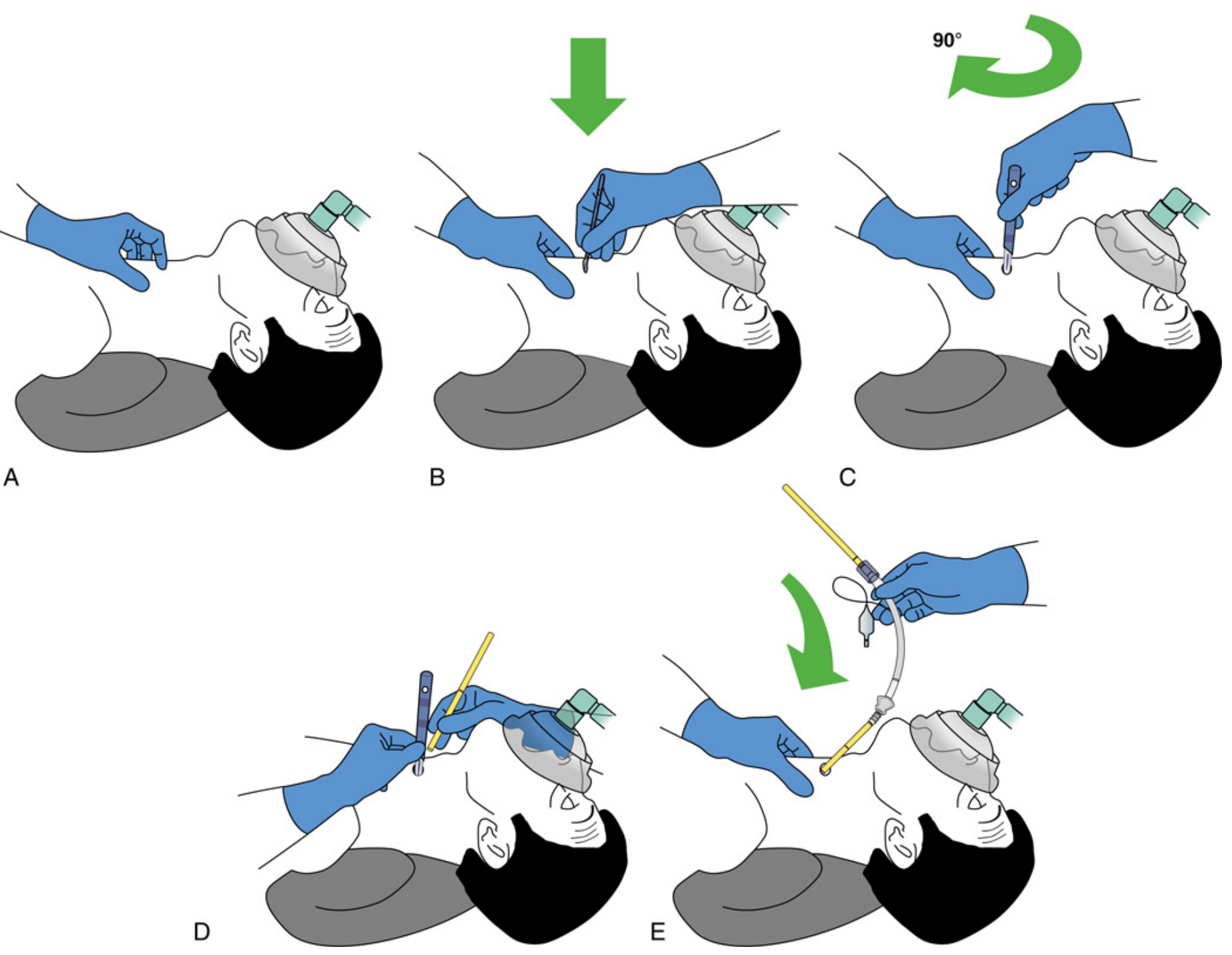
- (A) Identify the cricothyroid membrane (CTM)
- (B) Transverse stab incision through the CTM with No. 10 scalpel
- (C) Rotate scalpel 90° so sharp edge points caudally
- (D) Pull scalpel laterally to open incision; slide the coudé tip of the bougie (yellow) down the scalpel blade into the trachea
- (E) Railroad the 6.0-mm cuffed ETT over the bougie into the trachea
Diagram 2 - Midsagittal Anatomy: CTM Access Site
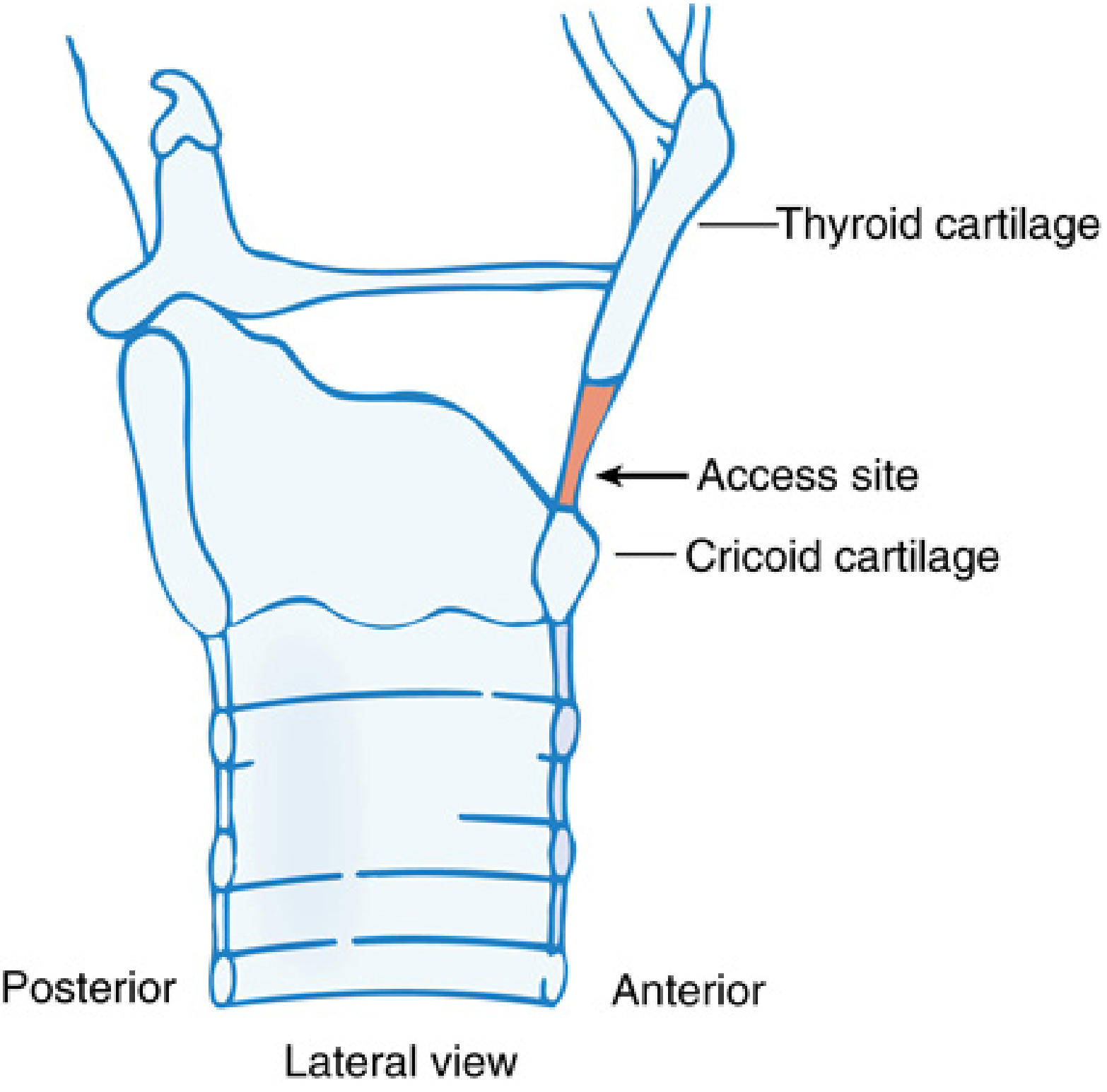
Diagram 3 - Railroading the ETT Over the Bougie / Arytenoid Hang-Up
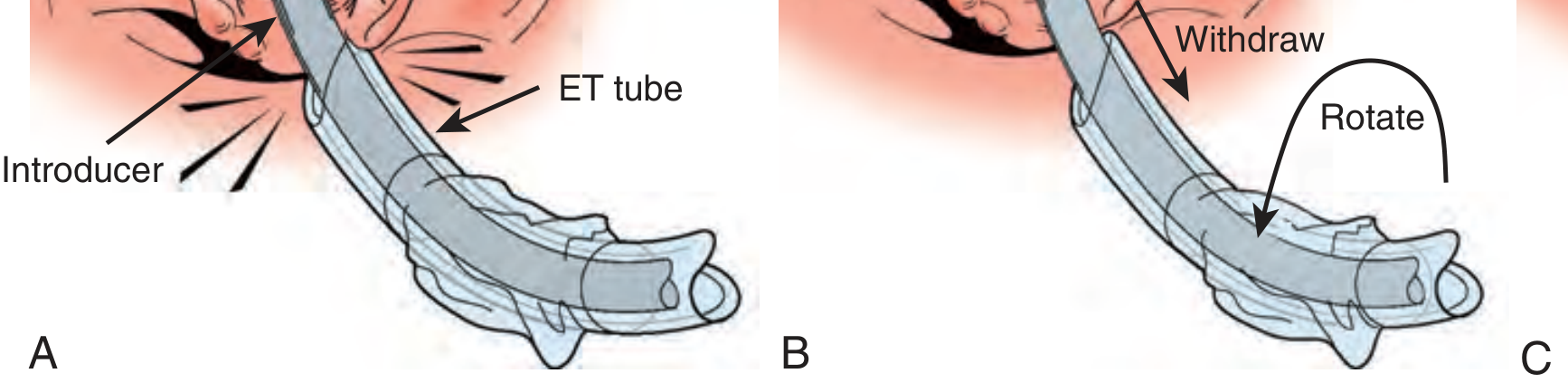
- (A) The tip of the ET tube catches on the right arytenoid cartilage as it is being railroaded over the introducer
- (B-C) Corrective maneuver: withdraw the ETT 2 cm to disengage, then rotate 90° counterclockwise to orient the bevel posteriorly, then re-advance
Diagram 4 - Types of Tracheal Tube Introducers
| Type | Length | Fr | Tip | Use |
|---|---|---|---|---|
| GEB curved tip (Eschmann) | 60 cm | 15 Fr | 40° coudé | Adult - difficult airway |
| GEB straight | 70 cm | 15 Fr | Straight | Adult - standard |
| Pediatric (Eschmann) | 70 cm | 10 Fr | Straight | Accommodates ≥4.0 mm ETT |
| Flectrach (single-use) | 60 cm | 15 Fr | Coudé | Adult - disposable |
| FROVA (hollow lumen) | 60 cm | — | Coudé | CO₂ detection, optional stiffening stylet |
Key Anatomical Principle from the Diagrams
- 60° distal bend when the laryngeal inlet is NOT visible - the factory coudé curve alone is insufficient
- 90° counterclockwise rotation of ETT as it enters the glottis - prevents right arytenoid hang-up
- Coudé tip along scalpel blade in cricothyrotomy - the bougie tracks down the blade into the trachea at right angles before being realigned
Give the above content regarding gum elastic bougie in handwrtten form for 10 marks question
ls /tmp/workspace/ 2>/dev/null || mkdir -p /tmp/workspace/geb-answer
mkdir -p /tmp/workspace/geb-answer && python3 -c " from PIL import Image, ImageDraw, ImageFont import os print('PIL available') # Check for fonts import subprocess result = subprocess.run(['fc-list', ':family=DejaVu'], capture_output=True, text=True) print(result.stdout[:300]) "
python3 -c " import os, glob # find handwriting-like fonts fonts = glob.glob('/usr/share/fonts/**/*.ttf', recursive=True) + glob.glob('/usr/share/fonts/**/*.otf', recursive=True) for f in fonts[:40]: print(f) "
pip install reportlab --quiet --user 2>/dev/null; python3 -c "from reportlab.platypus import SimpleDocTemplate; print('reportlab OK')"
~/geb-answer/generate_geb.py
#!/usr/bin/env python3
"""
Gum Elastic Bougie - Handwritten-style 10-mark exam answer PDF
Uses reportlab canvas for full control over ruled lines, blue ink, handwriting font feel
"""

import os, math, urllib.request, io
from reportlab.lib.pagesizes import A4
from reportlab.lib.units import mm, cm
from reportlab.lib.colors import HexColor, black, white, Color
from reportlab.pdfgen import canvas
from reportlab.platypus import (SimpleDocTemplate, Paragraph, Spacer, Table,
                                 TableStyle, KeepTogether, HRFlowable)
from reportlab.lib.styles import getSampleStyleSheet, ParagraphStyle
from reportlab.lib.enums import TA_LEFT, TA_CENTER, TA_JUSTIFY
from reportlab.graphics.shapes import Drawing, Rect, Circle, Line, String, Polygon
from reportlab.graphics import renderPDF
from reportlab.pdfbase import pdfmetrics
from reportlab.pdfbase.ttfonts import TTFont
from PIL import Image as PILImage

# ── Colours ────────────────────────────────────────────────────────────────────
INK        = HexColor('#1a237e')   # deep blue ink
INK_LIGHT  = HexColor('#1565C0')   # medium blue for body text
INK_SUB    = HexColor('#0d47a1')   # for subheadings
RED_INK    = HexColor('#b71c1c')   # red for emphasis
RULE_CLR   = HexColor('#bbdefb')   # ruled-line light blue
MARGIN_CLR = HexColor('#ef9a9a')   # red margin line
BG_CLR     = HexColor('#fffde7')   # cream/off-white paper
HEADER_CLR = HexColor('#e3f2fd')   # header band

W, H = A4   # 595 x 842 pt
LMARGIN = 22*mm
RMARGIN = 15*mm
TMARGIN = 25*mm
BMARGIN = 20*mm
LINE_H  = 8*mm     # ruled line spacing

FONT_BODY  = 'Helvetica'
FONT_BOLD  = 'Helvetica-Bold'
FONT_OBL   = 'Helvetica-Oblique'

OUT = '/tmp/workspace/geb-answer/GumElasticBougie_10marks.pdf'

# ── Page background painter ────────────────────────────────────────────────────
def draw_paper(c, page_no, total_pages):
    """Draw ruled notebook paper background on each page."""
    c.saveState()
    # cream background
    c.setFillColor(BG_CLR)
    c.rect(0, 0, W, H, fill=1, stroke=0)

    # ruled lines
    c.setStrokeColor(RULE_CLR)
    c.setLineWidth(0.4)
    y = H - TMARGIN
    while y > BMARGIN:
        c.line(0, y, W, y)
        y -= LINE_H

    # red margin line
    c.setStrokeColor(MARGIN_CLR)
    c.setLineWidth(0.8)
    c.line(LMARGIN - 3*mm, 0, LMARGIN - 3*mm, H)

    # header band
    c.setFillColor(HEADER_CLR)
    c.rect(0, H - TMARGIN + 2, W, TMARGIN - 2, fill=1, stroke=0)

    # header text
    c.setFillColor(INK)
    c.setFont(FONT_BOLD, 9)
    c.drawString(LMARGIN - 2*mm, H - TMARGIN + 8, 'ANAESTHESIA  |  AIRWAY MANAGEMENT')
    c.setFont(FONT_BODY, 9)
    c.drawRightString(W - RMARGIN, H - TMARGIN + 8, f'Page {page_no} of {total_pages}')

    # bottom footer
    c.setFillColor(HexColor('#555555'))
    c.setFont(FONT_BODY, 7)
    c.drawCentredString(W/2, BMARGIN - 8, 'Ref: Miller\'s Anesthesia 10e | Barash 9e | Morgan & Mikhail 7e | Roberts & Hedges')

    c.restoreState()

# ── Text helper ────────────────────────────────────────────────────────────────
class Writer:
    """Stateful line-writer for handwriting-style layout."""
    def __init__(self, c_obj, pages_ref):
        self.c = c_obj
        self.pages = pages_ref
        self.page_no = 1
        self.x = LMARGIN
        self.y = H - TMARGIN - LINE_H

    def _check_newpage(self, extra=0):
        if self.y - extra < BMARGIN + LINE_H:
            self.c.showPage()
            self.page_no += 1
            self.pages.append(self.page_no)
            draw_paper(self.c, self.page_no, '?')
            self.y = H - TMARGIN - LINE_H

    def blank(self, n=1):
        for _ in range(n):
            self._check_newpage()
            self.y -= LINE_H

    def heading1(self, txt):
        """Big underlined heading — main title."""
        self._check_newpage(LINE_H * 2)
        self.c.saveState()
        self.c.setFont(FONT_BOLD, 15)
        self.c.setFillColor(INK)
        self.c.drawString(self.x, self.y, txt)
        tw = self.c.stringWidth(txt, FONT_BOLD, 15)
        self.c.setStrokeColor(INK)
        self.c.setLineWidth(1.2)
        self.c.line(self.x, self.y - 2, self.x + tw, self.y - 2)
        self.c.restoreState()
        self.y -= LINE_H * 1.6

    def heading2(self, txt):
        """Section heading - bold blue, underlined."""
        self._check_newpage(LINE_H * 1.5)
        self.c.saveState()
        self.c.setFont(FONT_BOLD, 12)
        self.c.setFillColor(INK_SUB)
        tw = self.c.stringWidth(txt, FONT_BOLD, 12)
        # small filled rect behind heading
        self.c.setFillColor(HexColor('#e8eaf6'))
        self.c.rect(self.x - 2, self.y - 3, tw + 8, LINE_H - 1, fill=1, stroke=0)
        self.c.setFillColor(INK_SUB)
        self.c.drawString(self.x + 2, self.y, txt)
        self.c.restoreState()
        self.y -= LINE_H * 1.3

    def heading3(self, txt):
        """Sub-section heading."""
        self._check_newpage(LINE_H)
        self.c.saveState()
        self.c.setFont(FONT_BOLD, 11)
        self.c.setFillColor(RED_INK)
        self.c.drawString(self.x, self.y, txt)
        self.c.restoreState()
        self.y -= LINE_H * 1.1

    def body(self, txt, indent=0, bold=False, color=None):
        """Wrap and print body text."""
        font  = FONT_BOLD if bold else FONT_BODY
        fsize = 11
        col   = color or INK_LIGHT
        avail = W - self.x - RMARGIN - indent
        words = txt.split()
        line  = ''
        for word in words:
            test = (line + ' ' + word).strip()
            if self.c.stringWidth(test, font, fsize) < avail:
                line = test
            else:
                self._check_newpage()
                self.c.setFont(font, fsize)
                self.c.setFillColor(col)
                self.c.drawString(self.x + indent, self.y, line)
                self.y -= LINE_H
                line = word
        if line:
            self._check_newpage()
            self.c.setFont(font, fsize)
            self.c.setFillColor(col)
            self.c.drawString(self.x + indent, self.y, line)
            self.y -= LINE_H

    def bullet(self, txt, sym='\u2022', indent=5*mm):
        """Bullet point."""
        self._check_newpage()
        self.c.saveState()
        self.c.setFont(FONT_BOLD, 11)
        self.c.setFillColor(INK)
        self.c.drawString(self.x + indent, self.y, sym)
        self.c.restoreState()
        self.body(txt, indent=indent + 5*mm)

    def sub_bullet(self, txt, indent=10*mm):
        self._check_newpage()
        self.c.saveState()
        self.c.setFont(FONT_BODY, 10)
        self.c.setFillColor(HexColor('#555555'))
        self.c.drawString(self.x + indent, self.y, '\u25e6')
        self.c.restoreState()
        self.body(txt, indent=indent + 5*mm)

    def keyvalue(self, key, val):
        """Key: value line."""
        self._check_newpage()
        self.c.saveState()
        self.c.setFont(FONT_BOLD, 11)
        self.c.setFillColor(INK)
        kw = self.c.stringWidth(key + ': ', FONT_BOLD, 11)
        self.c.drawString(self.x + 5*mm, self.y, key + ':')
        self.c.setFont(FONT_BODY, 11)
        self.c.setFillColor(INK_LIGHT)
        self.c.drawString(self.x + 5*mm + kw, self.y, val)
        self.c.restoreState()
        self.y -= LINE_H

    def hline(self):
        self._check_newpage()
        self.c.saveState()
        self.c.setStrokeColor(HexColor('#9fa8da'))
        self.c.setLineWidth(0.6)
        self.c.line(self.x, self.y + 4, W - RMARGIN, self.y + 4)
        self.c.restoreState()
        self.y -= 2

    def reserve_space(self, h_mm):
        """Reserve vertical space (for a diagram)."""
        pts = h_mm * mm
        self._check_newpage(pts)
        top = self.y
        self.y -= pts
        return top  # top-left y for drawing

    def draw_image_from_url(self, url, h_mm=60, caption=''):
        """Download and embed an image."""
        pts = h_mm * mm
        self._check_newpage(pts + (LINE_H if caption else 0))
        try:
            req = urllib.request.Request(url, headers={'User-Agent': 'Mozilla/5.0'})
            data = urllib.request.urlopen(req, timeout=10).read()
            img_io = io.BytesIO(data)
            pil = PILImage.open(img_io)
            pil = pil.convert('RGB')
            iw, ih = pil.size
            aspect = iw / ih
            draw_w = min((W - LMARGIN - RMARGIN), aspect * pts)
            draw_h = draw_w / aspect
            # centre horizontally
            x_img = self.x + (W - LMARGIN - RMARGIN - draw_w) / 2
            img_io.seek(0)
            self.c.drawImage(
                urllib.request.urlopen(url),
                x_img, self.y - draw_h, draw_w, draw_h,
                preserveAspectRatio=True
            )
            self.y -= draw_h + 2
            if caption:
                self.c.setFont(FONT_OBL, 8.5)
                self.c.setFillColor(HexColor('#424242'))
                self.c.drawCentredString(W/2, self.y, caption)
                self.y -= LINE_H
        except Exception as e:
            # fallback: draw a placeholder box with label
            box_h = pts
            self.c.setStrokeColor(HexColor('#90a4ae'))
            self.c.setFillColor(HexColor('#eceff1'))
            self.c.rect(self.x, self.y - box_h, W - LMARGIN - RMARGIN, box_h, fill=1, stroke=1)
            self.c.setFont(FONT_OBL, 9)
            self.c.setFillColor(HexColor('#546e7a'))
            self.c.drawCentredString(W/2, self.y - box_h/2, f'[Diagram: {caption}]')
            self.y -= box_h + 2
            if caption:
                self.c.setFont(FONT_OBL, 8.5)
                self.c.setFillColor(HexColor('#424242'))
                self.c.drawCentredString(W/2, self.y, caption)
                self.y -= LINE_H

    def draw_local_image(self, path, h_mm=60, caption=''):
        """Embed a local image file."""
        pts = h_mm * mm
        self._check_newpage(pts + (LINE_H * 1.5 if caption else 0))
        try:
            pil = PILImage.open(path).convert('RGB')
            iw, ih = pil.size
            aspect = iw / ih
            avail_w = W - LMARGIN - RMARGIN
            draw_w = min(avail_w, aspect * pts)
            draw_h = draw_w / aspect
            x_img = self.x + (avail_w - draw_w) / 2
            self.c.drawImage(path, x_img, self.y - draw_h,
                             draw_w, draw_h, preserveAspectRatio=True)
            self.y -= draw_h + 3
            if caption:
                self.c.setFont(FONT_OBL, 8.5)
                self.c.setFillColor(HexColor('#424242'))
                self.c.drawCentredString(W/2, self.y, caption)
                self.y -= LINE_H
        except Exception as e:
            box_h = pts
            self.c.setStrokeColor(HexColor('#90a4ae'))
            self.c.setFillColor(HexColor('#eceff1'))
            self.c.rect(self.x, self.y - box_h,
                        W - LMARGIN - RMARGIN, box_h, fill=1, stroke=1)
            self.c.setFont(FONT_OBL, 9)
            self.c.setFillColor(HexColor('#546e7a'))
            self.c.drawCentredString(W/2, self.y - box_h/2,
                                     f'[Diagram: {caption}]  ({e})')
            self.y -= box_h + 3
            if caption:
                self.c.setFont(FONT_OBL, 8.5)
                self.c.setFillColor(HexColor('#424242'))
                self.c.drawCentredString(W/2, self.y, caption)
                self.y -= LINE_H


# ── Draw inline table ──────────────────────────────────────────────────────────
def draw_table(c, w_obj, rows, col_widths, header_row=True):
    """Simple manual table drawn on canvas."""
    fsize = 9.5
    row_h = LINE_H * 1.1
    total_w = sum(col_widths)
    table_h = len(rows) * row_h
    w_obj._check_newpage(table_h + LINE_H)

    y_top = w_obj.y
    x0 = w_obj.x

    for ri, row in enumerate(rows):
        y_row = y_top - ri * row_h
        is_hdr = (ri == 0 and header_row)
        # background
        c.setFillColor(HexColor('#e8eaf6') if is_hdr else (HexColor('#f5f5f5') if ri % 2 == 0 else white))
        c.rect(x0, y_row - row_h + 3, total_w, row_h, fill=1, stroke=0)
        # text
        x_col = x0
        for ci, cell in enumerate(row):
            font = FONT_BOLD if is_hdr else FONT_BODY
            c.setFont(font, fsize)
            c.setFillColor(INK if is_hdr else INK_LIGHT)
            c.drawString(x_col + 2, y_row - row_h/2 - fsize/3 + 4, str(cell))
            x_col += col_widths[ci]
        # grid lines
        c.setStrokeColor(HexColor('#9fa8da'))
        c.setLineWidth(0.4)
        c.rect(x0, y_row - row_h + 3, total_w, row_h, fill=0, stroke=1)

    w_obj.y -= table_h + LINE_H * 0.5


# ── Download diagram images ────────────────────────────────────────────────────
IMG_DIR = '/tmp/workspace/geb-answer/imgs'
os.makedirs(IMG_DIR, exist_ok=True)

IMGS = {
    'scalpel_bougie': 'https://cdn.orris.care/cdss_images/a19959bddb0bf08b96fd8057e597a6c55696aef08d2d7b23b02f3eb163e04bcb.png',
    'ctm_anatomy':    'https://cdn.orris.care/cdss_images/ea0344161d411c6b17c65e63077fff13be396ffe0e3c19acea6ad27ac394d39d.png',
    'arytenoid':      'https://cdn.orris.care/cdss_images/9a4e43dce9125a2ded39c1f7fd585e32d90b374b3f75934efb2912bc42eac996.png',
}

downloaded = {}
for name, url in IMGS.items():
    fpath = f'{IMG_DIR}/{name}.png'
    try:
        if not os.path.exists(fpath):
            req = urllib.request.Request(url, headers={'User-Agent':'Mozilla/5.0'})
            data = urllib.request.urlopen(req, timeout=15).read()
            with open(fpath, 'wb') as f:
                f.write(data)
        downloaded[name] = fpath
        print(f'  Downloaded: {name}')
    except Exception as e:
        print(f'  FAILED {name}: {e}')

print('Image downloads done:', list(downloaded.keys()))
~/geb-answer/build_geb_pdf.py
#!/usr/bin/env python3
"""
Gum Elastic Bougie - Handwritten-style 10-mark exam answer PDF
"""
import os, io, urllib.request
from PIL import Image as PILImage
from reportlab.lib.pagesizes import A4
from reportlab.lib.units import mm
from reportlab.lib.colors import HexColor, white
from reportlab.pdfgen import canvas as rl_canvas

W, H       = A4
LMARGIN    = 25*mm
RMARGIN    = 15*mm
TMARGIN    = 28*mm
BMARGIN    = 22*mm
LINE_H     = 8.2*mm
TXT_W      = W - LMARGIN - RMARGIN

INK        = HexColor('#1a237e')
INK_B      = HexColor('#0d47a1')
INK_BODY   = HexColor('#1565c0')
RED        = HexColor('#b71c1c')
RULE_CLR   = HexColor('#bbdefb')
MARGIN_CLR = HexColor('#ef9a9a')
BG         = HexColor('#fffde7')
HDR_BG     = HexColor('#e3f2fd')
TBL_HDR    = HexColor('#e8eaf6')
TBL_ALT    = HexColor('#f5f5f5')
GREY_TXT   = HexColor('#424242')

FB = 'Helvetica-Bold'
FN = 'Helvetica'
FI = 'Helvetica-Oblique'

IMG_URLS = {
    'scalpel': 'https://cdn.orris.care/cdss_images/a19959bddb0bf08b96fd8057e597a6c55696aef08d2d7b23b02f3eb163e04bcb.png',
    'anatomy': 'https://cdn.orris.care/cdss_images/ea0344161d411c6b17c65e63077fff13be396ffe0e3c19acea6ad27ac394d39d.png',
    'arytenoid': 'https://cdn.orris.care/cdss_images/9a4e43dce9125a2ded39c1f7fd585e32d90b374b3f75934efb2912bc42eac996.png',
}
IMG_DIR = '/tmp/workspace/geb-answer/imgs'
os.makedirs(IMG_DIR, exist_ok=True)

local_imgs = {}
for k, url in IMG_URLS.items():
    p = f'{IMG_DIR}/{k}.png'
    if not os.path.exists(p):
        try:
            req = urllib.request.Request(url, headers={'User-Agent': 'Mozilla/5.0'})
            data = urllib.request.urlopen(req, timeout=15).read()
            with open(p,'wb') as f: f.write(data)
        except Exception as e:
            print(f'  img fail {k}: {e}'); continue
    local_imgs[k] = p
    print(f'  ready: {k}')

# ── Canvas wrapper ─────────────────────────────────────────────────────────────
class Page:
    def __init__(self, c):
        self.c = c
        self.page_no = 0
        self.y = 0
        self.new_page()

    def new_page(self):
        if self.page_no > 0:
            self.c.showPage()
        self.page_no += 1
        self.y = H - TMARGIN - LINE_H
        self._draw_bg()

    def _draw_bg(self):
        c = self.c
        c.setFillColor(BG); c.rect(0,0,W,H,fill=1,stroke=0)
        # ruled lines
        c.setStrokeColor(RULE_CLR); c.setLineWidth(0.4)
        y = H - TMARGIN
        while y > BMARGIN - 5:
            c.line(0, y, W, y); y -= LINE_H
        # red margin
        c.setStrokeColor(MARGIN_CLR); c.setLineWidth(0.9)
        c.line(LMARGIN-4*mm, 0, LMARGIN-4*mm, H)
        # header band
        c.setFillColor(HDR_BG)
        c.rect(0, H-TMARGIN+1, W, TMARGIN-1, fill=1, stroke=0)
        c.setFillColor(INK); c.setFont(FB, 9.5)
        c.drawString(LMARGIN, H-TMARGIN+9, 'ANAESTHESIA  |  AIRWAY MANAGEMENT  |  10 MARKS')
        c.setFont(FN, 8.5); c.setFillColor(HexColor('#555555'))
        c.drawRightString(W-RMARGIN, H-TMARGIN+9, f'Page {self.page_no}')
        # footer
        c.setFont(FI, 7); c.setFillColor(HexColor('#757575'))
        c.drawCentredString(W/2, BMARGIN-10,
            "Ref: Miller's Anesthesia 10e | Barash 9e | Morgan & Mikhail 7e | Roberts & Hedges")

    def check(self, need=LINE_H):
        if self.y - need < BMARGIN + LINE_H:
            self.new_page()

    # ── text primitives ────────────────────────────────────────────────────────
    def h1(self, txt):
        self.check(LINE_H*2)
        c = self.c
        c.setFont(FB, 15); c.setFillColor(INK)
        c.drawString(LMARGIN, self.y, txt)
        tw = c.stringWidth(txt, FB, 15)
        c.setStrokeColor(INK); c.setLineWidth(1.3)
        c.line(LMARGIN, self.y-2, LMARGIN+tw, self.y-2)
        self.y -= LINE_H*1.8

    def h2(self, txt):
        self.check(LINE_H*1.6)
        c = self.c; tw = c.stringWidth(txt, FB, 12)
        c.setFillColor(TBL_HDR)
        c.rect(LMARGIN-2, self.y-3, tw+10, LINE_H-1, fill=1, stroke=0)
        c.setFont(FB, 12); c.setFillColor(INK_B)
        c.drawString(LMARGIN+2, self.y, txt)
        self.y -= LINE_H*1.4

    def h3(self, txt):
        self.check(LINE_H*1.3)
        c = self.c
        c.setFont(FB, 11); c.setFillColor(RED)
        c.drawString(LMARGIN+2*mm, self.y, txt)
        self.y -= LINE_H*1.1

    def text(self, txt, indent=0, bold=False, color=None, size=11):
        font  = FB if bold else FN
        col   = color or INK_BODY
        avail = TXT_W - indent
        words = txt.split(); line = ''
        for word in words:
            test = (line+' '+word).strip()
            if self.c.stringWidth(test, font, size) < avail:
                line = test
            else:
                self.check()
                self.c.setFont(font, size); self.c.setFillColor(col)
                self.c.drawString(LMARGIN+indent, self.y, line)
                self.y -= LINE_H; line = word
        if line:
            self.check()
            self.c.setFont(font, size); self.c.setFillColor(col)
            self.c.drawString(LMARGIN+indent, self.y, line)
            self.y -= LINE_H

    def bullet(self, txt, indent=4*mm, sym='\u2022'):
        self.check()
        self.c.setFont(FB,11); self.c.setFillColor(INK)
        self.c.drawString(LMARGIN+indent, self.y, sym)
        self.text(txt, indent=indent+5*mm)

    def sub_bullet(self, txt, indent=9*mm):
        self.check()
        self.c.setFont(FN,10); self.c.setFillColor(HexColor('#555'))
        self.c.drawString(LMARGIN+indent, self.y, '\u25e6')
        self.text(txt, indent=indent+5*mm, size=10, color=HexColor('#333'))

    def kv(self, key, val, indent=4*mm):
        self.check()
        c = self.c
        c.setFont(FB,11); c.setFillColor(INK)
        kw = c.stringWidth(key+': ', FB, 11)
        c.drawString(LMARGIN+indent, self.y, key+':')
        c.setFont(FN,11); c.setFillColor(INK_BODY)
        c.drawString(LMARGIN+indent+kw, self.y, val)
        self.y -= LINE_H

    def blank(self, n=1):
        for _ in range(n): self.check(); self.y -= LINE_H*0.5

    def hline(self):
        self.check()
        self.c.setStrokeColor(HexColor('#9fa8da')); self.c.setLineWidth(0.6)
        self.c.line(LMARGIN, self.y+4, W-RMARGIN, self.y+4)
        self.y -= 3

    def table(self, rows, col_w, hdr=True):
        fsize=9.5; row_h=LINE_H*1.05; total=sum(col_w)
        self.check(len(rows)*row_h + LINE_H)
        x0 = LMARGIN
        for ri, row in enumerate(rows):
            yr = self.y - ri*row_h
            is_h = ri==0 and hdr
            self.c.setFillColor(TBL_HDR if is_h else (TBL_ALT if ri%2==0 else white))
            self.c.rect(x0, yr-row_h+4, total, row_h, fill=1, stroke=0)
            xc = x0
            for ci, cell in enumerate(row):
                self.c.setFont(FB if is_h else FN, fsize)
                self.c.setFillColor(INK if is_h else INK_BODY)
                self.c.drawString(xc+2, yr-row_h/2-fsize/3+5, str(cell))
                xc += col_w[ci]
            self.c.setStrokeColor(HexColor('#9fa8da')); self.c.setLineWidth(0.4)
            self.c.rect(x0, yr-row_h+4, total, row_h, fill=0, stroke=1)
        self.y -= len(rows)*row_h + LINE_H*0.8

    def image(self, path, h_mm=65, caption=''):
        pts = h_mm*mm
        self.check(pts + (LINE_H*1.5 if caption else 0))
        try:
            pil = PILImage.open(path).convert('RGB')
            iw,ih = pil.size; aspect = iw/ih
            dw = min(TXT_W, aspect*pts); dh = dw/aspect
            xi = LMARGIN + (TXT_W-dw)/2
            self.c.drawImage(path, xi, self.y-dh, dw, dh, preserveAspectRatio=True)
            self.y -= dh+3
            if caption:
                self.c.setFont(FI, 8.5); self.c.setFillColor(GREY_TXT)
                self.c.drawCentredString(W/2, self.y, caption)
                self.y -= LINE_H
        except Exception as e:
            dh = pts
            self.c.setFillColor(HexColor('#eceff1'))
            self.c.rect(LMARGIN, self.y-dh, TXT_W, dh, fill=1, stroke=1)
            self.c.setFont(FI,9); self.c.setFillColor(HexColor('#546e7a'))
            self.c.drawCentredString(W/2, self.y-dh/2, f'[{caption}]')
            self.y -= dh+3

    def marks_box(self, n=10):
        """Draw a marks box in top-right corner of current area."""
        bw,bh = 22*mm, 10*mm
        bx = W-RMARGIN-bw; by = self.y+3
        self.c.setFillColor(HexColor('#ffeb3b'))
        self.c.setStrokeColor(INK); self.c.setLineWidth(0.8)
        self.c.rect(bx,by,bw,bh,fill=1,stroke=1)
        self.c.setFont(FB,11); self.c.setFillColor(INK)
        self.c.drawCentredString(bx+bw/2, by+bh/2-4, f'{n} Marks')


# ── BUILD PDF ──────────────────────────────────────────────────────────────────
out = '/tmp/workspace/geb-answer/GumElasticBougie_10marks.pdf'
c = rl_canvas.Canvas(out, pagesize=A4)
p = Page(c)

# ── TITLE ──────────────────────────────────────────────────────────────────────
p.marks_box(10)
p.h1('GUM ELASTIC BOUGIE (TRACHEAL TUBE INTRODUCER)')
p.blank()

# ── 1. Introduction ────────────────────────────────────────────────────────────
p.h2('1.  Introduction and History')
p.text('The gum elastic bougie (GEB), also called the Eschmann tracheal tube introducer,'
       ' is one of the most important adjuncts for managing the difficult airway.')
p.bullet('Originally described by Macintosh (>60 years ago) for difficult cord visualisation')
p.bullet('Modern device developed by Venn in 1973 for Eschmann Healthcare, Kent, England')
p.bullet('Most common airway adjunct used in British emergency departments for complicated intubations')
p.blank()

# ── 2. Design ──────────────────────────────────────────────────────────────────
p.h2('2.  Design and Physical Characteristics')
p.table(
    [
        ['Feature',              'Specification'],
        ['Adult curved tip',     '60 cm, 15 Fr (5 mm), 40-degree coude tip, 3.5 cm from distal end'],
        ['Adult straight',       '70 cm, 15 Fr'],
        ['Pediatric',            '70 cm, 10 Fr, straight; accommodates >= 4.0 mm ETT'],
        ['Min. ETT size (adult)','5.5 mm ID'],
        ['Material',             'Woven polyester (Dacron) + polyurethane resin coating'],
        ['Variants',             'FROVA Introducer (hollow lumen, CO2 detection); Flectrach (single-use)'],
    ],
    col_w=[55*mm, 105*mm]
)
p.text('The coude (angled) tip is the defining feature - it allows the bougie to be directed'
       ' anteriorly toward the larynx even when the glottis is NOT directly visible.')
p.blank()

# ── 3. Indications ─────────────────────────────────────────────────────────────
p.h2('3.  Indications')
p.bullet('Difficult or failed direct laryngoscopy - Cormack-Lehane grade III or IV')
p.bullet('Anticipated difficult airway (cervical spine injury, trauma, limited mouth opening)')
p.bullet('Cords not visible but epiglottis seen')
p.bullet('Soiled airway - blood, secretions, vomitus (bougie navigates past soiling)')
p.bullet('Scalpel-bougie cricothyrotomy (CICO scenario - cannot intubate, cannot oxygenate)')
p.bullet('Supraglottic airway (SGA) to ETT exchange - via King LT or i-gel')
p.blank()

# ── 4. Signs of Correct Tracheal Placement ────────────────────────────────────
p.h2('4.  Signs of Correct Tracheal Placement  (3 key signs)')
p.h3('A.  Tracheal Clicks (Most Classic - up to 90% of cases)')
p.text('The coude tip strikes the cartilaginous tracheal rings as the bougie is advanced,'
       ' producing a palpable "click-click" sensation. Felt by operator and by'
       ' assistant palpating the anterior neck.', indent=4*mm)
p.blank()
p.h3('B.  Hold-Up / Distal Stop (at ~40 cm)')
p.text('Bougie stops when it enters a main bronchus at ~40 cm depth. If the bougie'
       ' passes beyond 40 cm freely without stop, it is likely in the ESOPHAGUS'
       ' (no bifurcation).', indent=4*mm)
p.blank()
p.h3('C.  Visual Confirmation')
p.text('If arytenoids are visible and introducer passed anterior to them without'
       ' resistance = confirmed tracheal placement. The small calibre does NOT'
       ' obscure the laryngeal view.', indent=4*mm)
p.blank()

# ── 5. Technique ──────────────────────────────────────────────────────────────
p.h2('5.  Technique - Two-Person Method (Preferred)')
for n, step in enumerate([
    'Prepare: have styleted ETT and bougie ready before beginning laryngoscopy',
    'Laryngoscopy: obtain best possible view. If full cord view - use styleted ETT directly',
    'Grade III/IV view: shape bougie with 60-degree bend in distal portion (factory curve alone is insufficient)',
    'Pass bougie anterior to arytenoids into larynx. If only epiglottis visible, direct tip under epiglottis anteriorly',
    'Confirm: feel tracheal clicks or hold-up at ~40 cm',
    'Railroad ETT: assistant threads ETT over bougie with LARYNGOSCOPE STILL IN PLACE',
    'Rotate ETT 90 degrees counterclockwise as it approaches glottis (prevents right arytenoid hang-up)',
    'Remove bougie while advancing ETT; confirm with capnography',
], 1):
    p.bullet(f'Step {n}: {step}')
p.blank()

# ── 6. Common Errors ──────────────────────────────────────────────────────────
p.h2('6.  Common Errors and Troubleshooting')
p.table(
    [
        ['Problem',                         'Cause',                         'Solution'],
        ['ETT does not railroad',           'Tip on right arytenoid',        'Withdraw 2 cm + rotate 90 deg CCW'],
        ['Bougie stuck at 20-30 cm',        'Tip on anterior tracheal wall', 'Withdraw slightly + rotate 90 deg CW'],
        ['No hold-up at >40 cm',            'Esophageal placement',          'Withdraw, reshape to 60-deg, retry'],
        ['Bougie "too floppy"',             'Operator too close, bad angle', 'Align bougie with line of vision'],
        ['ETT deflects posteriorly',        'Laryngoscope removed too early','Reinsert laryngoscope first'],
        ['Slippery introducer',             'Full-length lubrication',       'Lubricate only distal end + ETT'],
    ],
    col_w=[52*mm, 56*mm, 52*mm]
)

# ── 7. Scalpel-Bougie Cricothyrotomy ──────────────────────────────────────────
p.h2('7.  Scalpel-Bougie Cricothyrotomy  (DAS 2015 - Preferred CICO Technique)')
p.text('Mnemonic: "STAB - TWIST - BOUGIE - TUBE"', bold=True, color=RED)
p.blank()
for step in [
    '1. Identify cricothyroid membrane (CTM) with left hand; stabilise larynx',
    '2. Transverse STAB incision through skin and CTM with No.10 scalpel',
    '3. TWIST: rotate scalpel 90 degrees - sharp edge points caudally',
    '4. Swap hands; pull scalpel laterally (left hand) to keep CTM open',
    '5. BOUGIE: slide coude tip of bougie down far side of scalpel blade into trachea',
    '6. Rotate and advance bougie 10-15 cm; remove scalpel',
    '7. TUBE: railroad a 6.0-mm cuffed ETT over bougie with rotation',
    '8. Remove bougie; inflate cuff; confirm with capnography',
]:
    p.bullet(step)
p.blank()

# ── DIAGRAMS ──────────────────────────────────────────────────────────────────
p.h2('8.  Diagrams')

p.h3('Diagram 1: Scalpel-Bougie Technique (Steps A-E)  [Miller\'s Anesthesia 10e, Fig. 40.32]')
if 'scalpel' in local_imgs:
    p.image(local_imgs['scalpel'], h_mm=70,
            caption='FIG. 40.32 - Stab, Twist, Bougie, Tube (A) Identify CTM  (B) Stab incision  (C) Rotate scalpel  (D) Bougie down blade  (E) Railroad ETT  [Miller\'s Anesthesia 10e]')
p.blank()

p.h3('Diagram 2: CTM Anatomy - Access Site  [Miller\'s Anesthesia 10e, Fig. 40.33]')
if 'anatomy' in local_imgs:
    p.image(local_imgs['anatomy'], h_mm=60,
            caption='FIG. 40.33 - Midsagittal anatomy: access point = lower third of cricothyroid membrane  [Miller\'s Anesthesia 10e]')
p.blank()

p.h3('Diagram 3: Arytenoid Hang-Up + Railroading Correction  [Roberts & Hedges, Fig. 4.20]')
if 'arytenoid' in local_imgs:
    p.image(local_imgs['arytenoid'], h_mm=50,
            caption='Fig. 4.20 - (A) ETT tip catches right arytenoid  (B-C) Withdraw 2 cm + rotate 90 deg CCW = smooth passage  [Roberts & Hedges]')
p.blank()

# ── 9. Evidence ───────────────────────────────────────────────────────────────
p.h2('9.  Evidence Base')
p.bullet('Bougie vs stylet - first attempt ED intubation success: 98% vs 87% (Jabre et al., JAMA 2018)')
p.bullet('RCT of 1,102 critically ill patients (JAMA 2021): no significant difference bougie vs stylet for first attempt success,'
         ' hypoxemia, esophageal intubation, pneumothorax, or oropharyngeal injury')
p.bullet('Bougie + video laryngoscopy (McGrath MAC, Pentax-AWS): improved success + reduced time in simulated vomitus airway')
p.bullet('DAS 2015: scalpel-bougie is the preferred technique for CICO emergency')
p.blank()

# ── 10. Advantages / Complications ───────────────────────────────────────────
p.h2('10.  Advantages and Complications')
p.h3('Advantages:')
for a in ['Low cost, highly portable, widely available',
          'Works in soiled airways (blood, vomitus) - fiberoptic scope fails here',
          'Does not obscure glottic view unlike full ETT',
          'Useful when only epiglottis is visible (grade III)',
          'Tactile feedback - clicks and hold-up confirm tracheal position',
          'Adaptable: works with DL, VL, cricothyrotomy, SGA exchange']:
    p.sub_bullet(a)
p.blank()
p.h3('Complications (rare):')
for a in ['Tracheal/bronchial trauma with forceful advancement',
          'Barotrauma if hollow-lumen versions used for jet ventilation',
          'Endobronchial intubation if ETT advanced too far over bougie',
          'Esophageal intubation if placement signs misinterpreted']:
    p.sub_bullet(a)
p.blank()

# ── References ────────────────────────────────────────────────────────────────
p.hline()
p.text("References:", bold=True, size=9, color=INK)
for ref in [
    "Miller's Anesthesia 10e, Chapter 40 (Airway Management)",
    "Barash, Cullen & Stoelting's Clinical Anesthesia 9e, Chapter 28",
    "Morgan & Mikhail's Clinical Anesthesiology 7e, Chapter 19",
    "Roberts & Hedges' Clinical Procedures in Emergency Medicine, Chapter 4",
]:
    p.text(f'\u2022  {ref}', size=8.5, color=GREY_TXT)

# finalize
c.save()
print(f'\nDONE: {out}')
cd /tmp/workspace/geb-answer && python3 build_geb_pdf.py
ls -lh /tmp/workspace/geb-answer/GumElasticBougie_10marks.pdf && python3 -c " from reportlab.lib.pagesizes import A4 # quick page-count check import subprocess result = subprocess.run(['python3', '-c', ''' import pikepdf pdf = pikepdf.open(\"/tmp/workspace/geb-answer/GumElasticBougie_10marks.pdf\") print(f\"Pages: {len(pdf.pages)}\") '''], capture_output=True, text=True) print(result.stdout, result.stderr[:200] if result.stderr else '') "
GumElasticBougie 10marks
PDF Document · PDF
-
Cream ruled notebook paper background with red margin line and blue header band - classic answer sheet look
-
Deep blue ink throughout, with bold section headings, red sub-headings, and body text in lighter blue
-
10 Marks box stamped at the top right
-
All content sections structured for exam scoring:
- Introduction & History
- Design & Physical Characteristics (table)
- Indications
- 3 Signs of Tracheal Placement (clicks, hold-up, visual)
- Two-Person Technique (step-by-step)
- Common Errors & Troubleshooting (table)
- Scalpel-Bougie Cricothyrotomy - "Stab, Twist, Bougie, Tube"
- 3 Diagrams from textbooks (Miller's Fig. 40.32 scalpel technique, Miller's Fig. 40.33 CTM anatomy, Roberts & Hedges Fig. 4.20 arytenoid correction)
- Evidence Base
- Advantages & Complications
-
References footer: Miller's 10e, Barash 9e, Morgan & Mikhail 7e, Roberts & Hedges