
Create a diagram of heparin nd its uses
heparin mechanism of action uses clinical pharmacology
A detailed medical diagram titled "HEPARIN: Mechanism of Action & Clinical Uses" with the following sections clearly organized: CENTER: A large circular icon labeled "HEPARIN" with the subtitle "Sulfated Polysaccharide Anticoagulant" and the structure description "Derived from porcine intestinal mucosa - polymer of D-glucuronic acid & N-acetyl-D-glucosamine" TOP LEFT SECTION titled "MECHANISM OF ACTION": - Arrow showing: Heparin binds Antithrombin (AT-III) via pentasaccharide sequence - Antithrombin activated → inhibits Thrombin (Factor IIa) and Factor Xa - UFH: Anti-Xa : Anti-IIa ratio = 1:1 - LMWH: Anti-Xa > Anti-IIa (more selective) - Also: releases TFPI (Tissue Factor Pathway Inhibitor) from endothelium TOP RIGHT SECTION titled "TYPES": - UFH (Unfractionated Heparin): MW 5000-30,000 Da, IV/SQ, monitor aPTT, reversible with protamine sulfate - LMWH (e.g. Enoxaparin): MW ~5000 Da, SQ, monitor anti-Xa, mostly reversible with protamine - Fondaparinux: Synthetic pentasaccharide, anti-Xa only, not reversible with protamine MIDDLE LEFT SECTION titled "CLINICAL USES": - DVT/PE treatment and prophylaxis - Acute Coronary Syndromes (NSTEMI, STEMI) - Atrial Fibrillation (stroke prevention) - Cardiopulmonary bypass / cardiac surgery - Dialysis / CRRT (renal replacement) - Bridging anticoagulation (peri-procedural) - Pregnancy (LMWH preferred) MIDDLE RIGHT SECTION titled "MONITORING": - UFH: aPTT (therapeutic range 60-100 sec), ACT (during bypass) - LMWH: anti-Xa levels (for special populations) - Platelet count: monitor for HIT (days 5-14) BOTTOM LEFT SECTION titled "ADVERSE EFFECTS": - Heparin-Induced Thrombocytopenia (HIT) - 5% with UFH, immune-mediated - Bleeding (most common) - Osteoporosis (long-term use) - Hypoaldosteronism (hyperkalemia) - Hypersensitivity reactions BOTTOM RIGHT SECTION titled "CONTRAINDICATIONS & REVERSAL": - Contraindications: active bleeding, HIT history, severe thrombocytopenia - Reversal: Protamine sulfate (1mg per 100 units UFH) - HIT treatment: Stop all heparin, switch to argatroban or bivalirudin Use a clean medical infographic style with color coding: blue for mechanism, green for uses, orange for monitoring, red for adverse effects, purple for types. White background, clear fonts, medical icons.
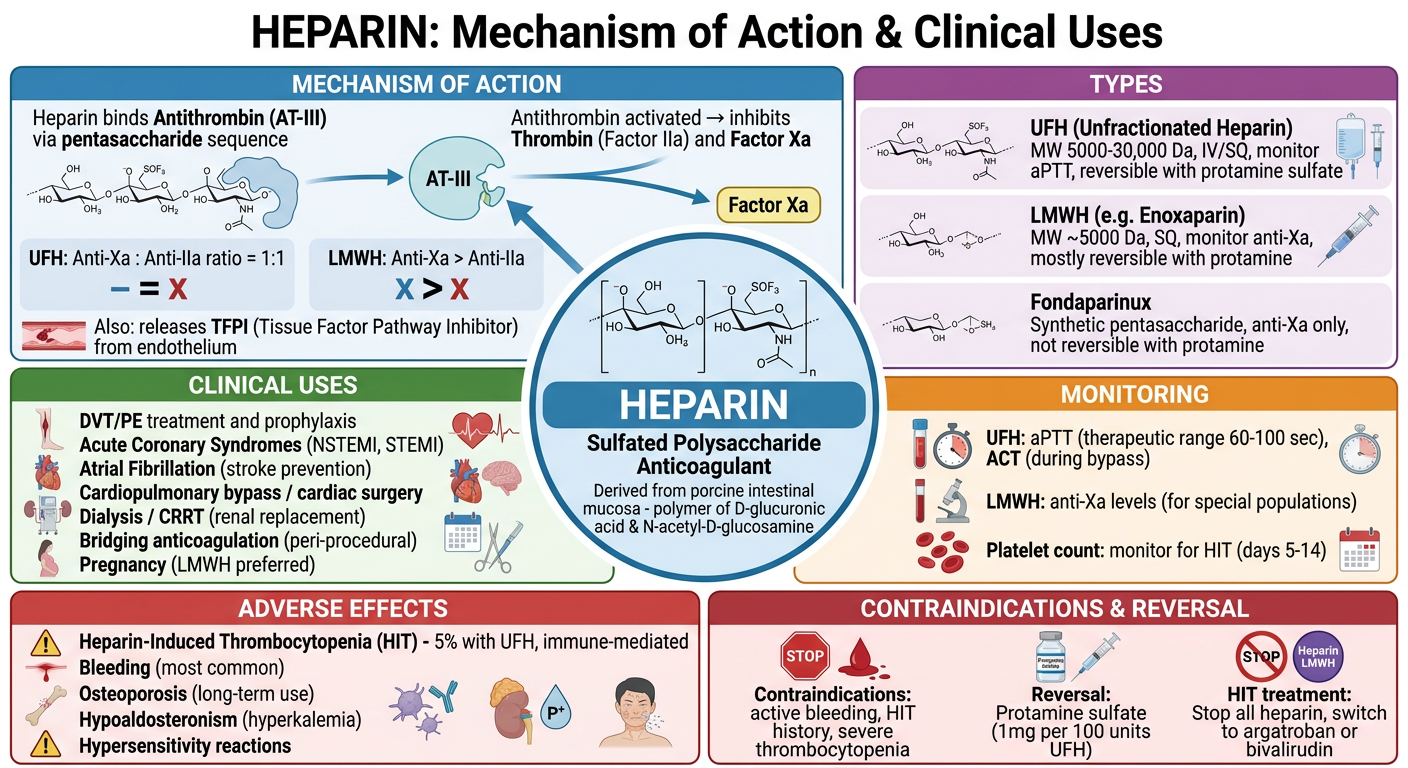
- Thrombin (Factor IIa) - requires the heparin chain to bridge AT and thrombin together (needs chains ≥18 saccharide units)
- Factor Xa - inhibited by the conformational change alone
| Type | MW | Anti-Xa:Anti-IIa | Monitor |
|---|---|---|---|
| UFH | 5,000-30,000 Da | 1:1 | aPTT |
| LMWH (e.g. enoxaparin) | ~5,000 Da | ~3:1 | Anti-Xa |
| Fondaparinux | 1,500 Da | Xa only | Anti-Xa |
- DVT/PE treatment and prophylaxis
- Acute coronary syndromes (NSTEMI/STEMI)
- Atrial fibrillation
- Cardiac surgery / cardiopulmonary bypass
- Dialysis and CRRT
- Peri-procedural bridging anticoagulation
- Pregnancy (LMWH is preferred)
- Bleeding (most common)
- HIT (Heparin-Induced Thrombocytopenia) - ~5% with UFH, immune-mediated, occurs days 5-14
- Osteoporosis (long-term), hyperkalemia, hypersensitivity