
Dengue
Reading File
Now let me search the medical library for dengue content in parallel.
Finding Sources
Searching PubMed
dengue fever management
Searching the Web
dengue fever 2025 2026 outbreak update WHO
Now let me read the key textbook sections on dengue in parallel - Harrison's (most comprehensive for internal medicine) and Robbins (pathology), plus the Red Book for clinical details.
Reading File
Reading File
Reading File
Now let me read more from the Red Book for diagnosis and treatment, and also fetch the Robbins pathology image.
Reading File
Reading File
Excellent - I now have comprehensive information from multiple authoritative textbooks. Let me fetch the dengue rash image for visual illustration.
Loading Image
I now have comprehensive information to deliver a thorough, well-structured answer on dengue.
Dengue
Overview
Dengue is a mosquito-borne viral illness caused by four closely related RNA flaviviruses (DENV-1, -2, -3, -4), transmitted primarily by Aedes aegypti and less commonly A. albopictus. It infects an estimated 400 million people annually, with ~100 million symptomatic cases and ~40,000 deaths from severe disease. 2024 was a historic peak with over 14 million cases globally; outbreaks are currently active in Sri Lanka (44,000+ cases in 2026) and other tropical regions. Cases in the US reached a 359% increase in 2024 vs. prior averages.
Virology & Transmission
- Family: Flaviviridae, genus Flavivirus
- Four serotypes: DENV-1, 2, 3, 4 - each can cause illness independently
- Primary vector: Aedes aegypti (peridomestic, daytime biting)
- Incubation: 3-14 days (human); 8-12 days in mosquito (extrinsic)
- Viremic window: 1-2 days before symptoms through ~7 days of illness (patients can infect mosquitoes during this period)
- Other routes: Vertical (20% risk, higher near delivery), blood/organ transplant, rarely breastfeeding or sexual contact
Red Book 2021, p. 521
Immunity & Pathogenesis - Antibody-Dependent Enhancement (ADE)
This is the key concept explaining severe dengue:
- First infection with any serotype → lifelong immunity against that serotype + cross-protection against the others (lasting 1-3 years)
- After cross-protection wanes, a second infection with a different serotype triggers ADE: prior cross-reactive antibodies bind the new virus but cannot neutralize it; instead they promote Fc receptor-mediated uptake into macrophages, amplifying viral replication and cytokine release
- This massive cytokine storm increases vascular permeability → plasma leakage → hemorrhage and shock
- DENV-2 is most commonly associated with severe secondary disease
- Infants with maternal dengue antibodies are also at risk (passive ADE)
Robbins & Cotran Pathologic Basis of Disease, p. 336; Harrison's 22E, p. 3901
Clinical Phases
Phase 1 - Febrile (Days 1-3)
- Sudden high fever (39-40°C)
- Severe myalgia, arthralgia, bone pain ("breakbone fever")
- Retro-orbital pain, headache
- Facial flushing, injected oropharynx
- Macular or maculopapular rash (appears days 3-5 as fever defervesces in ~50% of patients)
- Leukopenia, thrombocytopenia, mildly elevated LFTs
Phase 2 - Critical (Days 3-7, around defervescence)
- 24-48 hour window of significant plasma leakage
- Hematocrit rises (hemoconcentration) as intravascular fluid leaks
- Warning signs (require hospital monitoring):
- Abdominal pain or tenderness
- Persistent vomiting
- Clinical fluid accumulation (ascites, pleural effusion)
- Mucosal bleeding
- Lethargy/restlessness
- Liver enlargement >2 cm
- Rapid platelet decline with rising hematocrit
Phase 3 - Convalescent
- Gradual hemodynamic stabilization and clinical improvement
- Reabsorption of leaked fluid (risk of fluid overload if over-resuscitated)
- Bradycardia common
Red Book 2021, pp. 519-520
WHO 2009 Severity Classification
| Category | Criteria |
|---|---|
| Dengue without warning signs | Fever + ≥2 of: nausea/vomiting, rash, aches/pains, leukopenia, positive tourniquet test |
| Dengue with warning signs | Above + any warning sign (see Phase 2 above) |
| Severe dengue | Severe plasma leakage with shock or respiratory distress; severe bleeding; severe organ involvement (AST/ALT ≥1000 IU/L, impaired consciousness, cardiac/organ failure) |
The Dengue Rash
The characteristic rash appears in about 50% of patients, typically days 3-5:
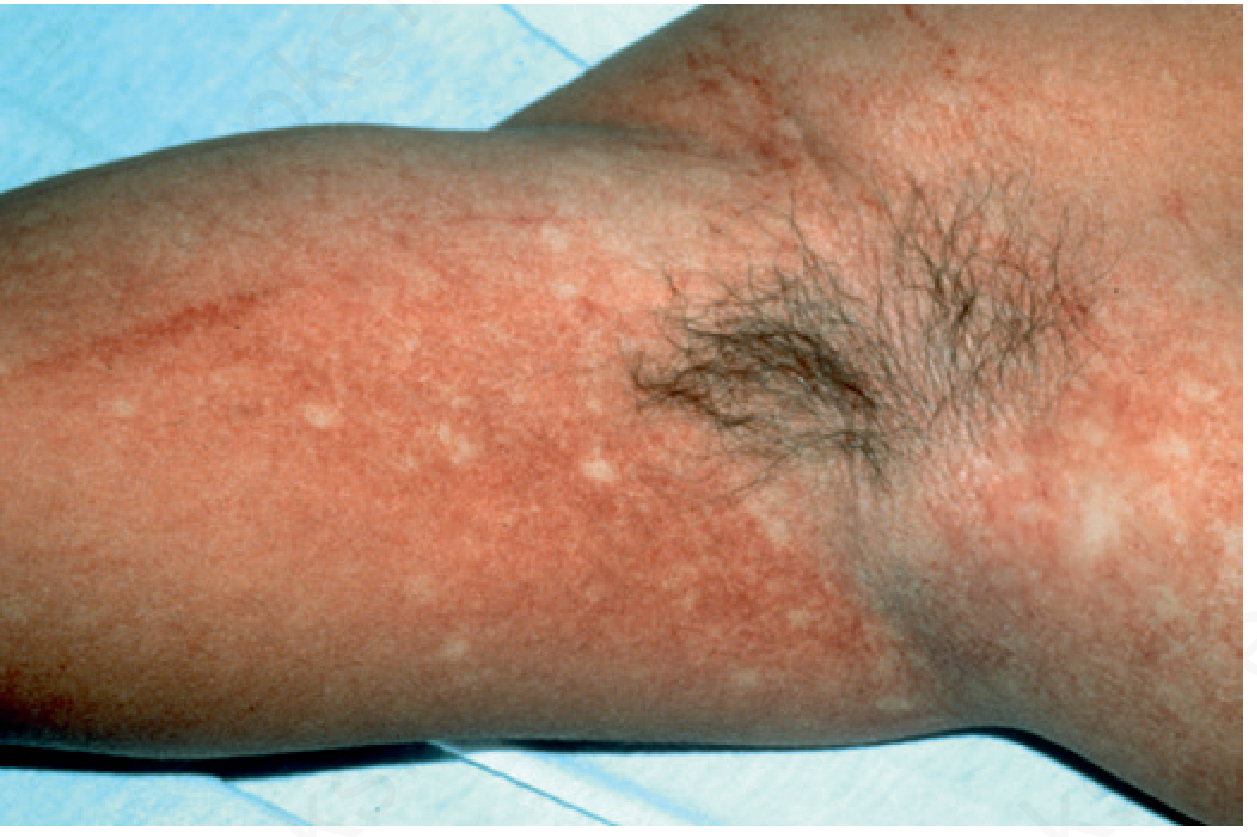
Dengue rash showing the pathognomonic "islands of white in a sea of red" - confluent morbilliform erythema with scattered islands of spared normal skin. Linear bleeding points can appear after blood pressure cuff application (positive tourniquet test). - Andrews' Diseases of the Skin
Tourniquet test: Inflate BP cuff to midpoint between systolic/diastolic for 5 min, wait 2 min, count petechiae - ≥10/sq inch = positive (suggestive of dengue).
Diagnosis
Timing determines which test to use:
| Timing | Preferred Tests |
|---|---|
| Days 1-7 (febrile phase) | RT-PCR for viral RNA or NS1 antigen ELISA |
| Day 3 onward | Anti-dengue IgM (positive in 99% by day 10) |
| Days 1-10 (combined) | NS1 antigen + IgM together identifies ≥90% of cases |
| Convalescent | 4-fold rise in IgG confirms recent infection |
Caveats:
- IgM can cross-react with Zika, West Nile, Japanese encephalitis, yellow fever
- IgG may be falsely positive in those previously vaccinated against other flaviviruses
- A 2025 Lancet Microbe meta-analysis (PMID 40209729) evaluated RT-PCR, NS1 ELISA, and IgM ELISA performance
Other labs: Leukopenia, thrombocytopenia (<100,000 in 50%), elevated transaminases (~3x normal)
Red Book 2021, pp. 521-522
Treatment
No specific antiviral exists. Management is entirely supportive.
Febrile Phase
- Oral hydration - encourage fluids
- Paracetamol/acetaminophen for fever and pain
- Avoid: aspirin, NSAIDs (ibuprofen), and salicylate-containing products - risk of bleeding
Critical Phase (hospitalized patients with warning signs/severe dengue)
- IV fluid resuscitation with crystalloids (normal saline or Ringer's lactate) - titrated carefully
- Monitor hematocrit every 4-6 hours
- Watch for: occult bleeding, shock, fluid overload
- Platelet transfusion: generally not given unless active severe bleeding or pre-procedure with platelets <50,000; prophylactic platelet transfusions are not routinely recommended
- With intensive supportive care: mortality drops from ~5-10% to <1%
- Refractory shock may require colloids or vasopressors
Convalescent Phase
- Caution with fluid administration - risk of overload as plasma re-enters intravascular space
- Monitor for pulmonary edema
Red Book 2021, pp. 522-523
High-Risk Groups
- Infants (maternal ADE antibodies)
- Pregnant women
- Second dengue infection (different serotype)
- Chronic illness: asthma, sickle cell disease, diabetes
- Persons with prior flavivirus vaccination (cross-reactive serology complications)
Rare/Atypical Manifestations
- Myocarditis, pancreatitis, hepatitis
- Hemophagocytic lymphohistiocytosis (HLH)
- Acute meningoencephalitis
- Post-dengue ADEM (acute disseminated encephalomyelitis)
Vaccines
- Dengvaxia (CYD-TDV): FDA-approved in the US for children 9-16 in dengue-endemic areas who have laboratory-confirmed prior infection only; can worsen disease in seronegative individuals (paradoxical ADE concern)
- Qdenga (TAK-003): Approved in several countries, studied in seronegative individuals with a better safety profile - newer option
- Fear remains that vaccines could potentiate severe disease in naive recipients
Prevention & Vector Control
- Eliminate standing water (breeding sites for Aedes)
- Window screens, air conditioning, insect repellents (DEET)
- Aedes mosquitoes bite during the day (unlike malaria-vector anophelines which bite at night)
- Novel: release of Wolbachia-infected Aedes mosquitoes has reduced dengue cases by 95-97% in dense urban areas in Colombia - a promising public health tool
- Military drones now being used in Sri Lanka (2026) to scan rooftops for mosquito breeding sites
Current Epidemiology (2025-2026)
- 2024 was a historic global peak: >14 million cases (WHO)
- Sri Lanka (2026): 44,000+ cases, 28 deaths as of June - worst outbreak in years, exacerbated by post-cyclone conditions
- Panama (2025): All 4 serotypes co-circulating (DENV-3 and -4 predominating), increasing severe case risk
- United States: 3,798 cases in 2024 - a 359% increase over the prior annual average of 828; local transmission documented in southern states
Sources: Harrison's Principles of Internal Medicine 22E (2025) | Robbins & Cotran Pathologic Basis of Disease | Red Book 2021 | Andrews' Diseases of the Skin | Recent: Yang ZS et al. systematic review, J Infect Public Health 2025 (PMID 41037858)
This is a shared conversation. Sign in to Orris to start your own chat.