
How does gibbs donnan effect contribute to rmp
The Gibbs-Donnan effect contributes to resting membrane potential (RMP) by creating an unequal distribution of ions across the cell membrane due to the presence of large, impermeant anions (proteins) inside the cell. This drives a Donnan equilibrium where more cations accumulate intracellularly, contributing to the negative intracellular charge. However, this alone would cause cell swelling, so the Na+/K+ ATPase pump counteracts it and reinforces the RMP.
Searching sources...
Reading File
Now let me search the medical library for relevant content on the Gibbs-Donnan effect and RMP.
Finding Sources
Finding Sources
Finding Sources
Excellent results. Let me now read the most relevant sections from Medical Physiology (which directly addresses Donnan forces and cell swelling) and Guyton (RMP), in parallel.
Reading File
Reading File
Reading File
Good content. Now let me read the Medical Physiology section on Donnan forces and cell swelling (the key section), and also get the Ganong's chapter summary.
Reading File
Reading File
Now let me get the critical Medical Physiology section that explains the full Donnan + pump interaction, and Costanzo's RMP section:
Reading File
Reading File
I now have rich, authoritative content from multiple textbooks. Let me also fetch the key diagram from Medical Physiology showing the Donnan equilibrium setup:
Loading Image
Loading Image
I have all the content needed. Here is a thorough, textbook-grounded answer:
Gibbs-Donnan Effect and the Resting Membrane Potential (RMP)
The Gibbs-Donnan effect is one of the foundational physicochemical forces that shapes the ionic environment of cells, and it plays an indirect but important role in establishing and maintaining the RMP.
1. What is the Gibbs-Donnan Effect?
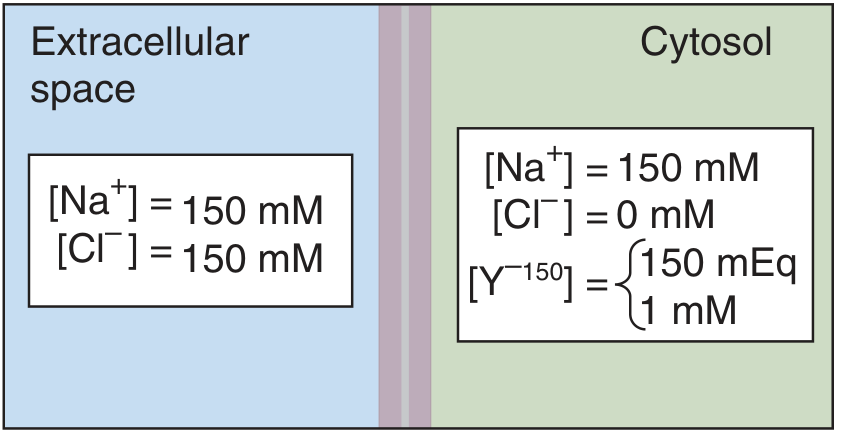
When a membrane separates two compartments and one compartment contains large, charged, impermeant molecules (such as intracellular proteins, Y⁻), the permeant small ions redistribute unevenly to satisfy two simultaneous constraints:
- Electrical neutrality must hold in each compartment
- Electrochemical equilibrium must be reached for each permeant ion (Nernst equation)
This produces the Donnan ratio (r):
[Na⁺]o / [Na⁺]i = [Cl⁻]i / [Cl⁻]o = r
At equilibrium, the same membrane voltage (Vm) satisfies the Nernst equation for all permeant ions simultaneously. Because the impermeant anions (proteins, Y⁻) carry negative charge inside, Na⁺ is attracted inward while Cl⁻ is pushed outward - resulting in more cations inside the cell than outside, and net inside-negative voltage. - Medical Physiology (Boron & Boulpaep), p. 203
2. How the Donnan Effect Contributes to RMP
a) Creates an inside-negative voltage
The impermeant intracellular anions (proteins, organic phosphates) cannot cross the membrane. Their negative charge:
- Repels intracellular Cl⁻ outward
- Attracts extracellular Na⁺ inward
- Results in unequal ion distribution that generates a negative intracellular potential
The membrane voltage at true Donnan equilibrium in a simple model would be approximately -18.4 mV (for Na⁺ and Cl⁻ alone), with a Donnan ratio r = 0.5. - Medical Physiology, p. 203
b) Creates unequal ion concentration gradients
These Donnan-driven concentration gradients are the substrate upon which the actual RMP is built. The high intracellular K⁺ and low intracellular Na⁺ (relative to ECF) that underlie the RMP depend partly on the fixed negative charge environment created by impermeant proteins.
c) Drives a tendency toward cell swelling (the problem it creates)
Pure Donnan equilibrium in a deformable (non-rigid) cell like an animal cell is unstable. At Donnan equilibrium, more total osmotically active particles accumulate inside than outside. Water follows osmotically, causing progressive cell swelling and eventual lysis. This is the "Donnan paradox." - Medical Physiology (Boron & Boulpaep), p. 204
3. The Na⁺/K⁺ ATPase: The Essential Counter-Force
The Na⁺-K⁺ pump resolves the Donnan paradox and is the central mechanism maintaining RMP:
| Pump action | Effect on RMP |
|---|---|
| Pumps 3 Na⁺ out, 2 K⁺ in (electrogenic) | Directly adds ~-4 mV to RMP |
| Maintains low [Na⁺]i, high [K⁺]i | Sustains K⁺ diffusion potential (~-94 mV) |
| Functionally excludes NaCl from cell | Counteracts Donnan-driven osmotic swelling |
| Keeps Vm negative | Excludes Cl⁻ from cell (Cl⁻ in electrochemical equilibrium) |
"The negative charge on impermeant intracellular solutes (e.g., proteins and organic phosphates) will lead to bursting unless the cell does 'osmotic work' to counteract the passive Donnan-like swelling. The net effect of this osmotic work is to largely exclude NaCl from the cell... In a sense, NaCl acts as a functionally impermeant solute in the extracellular space that offsets the osmotic effects of intracellular negative charges. This state of affairs is not an equilibrium but a steady state maintained by active transport." - Medical Physiology (Boron & Boulpaep), p. 204
When the Na⁺-K⁺ pump is inhibited:
- Na⁺ enters faster than K⁺ leaves → net intracellular cation gain → depolarization
- Depolarization reduces the driving force excluding Cl⁻ → Cl⁻ enters → net anion gain
- Increased intracellular particles → osmotic water entry → cell swelling
This confirms the pump's dual role: maintaining both RMP and cell volume. - Medical Physiology (Boron), p. 204
4. The Full Picture of RMP: Gibbs-Donnan + Goldman + Pump
The actual RMP (-70 to -90 mV) is determined by three overlapping contributions:
| Component | Mechanism | Contribution |
|---|---|---|
| K⁺ diffusion potential | K⁺ leaks out down its concentration gradient (maintained by pump) | ~-86 mV (largest contributor) |
| Na⁺ diffusion potential | Small Na⁺ leak inward partially offsets K⁺ effect | Reduces negativity |
| Electrogenic Na⁺/K⁺ pump | 3 Na⁺ out : 2 K⁺ in | ~-4 mV direct contribution |
| Gibbs-Donnan effect | Fixed intracellular anions create initial asymmetry; sustains K⁺ gradient environment | Indirect but foundational |
The Goldman equation integrates the relative permeabilities of K⁺, Na⁺, and Cl⁻ to give the actual membrane voltage. The Gibbs-Donnan effect sets the stage by establishing why these ion concentration differences exist in the first place. - Guyton & Hall Medical Physiology, p. 79; Costanzo Physiology 7th Ed., p. 26
As Ganong's summarizes: "Although the osmolality of solutions can be similar across a plasma membrane, the distribution of individual molecules and distribution of charge across the plasma membrane can be quite different. The separation of concentrations of charged species sets up an electrical gradient at the plasma membrane (inside negative). The electrochemical gradient is in large part maintained by the Na,K ATPase. These are affected by the Gibbs-Donnan equilibrium and can be calculated using the Nernst equation." - Ganong's Review of Medical Physiology, 26th Ed., p. summary
Summary
The Gibbs-Donnan effect contributes to RMP in the following ways:
- Directly: The impermeant intracellular anions (proteins, organic phosphates) create a fixed negative charge inside the cell, driving redistribution of permeant ions (Na⁺, K⁺, Cl⁻) and contributing an inside-negative voltage.
- Indirectly: It establishes the ionic concentration asymmetries that the Na⁺/K⁺ ATPase then amplifies and stabilizes. The pump does "osmotic work" to prevent the Donnan-driven cell swelling, and in doing so generates the high [K⁺]i and low [Na⁺]i gradients that are the primary determinants of the RMP (-70 to -90 mV).
- Continuously: Since proteins remain trapped inside the cell, Donnan forces are always present. The steady-state RMP is the result of perpetual balance between these passive Donnan forces and the active pumping of the Na⁺/K⁺ ATPase.
This is a shared conversation. Sign in to Orris to start your own chat.