
Dengue like illness
Reading File
"Dengue-like illness" is a broad clinical topic. Let me run parallel searches to cover the full picture — differential diagnosis, clinical features, pathophysiology, management, and relevant images.
Finding Sources
Finding Sources
Searching PubMed
"dengue" AND "differential diagnosis"
Now let me read the most authoritative sections in parallel — Harrison's (clinical), Robbins (pathology), Red Book (clinical detail), and Andrews' (skin manifestations).
Reading File
Reading File
Reading File
Reading File
Excellent. Now let me get the Red Book management/diagnosis section and search for differential diagnosis + lab findings in parallel.
Reading File
Finding Sources
Finding Sources
Now let me get the Rosen's Emergency Medicine section on dengue differential and the dengue rash image, plus Harrison's chikungunya/Zika comparison.
Reading File
Loading Image
Finding Sources
I now have comprehensive information to synthesize a thorough answer. Let me compile everything.
Dengue-Like Illness
What Is "Dengue-Like Illness"?
The term encompasses acute febrile syndromes that present with the hallmark triad of dengue fever — high fever, severe myalgia/arthralgia, and rash — but may or may not be caused by dengue virus itself. In practice it spans true dengue and its key mimics. It is a notifiable condition in the US surveillance system as a distinct category alongside confirmed dengue.
Dengue Fever: The Prototype
Etiology & Epidemiology
- Four flavivirus serotypes (DENV-1 to -4) transmitted by Aedes aegypti (primarily) and Aedes albopictus
- Estimated 400 million infections/year worldwide, 100 million symptomatic, ~40,000 deaths from severe dengue
- Endemic across tropical/subtropical belt — South/Southeast Asia, Pacific, Americas, Africa
- Leading cause of febrile illness in travelers returning from the Caribbean, Latin America, and South Asia
- Incubation: 3–14 days after the infectious mosquito bite
Clinical Phases (WHO 2009 Classification)
| Phase | Timing | Features |
|---|---|---|
| Febrile phase | Days 1–3 | Abrupt high fever, severe headache, retro-orbital pain, myalgia/arthralgia ("breakbone fever"), facial flushing, injected oropharynx, macular/morbilliform rash, leukopenia |
| Critical phase | Days 3–7 (around defervescence) | Plasma leakage, hemoconcentration (↑ Hct), thrombocytopenia nadir — risk of severe dengue |
| Recovery phase | Days 7–10 | Reabsorption of leaked fluids, bradycardia, generalized pruritus |
WHO Severity Classification
- Dengue without warning signs — fever + ≥2 of: nausea/vomiting, rash, aches/pains, leukopenia, positive tourniquet test
- Dengue with warning signs — above + any of: abdominal pain/tenderness, persistent vomiting, clinical fluid accumulation (ascites, pleural effusion), mucosal bleeding, lethargy/restlessness, liver enlargement >2 cm
- Severe dengue — severe plasma leakage → shock or respiratory distress; severe bleeding; or severe organ involvement (AST/ALT ≥1000 IU/L, impaired consciousness, organ failure)
The Rash
About 50% of patients develop a rash. In 90% it appears on days 3–5, often at defervescence:
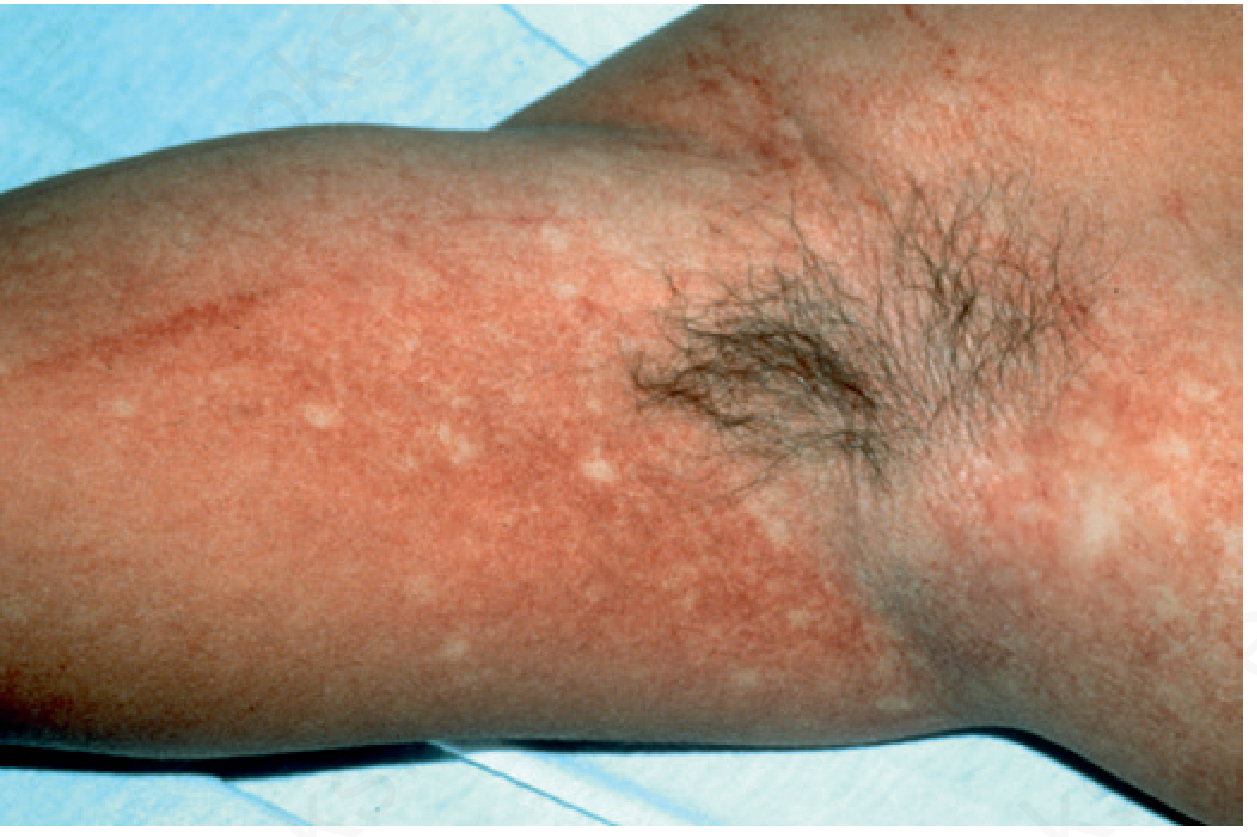
- Macular or morbilliform, usually confluent; "islands of white in a sea of red"
- Involves trunk (20%), extremities (30%), or generalized (50%)
- Mildly pruritic or asymptomatic
- Tourniquet test (Rumpel-Leede): inflate BP cuff for 5 min, wait 2 min → ≥10 petechiae/sq inch = positive
Pathophysiology of Severe Dengue
- Antibody-dependent enhancement (ADE): cross-reactive non-neutralizing antibodies from a prior serotype enhance Fc-receptor-mediated viral uptake into macrophages → amplified viral replication and cytokine storm → massive capillary leak
- Severe dengue predominantly occurs with second heterologous serotype infection (especially DENV-2 as the second serotype)
- Also occurs in infants with maternal anti-dengue antibodies (same ADE mechanism)
Differential Diagnosis — Dengue-Like Illness
The key mimics to consider, especially in a febrile traveler or endemic-area patient:
| Condition | Key distinguishing features |
|---|---|
| Chikungunya | Fever + rash + severe, debilitating polyarthritis/arthralgia (more prominent than dengue); less thrombocytopenia; joint symptoms may persist for months |
| Zika virus | Usually mild; non-purulent conjunctivitis prominent; rash often preceded by itch; teratogenic (microcephaly); associated with Guillain-Barré |
| Malaria | Cyclic fever pattern; splenomegaly; no rash typically; thick/thin blood films or RDT; can be rapidly fatal (P. falciparum) |
| Chikungunya + Dengue co-infection | Both co-circulate in same areas with same vector |
| Leptospirosis | Exposure to contaminated water; conjunctival suffusion; jaundice; can cause Weil's disease; positive serology |
| Rickettsial infections (e.g. RMSF, scrub typhus) | Eschar in scrub typhus; centripetal rash spreading to palms/soles in RMSF; responds to doxycycline |
| Yellow fever | Jaundice; bradycardia (Faget's sign); travel to endemic region; unvaccinated |
| Viral hemorrhagic fevers (Ebola, Marburg, Lassa) | Contact with infected individuals/animals; exposure history; severe bleeding |
| Measles | Koplik spots; cough, coryza, conjunctivitis; many dengue-endemic countries also have measles |
| Typhoid fever | Relative bradycardia, rose spots, diarrhea or constipation; gradual fever onset |
| Colorado tick fever | Tick exposure in Rocky Mountains; saddleback fever (biphasic); described as "dengue-like disease with rash" |
| COVID-19 | Dengue-like petechiae and erythema multiforme-like eruptions reported in early pandemic; PCR confirms |
| Influenza | Respiratory predominance; no rash; no thrombocytopenia |
Sources: Rosen's Emergency Medicine; Goldman-Cecil Medicine; Red Book 2021; Fitzpatrick's Dermatology
Laboratory Findings
| Finding | Significance |
|---|---|
| Leukopenia | Characteristic of dengue (helps distinguish from bacterial infection) |
| Thrombocytopenia (<100,000 in 50% of patients) | Marker of severity; nadir at defervescence |
| ↑ Hematocrit (hemoconcentration) | Signals plasma leakage → severe dengue risk |
| Elevated AST/ALT (~3× normal on average) | Dengue hepatitis; ≥1000 IU/L = severe dengue criterion |
| Positive tourniquet test | Suggests capillary fragility |
Diagnostic Testing
| Test | Window | Notes |
|---|---|---|
| RT-PCR (RNA detection) | Days 1–7 | Most specific for early infection |
| NS1 antigen EIA | Days 1–7–10 | Highly sensitive early; detects nonstructural protein 1 |
| IgM antibody EIA | From day 3–5 onwards; 99% positive by day 10 | Cross-reacts with Zika and other flaviviruses |
| IgG antibody | Persists for life | Fourfold rise (acute vs. convalescent) confirms infection |
| NS1 + IgM combo | Days 1–10 | Identifies ≥90% of primary and secondary cases |
Management
No specific antiviral exists — treatment is supportive
All patients:
- Rest, oral hydration, paracetamol (acetaminophen) for fever/pain
- Avoid NSAIDs and aspirin (risk of bleeding, Reye's syndrome)
- Monitor CBC, Hct, platelets daily around defervescence
Warning signs / critical phase monitoring:
- Watch for: persistent vomiting, severe abdominal pain, mucosal bleeding, early shock signs, rapid ↓ platelets + ↑ Hct
- IV crystalloid fluids for dehydration or plasma leakage
Severe dengue (DHF/DSS):
- ICU admission; fluid resuscitation (IV crystalloids first, then colloids/blood products if refractory shock)
- Blood product transfusion for hemorrhagic sequelae
- Early recognition reduces mortality from ~5–10% to <1%
- Avoid fluid overload during recovery phase (reabsorption phase risk)
Disposition:
- Outpatient: uncomplicated dengue without warning signs
- Admission: warning signs, dehydration requiring IV fluids
- ICU: dengue shock syndrome (DSS)
Vaccines
- Dengvaxia (CYD-TDV): licensed in several countries; only recommended for seropositive individuals (prior dengue infection confirmed) — naive recipients have increased risk of severe dengue on first natural infection post-vaccination (ADE concern)
- TAK-003 (Qdenga): approved in EU, Indonesia, Brazil; for ages 4–60; does not require prior serostatus testing
- Ongoing concern that vaccines might potentiate severe disease through ADE mechanisms remains a key challenge
Special Populations
| Population | Key concern |
|---|---|
| Infants | Maternal dengue antibodies → ADE risk → severe dengue |
| Pregnant women | Vertical transmission ~20% (higher near delivery); preterm birth, low birth weight risk |
| Travelers | Most common febrile illness returning from SE Asia within 1 month; also dominant in Caribbean/Latin America returnees |
| Patients with DM, asthma, sickle cell | Higher risk of severe disease |
| Elderly (>65) | Higher severe disease risk |
Key Clues to Diagnose Dengue Over Other Tropical Febrile Illnesses
From a predictive study in Honduras, the following features favor dengue:
- Petechiae
- Skin rash
- Myalgia
- Retro-ocular pain
- Positive tourniquet test
- Gingival bleeding
Sources: Andrews' Diseases of the Skin; Robbins Pathologic Basis of Disease; Red Book 2021; Harrison's Principles of Internal Medicine 22E (2025); Rosen's Emergency Medicine; Goldman-Cecil Medicine; Brenner & Rector's The Kidney; Fitzpatrick's Dermatology
This is a shared conversation. Sign in to Orris to start your own chat.