
Hey I already learnt about Hip joint anatomy ni bd Chaurasia 1 year ago Today is my test.Please give me hip joint.I already known about Hip joint It's only revision.Give me all muscles of the hip joint and anatomy of the Hip joint
Reading File
Searching for hip joint anatomy, muscles, and supporting structures in parallel.
search_medical_text
hip joint anatomy articular surfaces ligaments capsule
Bailey and Love's Short Practice of Surgery 28th Edition
Page 571
search_medical_text
muscles of hip joint movements flexion extension abduction adduction rotation
Bailey and Love's Short Practice of Surgery 28th Edition
Page 509
search_medical_image
hip joint anatomy muscles diagram
Immunotherapy for the Treatment of Lymphoma
Page 14
GradeResponse
GradeResponse
GradeResponse
Here is your rapid revision of the Hip Joint — BD Chaurasia style, clean and exam-focused.
🦴 HIP JOINT — Complete Revision
1. TYPE & ARTICULATION
| Feature | Detail |
|---|---|
| Type | Synovial, Ball & Socket (Multiaxial) |
| Articular surfaces | Head of femur + Acetabulum of hip bone |
| Acetabulum | Formed by ilium (2/5), ischium (2/5), pubis (1/5) |
| Articular area | Only lunate surface of acetabulum (horseshoe-shaped) |
| Centre of acetabulum | Non-articular acetabular fossa (contains fat pad + ligamentum teres) |
2. ARTICULAR SURFACES
- Head of femur: Covered with hyaline cartilage (except fovea capitis — attachment of ligamentum teres)
- Acetabular labrum: Fibrocartilaginous rim that deepens the socket; deficient inferiorly → bridged by transverse acetabular ligament
3. CAPSULE
- Attachment proximally: Rim of acetabulum + transverse acetabular ligament
- Attachment distally (femur):
- Anteriorly → intertrochanteric line
- Posteriorly → medial ⅔ of femoral neck (leaves lateral ⅓ extracapsular)
- Retinacular fibres: Reflected back along femoral neck → carry blood vessels to femoral head
4. LIGAMENTS
| Ligament | Origin | Insertion | Note |
|---|---|---|---|
| Iliofemoral (Y-ligament of Bigelow) | AIIS + acetabular rim | Intertrochanteric line | Strongest ligament; inverted Y shape; prevents hyperextension |
| Pubofemoral | Superior pubic ramus | Blends with capsule + iliofemoral | Limits abduction & extension |
| Ischiofemoral | Ischial part of acetabular rim | Greater trochanter (posterior) | Limits medial rotation & extension |
| Ligamentum teres | Margins of acetabular notch + transverse ligament | Fovea capitis of femoral head | Carries artery to head (acetabular branch of obturator) in children; weak mechanically |
| Transverse acetabular | Bridges acetabular notch | — | Converts notch → foramen; transmits neurovascular bundle |
📌 Bigelow's Y ligament is the most important ligament — it is taut in extension and prevents you from falling backwards when standing.
5. BLOOD SUPPLY TO FEMORAL HEAD
| Source | Route |
|---|---|
| Medial femoral circumflex artery (main) | Via retinacular vessels → most important in adults |
| Lateral femoral circumflex artery | Minor contribution |
| Acetabular branch of obturator artery | Via ligamentum teres → important in children |
📌 Fracture of femoral neck → disrupts retinacular vessels → avascular necrosis of femoral head
6. NERVE SUPPLY
Hilton's Law — nerves supplying a joint also supply muscles moving it and skin over them.
| Nerve | Root |
|---|---|
| Femoral nerve (anterior) | L2, L3, L4 |
| Obturator nerve | L2, L3, L4 |
| Nerve to rectus femoris | L2, L3 |
| Superior gluteal nerve | L4, L5, S1 |
| Inferior gluteal nerve | L5, S1, S2 |
| Nerve to quadratus femoris | L4, L5, S1 |
| Sciatic nerve (posterior) | L4–S3 |
7. MOVEMENTS & MUSCLES ⭐ (Most Important for Exam)
🔵 FLEXION (0–120° with knee flexed; 90° with knee straight)
| Muscle | Nerve |
|---|---|
| Iliopsoas (Chief flexor) | Femoral n. (L2,3,4) |
| Rectus femoris | Femoral n. |
| Sartorius | Femoral n. |
| Tensor fascia lata | Superior gluteal n. |
| Pectineus | Femoral n. |
| Adductor longus/brevis | Obturator n. |
🔴 EXTENSION (0–30°)
| Muscle | Nerve |
|---|---|
| Gluteus maximus (Chief extensor) | Inferior gluteal n. (L5, S1, S2) |
| Semimembranosus | Sciatic (tibial) |
| Semitendinosus | Sciatic (tibial) |
| Biceps femoris (long head) | Sciatic (tibial) |
| Adductor magnus (hamstring part) | Sciatic (tibial) |
🟡 ABDUCTION (0–45°)
| Muscle | Nerve |
|---|---|
| Gluteus medius (Chief abductor) | Superior gluteal n. (L4, L5, S1) |
| Gluteus minimus | Superior gluteal n. |
| Tensor fascia lata | Superior gluteal n. |
| Sartorius | Femoral n. |
| Piriformis | S1, S2 |
📌 Trendelenburg test — tests gluteus medius. Positive when stance-side hip drops due to weak abductors.
🟢 ADDUCTION (0–30°)
| Muscle | Nerve |
|---|---|
| Adductor longus (Chief adductor) | Obturator n. (L2,3,4) |
| Adductor brevis | Obturator n. |
| Adductor magnus | Obturator n. + Sciatic n. |
| Gracilis | Obturator n. |
| Pectineus | Femoral n. |
🟣 MEDIAL (INTERNAL) ROTATION (0–40°)
| Muscle | Nerve |
|---|---|
| Gluteus medius (anterior fibres) | Superior gluteal n. |
| Gluteus minimus (anterior fibres) | Superior gluteal n. |
| Tensor fascia lata | Superior gluteal n. |
| Adductor longus, brevis, magnus | Obturator n. |
| Pectineus | Femoral n. |
🟠 LATERAL (EXTERNAL) ROTATION (0–45°) — "6 Short External Rotators"
| Muscle | Nerve |
|---|---|
| Piriformis | S1, S2 |
| Obturator internus | Nerve to obturator internus (L5, S1) |
| Obturator externus | Obturator n. |
| Gemellus superior | Nerve to obturator internus |
| Gemellus inferior | Nerve to quadratus femoris |
| Quadratus femoris | Nerve to quadratus femoris (L4, L5, S1) |
| + Gluteus maximus (powerful lateral rotator) | Inferior gluteal n. |
📌 Mnemonic for 6 external rotators: "P GO GGQ" — Piriformis, Gemellus superior, Obturator internus, Gemellus inferior, Quadratus femoris, Obturator externus
8. RELATIONS
| Direction | Structure |
|---|---|
| Anterior | Femoral nerve, artery, vein (lateral to medial: N-A-V-E-L) separated by psoas |
| Posterior | Sciatic nerve (below piriformis), gluteus maximus |
| Superior | Reflected head of rectus femoris |
| Inferior | Obturator externus |
9. STABILITY OF HIP JOINT
Hip is inherently stable due to:
- Deep socket — acetabulum + labrum
- Strong ligaments — especially iliofemoral
- Atmospheric pressure — creates suction
- Muscle tone — dynamic stability (gluteus medius most important)
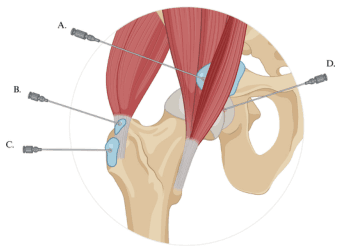
10. BURSAE AROUND HIP (Clinically Important)
| Bursa | Location | Clinical |
|---|---|---|
| Trochanteric bursa | Between gluteus maximus & greater trochanter | Trochanteric bursitis |
| Iliopsoas (iliopectineal) bursa | Between iliopsoas & capsule | Can communicate with joint |
| Ischial bursa | Over ischial tuberosity | "Weaver's bottom" |
⚡ QUICK EXAM BULLETS
- Strongest ligament: Iliofemoral (Bigelow's Y)
- Chief flexor: Iliopsoas
- Chief extensor: Gluteus maximus
- Chief abductor: Gluteus medius
- AVN risk: Femoral neck fracture → disrupts medial circumflex artery
- Trendelenburg +ve: Weak gluteus medius
- Hip dislocates posteriorly most commonly (80%) → sciatic nerve injury risk
- 6 short external rotators — all below piriformis except piriformis itself
- Ligamentum teres — carries blood in children, not adults
Good luck in your test! 🎯
This is a shared conversation. Sign in to Orris to start your own chat.