
Top 10 heart diseases with ecg finding
Reading File
Now let me search the library for ECG findings across major cardiac conditions in parallel:
Finding Sources
Finding Sources
Searching Images
ECG findings heart diseases myocardial infarction atrial fibrillation
Now let me search for specific ECG findings for each major cardiac condition in parallel:
Finding Sources
Finding Sources
Finding Sources
Searching Images
STEMI ST elevation myocardial infarction ECG 12-lead
Finding Sources
Finding Sources
Finding Sources
Searching Images
atrial fibrillation ECG irregularly irregular absent P waves
Finding Sources
Finding Sources
Searching Images
hypertrophic cardiomyopathy ECG deep S waves LVH
I now have comprehensive data to compile the full answer. Let me present the top 10 heart diseases with their ECG findings:
Top 10 Heart Diseases & Their ECG Findings
1. 🫀 ST-Elevation Myocardial Infarction (STEMI)
ECG Findings:
- ST-segment elevation ≥1 mm in ≥2 contiguous leads (convex "tombstone" morphology)
- Hyperacute (peaked) T-waves — earliest change
- Pathological Q-waves — develop within hours (indicate transmural necrosis)
- Reciprocal ST-depression in opposite leads
- T-wave inversion in the evolving phase
Localisation by leads:
| Territory | ST Elevation | Artery |
|---|---|---|
| Anterior | V1–V4 | LAD |
| Inferior | II, III, aVF | RCA |
| Lateral | I, aVL, V5–V6 | LCx |
| Posterior | V1–V2 depression + tall R | RCA/LCx |
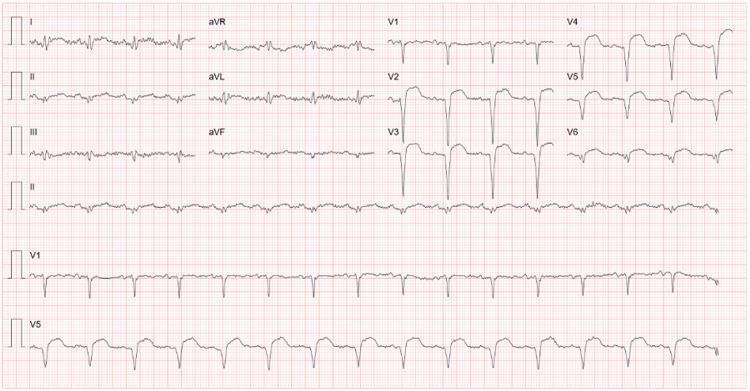
Goldman-Cecil Medicine — "Acute MI is classified based on whether the ECG shows ST-segment elevation (STEMI) or not (NSTEMI)."
2. 💓 Atrial Fibrillation (AF)
ECG Findings:
- Absent P waves — replaced by chaotic fibrillatory (f) waves (best seen in V1)
- Irregularly irregular R-R intervals — hallmark finding
- Narrow QRS complexes (unless aberrant conduction)
- Rapid ventricular response (>100 bpm) if uncontrolled
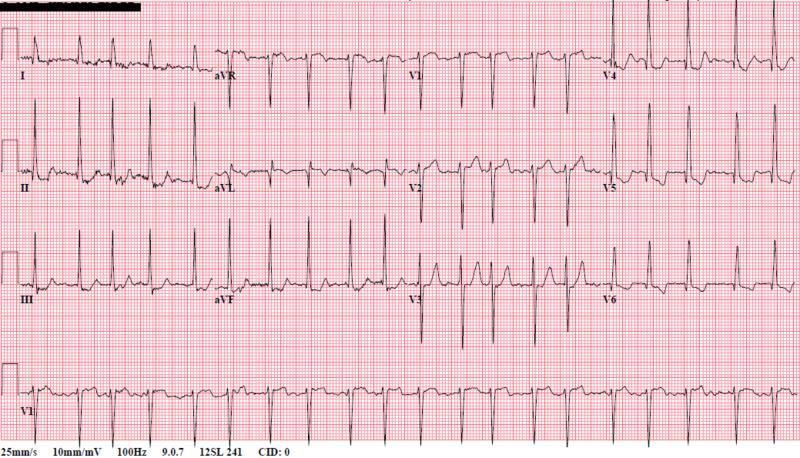
Braunwald's Heart Disease — "New atrial fibrillation or flutter" is a classic ECG manifestation of structural cardiac disease.
3. 🫁 Acute Pericarditis
ECG Findings (4 classic stages):
- Stage I: Diffuse concave ST elevation in nearly all leads (except aVR & V1) + PR depression (pathognomonic)
- Stage II: ST normalises, PR depression persists
- Stage III: T-wave inversions
- Stage IV: ECG normalises
Key differentiators from STEMI:
- ST elevation is diffuse (not regional)
- PR depression is present
- No reciprocal ST depression (except in aVR)
- No Q-waves
Washington Manual — "Classic ECG findings are diffuse ST-segment elevation with PR depression." Mulholland Surgery — "The EKG classically shows diffuse ST elevations without Q waves or T-wave inversion. PR depression can also be seen."
4. 💗 Hypertrophic Cardiomyopathy (HCM)
ECG Findings:
- Left ventricular hypertrophy (LVH) — Sokolow-Lyon criteria: deep S in V1 + tall R in V5 (sum >35 mm)
- Deep, broad Q-waves in lateral leads (I, aVL, V5–V6) — "septal Q-waves" (pseudoinfarction pattern)
- "Giant" symmetric T-wave inversions — especially in apical HCM (Yamaguchi syndrome) V3–V5 (up to 15 mm deep)
- Left axis deviation
- Atrial fibrillation common
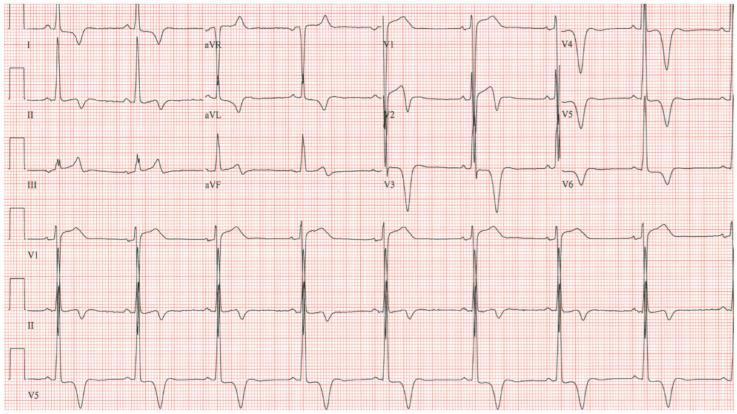
Tintinalli's Emergency Medicine — "Deep S-wave voltage (28 mm S in V2) and deep broad Q-waves are characteristic HCM ECG findings."
5. 🔁 Wolff-Parkinson-White (WPW) Syndrome / Pre-Excitation
ECG Findings (classic triad):
- Short PR interval (<120 ms) — accessory pathway bypasses AV node delay
- Delta wave — slurred upstroke at the beginning of the QRS (pre-excitation of ventricles)
- Widened QRS (>120 ms) — due to fusion of normal and accessory conduction
- Pseudo-ST/T changes (secondary repolarisation abnormalities)
- Can mimic LBBB or RBBB patterns depending on pathway location
Washington Manual — "WPW syndrome: short PR and a delta wave on the upstroke of QRS. Can have AVRT (orthodromic or antidromic) as the mechanism of SVT." Miller's Anesthesia — "WPW: characterised by a shortened PR interval and a delta wave (i.e., early activation/"pre-excitation" of the His–Purkinje system)."
6. ❤️ Heart Failure with LV Hypertrophy / Hypertensive Heart Disease
ECG Findings:
- LVH voltage criteria (Sokolow-Lyon, Cornell criteria)
- LV strain pattern — ST depression + T-wave inversion in lateral leads (I, aVL, V5–V6)
- Left atrial enlargement — broad, bifid P-wave (P-mitrale) in lead II; biphasic P in V1
- Left axis deviation
- LBBB in advanced disease
- Atrial fibrillation (from left atrial dilatation)
Robbins Pathology — "ECG or echocardiographic findings of left ventricular hypertrophy. The disease comes to attention with the onset of atrial fibrillation (secondary to left atrial enlargement)."
7. 📉 AV Heart Block (2nd & 3rd Degree)
ECG Findings:
| Type | ECG Pattern |
|---|---|
| 1st degree | PR interval >200 ms, all P waves conducted |
| Mobitz I (Wenckebach) | Progressive PR lengthening → dropped QRS; usually benign |
| Mobitz II | Constant PR, sudden dropped QRS; higher risk of progression |
| 3rd degree (complete) | P-waves and QRS are completely dissociated; escape rhythm (junctional 40–60 bpm or ventricular 20–40 bpm) |
Goldman-Cecil — "Complete heart block is usually preceded by abnormal baseline ECG findings, such as bundle branch block or second-degree AV block." Washington Manual — "Mobitz II 2nd-degree AV block carries a higher risk of progression to complete heart block than Mobitz I."
8. 🫀 Non-ST Elevation ACS (NSTEMI / Unstable Angina)
ECG Findings:
- ST depression ≥0.5–1 mm (horizontal or downsloping) in ≥2 contiguous leads
- T-wave inversions (deep, symmetric)
- Transient ST elevation that resolves
- ECG may be normal in ~20–30% of cases
- No pathological Q-waves (subendocardial infarction)
Goldman-Cecil — "MI is classified based on whether the ECG shows ST elevation (STEMI) or not (NSTEMI). NSTEMI shows no ST elevation but elevated biomarkers."
9. 🔴 Aortic Stenosis
ECG Findings:
- LVH — high voltage (pressure overload pattern)
- LV strain — ST-depression and T-wave inversion in V5–V6, I, aVL
- Left axis deviation
- Left atrial enlargement (P-mitrale)
- Left bundle branch block (advanced disease)
- Atrial fibrillation (late)
Tintinalli's — "ECG findings are generally nonspecific. The most common abnormality is left ventricular hypertrophy."
10. 🔶 Dilated Cardiomyopathy (DCM)
ECG Findings:
- Sinus tachycardia — compensatory
- Left bundle branch block (LBBB) — very common; QRS >120 ms, broad notched R in I/V5–V6
- LVH or low voltage (in end-stage)
- Pathological Q-waves — pseudoinfarction pattern (fibrosis)
- Left atrial enlargement
- Atrial fibrillation, ventricular ectopics, ventricular tachycardia
Quick Reference Summary Table
| # | Disease | Key ECG Sign |
|---|---|---|
| 1 | STEMI | ST elevation + Q-waves (regional) |
| 2 | Atrial Fibrillation | No P-waves + irregularly irregular |
| 3 | Acute Pericarditis | Diffuse concave ST elevation + PR depression |
| 4 | Hypertrophic Cardiomyopathy | LVH + giant T inversions + septal Q-waves |
| 5 | WPW Syndrome | Short PR + delta wave + wide QRS |
| 6 | Hypertensive Heart Disease / HF | LVH + strain pattern + P-mitrale |
| 7 | AV Block (complete) | P-QRS dissociation + escape rhythm |
| 8 | NSTEMI / Unstable Angina | ST depression + T-wave inversions |
| 9 | Aortic Stenosis | LVH + LV strain |
| 10 | Dilated Cardiomyopathy | LBBB + low voltage + pseudoQ |
Sources:
- Braunwald's Heart Disease: A Textbook of Cardiovascular Medicine
- Goldman-Cecil Medicine
- Harrison's Principles of Internal Medicine, 22nd Ed. (2025)
- Tintinalli's Emergency Medicine
- Washington Manual of Medical Therapeutics
- Robbins & Kumar Basic Pathology
- Miller's Anesthesia
This is a shared conversation. Sign in to Orris to start your own chat.