


Interpret the ecg based on the leads
Reading File
I'll search for ECG interpretation criteria to support this analysis, while simultaneously analyzing the tracing and measurements visible in the images.
search_medical_text
ECG interpretation QTc prolongation normal sinus rhythm inferior lead abnormality
Management of the Patient with a Prolonged QT Interval
Page 2
search_medical_image
normal sinus rhythm ECG 12 lead interpretation QT interval
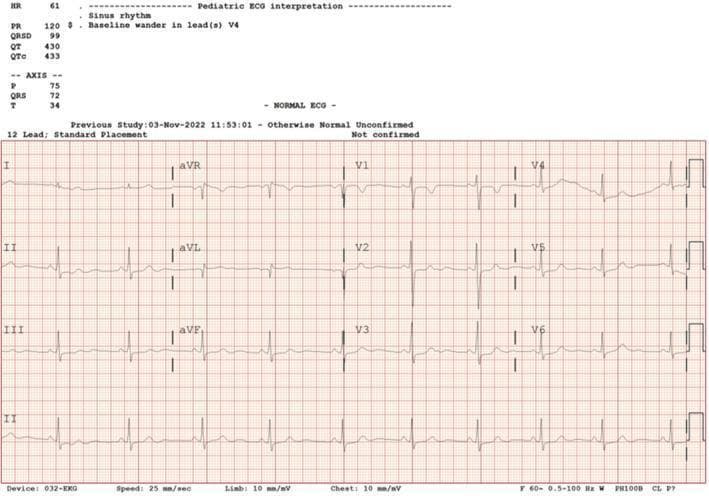
Hugging Face pmc clinical VQA raw
Page 0
GradeResponse
GradeResponse
Here is a thorough interpretation of this ECG based on the measurements, computer analysis, and visible lead morphology.
ECG Interpretation
Date/Time: 21-03-2026, 22:33:19
Machine: AC50 EMG ADS
Speed/Gain: 25 mm/s | 10 mm/mV
Measured Intervals & Parameters
| Parameter | Value | Normal Range |
|---|---|---|
| Ventricular Rate | 89 BPM | 60–100 BPM ✅ |
| PR Interval | 161 ms (range 102–191) | 120–200 ms ✅ |
| P/QRS/T Interval | 99 ms | <120 ms ✅ |
| QT Interval | 368 ms | Rate-dependent |
| QTc (corrected) | 448 ms | <440 ms (M) / <460 ms (F) ⚠️ |
| QRS/T Axis | 37–41° | 0–90° ✅ Normal axis |
| RV1/SV5 Amp | 0.07 / 0.39 mV | |
| RV5/SV1 Amp | 1.31 / 0.66 mV | |
| V2.33 reference | noted |
Computer-Generated Interpretation
The machine flagged three findings:
- 800 — Normal Sinus Rhythm
- 752 — Inferior Abnormal QK (< 18 years)
- Borderline Abnormal ECG ⚠️ (Unconfirmed — needs physician review)
Lead-by-Lead Analysis (from visible tracings)
Limb Leads (I, II, III, aVR, aVL, aVF):
- Lead II & III: Upright P waves confirm sinus rhythm. QRS complexes are narrow and regular. The "inferior abnormal QK" flag likely refers to a Q wave pattern in the inferior leads (II, III, aVF) that the machine considers abnormal for a patient under 18.
- aVR: Expected negative QRS deflection — consistent with normal axis.
- aVL: Small or biphasic QRS expected given the axis ~37–41°.
- aVF: Upright — consistent with normal inferior axis.
Precordial Leads (V1–V6):
- V1: rS pattern visible — normal for V1.
- V2–V3: Transitional zone morphology, prominent positive deflections visible — may represent early transition.
- V4–V5: Tall R waves; RV5/SV1 ratio of 1.31/0.66 mV — within normal limits, no LVH criteria met by voltage alone.
- V6: Upright QRS, normal lateral morphology.
- No obvious ST elevation or depression noted across the precordial leads.
- T waves appear upright in lateral leads.
Key Findings & Clinical Significance
| Finding | Significance |
|---|---|
| Normal sinus rhythm at 89 BPM | Reassuring |
| PR 161 ms | Normal; no first-degree AV block |
| QRS 99 ms | Narrow; no bundle branch block |
| QTc 448 ms | Borderline prolonged (upper limit of normal is 440 ms in males; 460 ms in females). In a patient <18 years, this warrants attention. |
| Normal QRS axis (37–41°) | No axis deviation |
| Inferior Q waves (code 752) | Machine-flagged as abnormal for age <18 — may reflect positional/physiologic Q waves or early inferior pathology; needs clinical correlation |
| No ST-segment changes visible | No acute ischemic pattern |
Summary & Recommendations
This ECG shows a normal sinus rhythm at 89 BPM with borderline QTc prolongation (448 ms). The key concern flagged by the machine is:
-
QTc 448 ms — borderline prolonged. In a patient under 18 years, QTc >440 ms raises consideration of congenital long QT syndrome (LQTS), drug-induced QTc prolongation, or electrolyte abnormalities (hypokalemia, hypomagnesemia, hypocalcemia).
-
Inferior Q wave abnormality (code 752) — physiologic Q waves in inferior leads are common in young patients, but the machine flagged this as abnormal for age. Clinical correlation is essential.
Important: The machine explicitly states "Unconfirmed Report — Need to Review." This ECG must be reviewed and interpreted by a qualified physician or cardiologist, especially given the patient's age (<18 years), borderline QTc, and the inferior lead abnormality flag. A clinical history, medication review, and electrolyte panel would be appropriate next steps.
But the patient is more than 45 years
Good context. That changes the interpretation of the machine's age-flag. Let me re-analyze with that in mind.
Revised ECG Interpretation (Patient >45 Years)
Re-evaluation of Machine Flags in Context
The machine flagged "752 Inferior Abnormal QK (<18 Year)" — this flag was generated because the machine likely did not have the patient's age entered, so it defaulted to a pediatric reference range. For a patient >45 years, this specific flag is not clinically applicable.
Parameters Re-assessed for Adult (>45 years)
| Parameter | Value | Adult Normal | Assessment |
|---|---|---|---|
| Ventricular Rate | 89 BPM | 60–100 | ✅ Normal |
| PR Interval | 161 ms | 120–200 ms | ✅ Normal |
| QRS Duration | 99 ms | <120 ms | ✅ Narrow, no BBB |
| QT Interval | 368 ms | Rate-dependent | — |
| QTc | 448 ms | <440 ms (M) / <460 ms (F) | ⚠️ Borderline (male) / ✅ Normal (female) |
| QRS Axis | 37–41° | -30° to +90° | ✅ Normal axis |
| RV5/SV1 | 1.31 / 0.66 mV | <3.5 mV (Sokolow) | ✅ No LVH by voltage |
Critical Re-interpretation: Inferior Q Waves in a >45-Year-Old
In an adult over 45, Q waves in the inferior leads (II, III, aVF) carry a very different clinical weight compared to a child:
| Possibility | Clinical Significance |
|---|---|
| Old inferior MI | Q waves in II, III, aVF in this age group raise concern for prior inferior myocardial infarction (RCA or LCx territory) |
| Physiologic Q waves | Small narrow Q waves in III and aVL can be normal, but machine-flagged "abnormal" pattern is more concerning at this age |
| Left posterior fascicular block | Can produce inferior Q-wave pattern |
This is the most important finding to pursue in this age group. Inferior Q waves in a >45-year-old should be correlated with:
- Symptoms (chest pain, dyspnea, prior cardiac history)
- Previous ECGs for comparison
- Cardiac biomarkers (Troponin, CK-MB) if any acute presentation
- Echocardiogram to assess inferior wall motion
QTc 448 ms in a >45-Year-Old
- In males >45: QTc 448 ms is mildly prolonged (normal <440 ms)
- In females >45: QTc 448 ms is within normal limits (<460 ms)
- Causes to consider at this age:
- Medications (antiarrhythmics, antipsychotics, antibiotics like azithromycin)
- Electrolyte imbalance (hypokalemia, hypomagnesemia)
- Structural heart disease
- Hypothyroidism
Revised Summary
| Finding | Revised Significance for >45 years |
|---|---|
| Normal sinus rhythm, 89 BPM | Reassuring |
| Narrow QRS, normal axis | No conduction defect |
| Inferior Q waves (II, III, aVF) | Must rule out old/silent inferior MI — highest priority |
| QTc 448 ms | Borderline (males) — check medications and electrolytes |
| No acute ST changes visible | No obvious ongoing ischemia on this tracing |
Recommended Next Steps
- Compare with prior ECGs — are these Q waves new or old?
- Cardiac biomarkers (Troponin) if any symptoms present
- Echocardiogram — assess inferior wall motion abnormality
- Electrolyte panel — K⁺, Mg²⁺, Ca²⁺ (for QTc)
- Medication review — any QT-prolonging drugs?
- Cardiology referral if Q waves are new or patient is symptomatic
The "Unconfirmed — Need to Review" note from the machine still stands. A qualified physician must review this ECG in full clinical context.
This is a shared conversation. Sign in to Orris to start your own chat.