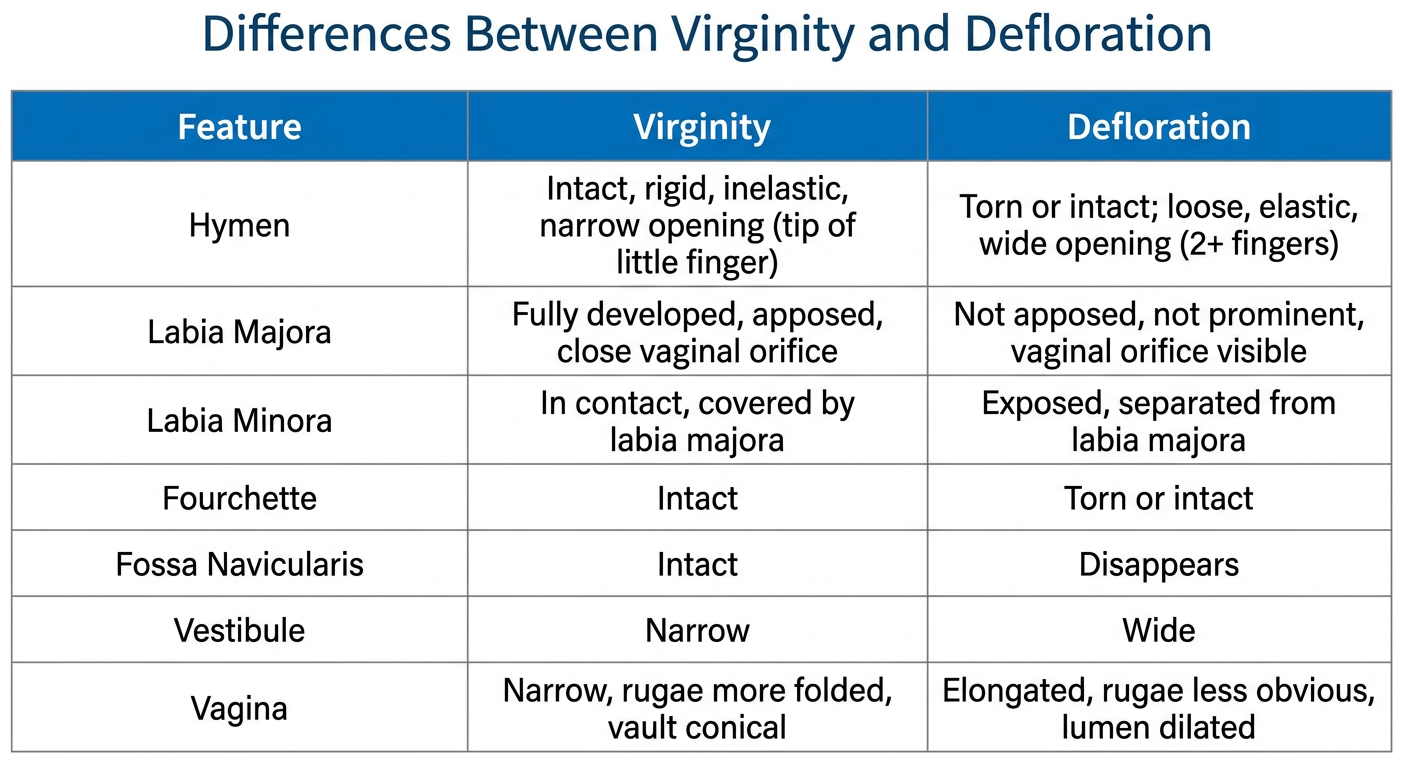
Virginity vs defloration in tabular form
Differences Between Virginity and Defloration
Definitions:
- Virginity - The state of a female (virgo intacta) who has never had sexual intercourse.
- Defloration - Loss of virginity; most commonly evidenced by rupture/alteration of the hymen following first coitus.
| Feature | Virginity | Defloration |
|---|---|---|
| Hymen | Intact, rigid, inelastic; edges are distinct, smooth and regular; narrow opening barely admitting the tip of the little finger | Torn or intact; if intact it is loose, elastic, with a wide opening allowing two or more fingers to pass easily |
| Labia Majora | Fully developed, apposed to each other, completely closing the vaginal orifice | Not apposed, not prominent; at the lower end the vaginal orifice may be visible |
| Labia Minora | In contact with each other; covered by the labia majora | Not in contact; exposed and separated from the labia majora |
| Fourchette | Intact | Torn or intact |
| Fossa Navicularis | Intact | Disappears |
| Vestibule | Narrow | Wide |
| Vagina | Narrow; rugae more folded; vault more conical | Grows in length after repeated intercourse; rugae less obvious; lumen dilated |
Important Medicolegal Notes
-
Hymen integrity is not absolute proof. The hymen can remain intact even after repeated sexual intercourse if it is loose, lax, folded, elastic, or thick and fleshy. Cases have been documented in pregnant women and sex workers with an intact hymen. - The Essentials of Forensic Medicine and Toxicology, 36th ed.
-
Defloration without rupture is possible. This is the basis for "false virgins" - women who have had sexual intercourse but whose hymen appears intact on examination. - P.C. Dikshit Textbook of Forensic Medicine and Toxicology
-
Signs of virginity must be assessed together. An intact hymen + normal fourchette/posterior commissure + narrow rugose vagina, taken together, may constitute evidence of virginity. Taken singly, none of these signs is conclusive.
-
Carunculae hymenales (myrtiformes) - After repeated coitus or childbirth, the hymen is destroyed and replaced by small, rounded, fleshy projections/tags around the hymenal ring. This is a positive sign of defloration.
-
Hymenoplasty - Surgical repair of a ruptured hymen (hymenoplasty) can restore the narrow hymenal orifice appearance, though congestion and scars at the site of united tears may be detectable on examination.
Generate a picture of table generated
A clean medical forensic reference table titled "Differences Between Virginity and Defloration" with two columns (Virginity and Defloration) and the following rows: Feature | Virginity | Defloration. Hymen: Intact, rigid, inelastic, narrow opening (tip of little finger) | Torn or intact; loose, elastic, wide opening (2+ fingers). Labia Majora: Fully developed, apposed, close vaginal orifice | Not apposed, not prominent, vaginal orifice visible. Labia Minora: In contact, covered by labia majora | Exposed, separated from labia majora. Fourchette: Intact | Torn or intact. Fossa Navicularis: Intact | Disappears. Vestibule: Narrow | Wide. Vagina: Narrow, rugae more folded, vault conical | Elongated, rugae less obvious, lumen dilated. Professional medical textbook style, white background, neat grid layout, clear readable font, blue header row.