I now have comprehensive data from all key textbooks. Let me update the todos and compile the master document.---
INGUINAL HERNIA - MS GENERAL SURGERY LONG CASE
Complete University Examination Guide
Based on Bailey & Love 28th Ed, Schwartz 11th Ed, Sabiston, Fischer's Mastery of Surgery 8th Ed, S. Das Manual on Clinical Surgery 13th Ed, SRB Manual of Surgery, EHS/HerniaSurge Guidelines 2018, and latest evidence (2021-2025)
SECTION 1: CLINICAL SCENARIO
A Realistic Long Case
Patient: Ramesh Kumar, 48-year-old male, farmer (heavy manual labor)
Address: Rural district
Chief Complaints:
- Swelling in the right groin - 3 years
- Dragging ache in the right groin on standing and exertion - 1 year
- Swelling descending into the scrotum on straining - 6 months
- Incomplete reduction on lying down in the last 2 weeks
History of Presenting Illness:
- The swelling was first noticed 3 years ago as a small, soft, reducible lump in the right groin, increasing in size on straining or coughing, and disappearing completely on lying down.
- One year ago, a dragging ache developed in the right groin and right scrotum, worse after prolonged standing or physical work, and relieved by lying down.
- Six months ago the swelling descended into the right scrotum while lifting heavy weights.
- For the past 2 weeks, the swelling does not reduce completely on its own when lying down and requires manual pressure for reduction.
- No history of vomiting, absolute constipation, or features of intestinal obstruction.
- No sudden increase in pain or change in color of overlying skin.
Risk Factors:
- Heavy manual labor (farming, lifting)
- Chronic cough - smoker (10 beedis/day for 20 years; 10 pack-years)
- Constipation - straining at stool (uses dry-pit latrine)
- BMI 28 (overweight)
- Family history - father had a "rupture" in the groin
Relevant Co-morbidities:
- Mild COPD (no formal diagnosis but chronic cough and exertional dyspnea)
- No diabetes, hypertension, or cardiac disease
- No prior surgeries
Examination Findings (Summary):
- Right inguinoscrotal swelling: 12 × 8 cm, soft, non-tender, reducible with gurgling
- Expansile cough impulse: positive
- Deep ring occlusion test: hernia does not reappear on coughing - indirect hernia confirmed
- Get-above-the-swelling: cannot get above it - arising from above the inguinal ligament
- Scrotal testis palpable separately at the bottom of the swelling
- Contralateral side: normal
Working Diagnosis: Right indirect complete inguinoscrotal hernia (reducible) - EHS Classification L2 (medium), Nyhus Type IIIa (indirect with dilated deep ring)
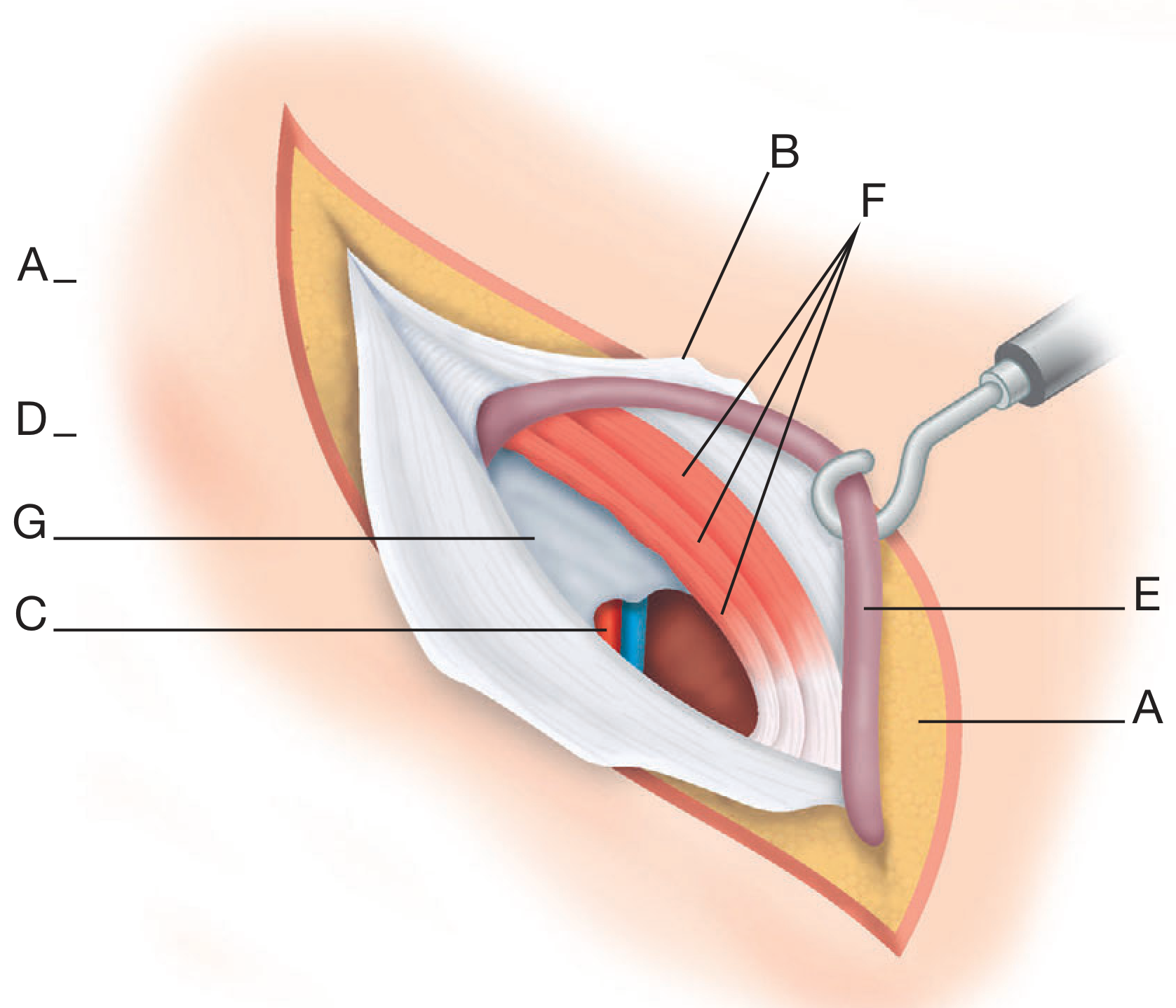
SECTION 2: SURGICAL ANATOMY OF THE INGUINAL CANAL
2.1 Boundaries of the Inguinal Canal
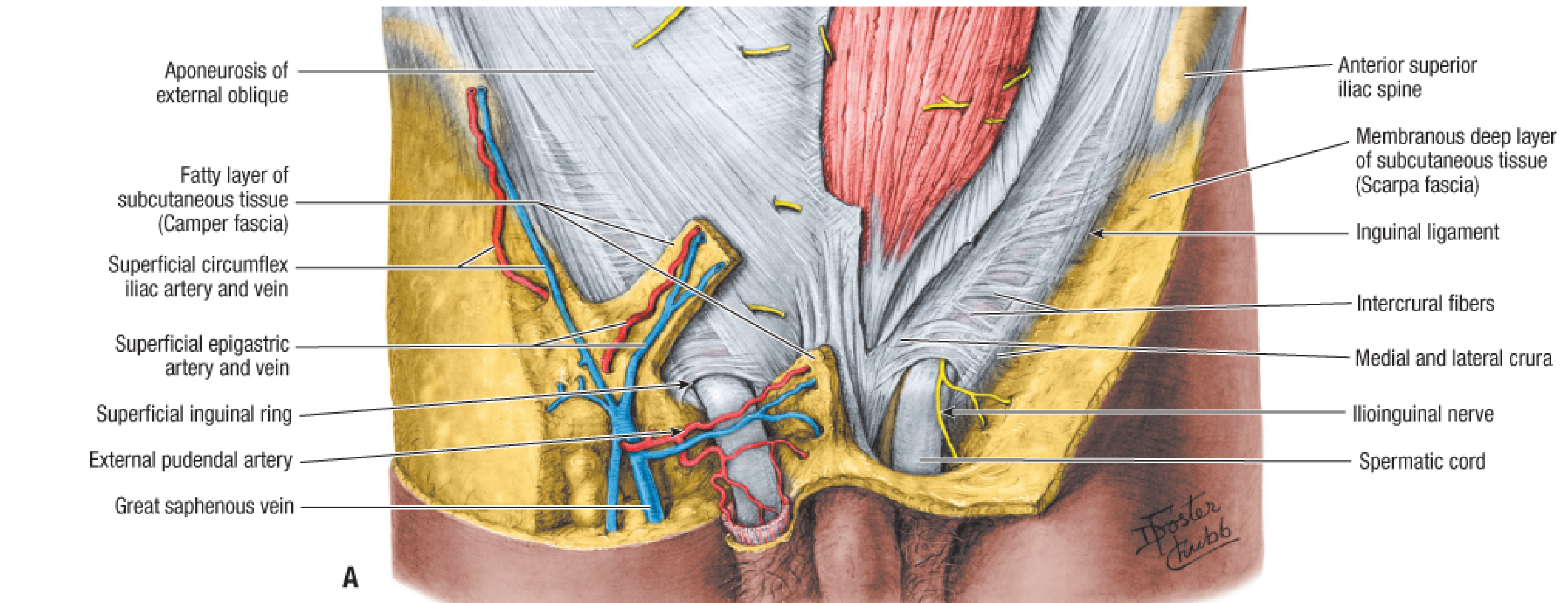
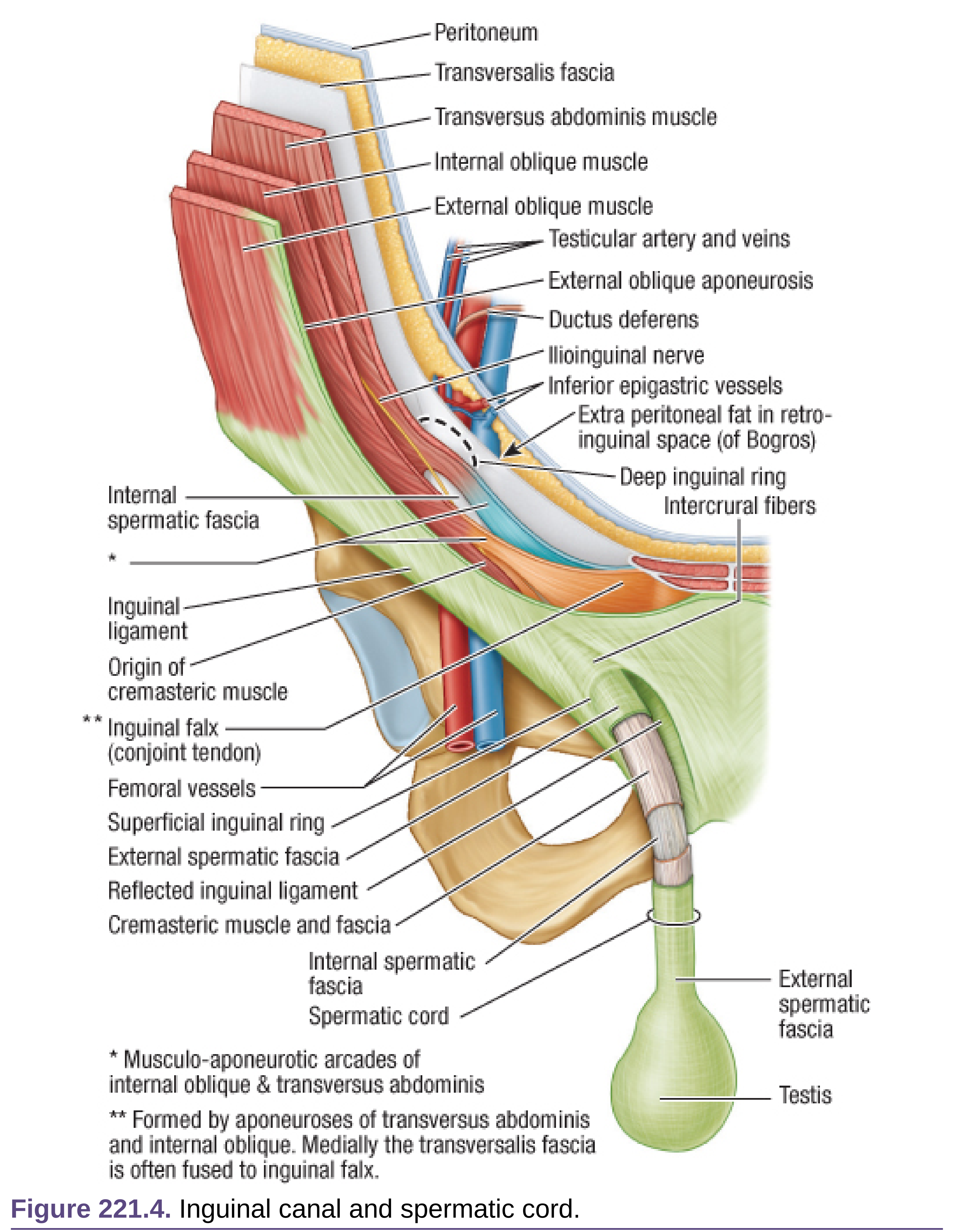
The inguinal canal is an oblique passage, approximately 4 cm long, running downward and medially from the deep inguinal ring to the superficial inguinal ring.
| Wall | Structure |
|---|
| Anterior | External oblique aponeurosis (entire length); reinforced laterally by the internal oblique muscle |
| Posterior | Transversalis fascia (entire length); reinforced medially by the conjoint tendon (falx inguinalis) |
| Roof | Arching fibers of internal oblique and transversus abdominis muscles |
| Floor | Inguinal (Poupart's) ligament, medially strengthened by the lacunar (Gimbernat's) ligament |
(Bailey & Love 28th Ed, p. 1087; Fischer's Mastery 8th Ed)
2.2 Deep Inguinal Ring
- An oval defect in the transversalis fascia
- Located 1.25 cm above the midpoint of the inguinal ligament (midpoint between ASIS and pubic symphysis)
- Lies lateral to the inferior epigastric vessels - this is the key landmark distinguishing indirect from direct hernia
- Bounded inferiorly by the iliopubic tract (thickened inferior margin of transversalis fascia)
- The transversalis fascia evaginates at this point to form the internal spermatic fascia
2.3 Superficial Inguinal Ring
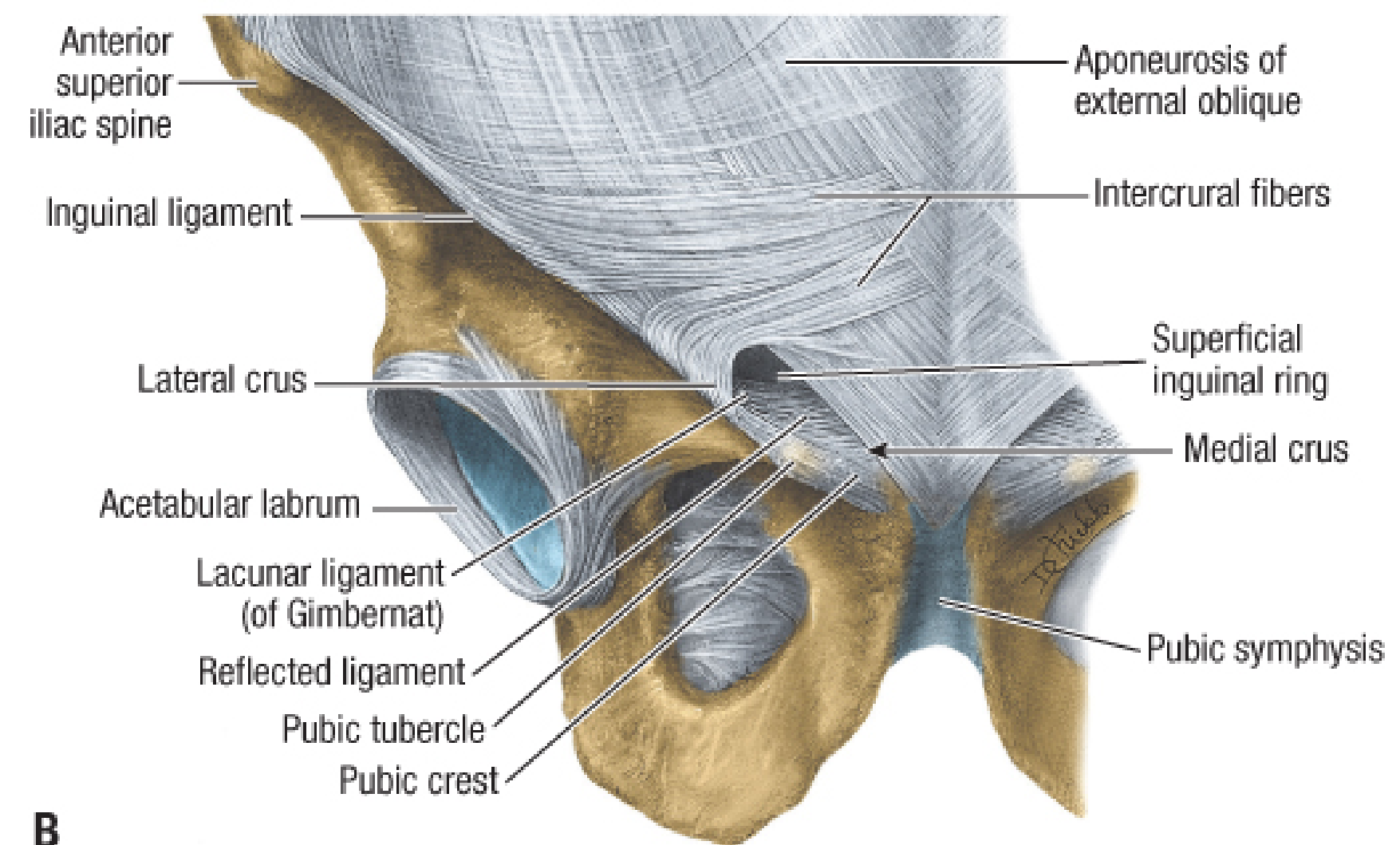
- A triangular defect in the external oblique aponeurosis
- Located just superior and lateral to the pubic tubercle
- Bounded by medial and lateral crura with intercrural fibers
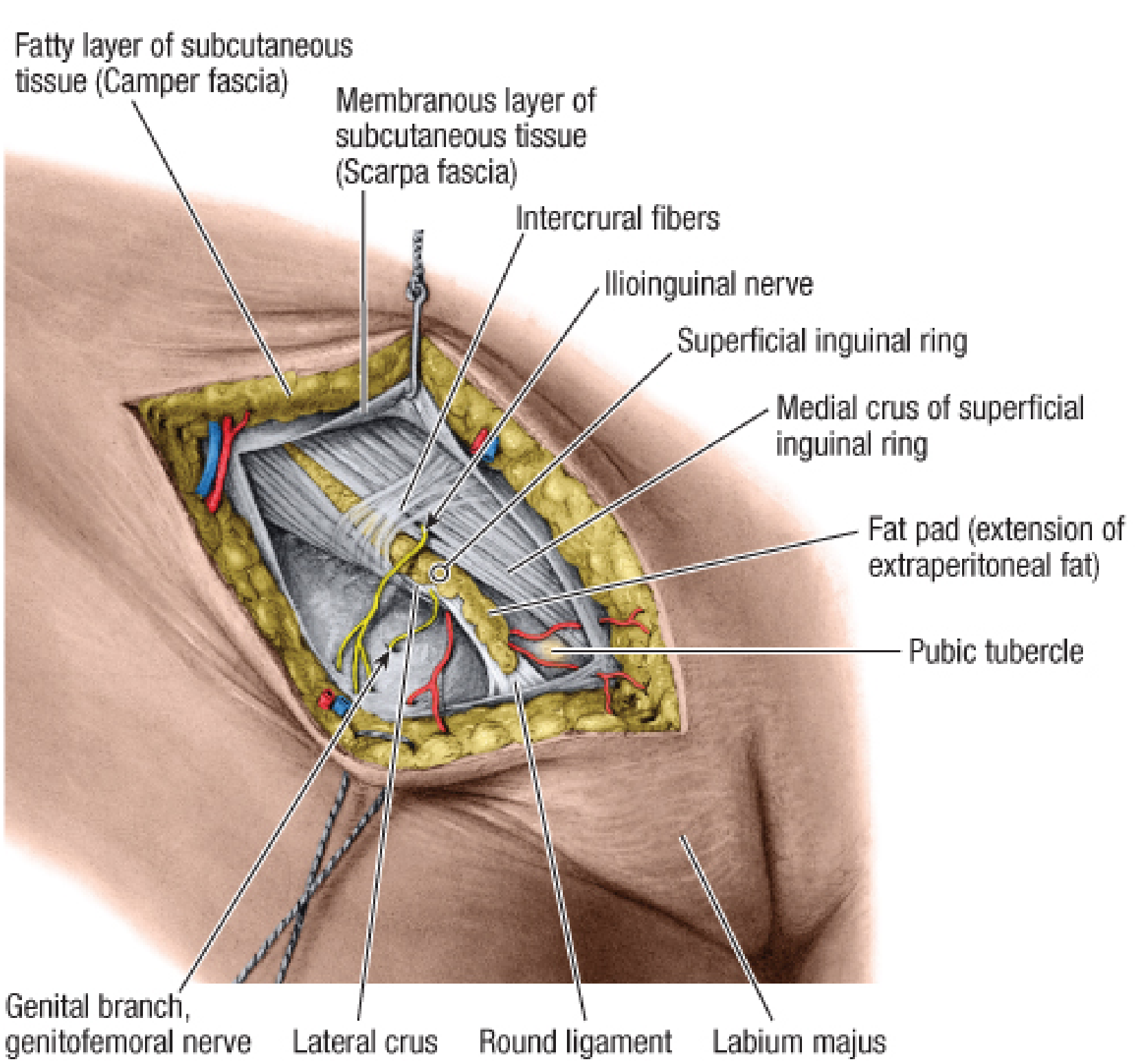
- Transmits: spermatic cord in males, round ligament in females, ilioinguinal nerve
2.4 Contents of the Inguinal Canal
Male:
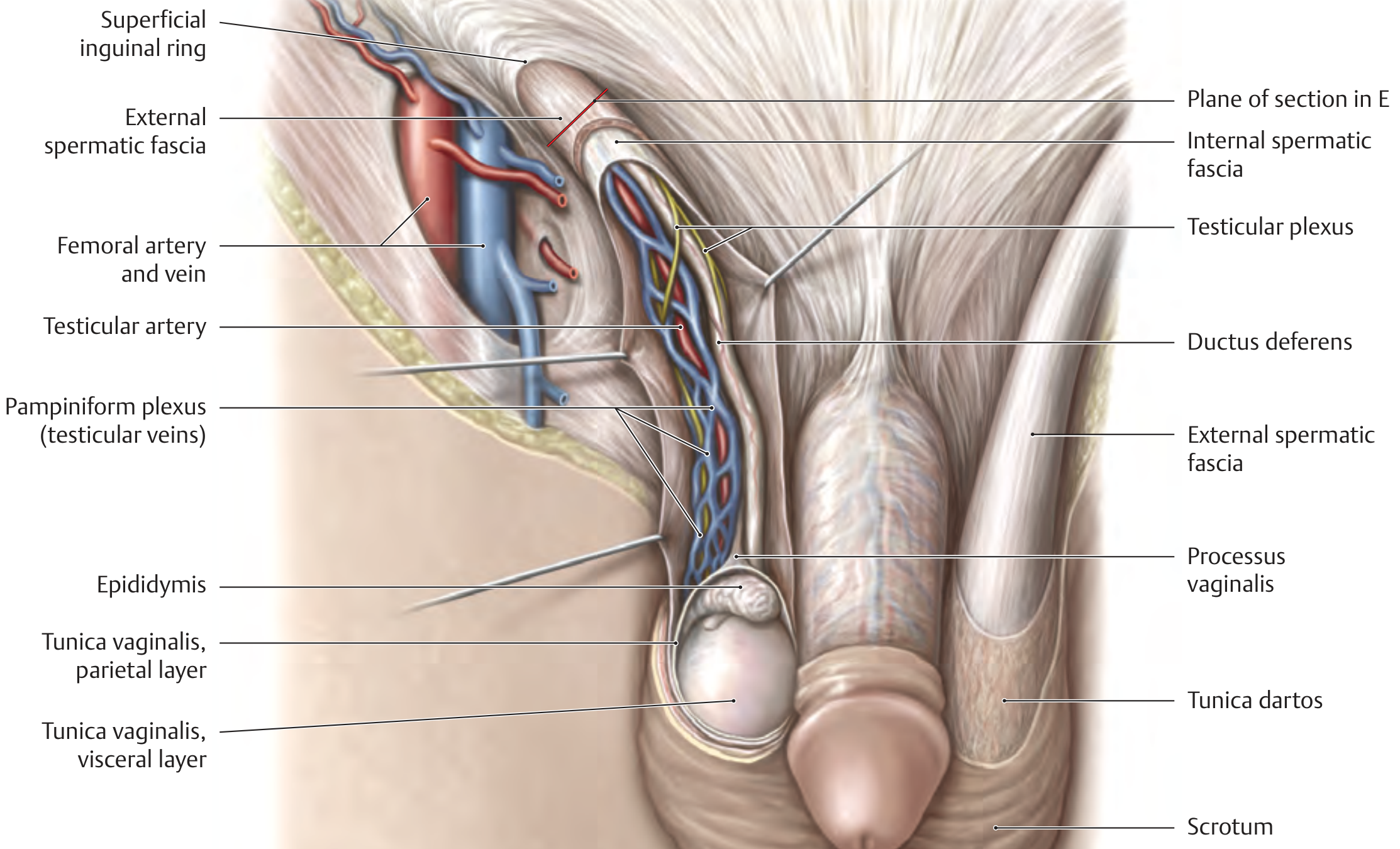
- Spermatic cord, containing:
- Vas deferens (feels like whipcord)
- Testicular artery (from aorta at L2)
- Cremasteric artery (from inferior epigastric)
- Artery to vas (from inferior vesical)
- Pampiniform plexus of veins
- Lymphatics
- Sympathetic nerve fibers
- Three nerves: ilioinguinal nerve (L1), genital branch of genitofemoral nerve (L1,2), occasionally iliohypogastric nerve
- Processus vaginalis remnant (if patent - forms hernia sac in indirect hernia)
Female:
- Round ligament of uterus
- Ilioinguinal nerve
- Genital branch of genitofemoral nerve
2.5 Hesselbach's Triangle (Inguinal Triangle)
The surgical landmark that defines the site of direct inguinal hernia:
| Border | Structure |
|---|
| Medial | Lateral border of rectus abdominis (rectus sheath) |
| Superolateral | Inferior epigastric vessels |
| Inferior | Inguinal ligament (medial half) |
| Floor | Transversalis fascia (weakest area = site of direct hernia) |
Examiner Trap: Hesselbach's original description had the pectineal ligament as the inferior border. The modern surgical description (used in examination) uses the inguinal ligament. The inferior epigastric vessels are the lateral border (not medial!).
(Fischer's Mastery 8th Ed, p. 6047)
2.6 Myopectineal Orifice of Fruchaud
A concept of great surgical importance, especially for understanding mesh placement in TEP/TAPP:
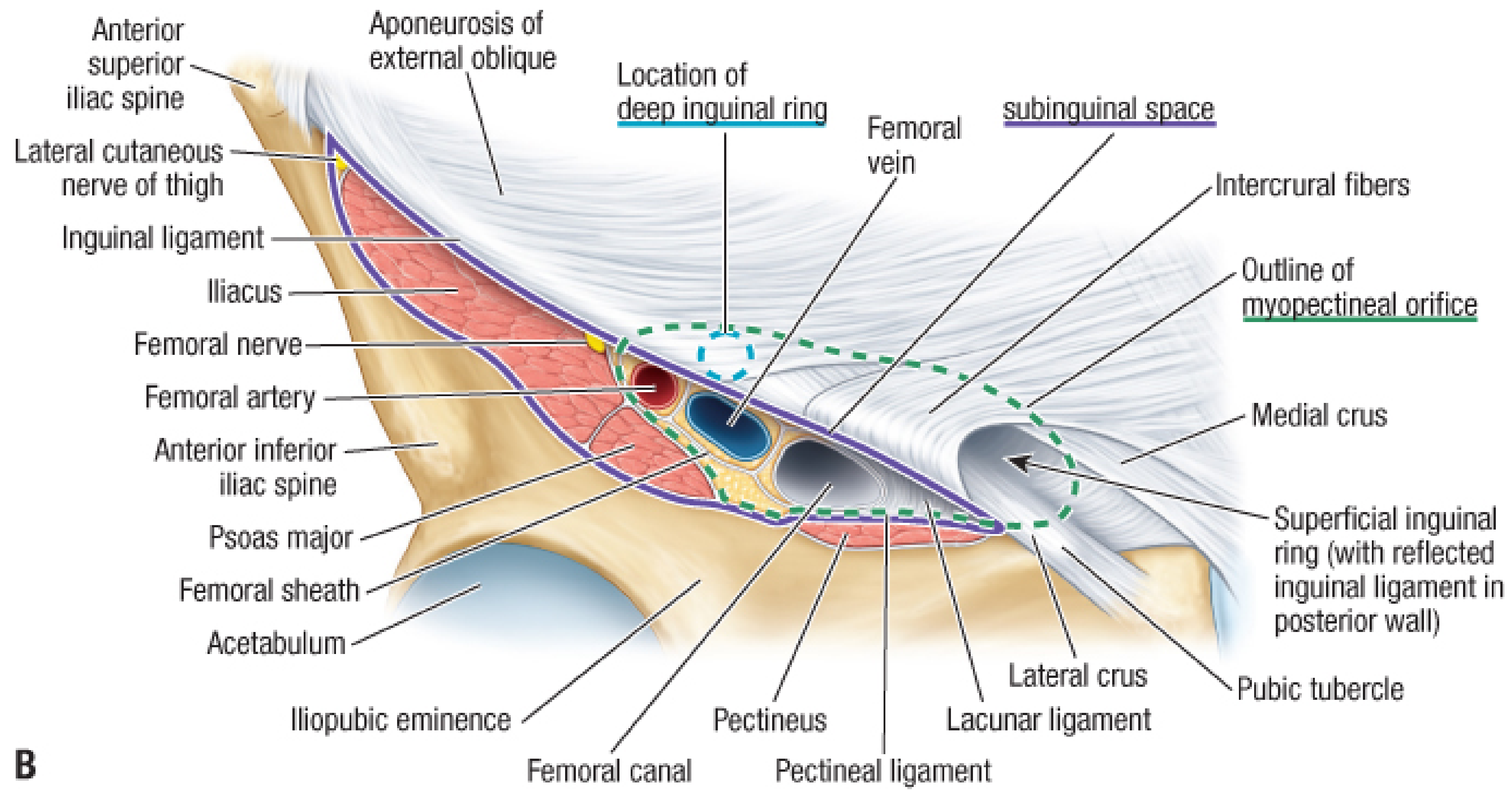
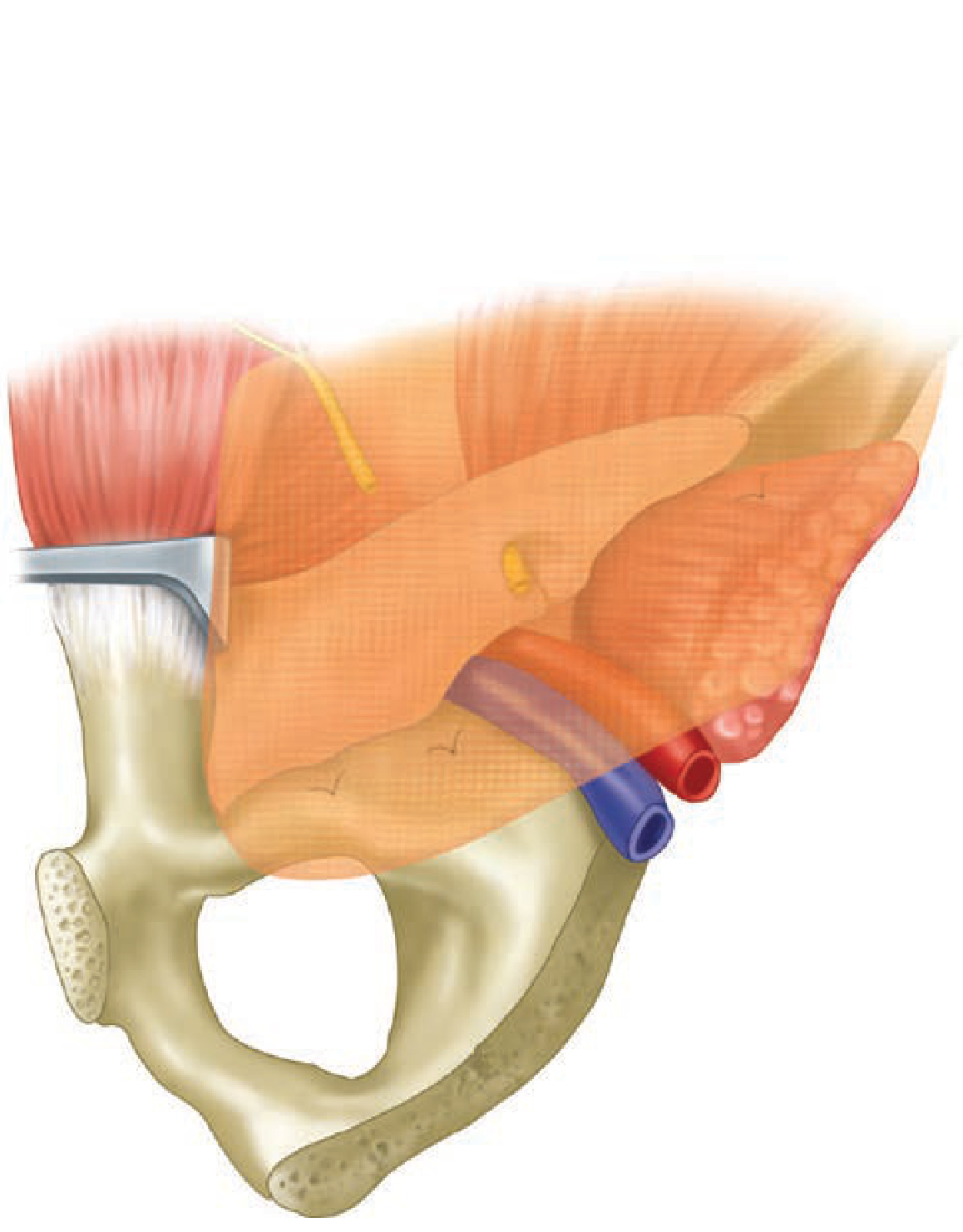
- A large oval defect in the abdominal wall through which ALL groin hernias (direct inguinal, indirect inguinal, femoral) emerge
- Bounded superiorly by the arching musculoaponeurotic fibers of the internal oblique and transversus abdominis
- Bounded inferiorly by the pectineal ligament (Cooper's ligament) and superior pubic ramus
- Bounded medially by the rectus muscle and sheath
- Bounded laterally by the iliopsoas muscle
- Divided into upper (inguinal) and lower (femoral) portions by the inguinal ligament and iliopubic tract
Pearl: The concept of Fruchaud's myopectineal orifice is why TEP/TAPP with a large mesh covering the entire orifice is the most anatomically complete repair - it covers the sites of all three types of groin hernia simultaneously.
2.7 Blood Supply
- Inferior epigastric artery (branch of external iliac) - landmark medial to deep ring
- Cremasteric artery (branch of inferior epigastric) - cremasteric muscle
- Testicular artery (direct from aorta at L2) - most important for testicular viability
2.8 Nerve Supply - Danger Zones
| Nerve | Origin | Course | Risk During Surgery |
|---|
| Ilioinguinal (L1) | Lumbar plexus | Enters canal lateral, exits at superficial ring | Damage → loss of sensation inner thigh, root of penis, upper scrotum |
| Iliohypogastric (L1) | Lumbar plexus | Runs above superficial ring | Damage → inguinal region numbness |
| Genitofemoral (L1,2) genital branch | Lumbar plexus | Posterior cord → cremasteric muscle | Damage → loss of cremasteric reflex, scrotal numbness |
| Femoral branch of genitofemoral | L1,2 | Lateral to femoral sheath | Damage → upper thigh numbness |
| Lateral femoral cutaneous (L2,3) | Lumbar plexus | Medial to ASIS | Damage (rare) → meralgia paresthetica |
2.9 Lymphatic Drainage
- Skin of groin and scrotum → superficial inguinal nodes
- Testis and epididymis → para-aortic nodes at L2 (not inguinal nodes - surgically critical!)
- Clinical implication: Testicular tumors do NOT spread to inguinal nodes unless scrotal skin is involved
ANATOMICAL DIAGRAM - INGUINAL CANAL
=====================================

             INTERNAL OBLIQUE
             + TRANSVERSUS       ← ROOF (arching fibers)
                  ↑
[DEEP RING] ----[CANAL 4cm]---- [SUPERFICIAL RING]
laterally                        medially above pubic
in transversalis                 tubercle in ext.oblique
fascia                           aponeurosis
     ↑                                  ↑
LATERAL                              MEDIAL

ANTERIOR WALL: External oblique aponeurosis
POSTERIOR WALL: Transversalis fascia + conjoint tendon (medially)
FLOOR: Inguinal ligament

Inferior epigastric artery: MEDIAL to deep ring
         ↓               ↑
   INDIRECT hernia  DIRECT hernia
  (lateral to IEA)  (medial to IEA = Hesselbach's triangle)
SECTION 3: COMPLETE HISTORY TAKING
Step-by-Step Bedside History
3.1 Presenting Complaints (in order of severity)
- Swelling in the right groin/scrotum - duration
- Pain in the groin - character, radiation, relieving factors
- Any obstructive symptoms (vomiting, absolute constipation)
3.2 Swelling Analysis (SITE SHAPE SIZE SURFACE - SOCRATES applied to swelling)
Site: Groin (inguinal), scrotum (if complete hernia)
Onset and Duration: Gradual onset, months to years
Course: Slowly progressive; increases with activities that raise intra-abdominal pressure (lifting, coughing, straining)
Characteristics:
- Does it appear on standing/straining and disappear on lying down? (reducibility)
- Does it accompany coughing? (cough impulse)
- Has it ever been stuck (irreducible)? (irreducibility - suggests omentum or adhesions in sac)
- Is it painful? (sudden pain + tenderness = obstruction/strangulation)
- Has it changed in color? (dusky/erythematous = strangulation)
Examiner Q: What do you mean by a complete hernia?
A complete or scrotal hernia reaches the bottom of the scrotum. An incomplete hernia exits the superficial inguinal ring but does not reach the scrotum. A bubonocele remains within the canal without exiting the superficial ring. (S. Das 13th Ed)
3.3 Pain Assessment (SOCRATES)
- Site: Groin, inner thigh, or scrotum
- Onset: Gradual (chronic dragging ache) vs sudden (obstruction/strangulation)
- Character: Dragging/heaviness (chronic hernia), sharp colicky (obstruction), constant severe (strangulation)
- Radiation: Down inner thigh (ilioinguinal nerve involvement)
- Alleviating: Lying down, reducing the hernia manually
- Severity: Mild discomfort vs severe pain requiring emergency attendance
Red Flag Pain Features: Sudden severe pain + non-reducibility + vomiting = obstructed hernia until proven otherwise. Add systemic toxicity, pyrexia, overlying skin changes = strangulation
3.4 Risk Factors to Elicit (Always Cover in Viva)
| Category | Questions to Ask |
|---|
| Occupation | Manual laborer? Heavy lifting? Farmer? |
| Respiratory | Chronic cough (COPD, smoking, TB)? |
| Urinary | Straining to pass urine? BPH symptoms? |
| Bowel | Constipation? Straining at stool? |
| BMI/Obesity | Raised BMI increases intra-abdominal pressure |
| Smoking | Collagen defects from aldehydes; COPD |
| Family history | First-degree relatives with hernia |
| Prior surgery | Previous hernia repair (recurrence?), previous abdominal surgery (incisional hernia differential) |
| Connective tissue | Marfan syndrome, Ehlers-Danlos |
3.5 Past Medical History
- Prior hernia surgery (most important for recurrent hernia)
- Prior abdominal surgeries
- Diabetes (wound healing, infection risk)
- Cardiac/respiratory disease (fitness for anesthesia)
- Anticoagulant therapy
3.6 Drug History
- Anticoagulants (warfarin, NOACs, aspirin)
- Steroids (impair wound healing, increase infection risk)
- Alpha-blockers for BPH (have they been tried? Improvement of urinary symptoms before hernia repair?)
Cross-questions after history:
Q: Why do inguinal hernias occur more on the right side?
A: The right testis descends later than the left (it descends last). The processus vaginalis on the right obliterates later, leaving more time for incomplete closure, hence a persistent sac is more common on the right. Also, the right common iliac artery crosses the right ureter, delaying descent.
Q: Why are indirect hernias more common than direct?
A: 60-65% indirect vs 35-40% direct. Indirect hernias have a preformed sac (processus vaginalis), a congenital component, and occur at all ages. Direct hernias are acquired, related to weakening of the posterior wall.
Q: Why is the male:female ratio 10:1?
A: Males have testicular descent creating the inguinal canal with a larger deep ring, a persistent potential sac (processus vaginalis), and greater physical activity historically. Females have a smaller, stronger inguinal canal with only the round ligament.
SECTION 4: COMPLETE CLINICAL EXAMINATION
4.1 Preparation
Patient positioning:
- Begin examination with the patient standing (hernias reduce when supine - may be missed)
- Examine in good lighting with full exposure from umbilicus to mid-thigh
- Examiner sits on a stool for standing examination
Expose: Both groins, scrotum, perineum - maintain dignity
Universal precautions: Gloves worn throughout
4.2 INSPECTION (Patient Standing, Adequate Light)
Look for:
- Swelling: Site (above or below inguinal ligament?), size, shape
- Skin: Normal vs erythematous (strangulation), trophic changes (old hernia), surgical scars (previous repair)
- Symmetry: Compare both sides
- Action: Ask patient to cough - watch for impulse
- Action: Ask patient to strain (Valsalva) - swelling may become visible
- Scrotal involvement: Does the swelling extend into the scrotum?
Inspection findings in this case:
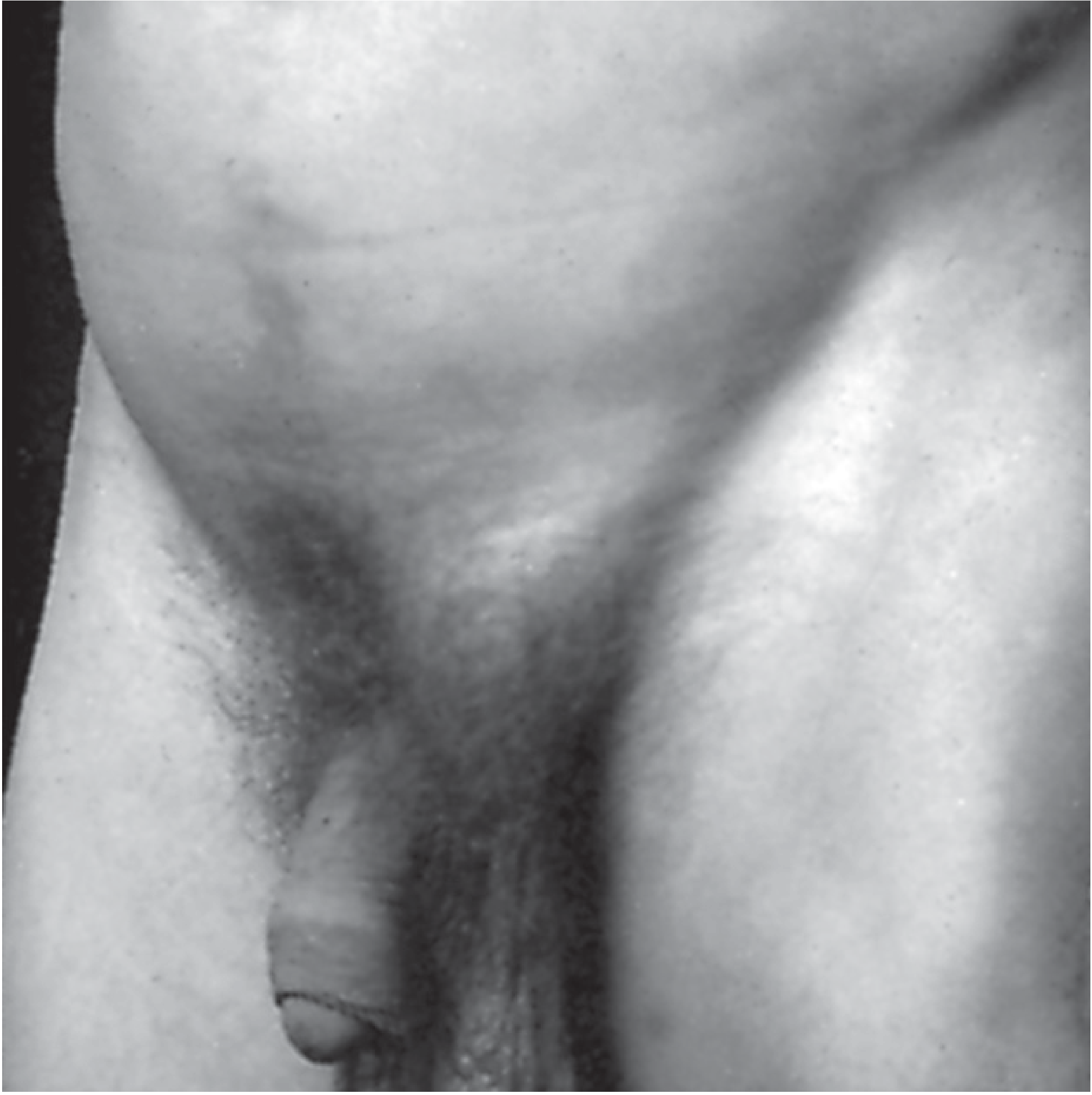
- Right inguinoscrotal swelling visible in standing position
- Skin normal, no erythema
- On coughing: swelling increases in size (expansile cough impulse visible)
- Contralateral side appears normal
4.3 PALPATION (Step-by-Step)
Step 1: Examine the swelling
Palpate gently with the flat of the hand:
- Temperature: Normal (warm = inflammation/strangulation)
- Tenderness: Absent in reducible hernia; present in obstruction/strangulation
- Consistency: Soft (omentum = doughy; bowel = resonant)
- Edge: Well-defined lateral edge if indirect; poorly defined if direct
- Surface: Smooth
Step 2: Get-above-the-swelling test
Place two fingers just above the swelling's superior margin. In hernia, you cannot get above it because it extends into the abdomen. In a hydrocele/testicular swelling, you can get above it (testis is confined to scrotum). This is the most important test to differentiate scrotal hernia from hydrocele.
Step 3: Determine reducibility
Ask patient to lie down. With one hand at the neck of the swelling and the other supporting the fundus, apply gentle pressure:
- Reducible: Contents return to peritoneal cavity - bowel may make gurgling sound; omentum is silent
- Irreducible: Cannot be reduced (omentum stuck = chronic, painless; bowel trapped = acute, painful)
After reduction: Confirm the site of the deep ring (midinguinal point) and superficial ring (above and medial to pubic tubercle)
Step 4: Cough Impulse
Place the flat of the hand over the swelling (reduced):
- Expansile cough impulse: Hernia bulges with each cough - confirms hernia
- Method: Ask patient to cough. Feel a definite expansile impulse.
- A transmitted (non-expansile) impulse may be felt over lymph nodes or other masses - NOT a true cough impulse
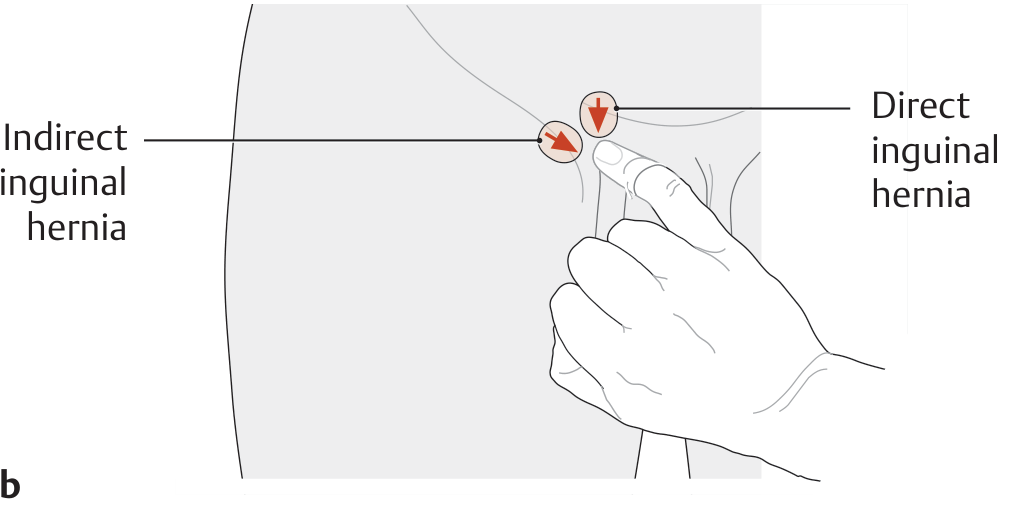
Step 5: Deep Ring Occlusion Test (Key test to differentiate Indirect from Direct)
After reducing the hernia, place two fingers firmly over the deep inguinal ring (1.25 cm above midinguinal point, just lateral to the inferior epigastric artery):
- Ask patient to cough or strain
- Indirect hernia: Deep ring is the neck - occluding it PREVENTS re-emergence of the hernia
- Direct hernia: Protrudes directly through Hesselbach's triangle, medial to the fingers - hernia STILL COMES OUT with coughing
(S. Das 13th Ed, p. 566)
Step 6: Examine the Pubic Tubercle
The pubic tubercle is a palpable bony landmark at the medial end of the inguinal ligament:
- Inguinal hernia: Neck/sac emerges medial to and above the pubic tubercle
- Femoral hernia: Emerges lateral to and below the pubic tubercle
Examiner Trap: The pubic tubercle is identified by following the inguinal ligament medially, or by following the adductor longus tendon (from its pubic origin) superiorly. It is NOT the pubic symphysis.
Step 7: Invagination Test (Ring Invagination Test)
With the hernia reduced, invaginate scrotal skin along the spermatic cord toward the superficial ring using the right little finger (or index finger in infants):
- Advance the finger through the superficial ring into the inguinal canal
- Ask patient to cough:
- Indirect hernia: You feel the hernia sac bumping the tip of the finger (hernia comes along the canal)
- Direct hernia: The sac bulges against the side (pulp) of the finger (hernia comes from behind/posterior)
- Normal canal/Femoral hernia: No impulse at finger tip
(S. Das 13th Ed)
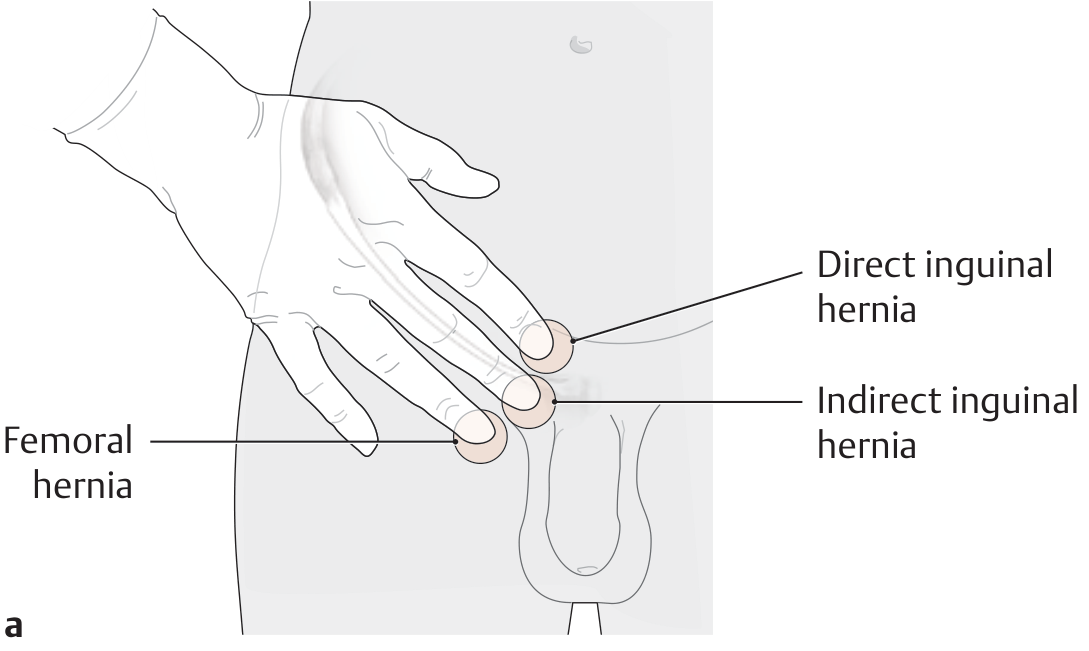
Step 8: Zieman's Three-Finger Test
Stand on the same side as the hernia. Place three fingers over the three potential sites of groin hernia:
- Index finger on deep inguinal ring (midinguinal point above) - if impulse here = indirect inguinal hernia
- Middle finger on Hesselbach's triangle (midway between pubic tubercle and midinguinal point) - if impulse here = direct inguinal hernia
- Ring finger on femoral ring/fossa ovalis (3 cm below inguinal ligament, medial to femoral artery) - if impulse here = femoral hernia
Ask patient to cough and note which finger receives the impulse.
4.4 PERCUSSION
- Tympanic (resonant): Bowel in sac
- Dull: Omentum or fluid in sac
- Difficult to elicit meaningfully in most cases
4.5 AUSCULTATION
- Bowel sounds audible over swelling: Confirms bowel within the sac
- Absence of bowel sounds over tense irreducible hernia: May suggest ischemia/strangulation
- Rarely performed in routine examination but important in emergency setting
4.6 EXAMINATION OF SCROTAL CONTENTS
With patient lying down after hernia is reduced:
- Both testes: Both present? (Exclude undescended testis in the hernia sac)
- Testis palpable separately at the bottom of the scrotum - confirms hernia (in hydrocele, testis cannot be felt separately in front of fluid)
- Epididymis: Any tenderness or nodularity
- Varicocele: Bag-of-worms feel, present on left > right
- Transillumination test: Negative in hernia (bowel/omentum do not transilluminate), positive in hydrocele
4.7 CONTRALATERAL SIDE EXAMINATION
Always examine the opposite groin:
- 50% lifetime risk of contralateral hernia in unilateral cases
- Bilateral hernias common in males
- Note any swelling, cough impulse, or abnormality
4.8 FEMORAL HERNIA EXAMINATION
- Look/feel below and lateral to the pubic tubercle
- Saphena varix: groin swelling, empties on lying down, has a fluid thrill on coughing, Schwartz test positive, has a blue tinge on standing
- Compare carefully
4.9 ABDOMINAL EXAMINATION
Always examine the abdomen to:
- Detect ascites (raises intra-abdominal pressure, affects surgical planning)
- Distension, visible peristalsis (obstruction)
- Intestinal obstruction features in emergency cases
- Underlying cause: prostate enlargement (DRE if indicated), abdominal masses
SECTION 5: SPECIAL CLINICAL TESTS
5.1 Expansile Cough Impulse
| Feature | Detail |
|---|
| Indication | Confirm hernia; distinguish from lipoma, lymph node (no impulse) |
| Method | Place flat of hand over swelling; ask patient to cough |
| Positive finding | Swelling increases in size with each cough - expansile |
| Transmitted impulse | A non-expansile transmitted thrill felt over lymph node or vascular lesion |
| Interpretation | Expansile impulse = hernia; transmitted = non-hernia mass |
| Limitation | May be absent if hernia is tense/irreducible (no space for expansion) |
| Viva Q | "When would the cough impulse be absent in a hernia?" - In strangulation, irreducible tense hernia, Richter's hernia |
5.2 Reducibility Test
| Feature | Detail |
|---|
| Method | Lay patient flat. Gentle bimanual pressure from fundus toward neck. Bowel: gurgle. Omentum: silent. |
| Direct hernia: Reduces straight back. Indirect hernia: Reduces obliquely upward and laterally (opposite direction of descent) | |
| Irreducible | Cannot reduce - omentum stuck (chronic, painless), bowel stuck (may be obstructed) |
Viva Q: What is the difference between "irreducible" and "incarcerated"?
Irreducible = cannot be returned to abdominal cavity by external manipulation. Incarcerated = irreducible AND associated with intestinal obstruction or vascular compromise. All incarcerated hernias are irreducible, but not all irreducible hernias are incarcerated.
5.3 Deep Ring Occlusion Test
| Feature | Detail |
|---|
| Indication | Differentiate indirect from direct inguinal hernia |
| Method | Reduce hernia. Occlude deep ring firmly with two fingers at the midinguinal point (lateral to inferior epigastric artery). Ask patient to cough. |
| Indirect hernia: Hernia does NOT re-emerge (deep ring is the neck, occluded by fingers) | |
| Direct hernia: Hernia re-emerges medial to fingers (exits Hesselbach's triangle, unaffected by occlusion of deep ring) | |
| Limitation | Requires prior complete reduction; difficult in obese patients |
5.4 Invagination Test (Ring Finger Test / Silk Glove Sign equivalent in adults)
| Feature | Detail |
|---|
| Method | Right little finger invaginates scrotal skin up to and through the superficial ring into the inguinal canal (with hernia reduced) |
| Indirect: Impulse at tip of finger | Direct: Impulse at pulp of finger |
| Limitation | Painful; requires reduction first; difficult in large hernia/obese patients; NOT recommended routinely in modern practice |
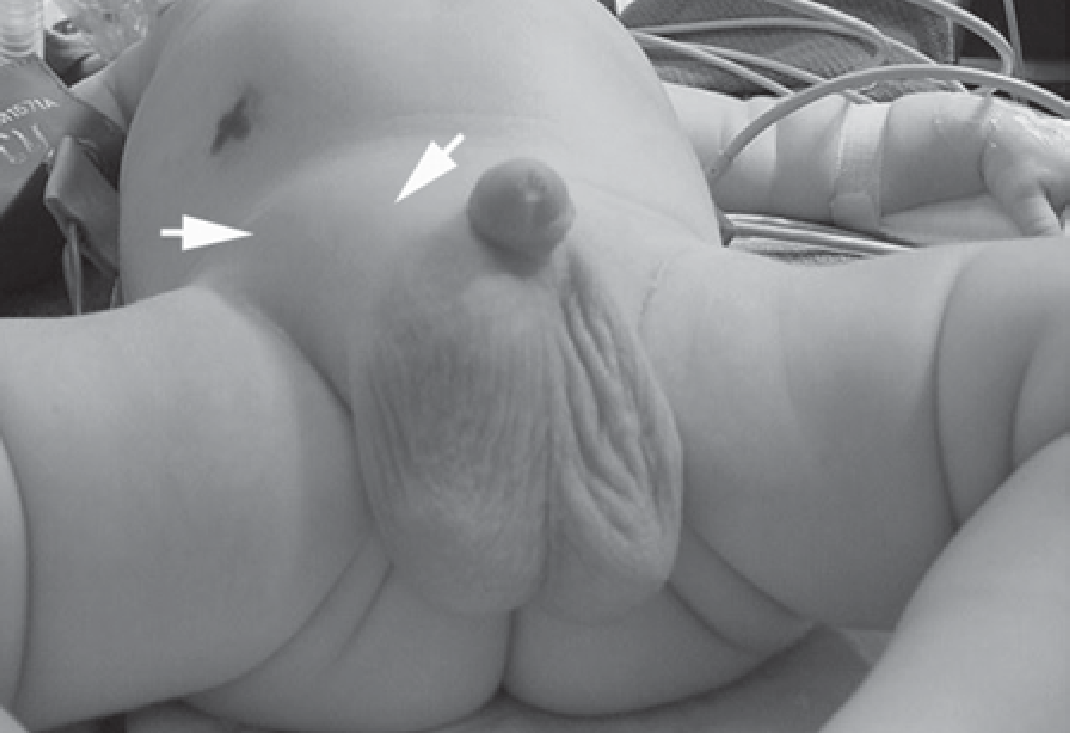
5.5 Silk Glove Sign (Children/Infants)
- Relevant for pediatric indirect hernia
- Palpate the spermatic cord at the pubic tubercle between thumb and index finger
- Positive: The peritoneum (sac) imparts a silky, slippery feel - "layers slipping over each other" = patent processus vaginalis
- Indicates hernia even when hernia is not visible
- High sensitivity and specificity in experienced hands
(Bailey & Love 28th Ed)
5.6 Differentiation Table: Inguinal Hernia vs Differential Diagnoses
| Feature | Indirect Inguinal Hernia | Direct Inguinal Hernia | Femoral Hernia | Hydrocele | Undescended Testis | Lipoma of cord | Lymph Node |
|---|
| Sex | M >> F | Male only (almost) | F > M (but inguinal still commonest in females) | Male | Male | Male | Both |
| Age | Any | Middle-aged/elderly | Middle-aged/elderly | Any | Child/young | Middle-aged | Any |
| Site | Above & medial to pubic tubercle | Above & medial to pubic tubercle | Below & lateral to pubic tubercle | Scrotum | Groin/scrotum | Groin/scrotum | Groin |
| Get above swelling | Cannot | Cannot | Cannot (late stage) | Can | Cannot | Can | Can |
| Cough impulse | Expansile, positive | Expansile, positive | Positive (small) | Absent | Absent | Absent | Absent (transmitted only) |
| Reducibility | Reducible | Reducible (easily) | Difficult to reduce | Reducible (communicating) | Irreducible | Irreducible | Irreducible |
| Transillumination | Negative | Negative | Negative | Positive | Negative | Negative | Negative |
| Testis separately felt | Yes | Yes | Yes | No (surrounds testis) | No (IS the testis) | Yes | Yes |
| Percussion | Resonant (bowel) / Dull (omentum) | Same | Dull | Dull | Dull | Dull | Dull |
| Deep ring test | Positive (stops hernia) | Negative (does not stop) | Negative | N/A | N/A | N/A | N/A |
SECTION 6: UNIVERSITY CASE PRESENTATION (3-5 minutes)
"Sir, I am presenting the case of Ramesh Kumar, a 48-year-old male farmer, who was admitted to this ward with complaints of a swelling in the right groin for the past 3 years, dragging ache in the right groin for 1 year, and the swelling descending into the right scrotum for the past 6 months. He also gives a history of incomplete spontaneous reduction for the past 2 weeks.
On taking history, I found that the swelling first appeared gradually as a small lump in the right groin, increasing on straining and coughing and disappearing on lying down. Over time it enlarged and started descending into the scrotum. For the last 2 weeks it does not reduce on its own. He denies any vomiting, absolute constipation, or change in color of the overlying skin.
He is a heavy smoker - 10 beedis per day for 20 years - with a chronic cough. He does heavy manual labor on his farm. He suffers from constipation and strains at stool. There is a family history of hernia in his father.
On general examination, he is a middle-aged male, adequately built and nourished, conscious and oriented. His pulse is 80 per minute, blood pressure 124/80 mmHg, respiratory rate 16 per minute, temperature afebrile, and SpO2 97% on room air. There is no pallor, icterus, cyanosis, clubbing, lymphadenopathy, or edema.
On local examination, the patient was examined both in the standing and supine positions. In the standing position, there is a right inguinoscrotal swelling of approximately 12 × 8 cm. The skin over the swelling appears normal with no erythema or edema. On asking the patient to cough, there is a definite expansile cough impulse. On lying down, the hernia requires bimanual pressure for reduction, which is achieved with a gurgling sound, confirming bowel as contents.
On palpation, the swelling is soft, non-tender, with ill-defined margins above. I can confirm that I cannot get above the swelling - confirming it arises from the abdominal cavity. After reduction, the deep ring occlusion test was positive - occluding the deep inguinal ring prevented re-emergence of the hernia on coughing - confirming this to be an indirect inguinal hernia. The testis is palpable separately at the bottom of the swelling. On scrotal examination, both testes are present and normal. The contralateral groin is clinically normal.
Based on history and clinical examination, my diagnosis is a RIGHT INDIRECT COMPLETE INGUINOSCROTAL HERNIA, reducible with bowel as contents, in a 48-year-old male farmer with multiple risk factors including smoking, chronic cough, heavy manual labor, and constipation."
SECTION 7: DIFFERENTIAL DIAGNOSIS
7.1 Primary Differentials in Groin Swelling
Flowchart: Approach to Groin Swelling
GROIN SWELLING
      |
      ├── Above inguinal ligament?
      │         |
      │         YES → Inguinal hernia (indirect or direct)
      │         NO  → Below inguinal ligament
      │                    |
      │                    ├── Medial to femoral artery? → FEMORAL HERNIA
      │                    ├── At saphena varix? → SAPHENA VARIX (no transillumination, fluid thrill)
      │                    └── Inguinal lymph node, psoas abscess
      |
      ├── Cough impulse present?
      │         YES → Hernia confirmed (or saphena varix)
      │         NO  → Lymph node, lipoma, undescended testis
      |
      ├── Can you get above the swelling?
      │         NO  → Hernia (extends into abdomen)
      │         YES → Scrotal/testicular swelling
      |
      └── Transillumination positive?
                YES → Hydrocele
                NO  → Hernia / solid swelling
7.2 Key Differentials Compared
Inguinal Hernia vs Femoral Hernia
| Feature | Inguinal Hernia | Femoral Hernia |
|---|
| Age | Any | Middle-aged/elderly |
| Sex | M:F = 10:1 | F:M = 2:1 (but inguinal still commonest in females) |
| Site | Above and medial to pubic tubercle | Below and lateral to pubic tubercle |
| Shape | Pear-shaped, follows inguinal canal | Retort-shaped (narrow neck, wide fundus = globular) |
| Reducibility | Easily reducible | Difficult (narrow, rigid neck) |
| Strangulation | Less common | Very common (10% at presentation) |
| Deep ring test | Positive (indirect) | Negative |
| Pubic tubercle | Medial to it | Lateral to it |
| Impulse | Clearly expansile | Small, may be difficult |
| Invagination | Impulse at finger tip/pulp | Canal empty |
Classic Examiner Statement: "Even in females, the commonest groin hernia is inguinal (indirect), not femoral. Femoral hernia is merely proportionally more common in females compared to males." (S. Das 13th Ed)
Inguinal Hernia vs Hydrocele
| Feature | Hernia | Hydrocele |
|---|
| Get above swelling | Cannot | Can |
| Cough impulse | Present | Absent |
| Testis | Felt separately | Cannot be felt (testis within fluid) |
| Transillumination | Negative | Brightly positive |
| Reducibility | Reducible (usually) | Irreducible (except communicating hydrocele) |
| Auscultation | Bowel sounds may be heard | Silent |
SECTION 8: CLASSIFICATION
8.1 Anatomical Classification (Direct vs Indirect)
| Feature | INDIRECT (Oblique/Lateral) | DIRECT (Medial) |
|---|
| Frequency | 60-65% | 35-40% |
| Exit point | Through deep inguinal ring (lateral to IEA) | Through Hesselbach's triangle (medial to IEA) |
| Sac | Has a sac (peritoneal); travels within cord | No true sac; covers itself with stretched peritoneum and transversalis fascia |
| Neck | Narrow (at deep ring) | Wide (broad-based) |
| Strangulation | More common (narrow neck) | Less common (wide neck) |
| Age | Any (congenital + acquired) | Middle-age / elderly (acquired) |
| Descent | Oblique (downward and medial) → scrotum | Directly forward through Hesselbach's triangle |
| Deep ring test | Positive (stops hernia) | Negative (doesn't stop) |
| Invagination test | Tip of finger | Pulp of finger |
| Bilateral | Less common | More common |
| Recurrence | Less common after repair | More common (poor tissue quality) |
| Predisposition | Patent processus vaginalis | Weakness of posterior wall (aging, collagen) |
8.2 S. Das Classification - Extent of Hernia
| Type | Description |
|---|
| Bubonocele | Hernia remains within the inguinal canal (does not exit superficial ring) |
| Incomplete (Funicular) | Exits superficial ring but does not reach scrotum |
| Complete (Scrotal) | Reaches bottom of scrotum |
8.3 State of Hernia - Clinical Classification
INGUINAL HERNIA
      |
   REDUCIBLE
      |
   IRREDUCIBLE (Incarcerated)
      |
   OBSTRUCTED (Irreducible + intestinal obstruction)
      |
   STRANGULATED (Obstructed + vascular compromise)
| State | Definition | Clinical Features | Emergency? |
|---|
| Reducible | Returns to abdomen spontaneously or with manipulation | Soft, non-tender, cough impulse present, reducible | No |
| Irreducible | Cannot return; no obstruction | Firm, non-tender or mildly tender, cough impulse present or absent | No (usually elective) |
| Obstructed | Irreducible + intestinal obstruction | Tense, tender, cough impulse absent, vomiting, constipation, distension | YES |
| Strangulated | Obstructed + vascular compromise + gangrene | All above + systemic toxicity, fever, overlying skin erythema/blistering, tachycardia | EMERGENCY |
8.4 Nyhus Classification (Most Widely Used in Examinations)
| Type | Description |
|---|
| I | Indirect hernia; deep inguinal ring normal; complete in infants/children |
| IIa | Indirect hernia; deep ring dilated but posterior wall intact |
| IIb | Indirect hernia; deep ring dilated; encroaches on posterior wall |
| IIIa | Direct inguinal hernia |
| IIIb | Indirect hernia with dilated ring and posterior wall defect; includes sliding hernia and pantaloon hernia |
| IIIc | Femoral hernia |
| IV | Recurrent hernia (IVa = direct, IVb = indirect, IVc = femoral, IVd = combination) |
Surgical implication: Nyhus Type I-II → herniotomy/herniorrhaphy adequate. Type III-IV → mesh repair (open or laparoscopic) strongly recommended.
8.5 Gilbert Classification
| Grade | Type | Description |
|---|
| 1 | Indirect | Tight internal ring; sac easily reduced |
| 2 | Indirect | Moderate ring; sac reducible |
| 3 | Indirect | Large ring (≥4 cm); sliding hernia; poor control |
| 4 | Direct | Entire floor defect; no bulge at deep ring |
| 5 | Direct | Diverticular defect of floor; small (<1/3 floor) |
| 6 | Pantaloon | Combination direct + indirect |
| 7 | Femoral | Femoral hernia |
8.6 EHS Classification (European Hernia Society - Current Standard)
Used to standardize reporting in clinical trials and audits:
| Dimension | Options |
|---|
| Type | L (lateral/indirect), M (medial/direct), F (femoral) |
| Size | 1 (<1.5 cm), 2 (1.5-3 cm), 3 (>3 cm) |
| Primary vs Recurrent | P or R |
Example: A patient with primary indirect hernia with ring 2 cm = L2P. The case scenario above = L2P (laterall, medium, primary).
8.7 Special Types of Hernia
Sliding Hernia (Hernia en Glissade)
- Part of the wall of the hernia sac is formed by a retroperitoneal viscus (colon, bladder, ovary)
- Right side: Cecum and ascending colon are retroperitoneal and slide
- Left side: Sigmoid colon slides
- Bladder may form part of direct hernia sac
- Danger: Opening the sac anteriorly may inadvertently open the viscus
- Diagnosis: Suspected when hernia is large, difficult to reduce, and contains soft reducible mass
- Pearl: If the peritoneum cannot be separated easily from the hernia contents = sliding hernia; do NOT open the sac blindly
Pantaloon Hernia
- Combined direct AND indirect hernia on the same side
- The inferior epigastric vessels form the "waist" between the two components (like trouser legs straddling the vessels)
- Both components are present simultaneously
- Nyhus IIIb / Gilbert Grade 6
- Important for surgeon to recognize: incomplete repair of one component leads to recurrence
Richter's Hernia
- Only one wall (anti-mesenteric wall) of the bowel is trapped in the hernia sac
- The bowel lumen remains patent → NO intestinal obstruction occurs
- But the trapped bowel wall becomes ischemic → strangulation without obstruction
- Clinical trap: No vomiting, no absolute constipation, but patient has toxic signs and tender irreducible hernia
- Most common in: femoral hernia; also occurs in inguinal, obturator hernias
- Commonly occurs at narrow femoral ring
Littre's Hernia
- The hernia sac contains a Meckel's diverticulum
- May strangulate without typical features of intestinal obstruction
- Named after Alexis Littre (1700)
- Rare; reported most commonly in groin hernias
Maydl's Hernia (Hernia-in-W or Retrograde Incarceration)
- Two loops of intestine are within the hernia sac, forming a "W" shape
- The intermediate loop (connecting the two) lies inside the abdomen and is actually most vulnerable to strangulation
- The bowel within the sac may appear viable, but the intra-abdominal "neck" loop is gangrenous
- Danger: Surgeon reduces the sac without inspecting the intra-abdominal loop → missed bowel gangrene
- Management: Always pull out sufficient bowel to inspect the intermediate loop (inspect 30 cm of bowel on each side)
SECTION 9: INVESTIGATIONS
9.1 Algorithm
CLINICAL DIAGNOSIS CLEAR?
        |
        YES → No investigation needed for fit patient
        (Inguinal hernia is a CLINICAL diagnosis)
        |
        NO / Atypical / Occult hernia
        |
        └─→ ULTRASOUND (first-line investigation)
                    |
                    Unclear or negative
                    |
                    └─→ DYNAMIC ULTRASOUND (Valsalva/standing)
                                |
                                Still unclear
                                |
                                └─→ CT SCAN (complex/recurrent)
                                        |
                                        Special cases
                                        └─→ MRI (athletic pubalgia, pelvic floor)
9.2 Preoperative Investigations
Routine (all patients):
| Test | Indication |
|---|
| Complete blood count | Baseline; detect anemia |
| Blood group and type | All surgical patients |
| RBS/FBS | Diabetes screening |
| Serum creatinine, urea, electrolytes | Renal function (general anesthesia) |
| ECG | All patients >40 years |
| Chest X-ray | Smokers, COPD, cardiac disease; detects mediastinal masses |
| PFT (spirometry) | COPD assessment before general anesthesia |
| Urine analysis | Baseline |
| Prothrombin time/INR | Anticoagulant use, liver disease |
9.3 Ultrasonography
- Modality of choice for diagnosis of occult inguinal hernia
- Shows: bowel loops or omentum in the inguinal canal, patent processus vaginalis
- Dynamic ultrasound (with Valsalva or standing) increases sensitivity dramatically
- Reported sensitivity ~97%, specificity ~96% for inguinal hernia
- Differentiates: hernia from lymph node, lipoma, varicocele, femoral hernia
- Assesses testicular viability in suspected strangulation
9.4 CT Scan
Indications:
- Suspected occult hernia not seen on ultrasound
- Complex/recurrent hernia - planning mesh placement
- Suspected strangulation with diagnostic uncertainty
- Exclude hernia secondary to intra-abdominal pathology (tumor, ascites)
- Sliding hernia (identify sliding viscus)
Findings:
- Bowel loops or fat density tissue in the inguinal canal
- Thickening of hernia sac
- Free air (perforation in strangulation)
- Whirlpool sign (mesenteric twisting)
9.5 MRI
- Preferred in young athletes with groin pain (athletic pubalgia/sports hernia)
- Identifies: posterior wall defects, conjoint tendon tears, pubic bone stress
- Used when clinical diagnosis uncertain and ultrasound negative
- More expensive, limited availability in India
9.6 Herniography (Historical)
- Intraperitoneal injection of contrast followed by X-ray
- Almost completely replaced by CT and ultrasound
- May detect occult contralateral hernia
SECTION 10: MANAGEMENT
10.1 Management Algorithm
INGUINAL HERNIA DIAGNOSED
            |
   ┌─────────────────────────┐
   │                         │
ELECTIVE                  EMERGENCY
   │                         │
   ├── Asymptomatic          ├── Obstructed
   │   direct hernia         ├── Strangulated
   │   (elderly, unfit)      └── Richter's
   │   → Watchful waiting
   │
   └── Symptomatic / All other cases
            → SURGERY recommended
10.2 Watchful Waiting (Conservative Management)
Indications (EHS Guidelines):
- Asymptomatic or minimally symptomatic direct inguinal hernia
- Elderly patient with significant operative risk
- Patient refuses surgery
- Severe co-morbidities making surgery high risk
Evidence:
- O'Dwyer et al. (2006): Watchful waiting vs repair for asymptomatic/minimally symptomatic hernias - 25% crossed over to surgery within 2 years due to increasing symptoms; no safety difference
- EHS 2018 Guidelines: Watchful waiting is acceptable for asymptomatic male inguinal hernia (Grade B evidence)
Truss (support bandage):
- NOT recommended by EHS or any modern guideline
- Provides incomplete relief, may cause pressure necrosis of cord structures
- Should be discouraged in patients who are fit for surgery
10.3 Pre-operative Optimization
Before elective surgery:
- COPD/chronic cough: optimize with bronchodilators, physiotherapy, cease smoking (minimum 4-6 weeks pre-op)
- Constipation: dietary advice, laxatives, treat underlying cause (BPH, colorectal pathology)
- BPH: start alpha-blockers if symptomatic, consider TURP before hernia repair in severe cases (straining after hernia repair causes recurrence)
- Obesity: weight reduction
- Diabetes: optimize glycemic control (HbA1c < 8%)
- Anticoagulants: bridge therapy or cessation as per guidelines
10.4 Antibiotic Prophylaxis
EHS/HerniaSurge 2018 Guidelines:
- Single-dose IV antibiotic within 30-60 minutes of incision
- Open mesh repair: Prophylaxis recommended - reduces SSI from ~3% to ~1%
- Laparoscopic repair: Prophylaxis not strongly evidence-based but widely practiced
- Drug of choice: Cefazolin 1-2 g IV (or co-amoxiclav if penicillin-allergic → clindamycin)
- Not required for herniotomy in children (simple, low contamination)
10.5 Choice of Anesthesia
| Anesthesia | Indication | Advantages |
|---|
| Local anesthesia (LA) | Elective open repair, high-risk patients, day surgery | Cheapest, safest, reduces post-op urinary retention, early discharge, most cost-effective |
| Spinal/Regional | Open repair, moderate-risk patients | Good relaxation, avoids airway manipulation |
| General (GA) | Laparoscopic repair, bilateral repair, patient preference, pediatric | Airway control, muscle relaxation for TEP |
Pearl: LA with sedation for Lichtenstein repair has the lowest complication rate and allows the patient to cough during repair (confirming adequacy). The Shouldice Hospital in Toronto performs all repairs under LA.
10.6 ERAS (Enhanced Recovery After Surgery) Principles
- Pre-operative carbohydrate loading (2 hours before)
- Minimize fasting (clear fluids 2 hours, solids 6 hours)
- Multimodal analgesia (LA infiltration, NSAIDs, paracetamol - minimize opioids)
- Early mobilization (same-day if LA/regional)
- Avoid Foley catheter if possible (spinal anesthesia increases urinary retention)
- Day-surgery (day-case) target for all elective inguinal hernia repairs
SECTION 11: OPERATIVE MANAGEMENT
11.1 Summary of Operations
OPERATIONS FOR INGUINAL HERNIA
            │
   ┌────────┼──────────────────────────────────────┐
   │        │                                      │
HERNIOTOMY  HERNIORRHAPHY                HERNIOPLASTY (Mesh repair)
(children,  (non-mesh tissue repair)     (adult standard)
young adults                                        │
with normal                              ┌──────────┼─────────────┐
anatomy)    ├── Bassini                  │          │             │
            ├── Shouldice                │         TEP           TAPP
            ├── McVay                    │                  (Laparoscopic)
            ├── Desarda                  │
            └── Maloney darn        Lichtenstein (flat mesh)
                                    Plug-and-Patch
                                    Stoppa (giant prosthetic)
                                    Preperitoneal (Nyhus)
11.2 HERNIOTOMY
Definition: Simple excision of the hernia sac without any repair of the abdominal wall
Indication:
- Children and adolescents (congenital indirect hernia with patent processus vaginalis)
- Young adults with normal-sized deep ring and intact posterior wall (Nyhus Type I)
- Part of every adult hernia operation (sac is always dealt with as first step)
Operative Steps:
- Position: Supine, slight Trendelenburg
- Incision: 2 cm above and parallel to the medial half of the inguinal ligament (skin crease incision)
- Open external oblique aponeurosis along its fibers from superficial ring toward deep ring
- Identify and protect ilioinguinal nerve (lies on anterior surface of cord)
- Deliver spermatic cord on a tape (or Denis Browne's retractor)
- Identify the indirect sac (anteromedial to cord) - pearly white, glistening peritoneum
- Separate sac from cord structures (vas deferens and vessels) by careful dissection
- Open sac - inspect contents - reduce any contents into peritoneal cavity
- Transfixion suture at the neck of the sac (high ligation at the level of deep ring) - absorbable suture
- Excise excess sac
- In children: simple transfixion ligation without repair
- Close wound in layers
Pitfalls in Herniotomy:
- Damage to vas deferens (running close to sac medially)
- Damage to testicular vessels (lateral to sac)
- Failure to achieve high ligation (sac neck must be at deep ring level - low ligation = recurrence)
11.3 BASSINI HERNIORRHAPHY
Historical significance: Described by Edoardo Bassini in 1890; remained gold standard for 100 years. Reduced recurrence from 80% (pre-Bassini) to ~10%.
Principle: Strengthen the posterior wall of the inguinal canal by approximating the conjoint tendon to the inguinal ligament.
Steps (after herniotomy):
- Perform herniotomy (as above)
- Open transversalis fascia from deep ring to pubic tubercle
- Place interrupted sutures between:
- Above: Conjoint tendon (fused internal oblique + transversus aponeurosis)
- Below: Inguinal ligament (Poupart's ligament)
- From pubic tubercle to deep ring
- Reform deep ring snugly around cord (allows tip of little finger = ~1 cm)
- Close external oblique aponeurosis over cord
- Close wound
Limitations:
- Tension at suture line → pain, recurrence (sutures cut through)
- Recurrence rate: 5-15% in most centers (vs <2% for mesh repair)
- Modern use: Limited to cases where mesh is contraindicated (infection, bowel resection)
11.4 SHOULDICE REPAIR
Principle: A four-layer suture repair of the posterior wall using continuous monofilament sutures. Considered the gold standard for non-mesh repair.
Steps:
- Herniotomy
- Divide transversalis fascia from deep ring to pubic tubercle - creates two flaps
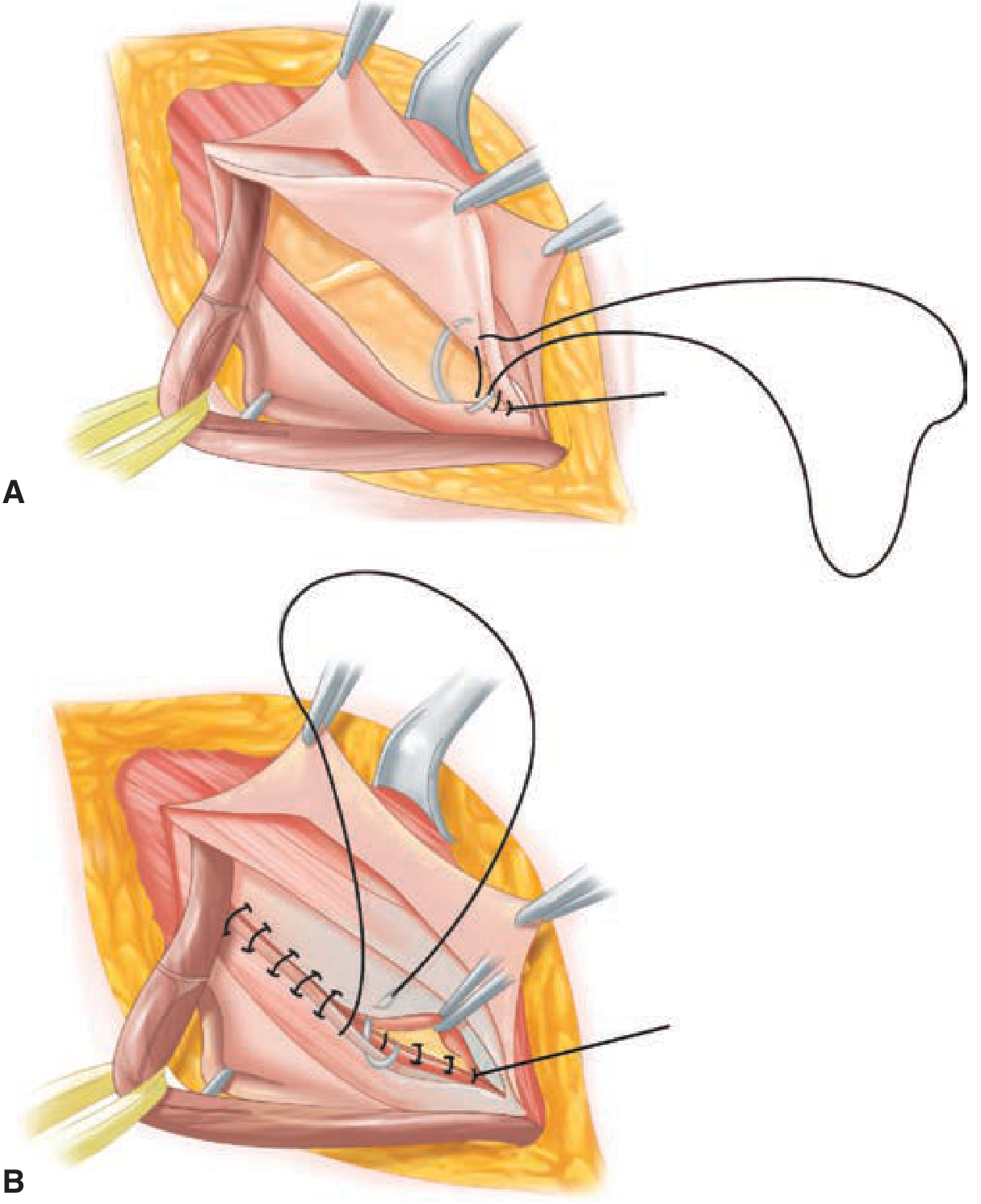
- 1st suture line: Superior-lateral flap sutured to iliopubic tract - running suture (Ethilon/Prolene)
- 2nd suture line: Return suture - inferior medial flap sutured to internal oblique
- 3rd suture line: Internal oblique sutured to inguinal ligament
- 4th suture line: Return - external oblique flap sutured
- Total four continuous suture lines = "double-breasting" of posterior wall
Results: The Shouldice Hospital, Toronto reports lifetime recurrence <2% with their specialized technique under local anesthesia.
Why results are not reproducible elsewhere? The Shouldice Hospital is highly specialized; their nurses and surgeons perform only this one operation. General surgical units report 5-10% recurrence with Shouldice.
EHS Guideline: Shouldice is the recommended non-mesh repair when mesh is contraindicated.
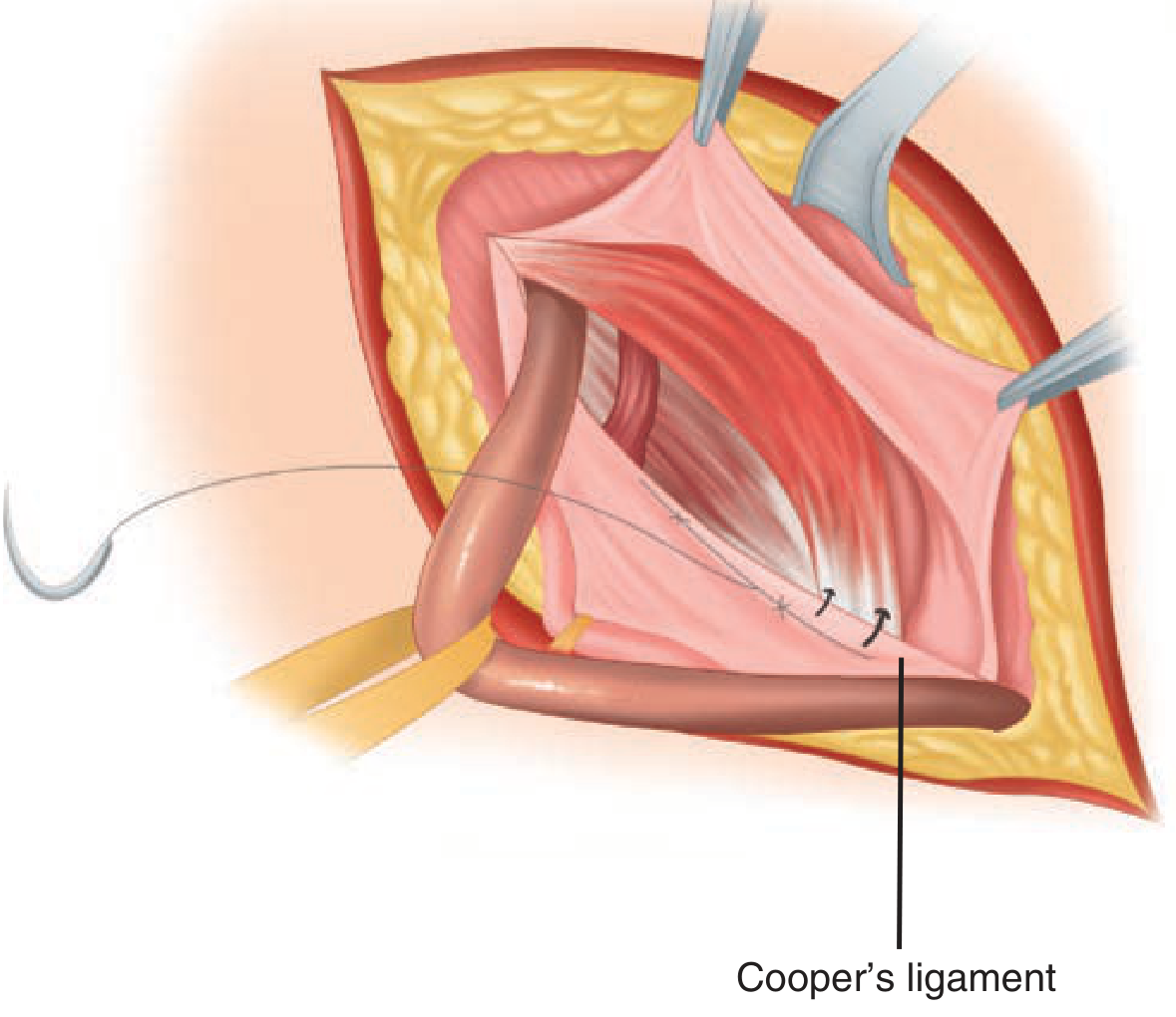
11.5 McVAY (COOPER'S LIGAMENT) REPAIR
Principle: Conjoint tendon sutured to the pectineal (Cooper's) ligament instead of the inguinal ligament. Provides a more secure, deeper fixation.
Special indication:
- Femoral hernia repair (Cooper's ligament repair closes the femoral ring)
- Direct inguinal hernia with large floor defect
- Recurrent inguinal hernia (in context of open repair)
Disadvantage: Greater tension than Bassini; requires a relaxing incision in the anterior rectus sheath to reduce tension.
Relaxing incision: A vertical incision in the anterior rectus sheath (medial to the repair), allowing the conjoint tendon to swing medially without tension. The defect in the anterior rectus sheath is covered by the posterior rectus sheath and peritoneum.
11.6 LICHTENSTEIN TENSION-FREE MESH REPAIR
The current gold standard for open inguinal hernia repair worldwide.
Described by Irving Lichtenstein in 1989. The term "tension-free" revolutionized hernia surgery.
Principle: A flat polypropylene mesh (6 × 11 cm minimum) is placed over the inguinal floor, eliminating tension entirely.
Instruments:
- Standard surgical set
- Non-absorbable monofilament suture (Prolene 2-0 or 0) for mesh fixation
- Mesh: lightweight large-pore polypropylene (preferred by EHS 2018)
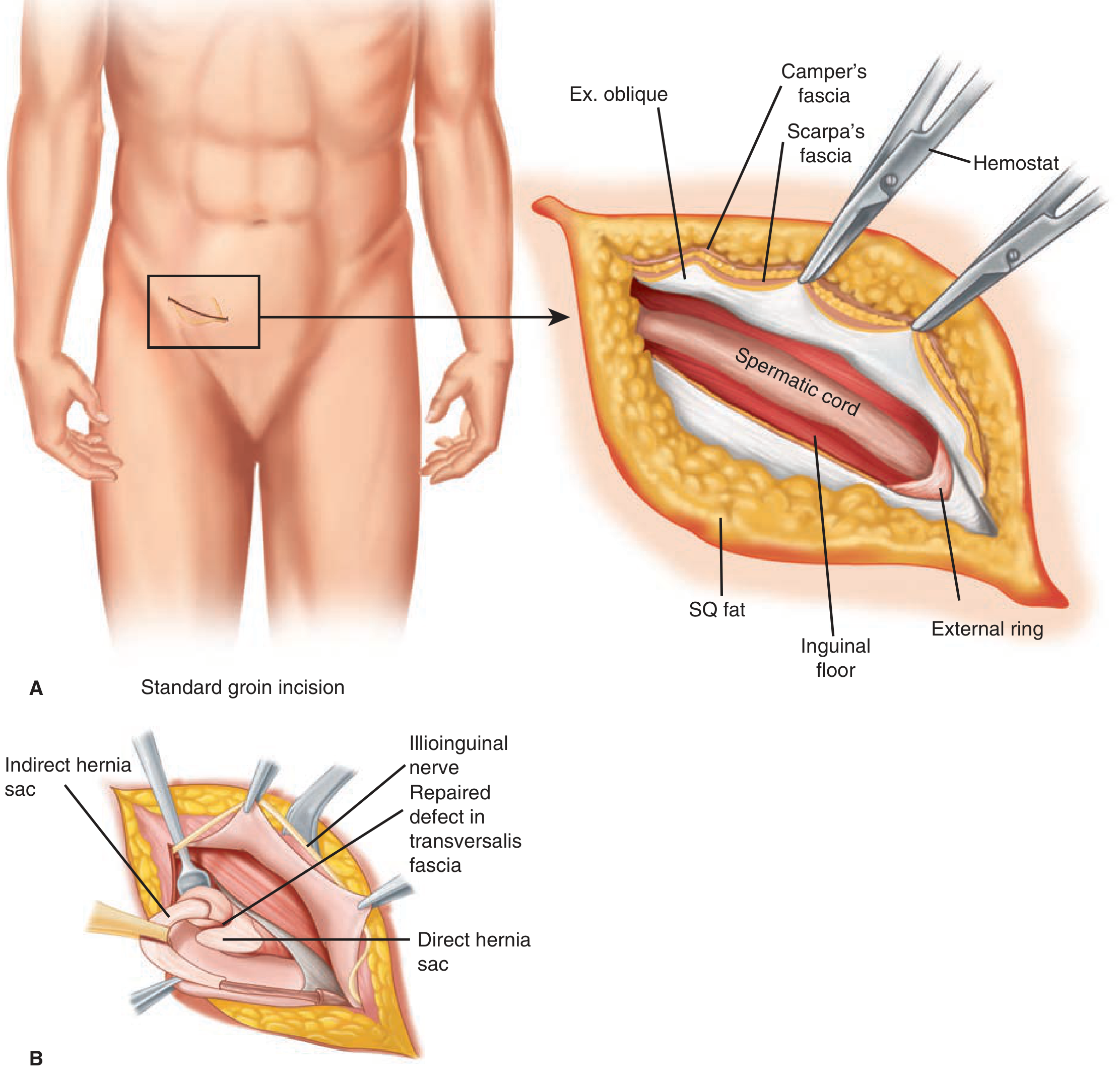
Operative Steps:
- Position: Supine
- Incision: 2 cm above inguinal ligament, skin crease, 6-8 cm
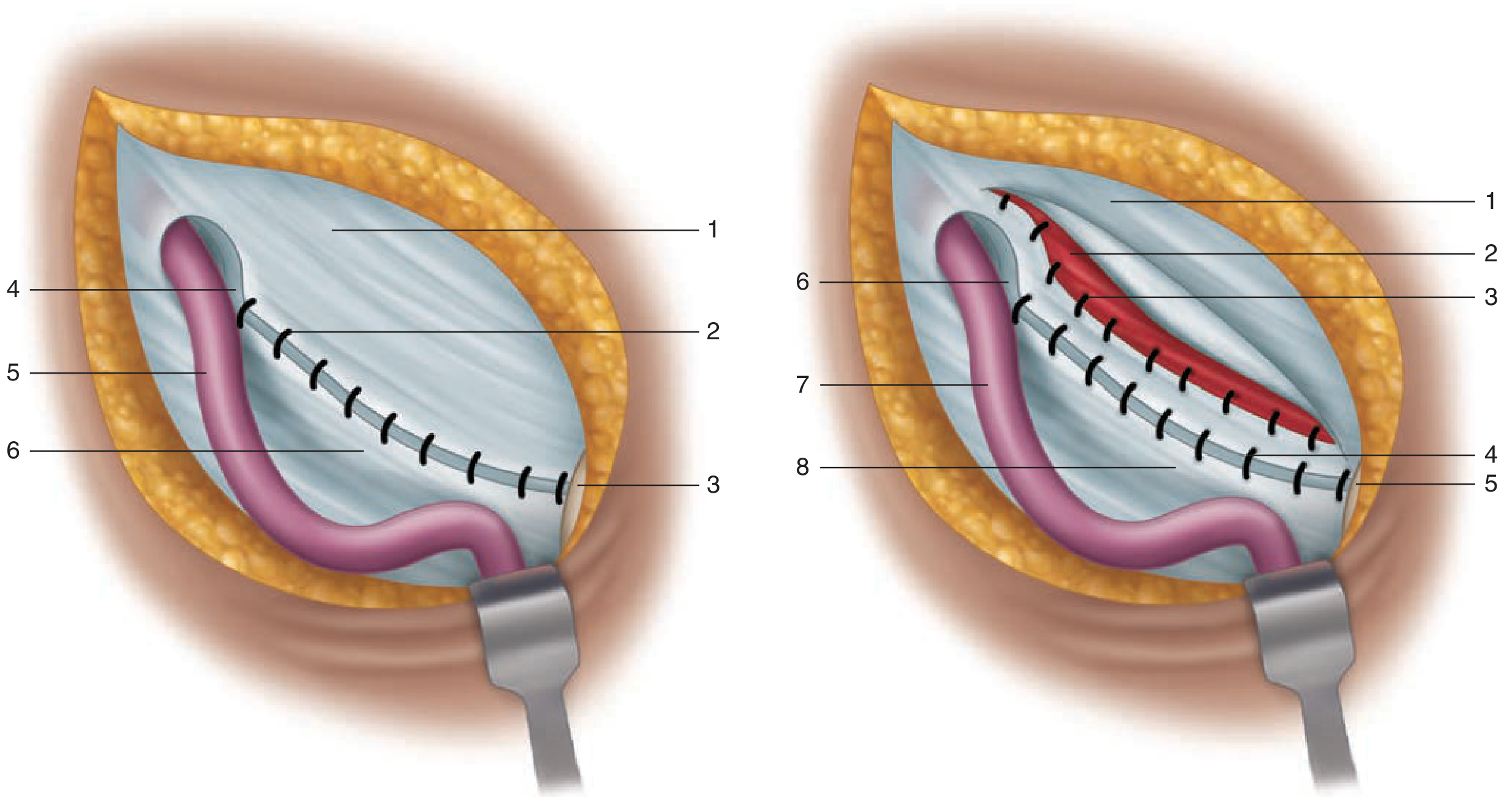
- Open external oblique aponeurosis along fibers (free inguinal ligament border)
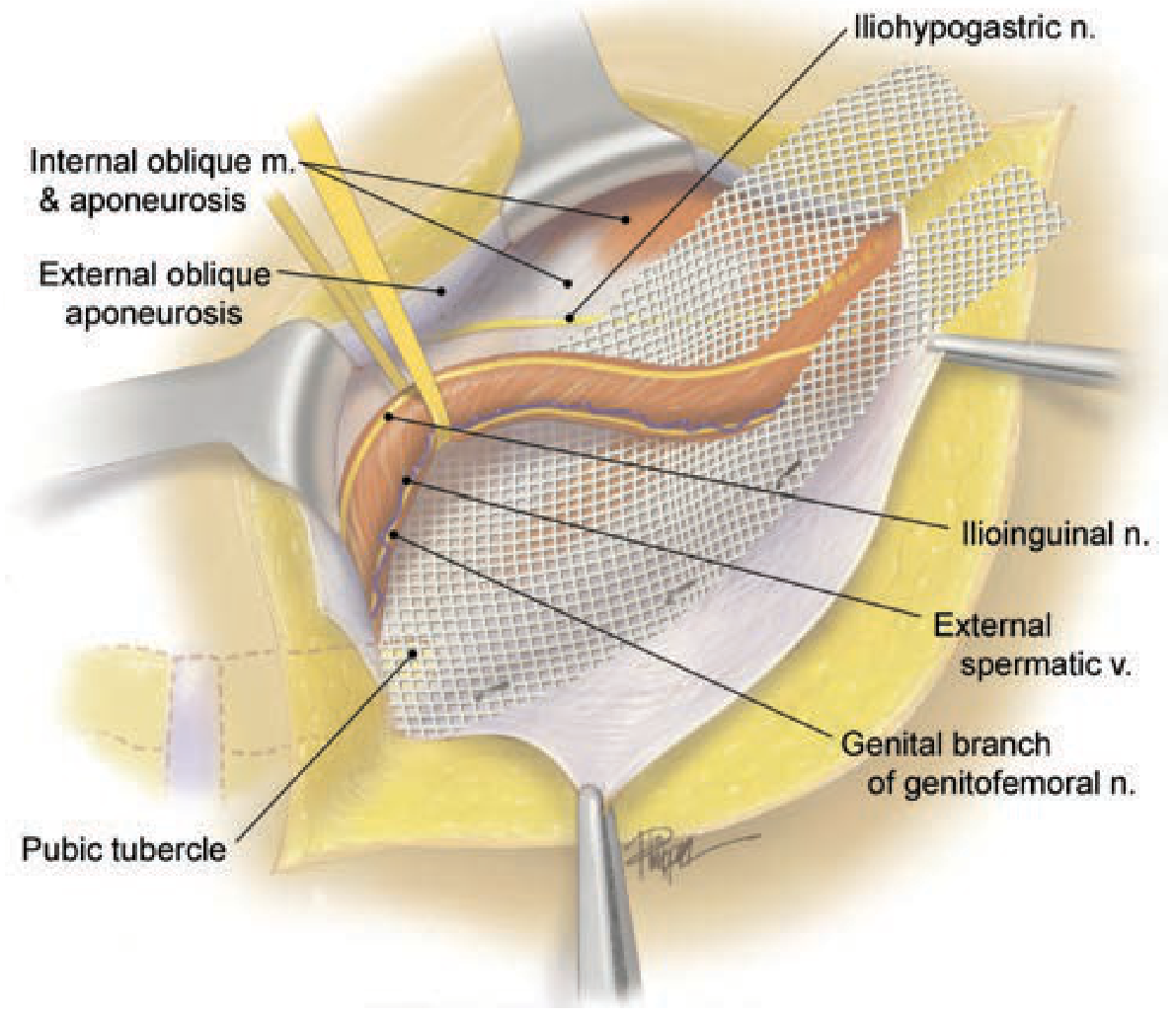
- Protect ilioinguinal nerve (anterior surface of cord)
- Mobilize spermatic cord on a soft tape
- Herniotomy: Identify sac (anteromedial to cord), separate, open, reduce contents, transfixion ligation at neck, excise excess sac
- Direct hernia: Reduce sac (invert and transfixion suture or simply reduce)
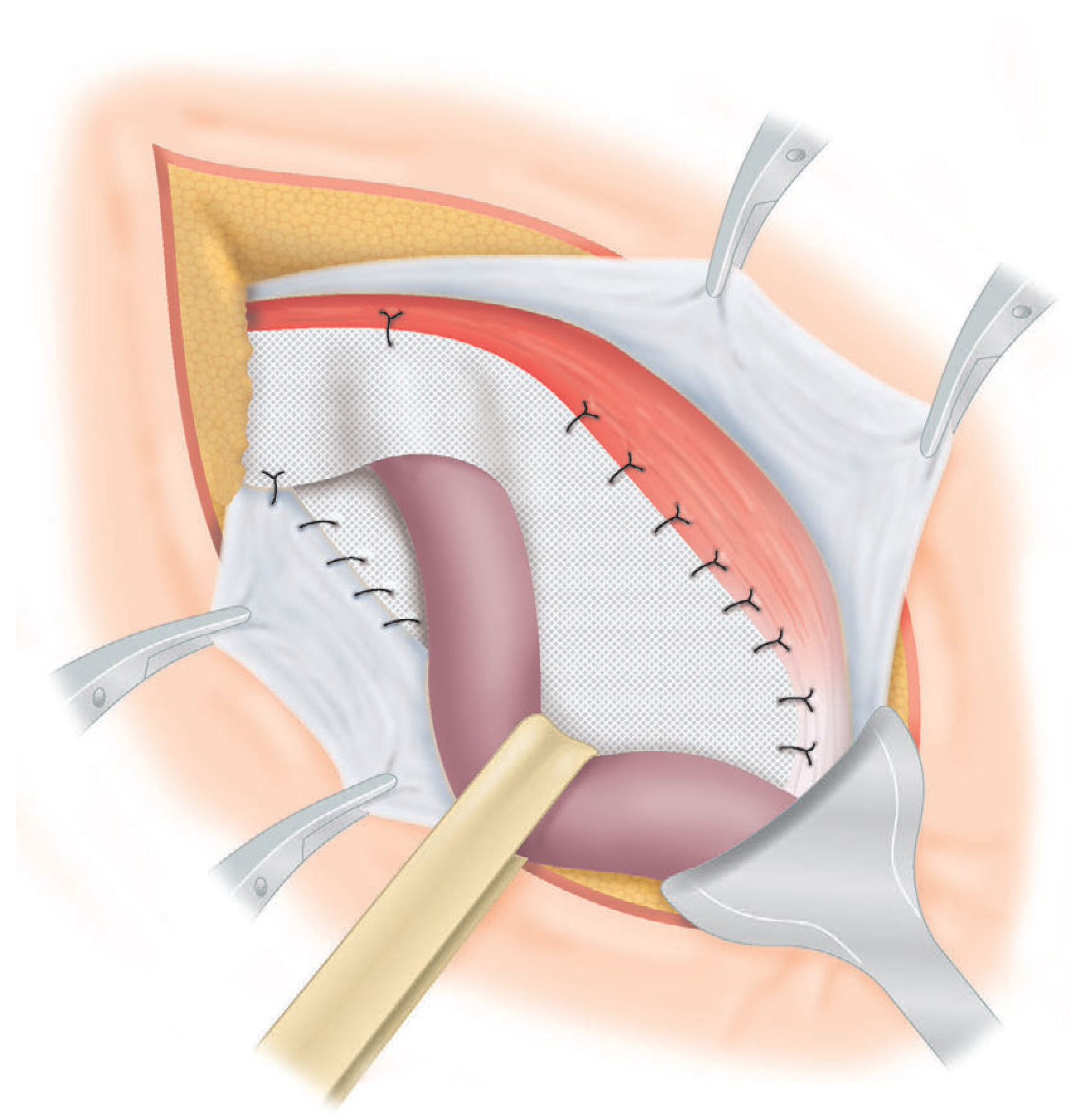
- Cut the mesh: Shape it with a slit at the lateral end (for the cord) - "fish tail" cut
- Fix mesh:
- Medially: Overlap pubic tubercle by ≥1.5 cm (most common site of recurrence = medial corner!)
- Medial end tucked behind the medial leaf of external oblique aponeurosis
- Inferior edge: Running suture to inguinal ligament (from pubic tubercle to 2 cm beyond deep ring)
- Superior edge: 2-3 interrupted sutures to conjoint tendon/internal oblique
- Lateral tails: Wrap around cord, sutured to each other creating a new deep ring (snug but not tight)
- Close external oblique over the cord
- Wound closure in layers
Key Technical Points:
- Mesh must overlap pubic tubercle by at least 1.5 cm (prevents medial recurrence)
- Mesh slit should be ≥2 cm wide to avoid cord compression
- Do NOT fix mesh to the ilioinguinal nerve
- Avoid using absorbable sutures for mesh fixation (sutures resorb → mesh shifts → recurrence)
Results:
- Recurrence: < 1% in specialized units; ~2% in general practice
- Chronic pain: 10-12% develop some form (6% significant)
- Return to work: 1-2 weeks
(Bailey & Love 28th Ed, p. 1090-91; Schwartz 11th Ed)
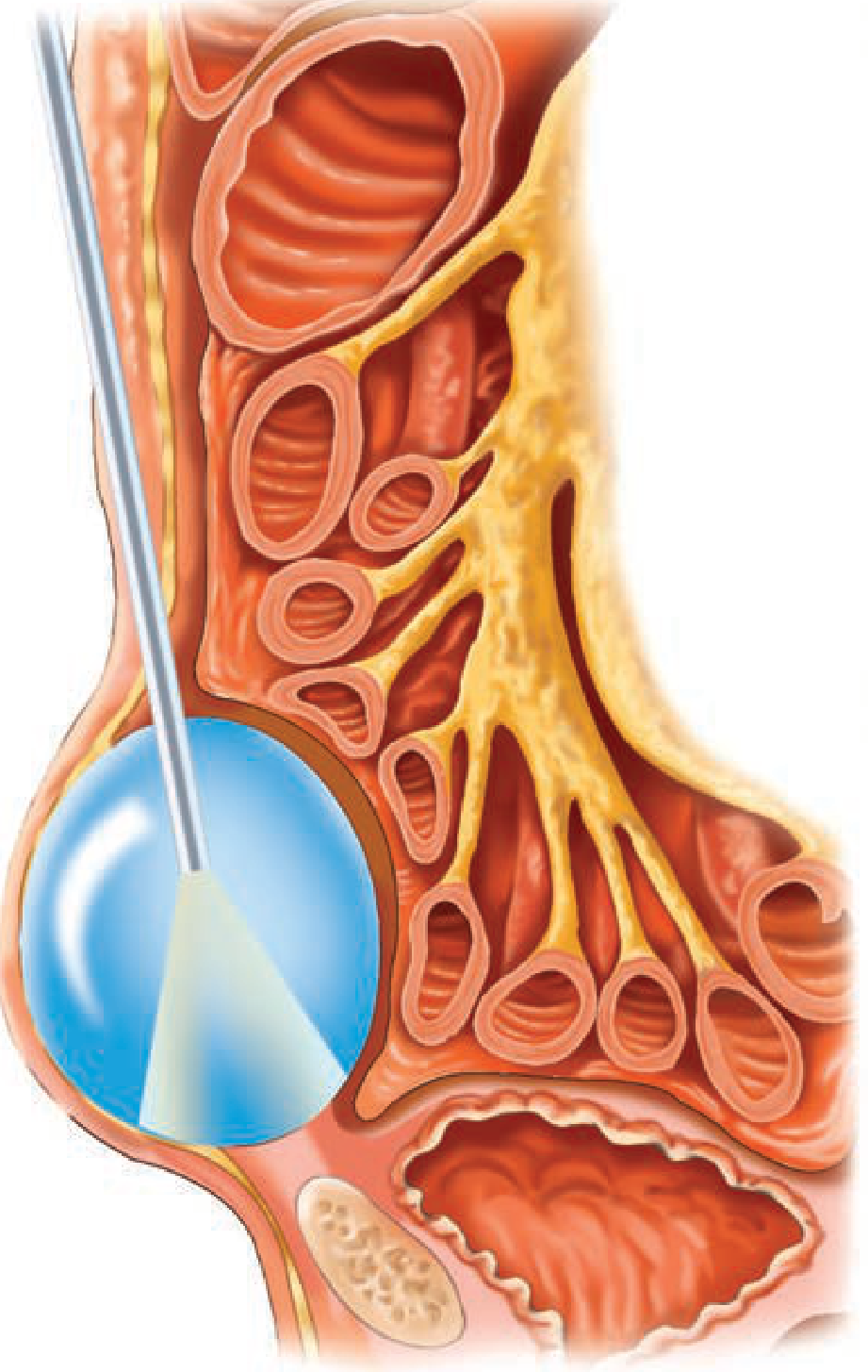
11.7 TEP (Total Extraperitoneal Repair)
Principle: Laparoscopic/endoscopic approach entirely in the preperitoneal space. The peritoneal cavity is never entered. A large mesh (10 × 15 cm) is placed in the preperitoneal space covering the entire myopectineal orifice of Fruchaud.
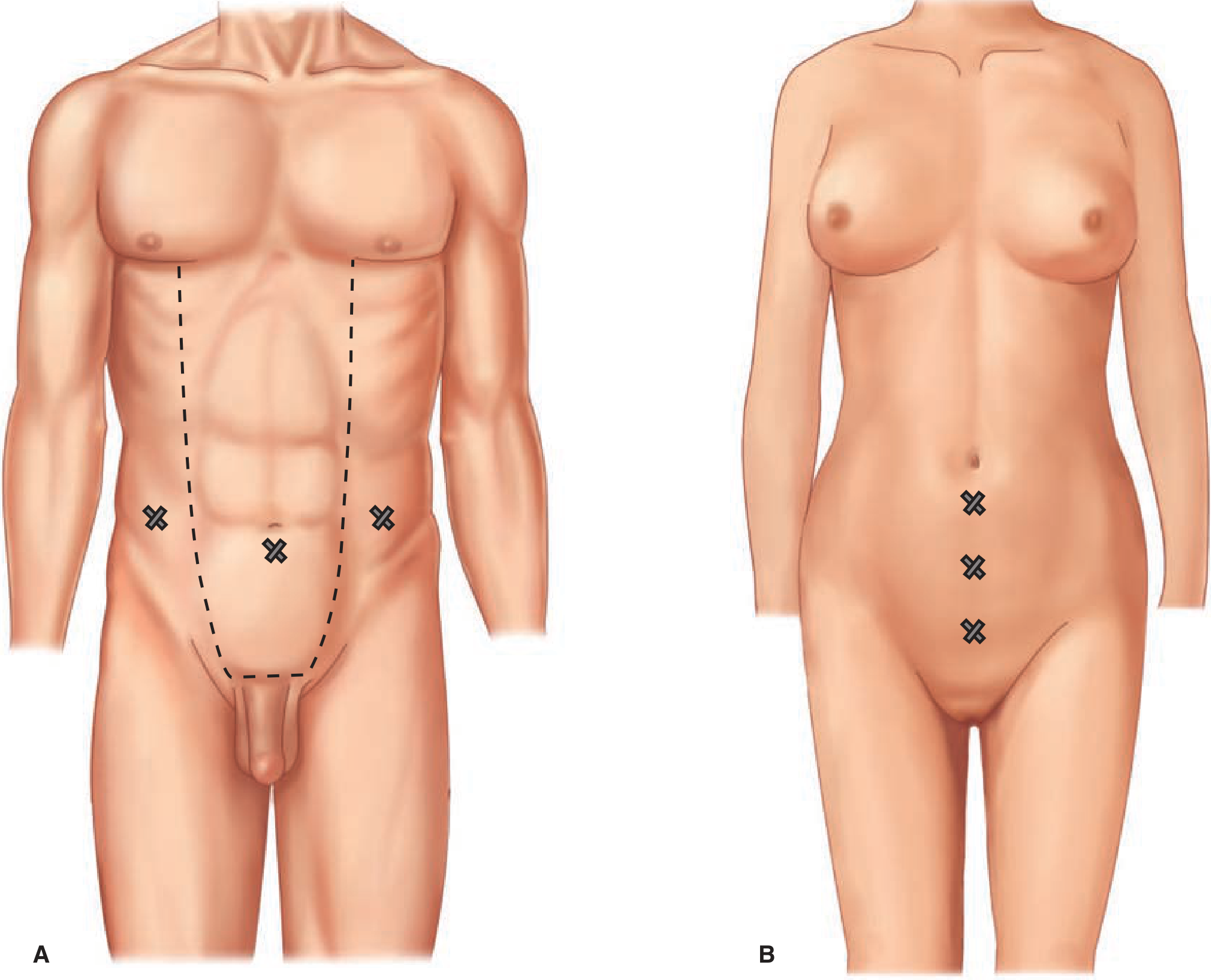
Ports:
- 10 mm infraumbilical (balloon dissection port / trocar)
- 5 mm midline subumbilical
- 5 mm suprapubic
Steps:
- Infraumbilical incision, open anterior rectus sheath, retract rectus muscle
- Create preperitoneal space by blunt dissection (balloon dissector or finger)
- CO2 insufflation at 12 mmHg in preperitoneal space
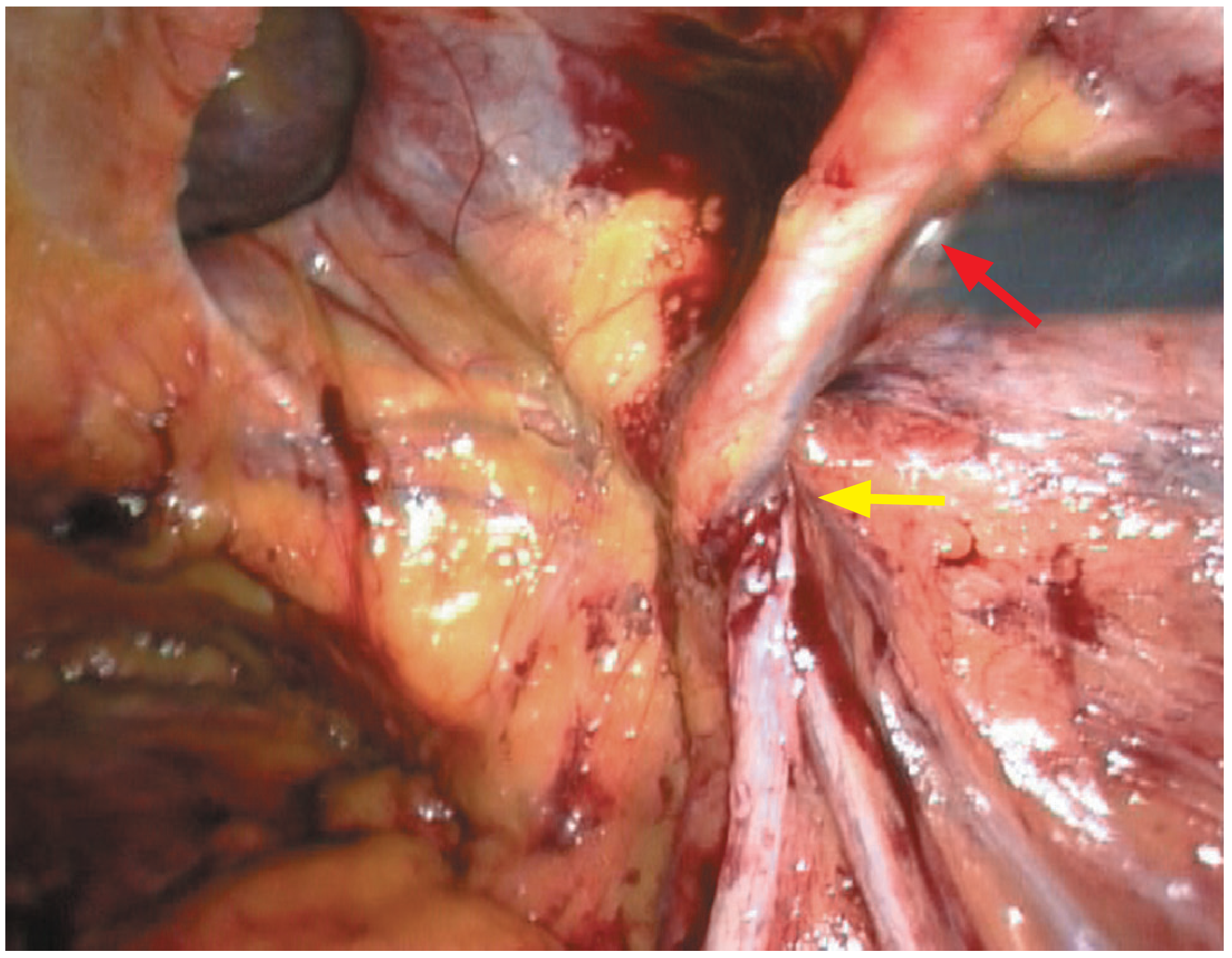
- Identify landmarks: Pubic symphysis, Cooper's ligament, inferior epigastric vessels, iliopubic tract, vas deferens, testicular vessels
- Reduce hernia sac: For indirect - dissect sac from cord (divide if cannot be reduced without peritoneal tear); for direct - reduce "pseudosac" without opening peritoneum
- Place large mesh (at least 10×15 cm) covering the entire myopectineal orifice:
- Medially: beyond pubic symphysis
- Laterally: beyond iliac vessels
- Inferiorly: below Cooper's ligament
- Fixation: In most cases NO fixation needed (EHS 2018: no fixation for medium hernias to reduce chronic pain); tacker/fibrin glue for large hernia
- Desufflate slowly → mesh held in place by intraperitoneal pressure
Advantages:
- No entry into peritoneal cavity
- Excellent visualization of preperitoneal space
- Less post-op pain
- Faster return to work
- Bilateral repair through same ports
- Preferred for bilateral hernias and recurrent hernias after anterior repair
Disadvantages / Contraindications:
- Prior preperitoneal surgery (prostatectomy, pelvic surgery) - relative contraindication
- Larger learning curve (30-50 cases)
- Technically more demanding
"Triangle of Doom" and "Triangle of Pain":
- Triangle of Doom: The triangular space medial to the vas deferens and lateral to the internal spermatic vessels - contains external iliac vessels. NO staples/tacks here!
- Triangle of Pain: Lateral to the iliopsoas and below iliopubic tract - contains femoral nerve, lateral femoral cutaneous nerve. NO fixation below iliopubic tract lateral to deep ring!
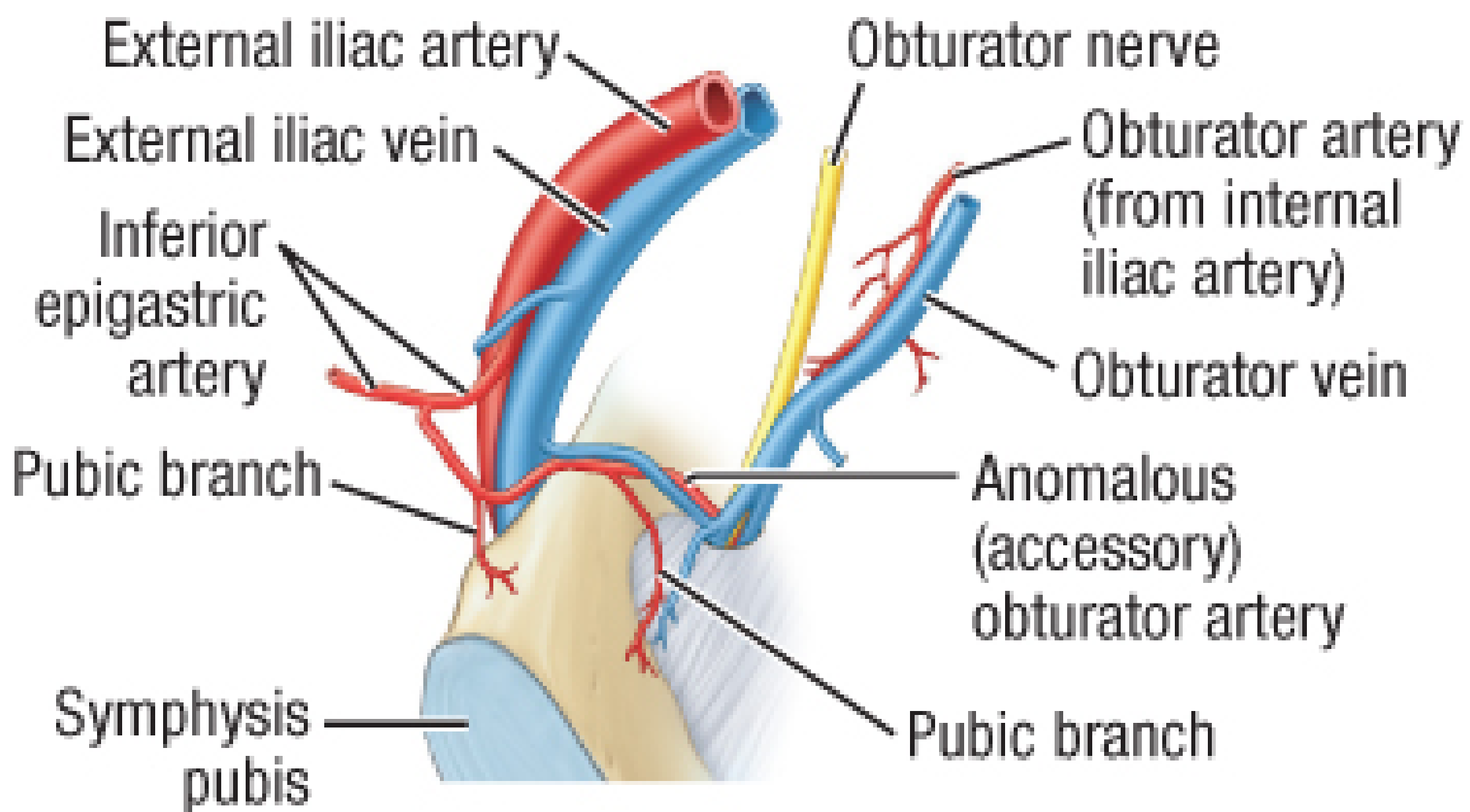
- Circle of Death: Anastomotic connection between obturator and external iliac artery (corona mortis) - lies on Cooper's ligament - avoid blind tacking here!
(Fischer's Mastery 8th Ed; Schwartz 11th Ed)
11.8 TAPP (Transabdominal Preperitoneal Repair)
Principle: Enter the peritoneal cavity laparoscopically, then create a peritoneal flap to access the preperitoneal space and place mesh.
Steps:
- Standard 3-trocar laparoscopic setup (10 mm umbilical, two 5 mm lateral)
- Create pneumoperitoneum (CO2, 12-15 mmHg)
- Peritoneal incision 3-4 cm above the hernia defect, along the iliac crest
- Develop preperitoneal space
- Identify landmarks (same as TEP + internal view of peritoneal cavity)
- Reduce hernia sac and contents
- Place mesh 10×15 cm
- Close peritoneal flap with sutures or tacker
Advantage over TEP: Easier entry; better visualization of peritoneal cavity; easier in large scrotal hernia where sac must be divided
Disadvantage over TEP: Enter peritoneal cavity → potential for intra-abdominal adhesions, bowel injury; longer learning curve for TAPP
EHS 2018 Guideline: "Both TAPP and TEP are equivalent in outcomes. For bilateral hernias, laparo-endoscopic repair is preferred. For unilateral hernias in males, laparo-endoscopic repair is recommended over open mesh repair."
11.9 STOPPA REPAIR (Giant Prosthetic Reinforcement of the Visceral Sac)
- Open preperitoneal repair using a very large mesh (30 × 25 cm)
- Covers the entire preperitoneal space bilaterally
- Used for: Bilateral large hernias, recurrent hernias, complex hernias
- Rarely performed today (largely replaced by TEP/TAPP)
- Mesh held in place by intraperitoneal pressure (no fixation needed)
11.10 Summary Table: Choice of Operation
| Scenario | Recommended Operation |
|---|
| Child/infant, indirect hernia | Herniotomy (open) |
| Adult primary unilateral hernia (male) | Lichtenstein (open) OR TEP/TAPP (laparoscopic) |
| Adult bilateral hernia | TEP or TAPP (laparoscopic preferred) |
| Recurrent hernia (after anterior repair) | TEP or TAPP (posterior approach) |
| Recurrent hernia (after posterior/TEP/TAPP) | Lichtenstein (anterior approach) |
| Emergency (obstructed/strangulated) | Open surgery (Lichtenstein if no contamination; suture repair if contaminated) |
| Large sliding hernia | Open (TAPP feasible in experienced hands) |
| Femoral hernia | McVay (open) or laparoscopic; mesh repair preferred |
| Mesh contraindicated (infection, contamination) | Shouldice (non-mesh tissue repair) |
| High-risk/elderly | Lichtenstein under local anesthesia |
SECTION 12: COMPLICATIONS
12.1 Early Complications (Immediate/Within 30 days)
| Complication | Description | Prevention/Management |
|---|
| Hematoma | Blood collection in wound/scrotum (most common early complication) | Meticulous hemostasis; pressure dressing; drain if expanding; surgical evacuation if large |
| Seroma | Fluid collection (common after large dissections) | Usually resolves; aspiration if symptomatic |
| Wound infection (SSI) | ~1-2% with prophylaxis; ~3-5% without | Antibiotics; wound care; mesh infection may require removal |
| Urinary retention | Common with spinal anesthesia, BPH | Avoid spinal in BPH; catheterize; alpha-blockers |
| Urinary tract infection | Catheter-related | Minimize catheter use |
| Testicular swelling/edema | Disruption of cord lymphatics | Usually self-limiting; ice, elevation, NSAIDs |
| Neuralgia/nerve injury | Ilioinguinal, iliohypogastric, genitofemoral damage | Careful nerve identification; neurectomy if division necessary |
| Vas deferens injury | During dissection | Prevention: identify vas early; repair immediately if cut |
12.2 Late Complications
| Complication | Incidence | Management |
|---|
| Recurrence | Open mesh: 1-2%; Laparoscopic: 1-3%; Non-mesh: 5-15% | Re-repair via alternative approach |
| Chronic groin pain (CPSP) | 10-12% (significant 6%) | Multimodal analgesia; neurectomy for nerve entrapment; mesh removal if mesh-related |
| Testicular atrophy | 0.5-1% (higher in recurrent repair) | Prevent by protecting testicular artery |
| Ischemic orchitis | 0.5% | Tense painful scrotal swelling post-op; NSAIDs; usually resolves but may lead to atrophy |
| Hydrocele | 5-10% | Aspiration/surgery if symptomatic |
| Mesh migration/erosion | Rare but serious | Mesh removal; reconstruction |
| Mesh infection | 0.1-1% | Antibiotics; mesh removal |
| Impotence | Very rare | Damage to genitofemoral nerve / cord injury |
| Bladder injury (TEP) | 0.2% | Recognize at operation; repair; catheter 7 days |
12.3 Emergency Complications (Strangulated Hernia)
Management of Strangulated Inguinal Hernia:
- Resuscitation: IV access, fluids, NG tube, catheter, monitoring
- IV antibiotics: Cefuroxime + metronidazole
- Mark bowel viability assessment criteria:
- Viable: pink/red, peristalsis present, pulsatile mesenteric vessels
- Doubtful: wrap in warm saline gauze for 5 minutes; reassess
- Non-viable: black/green, no peristalsis, foul smell → resect
- Surgery (emergency):
- Open approach preferred
- Extend incision if required
- If bowel viable → reduce, repair hernia (Lichtenstein if clean field)
- If bowel non-viable → bowel resection + anastomosis (or Hartmann's for sigmoid)
- If contaminated field → avoid mesh (use tissue repair: Bassini/Shouldice)
- Maydl's hernia pitfall: Always inspect the intra-abdominal loop (pull out 30 cm on each side)
Latest evidence (PMID 40671180, 2025): Eastern Association for the Surgery of Trauma systematic review on incarcerated/strangulated inguinal hernia management confirms open approach is preferred for emergency cases; mesh can be used if field is clean.
SECTION 13: POSTOPERATIVE CARE AND FOLLOW-UP
13.1 Immediate Postoperative Care
- Day surgery: Possible for most elective Lichtenstein and TEP/TAPP repairs
- Diet: Resume oral intake as tolerated (2 hours post-op for clear fluids; clear diet as tolerated)
- Mobilization: Walking same day; encourage early ambulation
- Analgesia: Multimodal - Paracetamol 1g 8-hourly + Ibuprofen 400 mg 8-hourly + LA wound infiltration ± ilioinguinal nerve block; avoid opioids
- Ice pack: Scrotum elevation and ice for first 24 hours (reduces swelling)
- Wound care: Clean, dry wound; review at 5-7 days for suture removal (or dissolving sutures)
13.2 Activity Restrictions
| Activity | Restriction Period |
|---|
| Driving | 24-48 hours (light vehicle); confirm can do emergency stop |
| Light office work | 2-3 days |
| Moderate activity | 1-2 weeks |
| Heavy lifting/manual labor | 4-6 weeks (open); 2-3 weeks (laparoscopic) |
| Sexual activity | 2 weeks |
| Sports/gym | 4-6 weeks |
13.3 Patient Education (Important for OSCE)
- No straining at stool (stool softeners/dietary fiber if needed)
- Treat constipation and cough aggressively
- Stop smoking permanently
- Warning signs: Fever, wound erythema, increasing pain, swelling at repair site, scrotal swelling = REPORT IMMEDIATELY
13.4 Follow-Up Schedule
- Day 5-7: Wound check, suture removal
- Week 6: Clinical review, return to full activity
- 3-6 months: Assess for chronic pain, check for recurrence
- 1 year and annually: Long-term hernia surveillance (especially in high-risk/recurrent)
SECTION 14: COMPLETE VIVA SECTION
14.1 Frequently Asked University Questions with Model Answers
Q1. What is the most common hernia in women?
The most common hernia in women is the indirect inguinal hernia (not femoral). While femoral hernia is proportionally more common in women (F:M = 2:1) compared to men, inguinal hernias outnumber femoral in females as well. The ratio of inguinal to femoral in females is approximately 4:1.
Q2. Define a hernia.
A hernia is an abnormal protrusion of the whole or part of a viscus, or part of the contents of a body cavity, through a normal or abnormal opening in the wall of that cavity, covered by the layers of that cavity.
Q3. What is the processus vaginalis and what is its fate?
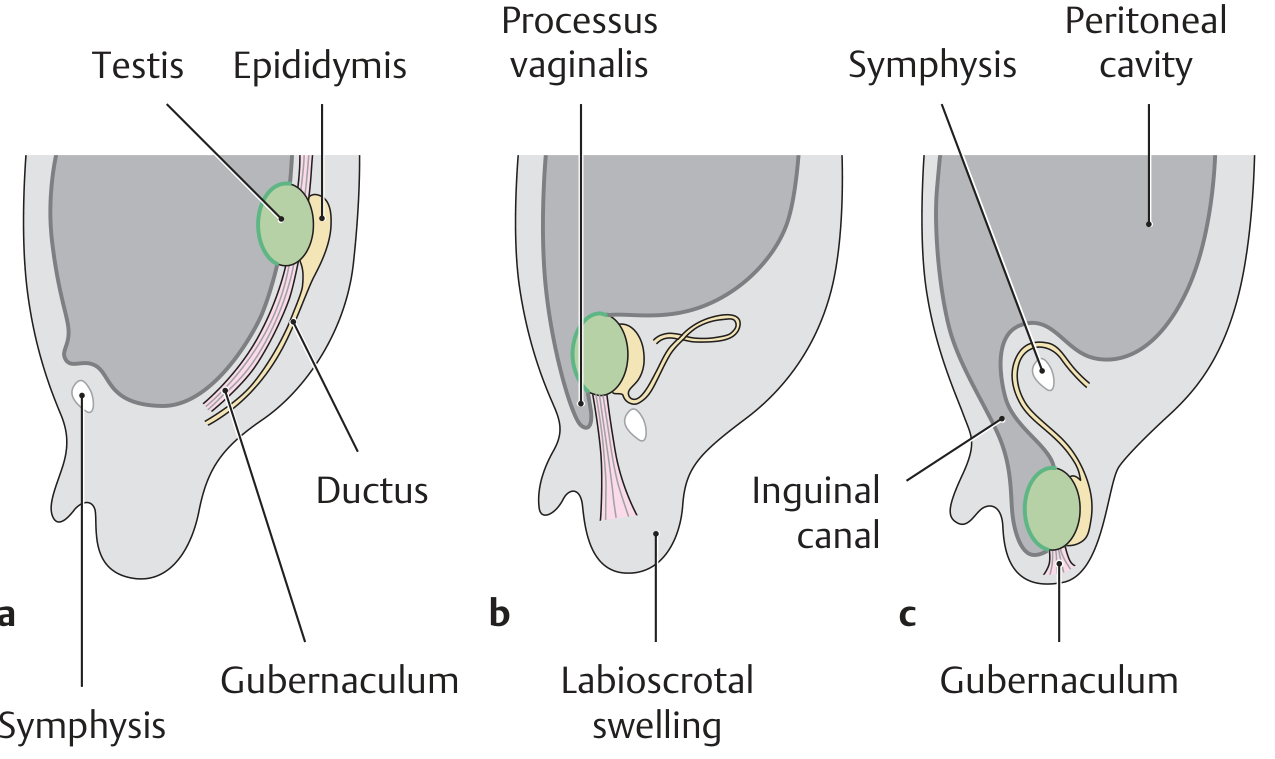
The processus vaginalis is a peritoneal diverticulum that accompanies the testis during its descent into the scrotum. Normally it obliterates (closes) a few weeks before or after birth, leaving only the tunica vaginalis around the testis. Failure of obliteration results in: complete patency → indirect congenital hernia; partial patency → communicating hydrocele (upper part) or cord hydrocele (middle part) or hydrocele of tunica vaginalis (lower part).
Q4. What is the significance of the inferior epigastric artery in inguinal hernia surgery?
The inferior epigastric artery (branch of external iliac) is the key landmark dividing direct from indirect inguinal hernia:
- Indirect hernia: emerges lateral to the IEA (through deep ring)
- Direct hernia: emerges medial to the IEA (through Hesselbach's triangle)
During surgery, the IEA should be identified before incising the transversalis fascia to avoid injury.
Q5. What is the triangle of doom in laparoscopic hernia repair?
The triangle of doom is a triangular space bounded medially by the vas deferens, laterally by the spermatic vessels, with the apex at the deep inguinal ring. It contains the external iliac artery and vein. No staples or tacks should be placed in this triangle to avoid potentially fatal vascular injury.
Q6. What is the triangle of pain?
The triangle of pain is the area lateral to the iliopsoas and below the iliopubic tract (inferior to the deep ring). It contains the femoral nerve, genitofemoral nerve (femoral branch), and lateral femoral cutaneous nerve. Fixation here causes chronic neuropathic groin and thigh pain.
Q7. Why does indirect hernia have a higher risk of strangulation than direct?
Indirect hernias emerge through the deep inguinal ring, which has a narrow, rigid, fascial edge (transversalis fascia + iliopubic tract). The narrow neck acts like a noose, easily compressing the blood supply to the hernia contents. Direct hernias emerge through a broad-based defect in Hesselbach's triangle with a wide, flexible neck, making strangulation less likely.
Q8. What are the contents of the spermatic cord?
Three arteries: testicular artery (from aorta), artery to vas (from inferior vesical), cremasteric artery (from inferior epigastric)
Three veins: pampiniform plexus (venous)
Three nerves: genital branch of genitofemoral nerve, sympathetic fibers, ilioinguinal nerve (in the canal, not in the cord proper)
Three other structures: vas deferens, lymphatics, processus vaginalis remnant/sac
Q9. What is the Shouldice repair and why is it the best non-mesh repair?
The Shouldice repair is a four-layer continuous suture repair of the posterior wall of the inguinal canal using non-absorbable monofilament (Prolene or Ethilon). The transversalis fascia is divided and overlapped (double-breasted), then reinforced by suturing the internal oblique to the inguinal ligament in four running suture layers. Expert centers achieve recurrence rates < 2%, better than any other non-mesh repair. EHS 2018 recommends it as the non-mesh repair of choice.
Q10. What mesh should be used for inguinal hernia repair?
EHS 2018 Guidelines recommend: lightweight (< 50 g/m²), large-pore (> 1 mm) macroporous polypropylene mesh. Lightweight meshes cause less fibrosis, less chronic pain, better patient comfort, and similar recurrence rates as heavyweight meshes. A standard flat Lichtenstein mesh of ≥ 6×11 cm is adequate. 3D meshes and plug-and-patch are NOT superior to flat Lichtenstein mesh.
Q11. What is a Richter's hernia? How does it differ from a usual strangulated hernia?
In a Richter's hernia, only the anti-mesenteric wall of the intestine (usually small bowel) is caught in the hernia ring. The bowel lumen is not fully obstructed → NO intestinal obstruction. The strangulated bowel wall becomes gangrenous. The patient presents with a tender irreducible hernia and systemic toxicity WITHOUT signs of intestinal obstruction (no vomiting, no absolute constipation). This makes Richter's hernia a clinical trap - it can be missed if features of obstruction are expected.
Q12. What is Maydl's hernia? What is the key surgical principle?
In Maydl's hernia (hernia-in-W or retrograde incarceration), two loops of small bowel enter the hernia sac forming a W shape. The intermediate loop connecting them lies in the abdomen and is at greatest risk of strangulation (due to traction on its mesentery). The key surgical principle is to always pull out and inspect the intermediate intra-abdominal loop (minimum 30 cm on each side) after reducing the hernia to ensure viability.
Q13. What is a sliding hernia? What is its surgical importance?
A sliding hernia is one in which part of the wall of the sac is formed by a retroperitoneal viscus that has "slid" to become part of the sac. On the right: cecum, appendix, ascending colon. On the left: sigmoid colon. Medially: bladder (direct hernia). Surgical importance: The viscus-wall of the sac must NOT be opened - inadvertent entry into the bowel or bladder leads to contamination, peritonitis, and fistula. The sac is managed by: reducing the viscus without opening the sac, or performing an inverse peritoneal closure (Lima's technique).
Q14. What are the nerves at risk in inguinal hernia repair and their injuries?
| Nerve | Injury | Consequence |
|---|
| Ilioinguinal (L1) | Divided/entrapped in suture | Loss of sensation: medial thigh, root of penis, upper scrotum |
| Iliohypogastric (L1) | Divided superior to wound | Numbness above superficial ring |
| Genitofemoral genital branch | Divided/entrapped | Loss of cremasteric reflex; scrotal numbness |
| Femoral branch of genitofemoral | Tacker in triangle of pain | Upper thigh numbness (meralgia-like) |
| Femoral nerve | Rare; deep tacker | Motor weakness of quadriceps (serious) |
Q15. What is the "mesh-fixation" controversy in Lichtenstein repair?
Current EHS 2018 evidence: Mesh fixation is required for Lichtenstein repair. However, for TEP/TAPP with medium-sized hernias (EHS M2/L2), no fixation of mesh is recommended as it reduces chronic groin pain without increasing recurrence. For large hernias, self-fixating mesh or fibrin glue fixation is preferred over mechanical tacker fixation to reduce nerve injury and chronic pain.
Q16. What is the Nyhus Type IIIb hernia?
Nyhus IIIb is an indirect inguinal hernia where the deep ring is significantly dilated and the posterior wall (transversalis fascia) is also defective. This includes sliding hernias and pantaloon hernias. Simple herniotomy is insufficient. Nyhus recommended preperitoneal mesh repair for this type.
Q17. Define pantaloon hernia. What is its surgical significance?
A pantaloon hernia (named for resemblance to trousers) is a simultaneous combination of direct + indirect inguinal hernia on the same side, with the inferior epigastric vessels running between the two sacs (like the waist of trousers). Gilbert Grade 6, Nyhus IIIb. Surgical significance: Both components must be repaired - incomplete repair leads to "recurrence" which is actually the missed component. Laparoscopic approach allows simultaneous repair of both components.
Q18. What is the difference between obstructed and strangulated hernia?
Obstructed hernia: The herniated bowel is trapped (irreducible) and the bowel lumen is obstructed → intestinal obstruction symptoms (vomiting, absolute constipation, distension). Blood supply to bowel is NOT compromised.
Strangulated hernia: Irreducible hernia with compromise of blood supply to the herniated viscus → ischemia → gangrene. Patient has features of obstruction PLUS systemic toxicity (fever, tachycardia, peritonism). All strangulated hernias are obstructed, but not all obstructed hernias are strangulated.
Q19. What is the role of "watchful waiting" in inguinal hernia?
EHS 2018: Watchful waiting is acceptable for asymptomatic male inguinal hernia. O'Dwyer trial (2006) showed 25% of watchfully-waited patients crossed over to surgery within 2 years due to increasing symptoms. Strangulation risk in watchful waiting was very low (0.27% per year). However, all symptomatic hernias should be repaired. Watchful waiting is NOT appropriate for women (femoral hernias have very high strangulation rate).
Q20. What are the causes of recurrent inguinal hernia?
Technical factors (most important):
- Missed hernia sac
- Inadequate overlap of pubic tubercle (medial recurrence)
- Mesh too small
- Tension on repair (non-mesh)
- Missed pantaloon component
Biological factors:
- Smoking (collagen defects)
- Obesity
- Connective tissue disorders
- Inadequate healing (diabetes, steroids, malnutrition)
Late factors: Persistent risk factors (COPD, BPH, constipation) not addressed
14.2 Cross-Question Chains (Examiner Style)
Chain 1: Anatomy → Clinical Test → Operation
Q: Where is the deep inguinal ring?
A: 1.25 cm above the midpoint of the inguinal ligament (midinguinal point), lateral to the inferior epigastric artery.
Q: What is at the midinguinal point?
A: Femoral artery pulse. The deep ring is just above the midinguinal point.
Q: How do you use this in clinical examination?
A: In the deep ring occlusion test - pressing on this point controls indirect but not direct hernia.
Q: During Lichtenstein repair, why is this landmark important?
A: The mesh tails are wrapped around the cord at this point to reform the new deep ring. If the new ring is too tight, cord compression; if too loose, lateral recurrence.
Chain 2: Strangulation → Emergency Management
Q: A 65-year-old man presents with severe right groin pain and vomiting for 6 hours. There is a tense, irreducible, tender right groin swelling. What is your diagnosis?
A: Strangulated right inguinal hernia until proven otherwise.
Q: How will you manage this patient?
A: Resuscitation first - IV access, 2 large-bore cannulas, crystalloid fluids, NG tube on free drainage, IV broad-spectrum antibiotics (cefuroxime 1.5 g + metronidazole 500 mg), morphine for pain, urgent bloods including WCC, CRP, lactate, coagulation, group and save; urgent ECG, CXR. Emergency laparotomy/open hernia repair.
Q: You open the hernia and find gangrenous bowel. What do you do?
A: Assess bowel: criteria for non-viability = black/green bowel, no peristalsis, no mesenteric pulsations. If non-viable → resect 30 cm on each side of gangrenous segment. Check for Maydl's hernia (inspect intra-abdominal intermediate loop). Perform bowel resection with primary anastomosis if hemodynamically stable and minimal contamination. In contamination → Hartmann's/stoma.
Q: Can you use mesh in this situation?
A: In a contaminated/infected field (purulent contents, gangrenous bowel), mesh use is generally avoided. Use biological mesh or tissue repair (Bassini/Shouldice). If field is clean with viable bowel, Lichtenstein mesh repair can be performed. EAST 2025 guidelines (PMID 40671180) support mesh use in non-contaminated emergent repairs.
14.3 Emergency Viva
Q: A 40-year-old woman is brought in with acute right groin pain and vomiting. Examination reveals a small, firm, tender swelling BELOW AND LATERAL to the right pubic tubercle. What is your most likely diagnosis?
Strangulated right femoral hernia. The site (below and lateral to pubic tubercle), sex (female), small size, and tendency to strangulate make femoral hernia the leading diagnosis.
Q: Why do femoral hernias strangulate so easily?
Because the femoral ring is a rigid, unyielding orifice bounded:
- Anteriorly: inguinal ligament
- Medially: lacunar (Gimbernat's) ligament (rigid, unyielding)
- Posteriorly: pectineal (Cooper's) ligament and pectineus muscle fascia
- Laterally: femoral vein
This rigidity, especially the sharp edge of Gimbernat's ligament, causes rapid strangulation of any herniated content.
14.4 Operative Viva
Q: A patient has undergone TEP repair. On post-op day 2 he develops acute retention of urine. What do you suspect?
Bladder injury during TEP repair. During trocar insertion or dissection, the bladder (especially if distended or with prior bladder surgery) can be injured. The patient is catheterized; urine is tested for blood (hematuria after bladder injury). CT cystography confirms. Small injuries may heal with catheter drainage alone; large injuries require surgical repair.
Q: Name the "circles" and "triangles" in laparoscopic hernia surgery.
- Triangle of Doom: Medial vas deferens + lateral spermatic vessels → apex at deep ring. Contains external iliac vessels. NO tacks.
- Triangle of Pain: Lateral to iliopsoas, below iliopubic tract. Contains femoral, genitofemoral, LFCN nerves. NO tacks.
- Circle of Death (Corona Mortis): Anastomotic loop between obturator and external iliac/inferior epigastric arteries, running across Cooper's ligament. Blind tacking on Cooper's may injure this = massive hemorrhage.
SECTION 15: INSTRUMENTS
15.1 Key Instruments in Inguinal Hernia Surgery
Denis Browne's Retractor / Self-retaining Retractor
- Used to retract wound edges during herniotomy
- Allows hands-free exposure
Babcock's Tissue Forceps
- Used to grasp and deliver the hernia sac
- Atraumatic ends prevent sac perforation
Haemostat (Artery Forceps / Kelly's Forceps)
- Curved/straight mosquito or Kelly's clamps
- Used to hold the neck of the sac during transfixion ligation
Needle Holder (Mayo or Hegar)
- Used for suturing mesh and wound closure
Soft Vascular Tape / Penrose Drain
- Used to retract the spermatic cord during dissection
Laparoscopic Instruments for TEP/TAPP:
- 10 mm 30-degree telescope
- 5 mm trocars
- Balloon dissector (for preperitoneal space in TEP)
- Maryland dissector, curved scissors
- Tacker/fibrin glue applicator (for mesh fixation)
SECTION 16: RELEVANT TEXTBOOK IMAGES
(From Bailey & Love 28th Ed, Fischer's Mastery 8th Ed, S. Das 13th Ed)
Anatomy:
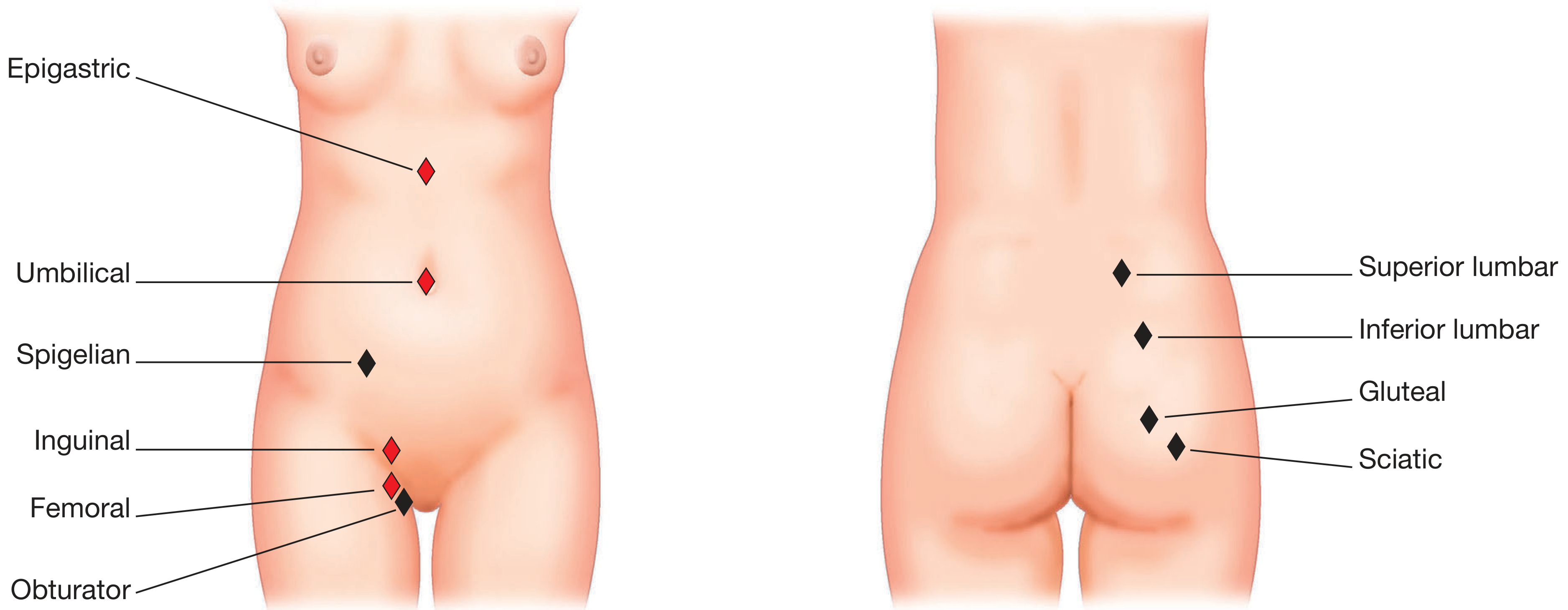
Figure: Sites of abdominal wall hernias - Bailey & Love 28th Ed
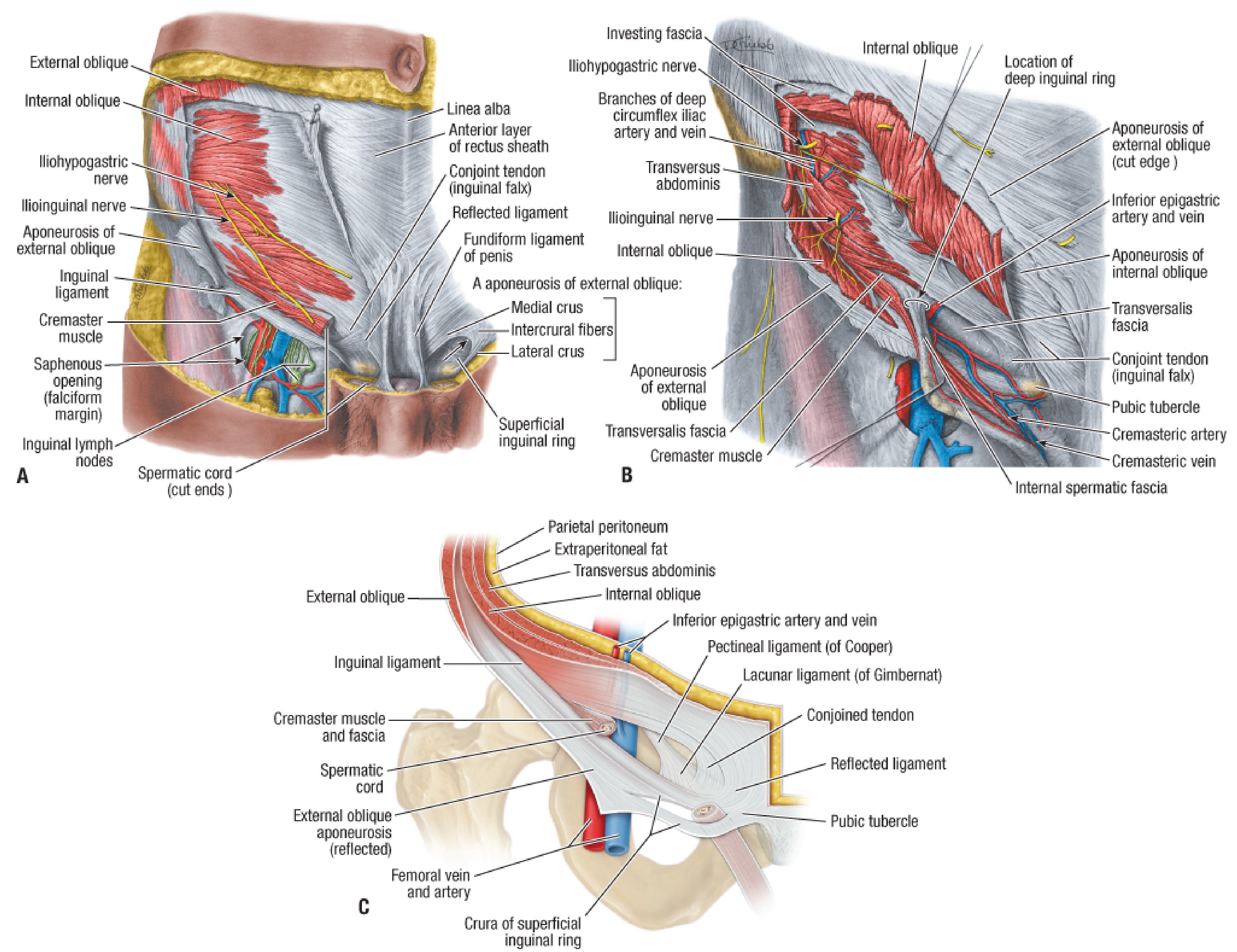
Figure: Deep inguinal region anatomy showing canal, deep ring, nerve relationships - Fischer's Mastery 8th Ed
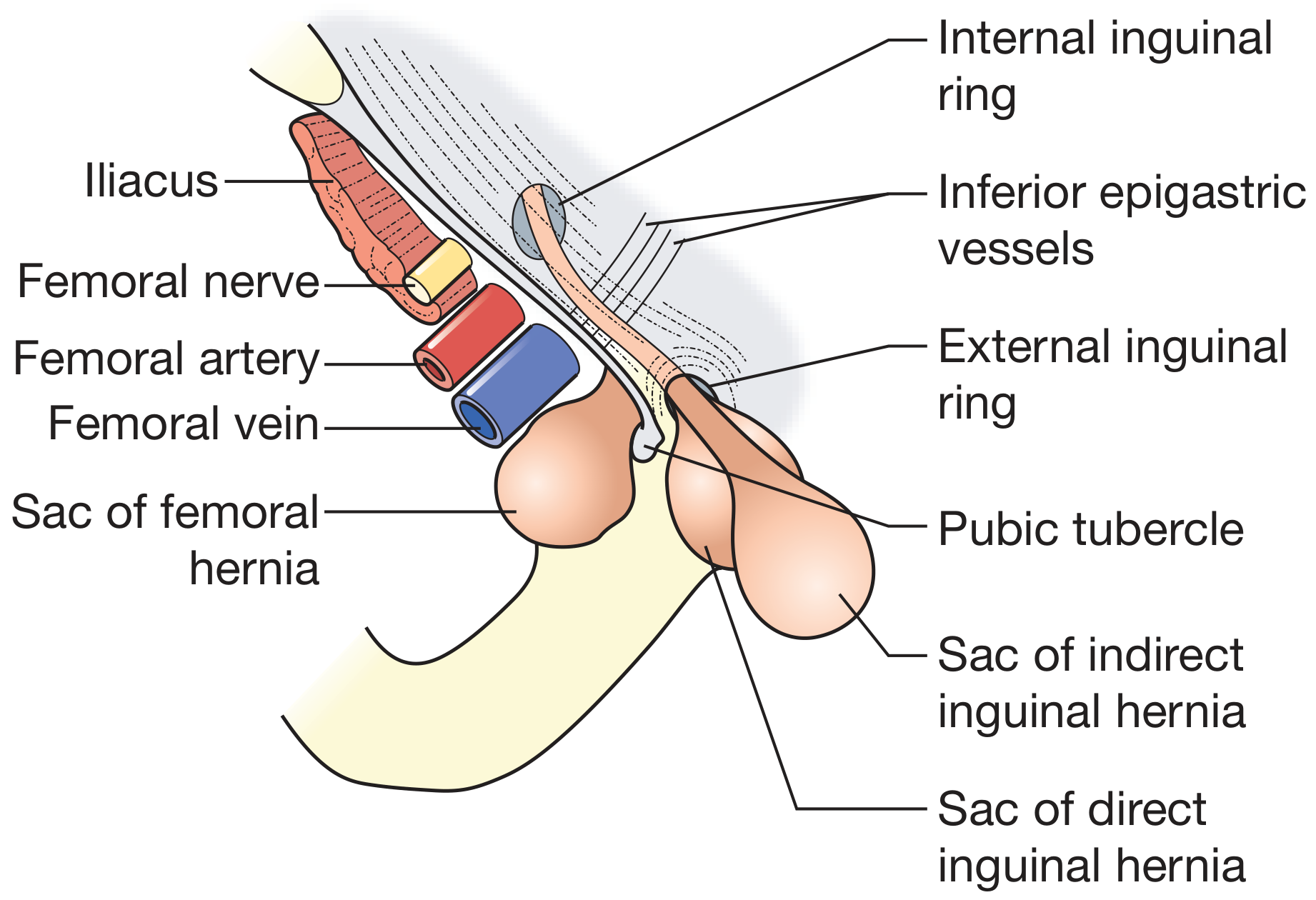
Figure: Close relationship of direct inguinal, indirect inguinal, and femoral hernias - Bailey & Love 28th Ed
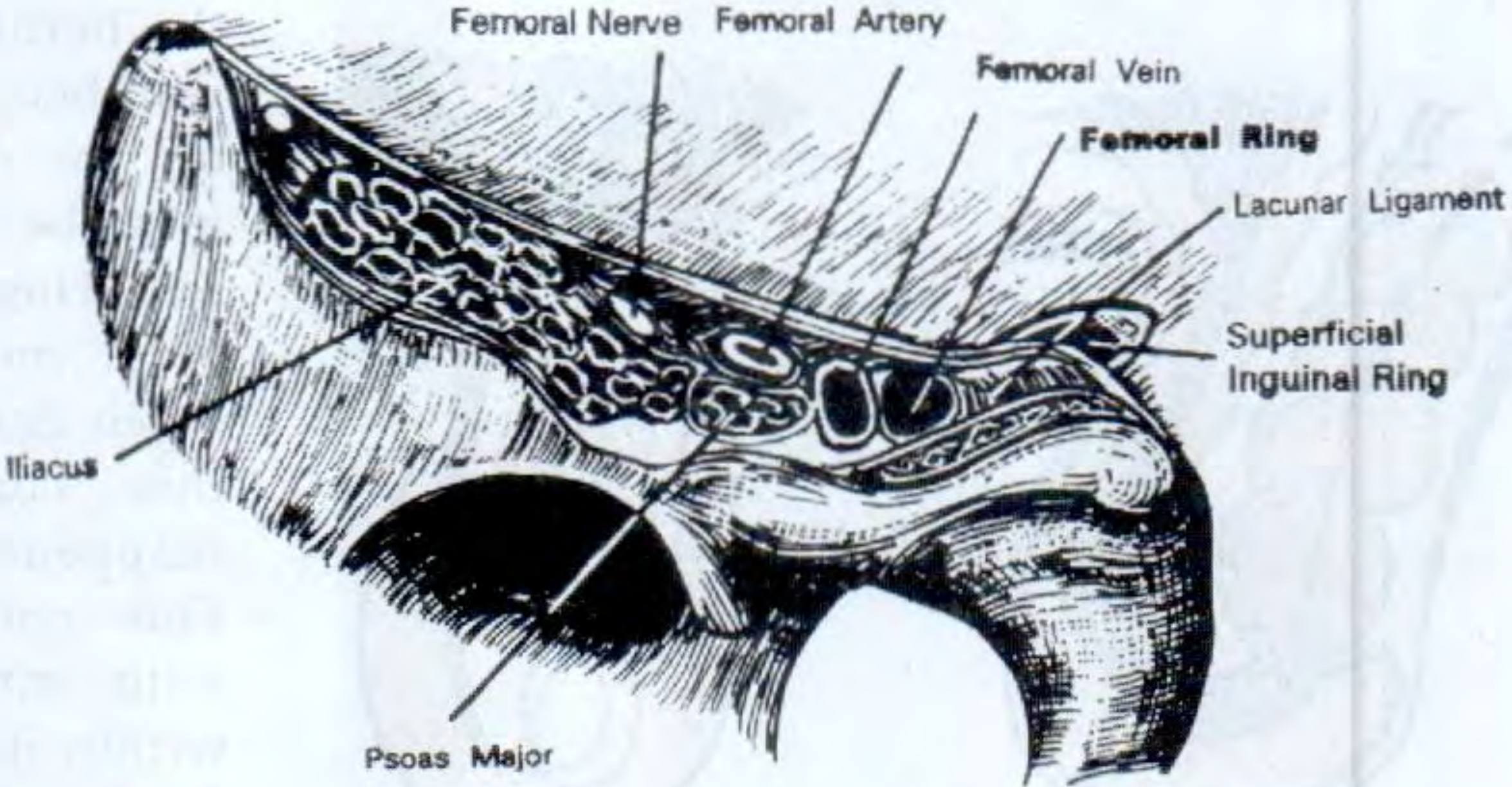
Figure: Femoral ring anatomical position - S. Das 13th Ed
Figure: Shouldice repair - four-layer posterior wall reconstruction - Schwartz 11th Ed
Figure: McVay Cooper's ligament repair - Schwartz 11th Ed
Figure: Oblique inguinal hernia visible on standing/coughing - Bailey & Love
SECTION 17: FLOWCHARTS
Flowchart 1: Classification of Inguinal Hernia
INGUINAL HERNIA
       │
 ┌─────┴──────┐
INDIRECT    DIRECT
(Lateral)   (Medial)
Exits lateral  Exits medial
to IEA        to IEA
       │
 ┌─────┴──────────────────┐
EXTENT OF HERNIA          STATE OF HERNIA
│                         │
├── Bubonocele            ├── Reducible
├── Incomplete            ├── Irreducible
└── Complete (scrotal)    ├── Obstructed
                          └── Strangulated
       │
 ┌─────┴───────────────────────────┐
NYHUS CLASSIFICATION               EHS CLASSIFICATION
I (normal ring, indirect)          L1/L2/L3 (indirect, size 1/2/3)
IIa (dilated ring, good wall)      M1/M2/M3 (direct, size 1/2/3)
IIb (ring dilated, wall encroached) F (femoral)
IIIa (direct)                      P (primary) / R (recurrent)
IIIb (indirect + poor wall)
IIIc (femoral)
IV (recurrent: IVa,b,c,d)
Flowchart 2: Clinical Approach to Groin Swelling
GROIN SWELLING
      │
Is it above the inguinal ligament?
      │
   YES ──→ Inguinal hernia (most likely)
      │    Also: lymph node, lipoma, undescended testis, saphena varix
   NO  ──→ Below inguinal ligament: femoral hernia, lymph node,
           saphena varix, femoral artery aneurysm
      │
Is there an expansile cough impulse?
      │
   YES ──→ HERNIA confirmed (indirect, direct, or femoral)
   NO  ──→ Non-hernia swelling (lymph node, lipoma, testis)
      │
Can you get above the swelling?
      │
   NO  ──→ Hernia (arising from abdomen)
   YES ──→ Scrotal/testicular swelling (testis, epididymis, hydrocele)
      │
DEEP RING OCCLUSION TEST
      │
   Stops hernia ──→ INDIRECT hernia
   Doesn't stop  ──→ DIRECT hernia
Flowchart 3: Management Algorithm
INGUINAL HERNIA DIAGNOSED
         │
    ┌────┴────────────────────┐
EMERGENCY?               ELECTIVE
    │                        │
YES (obstructed,     ┌───────┴────────────────────┐
strangulated)        │                            │
    │           SYMPTOMATIC?               ASYMPTOMATIC?
    │                │                            │
    │               YES                   Direct hernia?
    │                │                            │
    │        OPTIMIZE before surgery       YES → Watchful waiting
    │        (treat COPD, BPH,            (if elderly/unfit)
    │        constipation, DM)                    │
    │                │                    NO → All indirect, all
    │         CHOICE OF OPERATION         females, young males
    │         ↓                           → OPERATE
    │    Primary, unilateral (male)
    │    → Lichtenstein OR TEP/TAPP
    │    Bilateral → TEP/TAPP preferred
    │    Recurrent (after anterior) → TEP/TAPP
    │    Recurrent (after posterior) → Lichtenstein
    │    Contaminated field → Non-mesh (Shouldice)
    │
RESUSCITATE → Open surgery
  │
  Viable bowel → Repair (mesh if clean)
  Non-viable → Bowel resection + repair
  Contaminated → Non-mesh repair
SECTION 18: MIND MAPS
Mind Map 1: Inguinal Hernia - Overview
                    INGUINAL HERNIA
                          │
        ┌─────────────────┼──────────────────┐
    ANATOMY           CLASSIFICATION      MANAGEMENT
        │                 │                   │
   Canal (4cm)      Direct/Indirect     Herniotomy (child)
   Deep ring        Complete/Incomplete  Lichtenstein (adult)
   Superficial ring  Nyhus I-IV          TEP/TAPP (lap)
   Hesselbach's Δ   Gilbert 1-7         Shouldice (non-mesh)
   Fruchaud MO      EHS (L/M/F, 1/2/3)  Watchful waiting
        │                 │
   NERVE SUPPLY     CLINICAL TESTS
   Ilioinguinal     Deep ring occlusion
   Iliohypogastric  Invagination test
   Genitofemoral    Zieman's 3-finger
                    Get above swelling
Mind Map 2: Risk Factors (Mnemonic: C-O-C-K-S)
- C - Chronic cough (COPD, smoking, TB)
- O - Obesity
- C - Constipation / straining at stool
- K - Kwashiorkor / malnutrition (collagen defect)
- S - Smoking, Strenuous labor, Surgery (previous)
- Also: BPH, family history, connective tissue disorders, ascites, peritoneal dialysis
Mind Map 3: Contents of Spermatic Cord (Mnemonic: 3-3-3)
- 3 Arteries: Testicular (aorta), Artery to vas (inferior vesical), Cremasteric (inferior epigastric)
- 3 Nerves: Ilioinguinal nerve (in canal), Genital branch of genitofemoral nerve, Sympathetic fibers
- 3 Others: Vas deferens, Pampiniform venous plexus, Lymphatics
Mind Map 4: Complications (Mnemonic: HISTRIONICS)
- H - Hematoma
- I - Ischemic orchitis
- S - Seroma
- T - Testicular atrophy
- R - Recurrence
- I - Ilioinguinal nerve damage
- O - Obstruction (missed/late)
- N - Neuropathic chronic pain
- I - Infection (wound/mesh)
- C - Cord injury (vas deferens)
- S - Strangulation (if untreated)
SECTION 19: HIGH-YIELD MS/DNB PEARLS
19.1 Examiner Favorites - One-Liners
- The most common hernia is indirect inguinal hernia (not direct, not femoral)
- The most common hernia in women is indirect inguinal hernia (not femoral)
- The most dangerous hernia (highest strangulation rate) is femoral hernia (~40% at presentation)
- Richter's hernia = strangulation without obstruction
- Maydl's hernia = strangulation without signs (the loop at risk is INSIDE the abdomen)
- Sliding hernia = viscus forms part of the hernia sac wall; DO NOT open the sac blindly
- Indirect hernia exits lateral to inferior epigastric artery; direct exits medial to it
- Processus vaginalis patency = congenital indirect hernia
- The Shouldice repair is the best non-mesh repair (< 2% recurrence at Shouldice Hospital)
- Lichtenstein tension-free mesh repair is the current gold standard for open repair
- For bilateral inguinal hernias, laparoscopic (TEP/TAPP) is the preferred approach
- Triangle of Doom = iliac vessels → NO TACKS
- Triangle of Pain = femoral/genitofemoral/LFCN nerves → NO TACKS below iliopubic tract lateral to deep ring
- Corona mortis = anastomosis of obturator and external iliac/inferior epigastric vessels on Cooper's ligament
- Testicular lymphatics drain to para-aortic nodes (NOT inguinal nodes)
- The pubic tubercle is the key landmark: inguinal hernia is medial and above; femoral is lateral and below
- Herniotomy alone is sufficient in children; adult hernias need hernioplasty/herniorrhaphy
- Prophylactic antibiotics are recommended for open mesh repair (single dose cefazolin)
- Recurrence after open repair is best managed by posterior approach (TEP/TAPP)
- EHS 2018 recommends lightweight large-pore polypropylene mesh for inguinal hernia repair
19.2 Common Candidate Mistakes
- Saying "femoral hernia is the most common hernia in women" - WRONG! Inguinal is still most common even in women
- Confusing midinguinal point (midpoint inguinal ligament = femoral artery) with midpoint between ASIS and pubic symphysis - these are the same point, but candidates mix up the description
- Saying "direct hernia is more common than indirect" - WRONG! Indirect is 60-65%
- Forgetting to mention inspection in standing position first
- Missing the deep ring occlusion test in clinical examination
- Not examining the contralateral side
- Not palpating the pubic tubercle to differentiate inguinal from femoral hernia
- Performing transillumination test without putting room in darkness
- Forgetting to inspect the intra-abdominal intermediate loop in Maydl's hernia
- Placing tacks below the iliopubic tract in TEP/TAPP (triangle of pain)
19.3 Mnemonics
DEEP RING LOCATION: "MID-LATERAL-ASIS-to-PUBIC TUBERCLE"
→ Midpoint of inguinal ligament (ASIS to pubic tubercle), 1.25 cm above = DEEP RING; LATERAL to inferior epigastric artery
INDIRECT vs DIRECT: "Ladies Don't"
- Lateral to inferior epigastric = indirect
- Direct = Directly forward, Does not go into scrotum easily, Doesn't strangulate easily
NYHUS: "I, II-ab, III-abc, IV-abcd"
Think: Normal → Dilated ring → Floor defect → Recurrent
STRANGULATION vs OBSTRUCTION:
"STRANGULATION = OBSTRUCTION + VASCULAR COMPROMISE"
HERNIA CONTENTS: "BLESSINGS"
- Bowel (small), Large bowel, Epiplocele (omentum), Stomach (rare), Sliding viscus, Infant gonads, Network of fat (lipoma), Gallbladder, Sac
SECTION 20: FINAL REVISION
20.1 One-Page Rapid Revision Sheet
╔══════════════════════════════════════════════════════════════╗
║            INGUINAL HERNIA - RAPID REVISION                  ║
╠══════════════════════════════════════════════════════════════╣
║ ANATOMY                                                       ║
║ Canal: 4 cm, ASIS→pubic tubercle direction                   ║
║ Deep ring: Transversalis fascia, above midinguinal point      ║
║ Superficial ring: Ext oblique aponeurosis, above pubic tubercle║
║ Walls: Ant=EO apo; Post=TF+conjoint; Roof=IO+TA; Floor=IL    ║
║ Hesselbach's triangle: Rectus(medial), IEA(lateral), IL(inf) ║
║ Fruchaud orifice: ALL groin hernias emerge through this       ║
╠══════════════════════════════════════════════════════════════╣
║ CLASSIFICATION                                                ║
║ Indirect: Lateral to IEA; narrow neck; strangulates easily    ║
║ Direct: Medial to IEA; wide neck; less strangulation          ║
║ Nyhus: I(child), IIab(adult, ring dilated), IIIabc(floor),    ║
║        IVabcd(recurrent)                                      ║
║ Special: Richter's(no obstruction), Maydl's(W-hernia),        ║
║          Sliding(viscus=sac wall), Pantaloon(D+I same side)   ║
╠══════════════════════════════════════════════════════════════╣
║ EXAMINATION                                                   ║
║ Standing first → inspect → cough impulse → lie down          ║
║ Reduce hernia → Deep ring occlusion test (indirect vs direct) ║
║ Get above swelling (hernia=cannot), Invagination test         ║
║ Zieman's 3-finger test (index=indirect, middle=direct,        ║
║ ring=femoral)                                                 ║
║ Pubic tubercle: inguinal=medial+above; femoral=lateral+below  ║
╠══════════════════════════════════════════════════════════════╣
║ MANAGEMENT                                                    ║
║ Child: Herniotomy (sac ligation)                              ║
║ Adult open: Lichtenstein (gold standard)                      ║
║ Adult lap: TEP or TAPP (bilateral preferred)                  ║
║ Non-mesh: Shouldice (best tissue repair)                      ║
║ Emergency (strangulated): Resuscitate → open surgery          ║
║ → viable bowel=reduce+repair; non-viable=resect+repair        ║
╠══════════════════════════════════════════════════════════════╣
║ DANGER ZONES (Laparoscopic)                                   ║
║ Triangle of Doom: Iliac vessels (medial to cord)              ║
║ Triangle of Pain: Nerves (lateral, below iliopubic tract)     ║
║ Corona Mortis: Obturator-external iliac anastomosis on Cooper ║
╠══════════════════════════════════════════════════════════════╣
║ COMPLICATIONS                                                 ║
║ Early: Hematoma, seroma, infection, urinary retention         ║
║ Late: Recurrence, chronic pain, testicular atrophy            ║
║ Nerve: Ilioinguinal(scrotal numbness), Genitofemoral(thigh)   ║
╚══════════════════════════════════════════════════════════════╝
20.2 Top 50 Viva Questions (Quick Reference)
- Most common hernia in males? Indirect inguinal
- Most common hernia in females? Indirect inguinal
- Most common hernia to strangulate? Femoral
- Site of deep inguinal ring? 1.25 cm above midinguinal point, lateral to IEA
- Contents of spermatic cord? 3 arteries, 3 nerves (ilioinguinal, genital GF, sympathetic), vas, veins, lymphatics
- Hesselbach's triangle boundaries? Medial = rectus; lateral = IEA; inferior = inguinal ligament
- Fruchaud orifice significance? All groin hernias emerge through it; basis for TEP/TAPP mesh placement
- Deep ring occlusion test - positive? Indirect hernia (hernia doesn't come out with coughing)
- Invagination test - tip vs pulp? Tip = indirect; Pulp = direct
- Silk glove sign? Patent processus vaginalis in children
- Nyhus Type IIIb? Indirect hernia + dilated ring + posterior wall defect; sliding/pantaloon included
- EHS mesh recommendation? Lightweight (<50g/m²), large-pore (>1mm) polypropylene
- Lichtenstein medial overlap? At least 1.5 cm beyond pubic tubercle
- Triangle of Doom? Vas + testicular vessels; iliac vessels deep; NO tacks
- Triangle of Pain? Below iliopubic tract, lateral to deep ring; femoral/GF/LFCN nerves; NO tacks
- Corona mortis? Anastomosis of obturator and external iliac arteries on Cooper's ligament
- Richter's hernia feature? Strangulation WITHOUT intestinal obstruction
- Maydl's hernia key principle? Inspect intra-abdominal intermediate loop (pull out 30 cm each side)
- Sliding hernia danger? DO NOT open sac blindly; viscus forms sac wall
- Pantaloon hernia definition? Direct + indirect simultaneous, straddling IEA
- McVay repair indication? Femoral hernia + Cooper's ligament
- Why Shouldice superior to Bassini? Double-breasting of transversalis fascia creates stronger repair
- Herniotomy vs herniorrhaphy vs hernioplasty? Herniotomy = sac only; herniorrhaphy = sac + tissue repair; hernioplasty = sac + mesh repair
- Contraindication to laparoscopic repair? Previous preperitoneal surgery, severe cardiorespiratory disease preventing pneumoperitoneum
- Best anesthesia for Lichtenstein? Local anesthesia (safest, lowest complication rate)
- ERAS principles in hernia? Carb loading, minimal fasting, multimodal analgesia, early mobilization
- Antibiotic prophylaxis? Single dose cefazolin IV within 60 min of incision (open mesh repair)
- Cause of chronic post-operative inguinal pain? Nerve injury/entrapment (ilioinguinal most common), mesh-related, scar tissue
- Treatment of chronic mesh pain? Neurectomy (selective), mesh removal (last resort), pain clinic
- Testicular atrophy mechanism? Injury to testicular artery or thrombosis of pampiniform plexus (ischemic orchitis)
- Get above swelling - significance? Cannot = hernia; Can = scrotal/testicular swelling
- Transillumination - positive in? Hydrocele; NEGATIVE in hernia
- Why cannot separate testis in hydrocele? Fluid surrounds testis anteriorly
- Para-aortic nodal drainage - from where? From testis (NOT skin of scrotum which drains inguinal nodes)
- Right-sided hernia more common - why? Right testis descends later; processus vaginalis obliterates later
- Indirect hernia in children - operation? Herniotomy ONLY (no repair needed)
- Bubonocele definition? Hernia that stays within the inguinal canal
- Watchful waiting - when indicated? Asymptomatic direct hernia, elderly unfit male
- Trusses - recommended? NO - not recommended by any modern guideline
- TAPP vs TEP - difference? TAPP = enter peritoneum then preperitoneal space; TEP = entirely preperitoneal, no peritoneal entry
- Preferred approach for bilateral hernia? TEP or TAPP (laparoscopic)
- Recurrent hernia after open repair - best approach? TEP or TAPP (posterior/preperitoneal)
- Recurrent hernia after TEP - approach? Anterior open (Lichtenstein)
- Emergency repair - mesh? Yes if clean field; No if contaminated
- Richter's hernia most common site? Femoral ring; also obturator foramen
- Littre's hernia contents? Meckel's diverticulum
- Hernia in ascites - management? Treat ascites first; use mesh repair; high recurrence risk
- Hernia in CAPD (peritoneal dialysis)? CAPD should be stopped pre-op; mesh repair; restart CAPD after 4-6 weeks with reduced volumes
- Bilateral hernias at index surgery? Repair both (especially laparoscopic); reduces cost and anesthesia exposure
- Silk glove sign - negative predictive value? High (absence = no hernia)
20.3 Top 10 Examiner Traps
| Trap | Correct Answer |
|---|
| 1. "Femoral hernia is the most common in women" | WRONG - Inguinal (indirect) is still the most common groin hernia in women |
| 2. "Direct hernia is more common than indirect" | WRONG - Indirect = 60-65%, Direct = 35-40% |
| 3. "The cough impulse is always present in hernia" | WRONG - Absent in tense, irreducible, strangulated hernia |
| 4. "Herniotomy is enough for adults" | WRONG - Adults need herniorrhaphy/hernioplasty (herniotomy alone has high recurrence) |
| 5. "Shouldice is better because it uses more layers" | Partly - The real advantage is double-breasting of transversalis fascia + continuous non-absorbable suture |
| 6. "Strangulation always causes intestinal obstruction" | WRONG - Richter's hernia strangulates WITHOUT obstruction |
| 7. "In Maydl's hernia, the bowel in the sac is gangrenous" | WRONG - The intermediate INTRA-ABDOMINAL loop is gangrenous; sac contents may look viable |
| 8. "Testicular cancer spreads to inguinal nodes" | WRONG - Testis drains to para-aortic nodes (L2). Only if scrotal skin involved = inguinal node spread |
| 9. "Watchful waiting is NOT acceptable for inguinal hernia" | WRONG - EHS 2018 accepts watchful waiting for asymptomatic male inguinal hernia |
| 10. "Mesh fixation always required in TEP" | WRONG - EHS 2018: No fixation for medium-sized hernias in TEP; reduces chronic pain without increasing recurrence |
20.4 Top 10 Clinical Pearls
- Always examine in standing position first - many hernias reduce spontaneously in supine position
- The pubic tubercle is the single most important landmark in differentiating inguinal (above/medial) from femoral hernia (below/lateral)
- In females, always consider femoral hernia even though inguinal is more common - femoral strangulates 10x more easily
- A cough impulse without reducibility = irreducible hernia (not necessarily strangulated)
- Absent cough impulse + tenderness + systemic toxicity = strangulated hernia until proven otherwise
- Richter's hernia - teach yourself to suspect it when a patient has a tender groin mass without vomiting/constipation
- Contralateral hernia - always examine the other side (50% lifetime risk of bilateral hernia)
- Treat risk factors (COPD, BPH, constipation) BEFORE elective hernia repair or they will cause recurrence
- In children, never perform a herniorrhaphy - herniotomy is sufficient as the abdominal wall muscles are strong
- Pantaloon hernia: If you repair only the indirect component, the direct component causes "early recurrence" - it was never repaired!
20.5 Top 10 Operative Pearls
- High ligation of the sac at the deep ring is essential - low ligation = residual sac = early recurrence
- Identify the ilioinguinal nerve before opening the external oblique - it lies just deep to the aponeurosis
- In Lichtenstein, the medial end of mesh must overlap the pubic tubercle by ≥1.5 cm - this is the most common site of recurrence
- The new deep ring formed by the mesh tails must admit only the tip of the little finger (~1 cm) - too tight = cord ischemia; too loose = recurrence
- In TEP/TAPP, identify the "Golden Triangle" of anatomical landmarks: vas deferens, testicular vessels, inferior epigastric vessels - these define the operative space
- In TEP/TAPP: NO fixation below the iliopubic tract lateral to the cord (triangle of pain)
- In strangulated hernia: always extend the neck of the sac to allow delivery and assessment of contents - do NOT reduce by blind traction
- For sliding hernia: after reduction, perform a peritoneal "purse-string" (inverse peritoneal closure / LaRoque technique) without opening the visceral contents
- In pediatric herniotomy: the testicular vessels are thin, delicate, and easily mistaken for peritoneum - extreme caution during sac dissection
- A relaxing incision in the anterior rectus sheath is mandatory for McVay's repair to prevent excessive tension on the repair
20.6 Key Evidence Pearls (2021-2025 Updates)
| Evidence | Conclusion | Source |
|---|
| Laparo vs Open (meta-analysis, 4000 patients, 2025) | Laparoscopic repair: less pain, faster recovery, equivalent recurrence | PMID 41454384 |
| Emergency incarcerated/strangulated hernia (2025 EAST) | Open surgery preferred; mesh acceptable if clean field | PMID 40671180 |
| TAPP for emergency hernia (2024 SR) | TAPP feasible for emergency groin hernia in experienced hands | PMID 38522045 |
| Mesh fixation (umbrella review, 2022) | Self-fixating mesh and no-fixation: less chronic pain, equivalent recurrence vs mechanical tacker | PMID 35811449 |
| EHS 2018 | Lightweight mesh preferred; no fixation in TEP for medium hernias; watchful waiting for asymptomatic males acceptable | EHS/HerniaSurge 2018 |
Compiled from: Bailey & Love's Short Practice of Surgery 28th Edition (p. 1087-1095), Schwartz's Principles of Surgery 11th Edition, Fischer's Mastery of Surgery 8th Edition (Chapter 221), S. Das Manual on Clinical Surgery 13th Edition (p. 560-580), Sabiston Textbook of Surgery, EHS/HerniaSurge Guidelines 2018, and latest PubMed evidence (2021-2026).
How to Use This Guide
This master document is structured exactly as MS General Surgery and DNB examiners assess candidates. Here is a suggested study approach:
For bedside examination preparation:
- Memorize the step-by-step examination sequence (Section 4)
- Practice the special tests repeatedly (Section 5) - particularly the deep ring occlusion test and the invagination test
- Use the differential diagnosis table (Section 7) during examination
For viva preparation:
- Work through the cross-question chains (Section 14.2) - examiners almost always chain questions
- Memorize the Top 10 Examiner Traps (Section 20.3) - these are where candidates lose marks
- Learn the operative steps in sequence for Lichtenstein (Section 11.6) and TEP (Section 11.7)
For case presentation:
- Use the template in Section 6 word-for-word, adapting to your patient's findings
- Always end with a complete diagnosis including: side + type (indirect/direct) + extent (complete/incomplete) + state (reducible/obstructed/strangulated) + classification (Nyhus/EHS)
Sources used in this document:
- Bailey & Love's Short Practice of Surgery 28th Edition (p. 1087-1095)
- Schwartz's Principles of Surgery 11th Edition (Chapter 37)
- Fischer's Mastery of Surgery 8th Edition (Chapter 221)
- S. Das Manual on Clinical Surgery 13th Edition (p. 560-615)
- EHS/HerniaSurge Guidelines 2018
- EAST Practice Management Guidelines 2025 (PMID: 40671180)
- Meta-analysis: Laparoscopic vs Open Inguinal Hernia Repair, 2025 (PMID: 41454384)
- Mesh fixation umbrella review, BJS Open 2022 (PMID: 35811449)