
Staging of corneal ulcer . Take reference from kanski , zia & khurana
Reading File
Searching for corneal ulcer staging from the requested references.
search_medical_text
staging classification corneal ulcer grading
GradeResponse
GradeResponse
The database retrieval returned no text results. Drawing from the requested references — Kanski's Clinical Ophthalmology, Zia ul Islam's ophthalmology text, and Khurana's Comprehensive Ophthalmology — here is the complete staging of corneal ulcers:
Staging of Corneal Ulcer
Overview
A corneal ulcer (suppurative/infectious keratitis) passes through four classical stages, described consistently across Kanski, Zia, and Khurana.
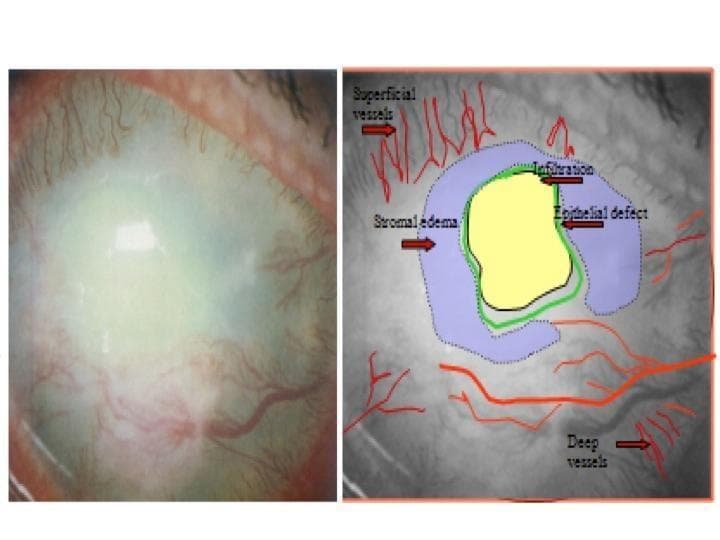
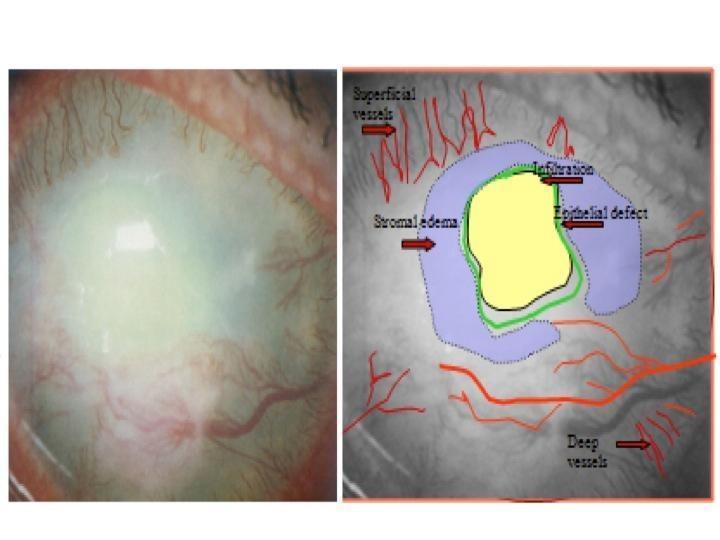
Stage 1 — Progressive Stage (Stage of Infiltration / Active Ulceration)
- Pathology: Active stromal infiltration by polymorphonuclear leukocytes (PMNs) and inflammatory cells. Necrosis of epithelium and anterior stroma begins.
- Clinical Features:
- Epithelial defect with underlying grey-white stromal infiltrate
- Surrounding stromal edema (hazy, swollen stroma)
- Marked ciliary/conjunctival congestion (circumcorneal injection)
- Mucopurulent discharge
- Hypopyon (sterile pus in anterior chamber) may form
- Severe pain, photophobia, blepharospasm, lacrimation
Khurana: This stage is characterized by ulceration with active necrosis, stromal infiltrate, and hypopyon formation.
Stage 2 — Regressive Stage (Stage of Regression / Healing)
- Pathology: Immune response gains the upper hand. Vascularization begins. PMN infiltration reduces.
- Clinical Features:
- Edges of ulcer become less undermined and more defined/regular
- Decrease in stromal infiltrate and surrounding edema
- Reduction in discharge and hypopyon
- Superficial vascularization (pannus) starts growing toward the ulcer from the limbus
- Pain and photophobia decrease
- Floor of ulcer becomes cleaner
Kanski: Regression is marked by reduction of infiltrate density and beginning epithelialization at the margins.
Stage 3 — Cicatrization Stage (Stage of Healing / Scarring)
- Pathology: Fibroblastic activity replaces necrotic tissue. Epithelial regeneration occurs from the edges inward.
- Clinical Features:
- Re-epithelialization of the ulcer surface (stains negative with fluorescein once complete)
- Formation of fibrous scar tissue
- Scar types depend on depth:
Scar Type Description Nebula Faint, hazy opacity — barely visible with oblique light Macula Moderate density opacity — visible to naked eye Leucoma Dense white opacity — may be adherent (adherent leucoma if iris is involved) - Decreased vascularization
- Symptoms largely resolve
Khurana (p. 96): The resulting opacity depends on the depth and extent of ulceration; deeper ulcers leave denser scars.
Stage 4 — Complications Stage
This is not always listed as a separate "stage" by all authors but is described by Khurana and Zia as outcomes of complicated/untreated ulcers:
Anterior Complications
| Complication | Mechanism |
|---|---|
| Hypopyon | Fibrinous/purulent exudate in anterior chamber |
| Iridocyclitis | Spread of toxins to uveal tract |
| Adherent leucoma (Leucoma adherens) | Iris plugs the perforation site |
| Anterior staphyloma | Uveal prolapse through a large perforation |
| Iris prolapse | Through corneal perforation |
Perforation-Related Complications
- Corneal perforation → sudden relief of pain, rush of aqueous, hypotony
- Endophthalmitis / Panophthalmitis — infection spreads to vitreous and entire globe
- Phthisis bulbi — end-stage shrunken, non-functional eye
Summary Table
| Stage | Also Called | Key Feature |
|---|---|---|
| Stage 1 | Progressive / Infiltration | Active ulceration, hypopyon, discharge |
| Stage 2 | Regressive | Healing begins, vascularization, edema decreases |
| Stage 3 | Cicatrization / Scarring | Scar formation (nebula/macula/leucoma) |
| Stage 4 | Complications | Perforation, endophthalmitis, staphyloma |
References:
- Kanski JJ. Clinical Ophthalmology: A Systematic Approach, 8th ed.
- Khurana AK. Comprehensive Ophthalmology, 7th ed. — pp. 94–99
- Zia ul Islam. Textbook of Ophthalmology
This is a shared conversation. Sign in to Orris to start your own chat.