
Hyperkalemia treatment guidelines
I'll start with a quick overview while I pull from the medical library and recent literature simultaneously.
Quick answer: Hyperkalemia treatment follows a stepwise approach - (1) cardiac membrane stabilization with calcium gluconate/chloride, (2) shifting K+ into cells using insulin+dextrose, beta-agonists, and sodium bicarbonate, and (3) removing K+ from the body via diuretics, kayexalate, patiromer, or dialysis. The urgency depends on the K+ level and ECG changes.
Searching sources...
Reading File
Searching PubMed
hyperkalemia treatment guidelines management
Good. Now I'll search the medical library for hyperkalemia treatment content and pull details on the key PubMed articles in parallel.
Finding Sources
Reading Article
PMID: 40685253
Reading Article
PMID: 40542996
Now I'll read the most comprehensive textbook sections in parallel.
Reading File
Reading File
Reading File
Excellent - I have rich content from multiple textbooks. Let me also fetch the treatment flowchart image and get the remaining NKF textbook content.
Loading Image
Reading File
I now have comprehensive content from multiple authoritative sources. Here is the full, synthesized answer:
Hyperkalemia Treatment Guidelines
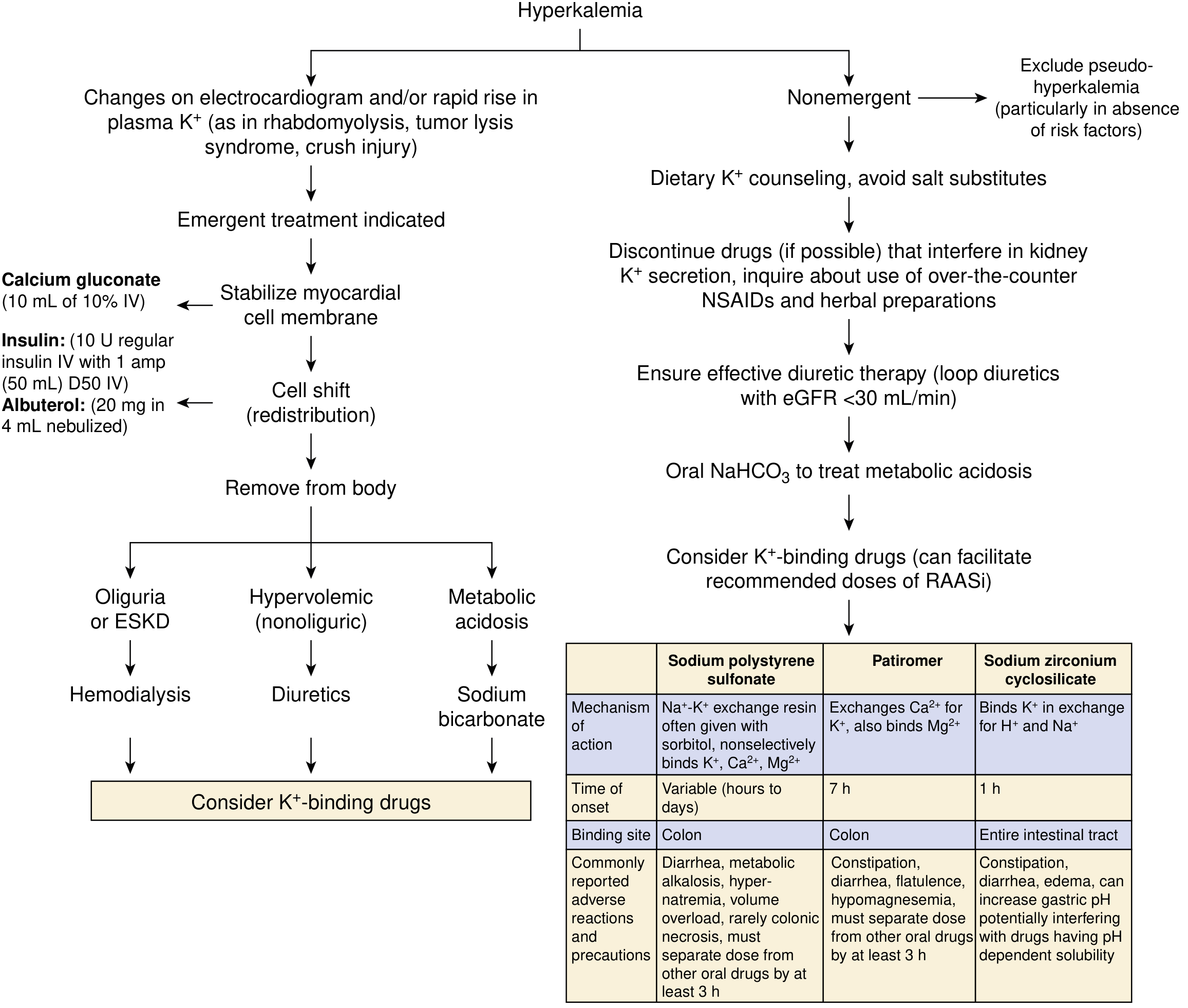
Fig. 10.3 - Approach to treatment of hyperkalemia (Palmer BF, Clegg DJ. Am J Kidney Dis. 2019)
Classification by Severity
| Severity | K+ Level | ECG Findings | Urgency |
|---|---|---|---|
| Mild | 5.5-6.0 mEq/L | None | Hours |
| Moderate | 6.0-6.5 mEq/L | Peaked T waves | Prompt (within 1 hour) |
| Severe | >6.5 mEq/L or any level with ECG changes | Wide QRS, loss of P waves, sine wave | Emergent |
There is no single plasma K+ concentration that defines "severe" hyperkalemia - any ECG change consistent with hyperkalemia renders the level "severe" and requires emergent management, regardless of the absolute value. - NKF Primer on Kidney Diseases, 8e
STEP 1 - Stabilize the Cardiac Membrane (Emergent, ECG changes present)
Calcium salts - do NOT lower plasma K+, but directly antagonize the cardiac membrane effects of hyperkalemia.
- Calcium gluconate: 10 mL of 10% solution IV over 1-3 minutes (preferred for peripheral IV access)
- Calcium chloride: 3-5 mL of 10% solution IV (more elemental calcium per ampule, but causes skin necrosis if it infiltrates - use central line only)
- Effect is rapid and nearly immediate; if no ECG improvement in 3-5 minutes, repeat the dose
- Effect is transient (30-60 min) - must follow with redistribution therapies
- Caution in digoxin toxicity: calcium potentiates digoxin cardiotoxicity
STEP 2 - Shift K+ Into Cells (Redistribution - Temporizing)
A. Insulin + Dextrose (fastest and most reliable)
- Regular insulin 10 units IV + 50 mL of 50% dextrose (D50W) as a bolus
- Follow with D5W infusion at 100 mL/hour to prevent late hypoglycemia
- K+ begins to fall within 15 minutes, peak effect at ~60 minutes
- Key cautions:
- Never give dextrose without insulin - in patients with inadequate endogenous insulin, hyperglycemia can paradoxically raise K+
- If blood glucose >300 mg/dL, insulin can be given without dextrose
- Monitor glucose closely; hypoglycemia is common in renal failure (prolonged insulin half-life)
- Lispro/aspart may cause less hypoglycemia in kidney failure as they are not renally metabolized
B. Nebulized Albuterol (Beta-2 Agonist)
- 20 mg nebulized over 10 minutes (use concentrated 5 mg/mL formulation)
- Onset ~30 minutes; effect is additive to insulin
- The dose needed for K+ lowering is much higher than the bronchodilator dose
- IV albuterol 0.5 mg (available in Europe) is equivalent to 20 mg nebulized
- Low-dose IV epinephrine infusion can also be used in emergencies (e.g., post-massive transfusion) with added inotropic benefit
C. Sodium Bicarbonate
- Lowers K+ by enhancing renal K+ excretion, not by cell shift (useful in patients with residual kidney function)
- Onset within 15 minutes when metabolic acidosis is present
- Indications: metabolic acidosis (especially serum bicarb <10 mmol/L) AND the patient has residual kidney function
- Not indicated as routine emergency monotherapy in patients without residual kidney function (ESKD/dialysis patients)
- Does not enhance the potassium-lowering effects of insulin or albuterol - no additive benefit in combination
STEP 3 - Remove K+ from the Body (Definitive Therapy)
A. Diuretics
- Loop and thiazide diuretics - effective if adequate kidney function exists
- Loop diuretics preferred when eGFR <30 mL/min
- Not useful in oliguric AKI or ESKD
B. Hemodialysis
- Most effective modality for K+ removal
- Indicated for severe hyperkalemia with oliguria, AKI, or ESKD
- Cannot typically be initiated fast enough to replace emergency measures above - stabilize with Steps 1-2 first
C. Potassium Binders (oral/rectal - adjunct and chronic prevention)
| Drug | Mechanism | Binding Site | Onset | Starting Dose | Key Adverse Effects |
|---|---|---|---|---|---|
| Sodium polystyrene sulfonate (SPS/Kayexalate) | Na+-K+ exchange resin | Colon | Hours to days (variable) | 50 g in 30 mL sorbitol PO or enema | Diarrhea, metabolic alkalosis, hypernatremia, rare colonic necrosis (FDA black box warning) |
| Patiromer (Veltassa) | Exchanges Ca2+ for K+ | Colon | ~7 hours | 8.4 g once daily; titrate weekly | Constipation, diarrhea, hypomagnesemia; separate from other drugs by 3 hours |
| Sodium zirconium cyclosilicate (Lokelma) | Binds K+ in exchange for H+ and Na+ | Entire GI tract | ~1 hour | 10 g three times daily x 48 h, then 5-10 g once daily | Constipation, diarrhea, edema; can raise gastric pH |
Important caveats for binders:
- SPS: not approved for chronic management; evidence base is weak (mostly small, low-quality studies); colonic necrosis risk is real especially with sorbitol
- Patiromer and SZC: FDA-approved for chronic management of hyperkalemia; multiple RCTs show ~1 mEq/L sustained reduction in K+; particularly useful to allow continuation/up-titration of RAASi in CKD and heart failure
- None of the binders should be used as monotherapy for acute or emergency hyperkalemia - use only as adjuncts to Steps 1-2
Non-Emergent Management (No ECG Changes)
- Stop exogenous K+ (IV fluids, dietary sources, salt substitutes)
- Dietary K+ counseling - avoid high-K+ foods, salt substitutes containing KCl
- Discontinue or dose-reduce causative drugs where possible: NSAIDs, ACE inhibitors, ARBs, potassium-sparing diuretics, trimethoprim, heparin
- Treat underlying cause (e.g., fludrocortisone for hypoaldosteronism)
- Ensure effective diuretic therapy - loop diuretics especially when eGFR <30 mL/min
- Oral NaHCO3 to treat metabolic acidosis
- Consider K+ binders - particularly to enable guideline-directed RAASi use in CKD/HF patients
Special Clinical Situations
Hyperkalemia in CKD/Heart Failure on RAASi
A 2025 systematic review and network meta-analysis (PMID: 40542996) found that novel potassium binders (patiromer and SZC) improved RAASi optimization by 38% compared to placebo, decreased hyperkalemia incidence by 28%, and reduced K+ by 0.71 mEq/L. The 2025 GUARDIAN-HK European consensus (PMID: 40685253) explicitly states that RAASi should no longer be considered a reversible cause of hyperkalemia - instead, K+ binders should be used to maintain patients on guideline-directed target doses.
Perioperative/Anesthetic Considerations
- Elective surgery should be deferred until hyperkalemia is corrected
- Succinylcholine is contraindicated - depolarizing blockade causes additional K+ release
- Avoid potassium-containing IV solutions (e.g., lactated Ringer's)
- Avoid metabolic or respiratory acidosis - use controlled ventilation
- Monitor neuromuscular function closely - hyperkalemia accentuates NMB effects
- Morgan and Mikhail's Clinical Anesthesiology, 7e
Digoxin-Toxic Patients
- Calcium is relatively contraindicated - calcium potentiates digoxin cardiotoxicity ("stone heart" syndrome)
- Consider Digibind (digoxin-specific antibody fragments) instead
Summary Algorithm
Hyperkalemia
    |
    ├── ECG changes or K+ >6.5 mEq/L → EMERGENT
    │       1. Calcium gluconate 10 mL 10% IV (stabilize membrane)
    │       2. Insulin 10U + D50W IV (shift)
    │          + Albuterol 20 mg nebulized (shift, additive)
    │       3. Remove: Diuretics / Dialysis / Binders (adjunct)
    │
    └── No ECG changes, K+ 5.5-6.5 mEq/L → NON-EMERGENT
            - Stop K+ sources, dietary counseling
            - Remove causative drugs
            - Loop diuretics (if renal function intact)
            - Oral NaHCO3 (if metabolic acidosis)
            - Chronic K+ binders (patiromer or SZC) to enable RAASi
Sources:
- NKF Primer on Kidney Diseases, 8e (p. 128-129)
- Morgan and Mikhail's Clinical Anesthesiology, 7e (p. 2180-2181)
- Sabiston Textbook of Surgery, 11e (Box 33.5, p. 602)
- GUARDIAN-HK European Steering Committee, 2025 [PMID: 40685253]
- Huang et al., Drugs, 2025 - Novel Potassium Binders Meta-analysis [PMID: 40542996]
This is a shared conversation. Sign in to Orris to start your own chat.