
Changes in the corpse
This is a medical/forensic topic. Let me invoke the medical library skill first.
Searching sources...
Reading File
Now let me search the medical library for postmortem changes in the corpse, and run parallel searches.
Finding Sources
Finding Sources
Searching Images
postmortem changes rigor mortis livor mortis decomposition
Finding Sources
Finding Sources
Finding Sources
Excellent - I have three forensic medicine textbooks with relevant content. Let me read the key sections in parallel.
Reading File
Reading File
I have rich content. Let me now read the decomposition/putrefaction sections and the livor mortis sections.
Reading File
Reading File
Reading File
Finding Sources
Reading File
Reading File
I now have comprehensive content. Let me also fetch a couple of key images to include in my answer.
Reading File
I now have enough comprehensive material from authoritative forensic medicine textbooks. Let me compile the full answer.
Changes in the Corpse (Postmortem Changes)
After death, the body undergoes a predictable series of changes that are broadly divided into early postmortem changes and late postmortem changes (decomposition). These changes are of enormous medicolegal importance - they help estimate the time since death (postmortem interval) and the manner of death.
I. EARLY POSTMORTEM CHANGES
1. Algor Mortis (Cooling of the Body)
After death, the body cools toward the ambient temperature. The rate of cooling depends on:
- Body size and surface area
- Clothing and insulation
- Environmental temperature and humidity
- Air movement
A rough rule used is: body loses ~1.5°F (0.83°C) per hour in the first 12 hours under standard conditions. The "Rule of Thumb": a normally clothed body loses ~1°C/hour.
2. Livor Mortis (Postmortem Hypostasis / Cadaveric Lividity)
Also called postmortem staining, subcutaneous hypostasis, cadaveric lividity, suggillations, or vibices.
Mechanism: After circulation stops, blood stagnates in capillaries and venules and sinks by gravity to the lowest (dependent) parts of the body. Deoxyhemoglobin causes the characteristic bluish-purple color in the dependent skin.
Appearance: Bluish-purple or purplish-red discoloration in the most superficial layers of the dermis of dependent body parts.
Timing (Mallach's data from The Essentials of Forensic Medicine and Toxicology, 36th ed.):
| Stage | Lower Limit (hrs) | Upper Limit (hrs) |
|---|---|---|
| Beginning | 0.25 | 3 |
| Confluence | 1 | 4 |
| Maximum | 3 | 16 |
| Thumb pressure blanches | 1 | 20 |
| Complete shifting possible | 2 | 6 |
| Incomplete shifting | 4 | 24 |
Key forensic points:
- Livor is fixed (no longer shifts) after ~8-12 hours because blood coagulates and escapes the vessels by diapedesis into tissues
- If the body is moved after fixation, a double lividity pattern appears (old + new), indicating the body was repositioned
- Tardieu spots are petechiae within areas of livor, caused by rupture of overdistended capillaries - they should not be confused with antemortem bruising
- Color variations can suggest cause of death: cherry-red in CO poisoning, pink in cyanide poisoning or cold exposure, brown in methaemoglobinaemia
The distribution of livor reflects terminal posture. It is one of the most useful indicators that a body has been moved after death.
- DiMaio's Forensic Pathology, 3rd ed.
3. Rigor Mortis (Postmortem Rigidity)
Mechanism: ATP is the energy source that keeps actin-myosin filaments in a state of relaxation. After death, ATP production ceases but consumption continues. When ATP falls to a critical level (~15% of normal), actin and myosin form a rigid, inextensible actomyosin complex, causing muscle stiffening. The process is irreversible until putrefaction physically disrupts the actomyosin complex.
- The Essentials of Forensic Medicine and Toxicology, 36th ed.; DiMaio's Forensic Pathology, 3rd ed.
Order of Appearance - Nysten's Rule: Rigor appears first in smaller muscles, descending from the head downward:
- Eyelids and jaw
- Neck
- Trunk
- Upper limbs
- Lower limbs
Rigor involves all muscles simultaneously at the cellular level, but becomes apparent first in smaller muscles.
Timing:
| Condition | Onset | Full Development | Duration |
|---|---|---|---|
| India (summer/tropical) | 1-2 hrs | 6 hrs | 18-36 hrs |
| Temperate countries | 3-6 hrs | 12 hrs | 2-3 days |
- "Rule of 12" (onset at 12 hr, complete at 12 hr, resolved in 12 hr) is NOT applicable in tropical countries
Factors affecting rigor:
- Accelerate onset: violent exercise, convulsions, high body temperature, fever, strychnine poisoning, excited delirium
- Delay onset: cold temperature, old age, emaciation, wasting diseases
- Cadaveric spasm (instantaneous rigor): Rare. Occurs at the moment of death in a state of extreme muscular activity (e.g., a person dying clutching an object). Forensically significant - object firmly clenched in hand cannot be mimicked postmortem
Breaking rigor: Rigor can be broken by passive stretching. It will not return if completely established; only the unbroken residual rigor can still set in.
Effects on the dead body:
- In the heart, rigor causes ventricular contraction that may mimic left ventricular hypertrophy
- Facial grimacing from rigor does NOT indicate the deceased's emotional state at time of death
- Rarely, uterine rigor can expel a fetus (postmortem fetal extrusion, "coffin birth")
II. LATE POSTMORTEM CHANGES (Decomposition)
Decomposition involves two parallel processes: (1) Autolysis and (2) Putrefaction.
1. Autolysis (Self-Digestion)
- Occurs immediately after death without bacterial involvement
- Cell membranes break down, releasing lysosomal hydrolases (proteolytic, glycolytic, lipolytic)
- Earliest in: intestinal lining, adrenal medulla, pancreas (within hours of death)
- Brain undergoes early softening/liquefaction (especially in neonates)
- Autodigestion by gastric acid is common in the newborn
- Increased by heat; stopped by freezing
2. Putrefaction
Putrefaction is caused by bacteria (mainly anaerobes from the gut, e.g., Clostridium welchii) and leads to fermentation of tissues.
Signs of Putrefaction - Sequence:
-
Greenish discoloration of skin - first appears over the right iliac fossa (cecum area, closest to the bowel), within ~24-36 hours in summer. The color gradually extends to the whole abdomen, then the whole body, changing from green → greenish-brown → greenish-black.
-
Foul-smelling gases - H₂S, methane, ammonia, CO₂, mercaptans, phosphorated hydrogen accumulate in gut (12-18 hrs in summer).
-
Bloating / Distension - Gas accumulates in the abdomen, intestines, and tissues. Features become distended and bloated. Diaphragm is pushed up, compressing heart and lungs, and can expel bloodstained fluid from mouth and nose (should not be mistaken for antemortem hemorrhage).
-
Skin blistering - Gas forces fluid between epidermis and dermis, forming blisters (18-24 hours). Epidermis peels off in large sheets ("skin slippage").
-
Marbling - Hemolysis of red cells releases hemoglobin, which diffuses through vessel walls and stains surrounding tissue with a greenish-black network along vessel lines (a tree-branch or marble pattern).
-
Eyes and mouth - Eyeballs soften, cornea becomes white and flattened; eyes eventually collapse. Tongue may protrude.
-
Rectum/anal prolapse - Gas pressure can force protrusion of the rectum.
-
Liquefaction - Organs progressively liquefy. Soft, blood-rich organs near gut sources putrefy first. Fibrous and muscular organs (e.g., uterus, heart) resist longer. Eventually the body is reduced to a skeleton and adipocere/mummification residues.
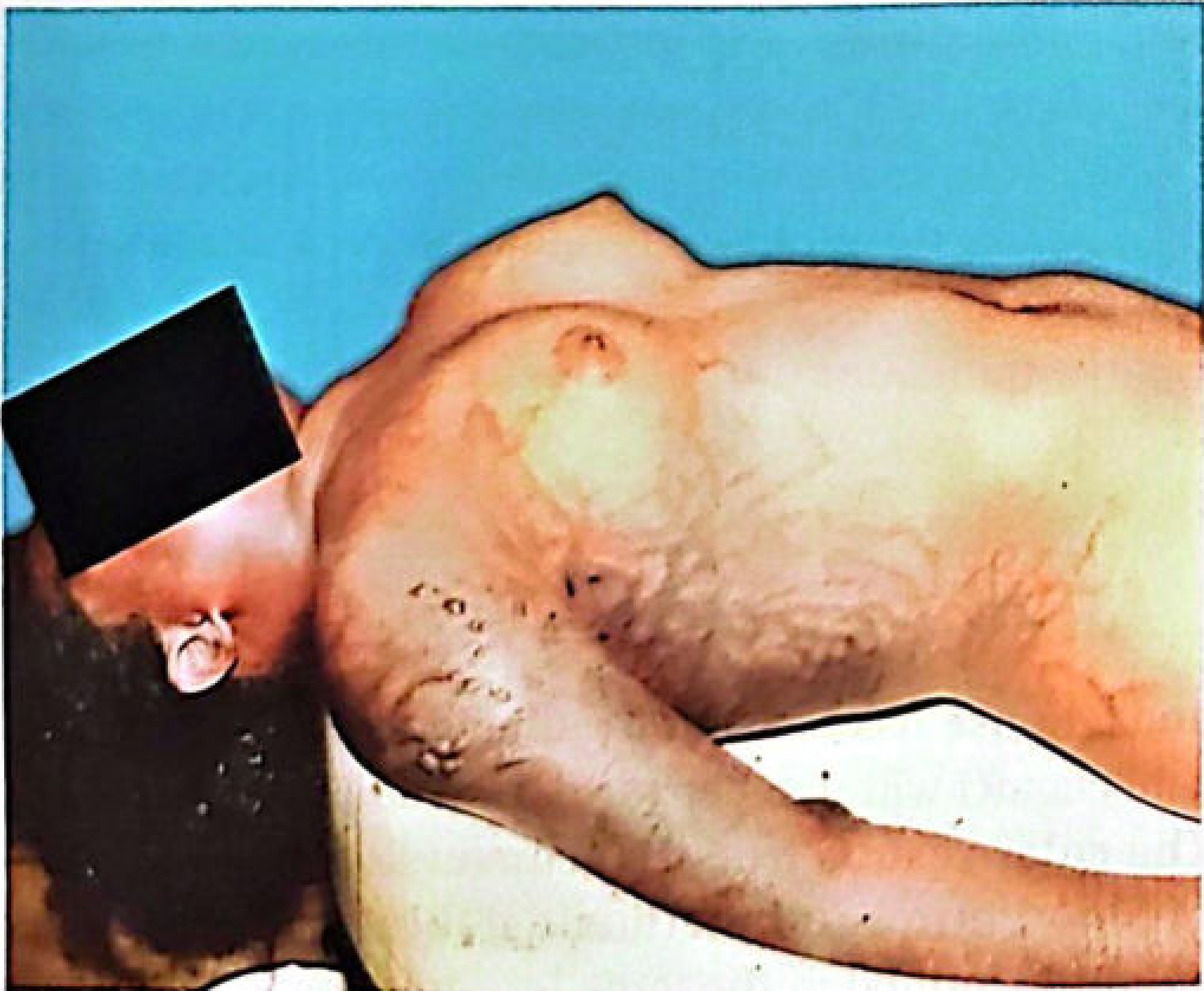
Fig: Putrefactive network (Marbling) - The Essentials of Forensic Medicine and Toxicology, 36th ed.
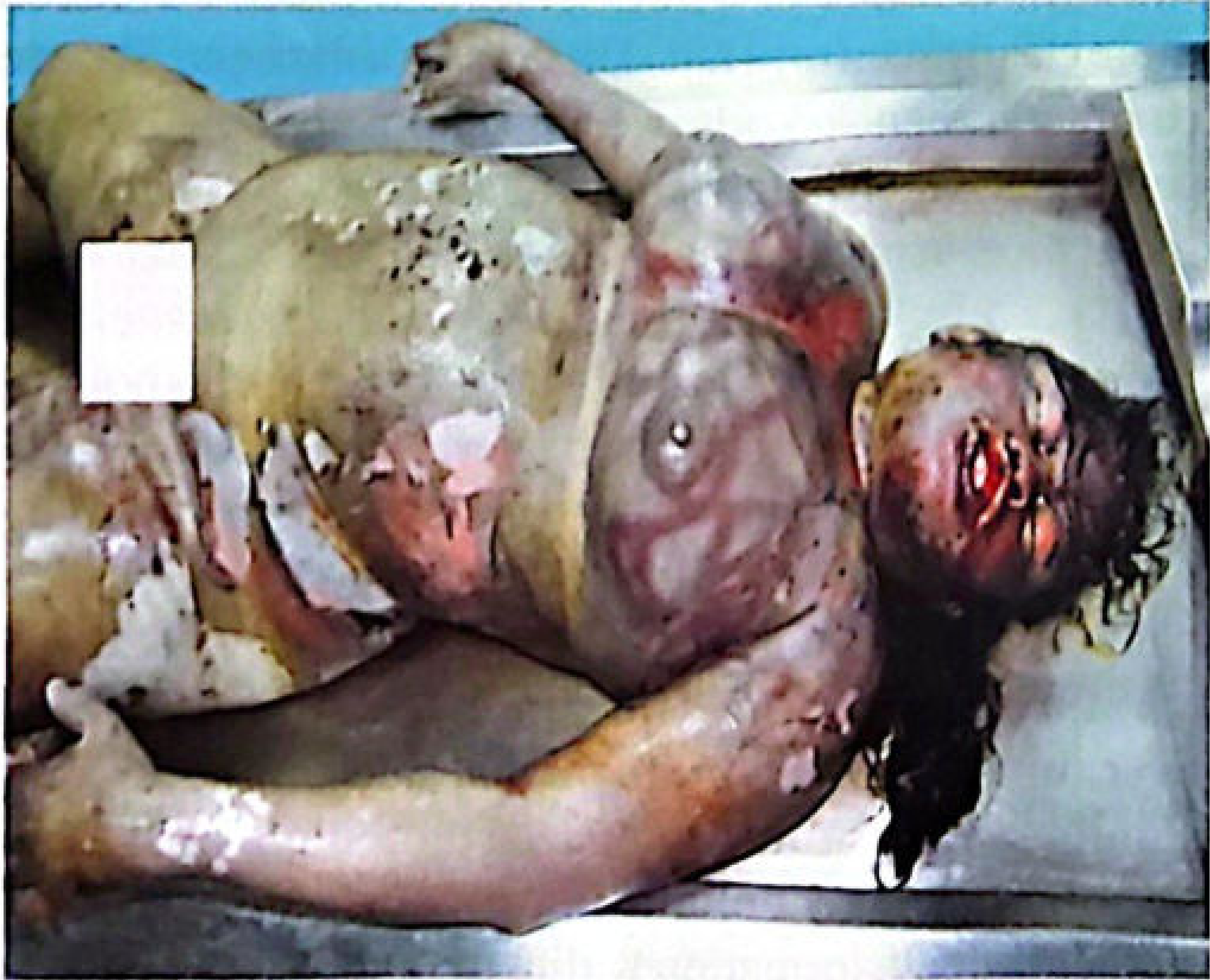
Fig: Advanced decomposition. Marbling and bloating.
Order of internal organ putrefaction:
- Lining of intestine, adrenal medulla, pancreas: within hours
- Liver, spleen, kidneys (parenchyma): days
- Fibrous and muscular organs (uterus, heart, diaphragm): weeks to months
- Bones: last to resist
3. Special Forms of Decomposition
A. Mummification
- Occurs in hot, dry, or artificially desiccated conditions
- Body dries and shrivels rather than liquefying; skin becomes hard, leathery, dark brown
- Can preserve the body for years or centuries
- Part of the body may mummify while the rest putrefies
B. Adipocere ("Grave Wax" / Saponification)
- Occurs in damp, warm, and anaerobic conditions (waterlogged graves, submersion in water)
- Body fat undergoes saponification (conversion to a yellow-white waxy or soap-like substance)
- Hydrogenation of unsaturated fats → saturated fatty acids (palmitic, stearic, hydroxystearic acids)
- Preserves body contours; can allow identification of injuries for many years
C. Maceration
- Occurs in a fetus that dies in utero with intact membranes
- Caused by autolysis in the amniotic fluid (no bacterial action)
- Skin becomes soft, discolored, and peels off; bones become separated
III. Factors Modifying Rate of Putrefaction
External (Environmental):
| Factor | Accelerates | Delays |
|---|---|---|
| Temperature | High (30-40°C optimal) | Cold/freezing |
| Moisture | Damp conditions | Dry conditions |
| Air | Free access | Exclusion (sealed coffin) |
| Burial | Shallow, warm, damp soil | Deep, dry, sandy soil; lime burial |
Internal (Body-related):
| Factor | Accelerates | Delays |
|---|---|---|
| Age | Children | Newborns (if unfed, sterile gut); elderly |
| Build | Fat and flabby bodies | Lean, muscular |
| Cause of death | Septicemia, drowning | Wasting diseases, dry conditions |
| Ante-mortem poisoning | - | Arsenic, antimony delay putrefaction |
Casper's rule: A body decomposes twice as fast in air as in water, and eight times faster in air than when buried in the ground.
Forensic Significance Summary
| Change | Use |
|---|---|
| Livor mortis | Estimate time of death; detect if body was moved |
| Rigor mortis | Estimate time of death (postmortem interval) |
| Algor mortis | Estimate time of death in early postmortem period |
| Putrefaction stage | Approximate postmortem interval in later cases |
| Adipocere | May allow identification and injury analysis years later |
| Cadaveric spasm | Proves the object was held at the moment of death |
Sources: The Essentials of Forensic Medicine and Toxicology, 36th ed. (2026); DiMaio's Forensic Pathology, 3rd ed.; Parikh's Textbook of Medical Jurisprudence Forensic Medicine and Toxicology
This is a shared conversation. Sign in to Orris to start your own chat.