
Hypertension pathogenesis
Reading File
Searching for comprehensive coverage of hypertension pathogenesis across its major mechanisms.
search_medical_text
hypertension pathogenesis mechanisms pathophysiology
Harrison's Principles of Internal Medicine, Twenty First Edition
Page 7634
search_medical_text
RAAS sympathetic nervous system vascular remodeling hypertension
Management of Elevated Blood Pressure and Hypertension
Page 17
GradeResponse
GradeResponse
GradeResponse
Hypertension Pathogenesis
Core Hemodynamic Framework
Arterial pressure is the product of two variables (Harrison's, p. 7634):
BP = Cardiac Output (CO) × Peripheral Vascular Resistance (PVR)
- CO is determined by stroke volume (myocardial contractility + vascular compartment size) and heart rate.
- PVR is governed by functional and structural changes in small arteries (lumen 100–400 μm) and arterioles.
Hypertension arises when one or both of these are chronically elevated, through a complex interplay of genetic, environmental, neurohumoral, and organ-level mechanisms.
Major Pathophysiological Mechanisms
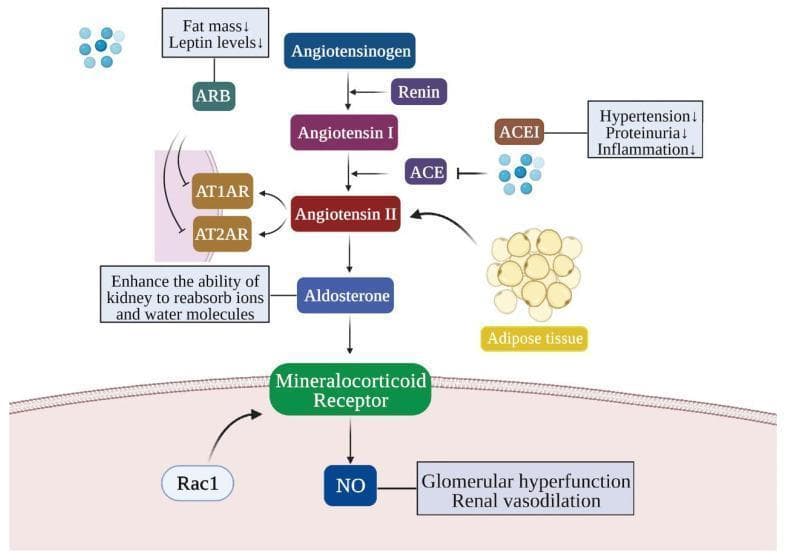
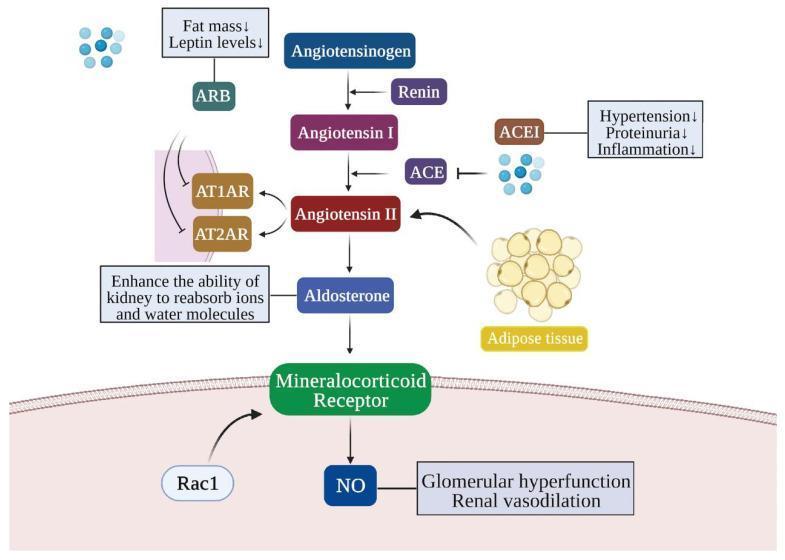
1. Renin-Angiotensin-Aldosterone System (RAAS)
The RAAS is a central driver of BP regulation and hypertension:
- Renin (released by juxtaglomerular cells in response to low renal perfusion, low Na⁺, or SNS activation) cleaves angiotensinogen → Angiotensin I
- ACE (in lung endothelium) converts Ang I → Angiotensin II (Ang II)
- Ang II acts on AT₁ receptors to cause:
- Potent vasoconstriction (↑ PVR)
- Aldosterone release → Na⁺ and water retention (↑ CO)
- Direct renal tubular Na⁺ reabsorption
- Vascular smooth muscle hypertrophy (structural remodeling)
- Central sympathetic activation
- Oxidative stress and endothelial dysfunction
2. Sympathetic Nervous System (SNS) Overactivity
- Increased efferent SNS tone elevates BP via:
- Increased heart rate and contractility (↑ CO)
- Vasoconstriction (↑ PVR)
- Renal vasoconstriction → renin release (activating RAAS)
- Na⁺ retention
- Triggers include stress, obesity (leptin-mediated), sleep apnea, and baroreceptor dysfunction
- Chronic SNS activation resets the baroreflex to a higher set point
3. Renal Mechanisms — Pressure-Natriuresis Dysfunction
The kidney normally adjusts Na⁺ excretion in proportion to perfusion pressure (Guyton's model). In hypertension:
- The pressure-natriuresis curve is shifted rightward — higher BP is required to achieve the same natriuresis
- Causes include reduced nephron number (Brenner hypothesis), intrarenal RAAS activation, and tubular Na⁺ transporter upregulation (NHE3, ENaC)
- Volume expansion → sustained ↑ CO → ↑ BP
4. Vascular Remodeling and Endothelial Dysfunction
| Feature | Effect |
|---|---|
| Reduced nitric oxide (NO) bioavailability | Impaired vasodilation, ↑ PVR |
| ↑ Reactive oxygen species (ROS) | NO scavenging, oxidative endothelial injury |
| Smooth muscle hypertrophy/hyperplasia | Permanent ↑ in wall:lumen ratio |
| ↑ Endothelin-1 | Vasoconstriction |
| Arterial stiffness (↓ elastin, ↑ collagen) | ↑ Pulse wave velocity, isolated systolic HTN |
Ang II, aldosterone, and chronic shear stress all contribute to these structural changes, which make hypertension self-perpetuating.
5. Genetic and Polygenic Contributions
- Hypertension is highly heritable (~30–50%)
- Monogenic forms (rare): Liddle syndrome (ENaC gain-of-function), glucocorticoid-remediable aldosteronism, Gordon syndrome (WNK kinase mutations)
- Common/polygenic: hundreds of SNPs each with small effect, involving Na⁺ transport, RAAS components, adrenergic receptors, and endothelial function
- As noted in the management guidelines (GLGCA, p. 17), "the contribution of these factors may differ among males and females"
6. Salt Sensitivity and Volume Dysregulation
- ~50% of hypertensives are salt-sensitive (BP rises with Na⁺ load)
- More prevalent in Black populations, elderly, CKD, and diabetics
- Mechanisms: blunted renal dopamine response, RAAS over-activation, aldosterone excess, reduced renal medullary prostaglandins
7. Neuroinflammation and Immune Activation
- T lymphocytes (particularly Th17 cells) infiltrate the kidney and vasculature in hypertension
- Ang II drives T-cell activation → release of IL-17, TNF-α
- These cytokines promote renal Na⁺ retention and vascular inflammation
- An emerging mechanism explaining why anti-inflammatory pathways can lower BP experimentally
8. Obesity and Metabolic Factors
- Adipose tissue is a source of angiotensinogen (direct RAAS input)
- Leptin hypersecretion activates the SNS (renal and adrenal)
- Insulin resistance → hyperinsulinemia → Na⁺ retention, SNS activation
- Obstructive sleep apnea causes intermittent hypoxia → chemoreceptor activation → chronic SNS elevation
Integrated Model
Genetic predisposition + Environmental factors (Na⁺, obesity, stress)
                        ↓
        ↑ RAAS + ↑ SNS + Renal Na⁺ retention
                        ↓
           ↑ CO and/or ↑ PVR → Elevated BP
                        ↓
        Vascular remodeling + Endothelial dysfunction
                        ↓
        BP elevation becomes structural and self-sustaining
(Management of Elevated Blood Pressure and Hypertension, p. 17; Harrison's, p. 7634)
Secondary Hypertension — Distinct Pathogenic Pathways
| Cause | Mechanism |
|---|---|
| Primary hyperaldosteronism | Autonomous aldosterone → Na⁺/water retention |
| Renal artery stenosis | ↓ Renal perfusion → ↑ renin → RAAS activation |
| Pheochromocytoma | Catecholamine excess → ↑ CO and ↑ PVR |
| Cushing's syndrome | Glucocorticoid-mediated Na⁺ retention, ↑ vascular reactivity |
| CKD | ↓ Nephron mass, volume overload, RAAS activation |
| Hypothyroidism | ↓ CO but ↑ PVR (diastolic HTN) |
Understanding these overlapping mechanisms is the basis for rational antihypertensive therapy — diuretics (volume), ACEi/ARBs (RAAS), beta-blockers (SNS/CO), CCBs (PVR), and aldosterone antagonists each target distinct nodes in the pathogenic cascade.
This is a shared conversation. Sign in to Orris to start your own chat.