
Segment of facial nerve
Reading File
Finding Sources
Finding Sources
Reading File
Reading File
Finding Sources
Finding Sources
Reading File
Reading File
Reading File
Searching Images
segments of facial nerve anatomy diagram
Loading Image
Loading Image
Here is a comprehensive account of the segments of the facial nerve (CN VII), based on authoritative otolaryngology and anatomy textbooks.
Segments of the Facial Nerve
The facial nerve is divided into 6 segments, tracing its course from the brainstem to the face.
1. Intracranial (Cisternal) Segment — 17–24 mm
- Runs from the pontomedullary junction to the internal auditory canal (IAC) fundus.
- Travels through the cerebellopontine angle (CPA) cistern alongside CN VIII (vestibulocochlear nerve).
- Accompanied by the nervus intermedius, which carries parasympathetic, taste, and somatic sensory fibers.
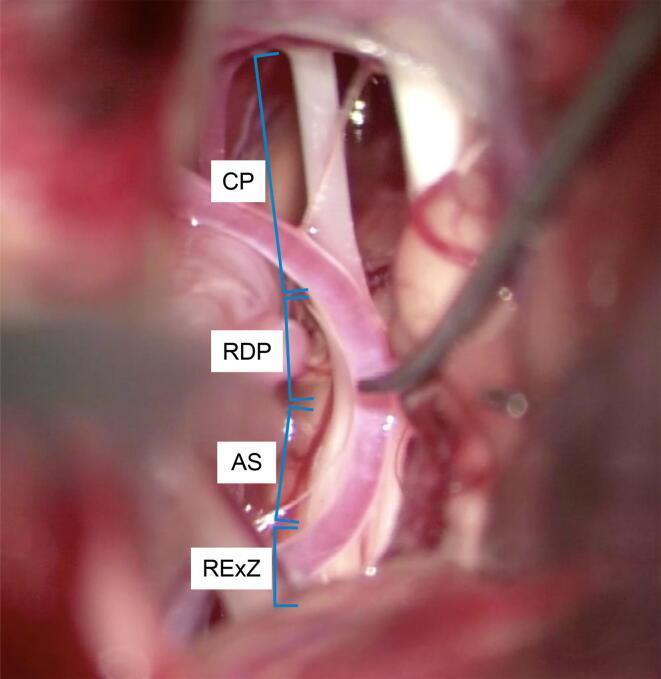
- Sub-segments at the root exit zone (intraoperative classification): Root Exit Zone (RExZ) → Attached Segment (AS) → Root Detachment Point (RDP, Obersteiner-Redlich zone) → Cisternal Portion (CP).
2. Meatal (IAC) Segment — 8–10 mm
- Runs from the fundus of the IAC in its anterosuperior quadrant to the meatal foramen (porus acusticus internus).
- The nerve has no fibrous sheath or endoneurium here; surrounded only by a thin arachnoid layer.
- Surgical landmark: Vertical crest (Bill's bar) separates the facial nerve from the superior vestibular nerve.
3. Labyrinthine Segment — ~4 mm (shortest & narrowest)
- From the meatal foramen to the geniculate ganglion.
- This is the narrowest part of the fallopian (bony) canal — the nerve is most susceptible to compression and ischemia here (inflammatory swelling in Bell palsy, herpes zoster).
- Travels superior to the cochlea.
- Lacks epineurium and associated vascular plexus → vulnerable to injury.
- Blood supply watershed: vertebrobasilar (via AICA labyrinthine branches) meets the external carotid system (petrosal branch of middle meningeal artery).
4. Tympanic (Horizontal) Segment — ~11 mm
- From the geniculate ganglion (first genu, acute posterior turn) to the second genu (pyramidal eminence level).
- Runs along the medial wall of the middle ear — superior to the oval window, below the lateral semicircular canal.
- The nerve acquires its fibrous sheath at and distal to the geniculate ganglion.
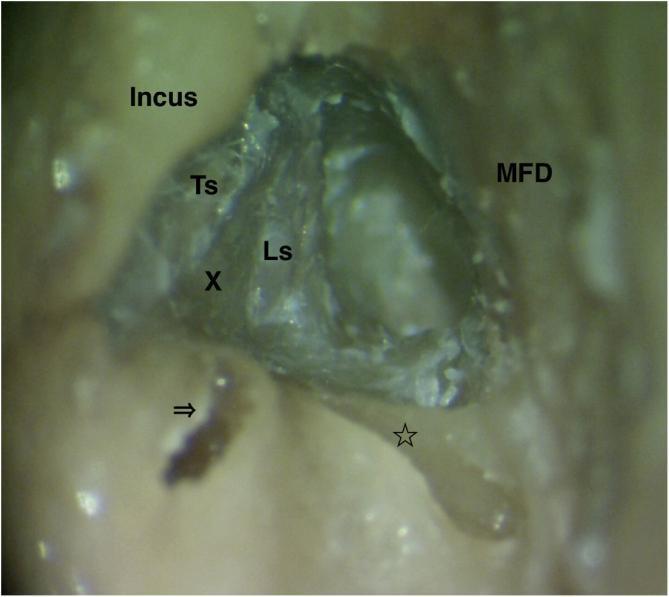
- Most common site of congenital bony dehiscence (above the oval window, in ~25% of ears) → risk of injury during otologic surgery and toxic effects of otitis media.
- Surgical landmarks: cochleariform process, supratubal recess.
5. Mastoid (Vertical) Segment — ~13 mm
- From the second genu to the stylomastoid foramen.
- Chorda tympani branches off within this segment → carries taste from anterior 2/3 tongue and preganglionic parasympathetics to submandibular/sublingual glands.
- Stapedial branch also arises here.
- The facial recess (posterior tympanotomy) lies between the mastoid segment and the chorda tympani — a critical surgical corridor.
- Most variable segment in anatomy, especially in congenital aural atresia; the nerve runs more anterior/lateral in newborns (underdeveloped mastoid tip → risk during postauricular approaches and forceps delivery).
- Surgical landmarks: pyramidal eminence, short process of incus, prominence of lateral SCC.
6. Extratemporal Segment
- Exits the stylomastoid foramen → enters the parotid gland.
- Divides into upper and lower trunks within the parotid, then into five terminal branches:
| Branch | Muscles innervated |
|---|---|
| Temporal | Frontalis, orbicularis oculi (upper), corrugator |
| Zygomatic | Orbicularis oculi (lower), zygomaticus |
| Buccal | Buccinator, orbicularis oris, nasalis |
| Marginal mandibular | Depressors of lower lip, mentalis |
| Cervical | Platysma |
Surgical Landmarks by Segment
| Segment | Key Surgical Landmark |
|---|---|
| Labyrinthine | Vertical crest (Bill's bar) |
| Geniculate ganglion | Retrograde dissection of GSPN (middle fossa) |
| Tympanic | Cochleariform process; supratubal recess |
| Second genu | Oval window |
| Mastoid | Pyramidal eminence; short process of incus; lateral SCC |
| Stylomastoid foramen | Cephalic edge/aponeurosis of posterior digastric muscle |
Key Clinical Points
| Clinical Scenario | Segment Involved |
|---|---|
| Bell palsy — edema/compression | Labyrinthine (narrowest, no epineurium) |
| Congenital dehiscence | Tympanic (above oval window) |
| Cholesteatoma erosion | Tympanic/second genu |
| Temporal bone fracture | Geniculate ganglion (thin/dehiscent bone) + labyrinthine |
| Parotid tumor/surgery | Extratemporal branches |
| Forceps delivery injury | Mastoid (superficial in newborns) |
| Bell palsy MRI | Enhancement: distal IAC → labyrinthine → anterior tympanic |
Sources: K.J. Lee's Essential Otolaryngology, pp. 422–423; Cummings Otolaryngology Head and Neck Surgery, pp. 2451–2452; Gray's Anatomy for Students
This is a shared conversation. Sign in to Orris to start your own chat.