
morphological features of prostatic hyperplasia according to Robbins along eith figure so that i can memorize
Reading File
Finding Sources
Searching Images
benign prostatic hyperplasia Robbins gross morphology nodular enlargement histology glands stroma
Searching PubMed
"prostatic hyperplasia" AND morphology
Searching the Web
Robbins Basic Pathology benign prostatic hyperplasia morphology nodular hyperplasia periurethral zone
Finding Sources
Finding Sources
query_images_db
Reading File
Reading File
Finding Sources
Finding Sources
Finding Sources
query_images_db
Finding Sources
query_images_db
Reading File
Loading Image
Loading Image
Reading File
Reading File
Benign Prostatic Hyperplasia - Morphology (Robbins)
Core idea: BPH is a nodular hyperplasia of both glands and fibromuscular stroma occurring in the transition zone, around the urethra.
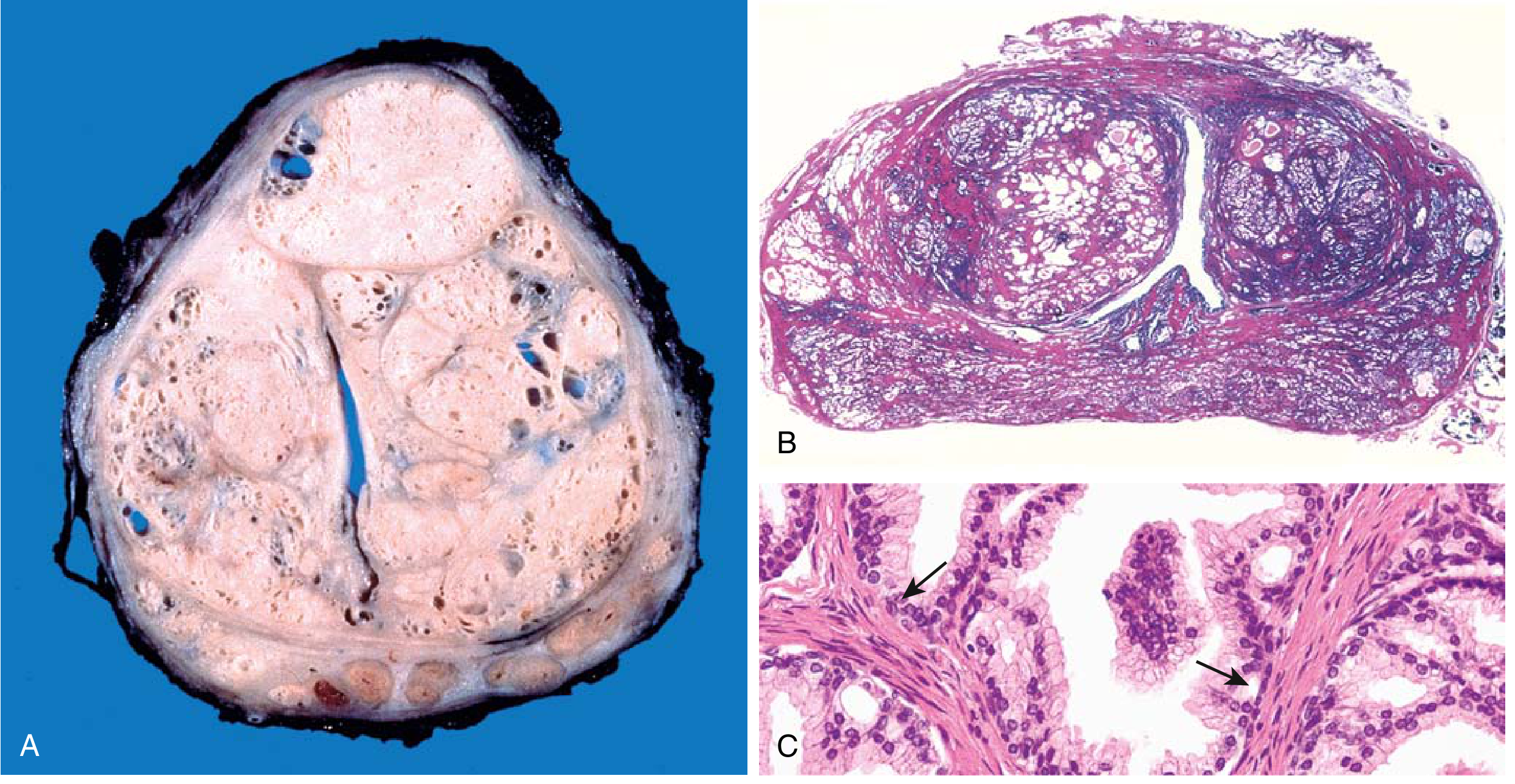
Gross morphology
| Feature | What to remember |
|---|---|
| Site | Transition (periurethral) zone |
| Size/weight | Prostate often enlarges 3-5 times, typically 60-100 g or more |
| Pattern | Multiple, well-circumscribed hyperplastic nodules |
| Urethral effect | Nodules encroach upon and compress the prostatic urethra into a slit-like lumen |
| Cut surface | Nodules can be solid or contain cystic spaces |
| Why cystic? | Cystic spaces represent dilated hyperplastic glands |
Microscopic morphology
-
Nodules contain variable proportions of:
- Glandular proliferation
- Fibromuscular stromal proliferation
Thus, some nodules are predominantly glandular, while others are predominantly stromal.
-
Glands
- Increased in number and often large/dilated.
- Lined by tall columnar secretory cells.
- Show characteristic papillary infoldings into the lumen.
-
Basal-cell layer is retained
- A peripheral layer of flattened basal cells remains present.
- This is an important distinction from prostatic adenocarcinoma, where basal cells are absent.
-
Luminal secretion
- Gland lumina may contain laminated eosinophilic proteinaceous concretions called corpora amylacea.
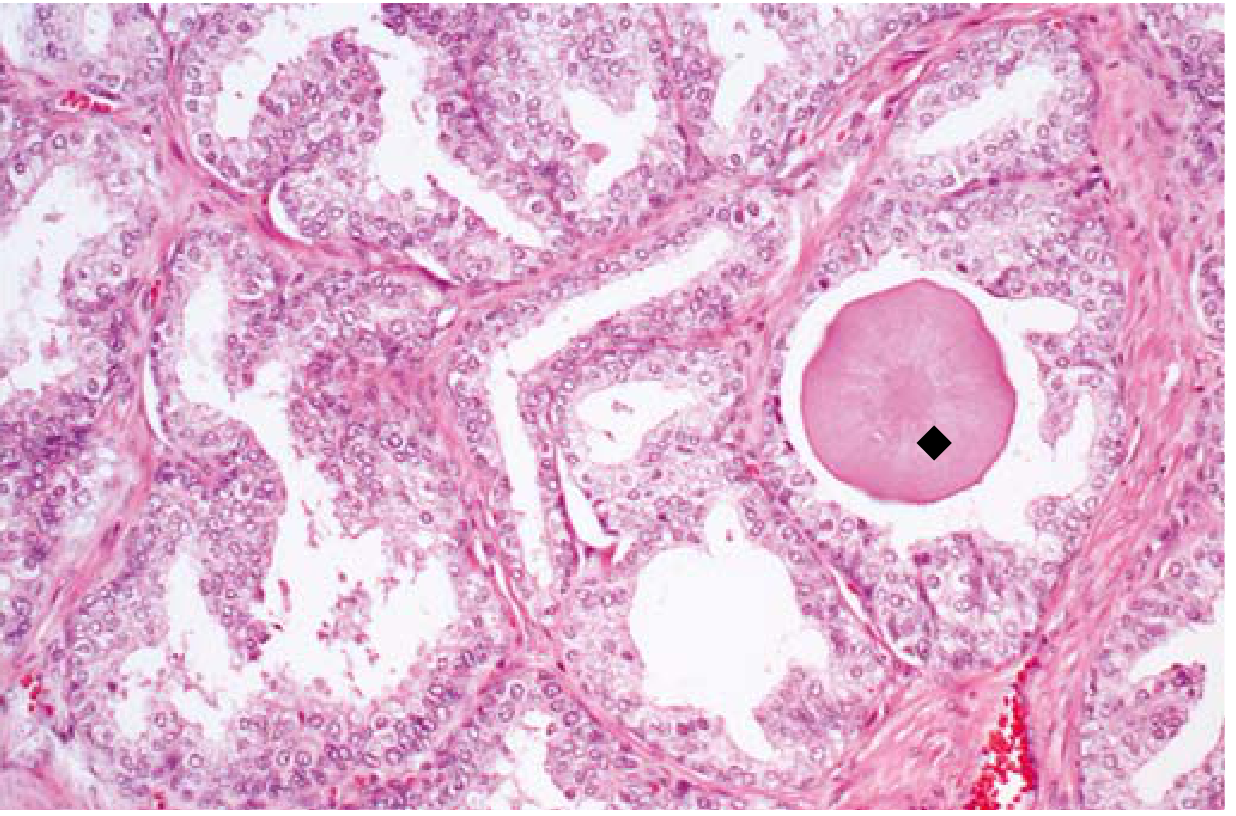
One-line exam answer
BPH is a nodular proliferation of glands and fibromuscular stroma in the transition/periurethral zone, producing an enlarged prostate with nodules that compress the urethra. Microscopically, glands are increased and often cystically dilated, show papillary infoldings, retain a basal-cell layer, and may contain corpora amylacea.
Memory aid: “TUGS BPH”
- T - Transition zone
- U - Urethra compressed into a slit
- G - Glands proliferate, dilate, and show papillary infoldings
- S - Stroma also proliferates, fibromuscular
- B - Basal cells present
- P - Prostatic nodules, solid or cystic
- H - Hyaline laminated secretions = corpora amylacea
BPH versus carcinoma: high-yield contrast
| BPH | Prostatic adenocarcinoma |
|---|---|
| Transition/periurethral zone | Usually peripheral zone |
| Nodular, often symmetrical enlargement | Infiltrative lesion, may be palpable posteriorly |
| Basal cells present | Basal cells absent |
| Urinary obstruction is common | May be asymptomatic initially |
Robbins & Kumar Basic Pathology, p. 659-660: BPH involves the transition zone, compresses the urethra, and consists of proliferating glands plus fibromuscular stroma, with retained basal cells and possible corpora amylacea.
Make a labeled BPH morphology diagram
Your credits are exhausted. You can purchase a top-up or subscribe to a plan to continue using Orris. If you're already subscribed, your daily credits will reset tomorrow.
This is a shared conversation. Sign in to Orris to start your own chat.