

How is this Xray chest ?
Reading File
I will analyze this chest X-ray image alongside relevant imaging findings from the medical database.
search_medical_image
chest X-ray hemothorax pleural effusion trauma findings
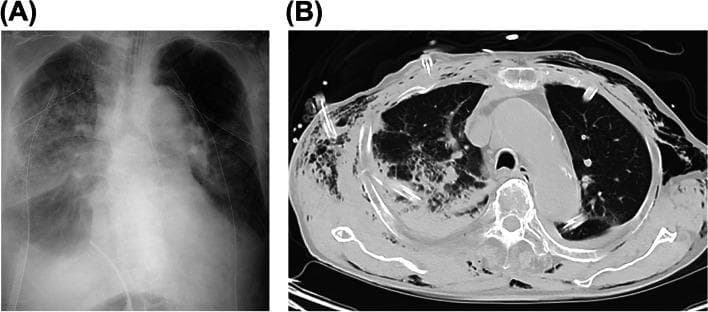
Hugging Face pmc clinical VQA raw
Page 0
search_medical_text
chest X-ray pleural effusion hemothorax opacification interpretation
Management of Empyema
Page 4
GradeResponse
GradeResponse
Chest X-ray Analysis — Patient: SUNIL, Male | Gandhi Hospital, Musheerabad
View: AP (Anteroposterior) | Note: Header states "Spine Cervical AP" — likely a labeling error, as the image is clearly a chest projection.
Key Findings
| Region | Finding |
|---|---|
| Left hemithorax | Massive homogeneous opacification of the left lower and mid zones with loss of the left heart border and left costophrenic angle — consistent with a large pleural effusion or hemothorax |
| Mediastinum | Appears shifted toward the right, suggesting a large volume left-sided collection causing mass effect (tracheal and mediastinal rightward shift) |
| Right lung | Relatively well-aerated with visible lung markings; right costophrenic angle appears preserved |
| Ribs | Multiple ribs visible; no obvious fracture lines on this view, though rib fractures cannot be excluded without dedicated views |
| Soft tissues | No visible subcutaneous emphysema on this view |
| Bones | Left shoulder/clavicle and bilateral humeral heads visible; no gross bony abnormality apparent |
Impression
Large left-sided pleural effusion / hemothorax causing significant rightward mediastinal shift.
Given the context (MLC — Medico-Legal Case number 6361), this is most likely a traumatic hemothorax. The combination of:
- Massive left opacification
- Mediastinal shift to the right
- MLC tagging (indicating trauma, accident, or assault)
...strongly points to traumatic left hemothorax, though other causes (empyema, malignant effusion) must be considered clinically.
Recommended Next Steps
- Urgent clinical correlation — hemodynamic status, oxygen saturation, mechanism of injury
- Ultrasound chest — to confirm fluid, assess volume, and guide drainage
- CT chest — to evaluate for associated lung contusion, rib fractures, pneumothorax, or vascular injury
- Intercostal drain (ICD) placement if hemothorax is confirmed and patient is symptomatic or hemodynamically compromised
- Repeat CXR post-drainage to assess lung re-expansion
⚠️ Disclaimer: This is an AI-assisted interpretation for educational/clinical support purposes only. Final radiological diagnosis must be made by a qualified radiologist with full clinical context.
This is a shared conversation. Sign in to Orris to start your own chat.