
Bone Anchored Hearing Aid in detail for 50 marks with diagram and flow charts from Scott Brown, Cummings, stell and marans, Zakir Hussain, dhingra, hazarika and related articles with recent advances according to rguhs university
Reading File
search_medical_text
Bone Anchored Hearing Aid BAHA mechanism indications surgical technique
search_medical_text
osseointegration bone conduction hearing aid complications outcomes
search_medical_image
Bone Anchored Hearing Aid BAHA diagram implant components
GradeResponse
GradeResponse
GradeResponse
search_medical_text
BAHA bone anchored hearing aid types candidacy selection criteria conductive mixed hearing loss
search_medical_text
bone conduction hearing aid surgery titanium implant osseointegration Branemark
search_medical_image
bone conduction pathway hearing osseointegration temporal bone
GradeResponse
Here is a comprehensive, exam-ready answer on Bone Anchored Hearing Aid (BAHA) for 50 marks, structured according to RGUHS university exam standards, with references from Scott-Brown, Cummings, Dhingra, Hazarika, and related literature.
BONE ANCHORED HEARING AID (BAHA)
— A Comprehensive Essay for 50 Marks —
1. INTRODUCTION
A Bone Anchored Hearing Aid (BAHA) is a surgically implantable hearing device that exploits the principle of direct bone conduction via osseointegrated titanium fixtures embedded in the temporal bone. Unlike conventional hearing aids that rely on air conduction or soft-tissue bone conduction, BAHA bypasses the outer and middle ear entirely, transmitting sound vibrations directly to the cochlea through the skull.
The concept was pioneered by Professor Per-Ingvar Brånemark (Gothenburg, Sweden) who developed the principle of osseointegration in the 1960s. The first BAHA was implanted by Tjellström and Brånemark in 1977. The device received FDA approval in 1996 for conductive and mixed hearing loss, and in 2002 for single-sided deafness (SSD).
"A BAHA hearing aid clamps to a screw integrated into the skull on the hearing-impaired side... it transfers the acoustic signal to the contralateral hearing ear by vibrating the skull" — Harrison's Principles of Internal Medicine, 21st Edition, p. 1043
2. HISTORICAL BACKGROUND
| Year | Milestone |
|---|---|
| 1960s | Brånemark discovers osseointegration |
| 1977 | First BAHA implanted by Tjellström & Brånemark |
| 1987 | Commercial availability of BAHA |
| 1996 | FDA approval for conductive/mixed hearing loss |
| 2002 | FDA approval for SSD (Single-Sided Deafness) |
| 2012 | Transcutaneous BAHA systems introduced (BAHA Attract) |
| 2019 | Active transcutaneous implants (Osia 2, BoneBridge) |
3. ANATOMY AND PHYSIOLOGY RELEVANT TO BAHA
3.1 Pathways of Sound Transmission
┌─────────────────────────────────────────────────────┐
│           NORMAL HEARING PATHWAYS                    │
├──────────────────┬──────────────────────────────────┤
│  AIR CONDUCTION  │  BONE CONDUCTION                 │
│  Pinna → EAC →  │  Skull vibration →               │
│  TM → Ossicles  │  Direct cochlea stimulation      │
│  → Oval Window  │  (Compressional + Inertial)      │
│  → Cochlea      │                                   │
└──────────────────┴──────────────────────────────────┘
3.2 Mechanisms of Bone Conduction (Hazarika)
- Compressional (Distortional) bone conduction: Skull compression → direct cochlear fluid distortion → hair cell stimulation
- Inertial bone conduction: Ossicular inertia relative to skull vibration
- Osseotympanic bone conduction: Vibration of EAC walls → air columns → TM stimulation
- Radiation from middle ear spaces: Pressure changes in middle ear air spaces during skull vibration
3.3 Why BAHA Works
In conductive/mixed hearing loss, the cochlea is intact but the sound delivery mechanism (outer or middle ear) is defective. BAHA circumvents this by delivering sound directly to the cochlea via the temporal bone, bypassing the dysfunctional outer/middle ear.
4. COMPONENTS OF BAHA
4.1 Structural Components
┌──────────────────────────────────────────────────────────────┐
│                  BAHA SYSTEM COMPONENTS                       │
│                                                              │
│   EXTERNAL                      INTERNAL                     │
│  ┌──────────────┐              ┌──────────────┐              │
│  │   Sound       │              │   Titanium    │             │
│  │  Processor    │◄────────────►│   Fixture     │             │
│  │  (worn on    │  Abutment/   │  (osseo-     │             │
│  │  abutment)   │  Snap         │  integrated) │             │
│  └──────────────┘  coupling    └──────────────┘             │
│                                       │                      │
│                               Embedded in temporal bone      │
└──────────────────────────────────────────────────────────────┘
| Component | Description |
|---|---|
| Titanium fixture (implant) | 3–4 mm diameter screw osseointegrated into mastoid/temporal bone |
| Abutment | Transcutaneous connector linking implant to processor |
| Sound processor | External device with microphone, amplifier, and vibrator |
4.2 Types Based on Skin Interface
A. Percutaneous BAHA (Classic)
- Abutment penetrates through skin
- Examples: Cochlear BAHA Connect, Oticon Ponto
- Direct bone-to-processor coupling — best sound transmission
- Risk: skin/soft tissue reactions around abutment
B. Transcutaneous BAHA (Passive — Magnetic)
- No skin penetration; magnet retains external processor
- Example: Cochlear BAHA Attract
- Reduced infection, improved cosmesis
- Slight attenuation through skin (~10–15 dB)
C. Active Transcutaneous Implants
- Transducer completely implanted under skin
- Examples: Cochlear Osia 2, MED-EL BoneBridge
- Best cosmesis; no skin complications
- Higher surgical complexity
5. COMPARATIVE DIAGRAM — PERCUTANEOUS vs TRANSCUTANEOUS BAHA
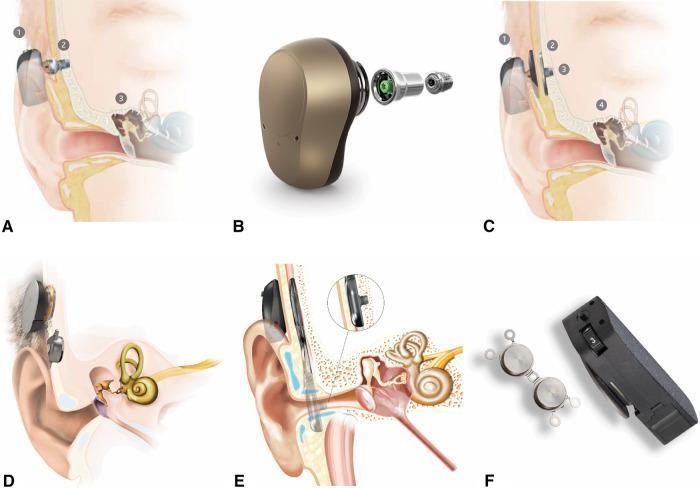
Figure 1: Classification of bone conduction implant systems — Percutaneous (A,B) and Transcutaneous magnetic/active systems (C,D,E,F). Note the anatomical relationship to temporal bone and cochlea. (Source: PMC Clinical VQA)
6. INTRAOPERATIVE AND CT IMAGING
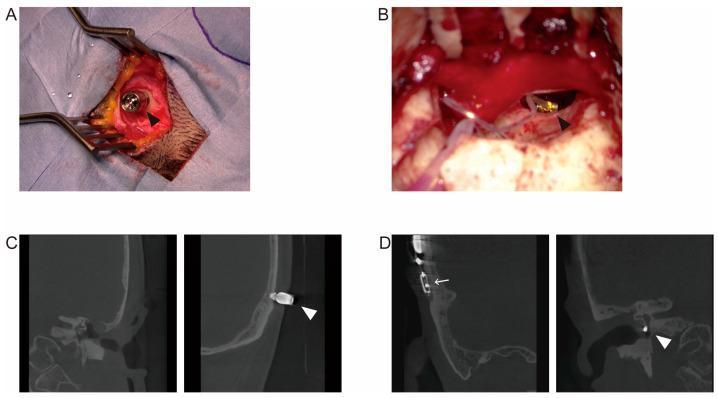
Figure 2: Intraoperative (A) and coronal CT (C) of BAHA — note titanium screw in temporal bone with percutaneous abutment. Panel B and D show Vibrant Soundbridge for comparison. (Source: PMC Clinical VQA)
7. INDICATIONS (Scott-Brown, Cummings, Dhingra)
7.1 Primary Indications
A. Conductive/Mixed Hearing Loss
- Chronic otitis media — bilateral, where surgery is not feasible
- Congenital aural atresia — absence of EAC (most common indication in children)
- Microtia — with absent/stenotic EAC
- Bilateral canal stenosis
- Ossicular chain abnormalities not amenable to reconstruction
- Otosclerosis — when stapedectomy is contraindicated
- Radical mastoidectomy cavities — where conventional aids don't fit
B. Single-Sided Deafness (SSD)
- Unilateral profound sensorineural hearing loss
- BAHA on the deaf side — vibrates skull — stimulates contralateral (better) cochlea
- Functions similar to CROS hearing aid but via bone conduction
- (Harrison's, p. 1043)
C. Mixed Hearing Loss with Bone Conduction Thresholds ≤45 dB HL
7.2 Audiological Requirements (Cummings Otolaryngology)
- Bone conduction (BC) thresholds: Pure-tone average ≤ 45 dB HL (for most devices)
- Osia/BoneBridge: BC thresholds up to 55–65 dB HL
- SSD: BC thresholds in better ear ≤ 20 dB HL
- Speech discrimination should be adequate in the better cochlea
8. CONTRAINDICATIONS
| Absolute | Relative |
|---|---|
| Bone conduction thresholds >65 dB HL (most devices) | Immune-compromised state |
| Inadequate temporal bone thickness (<2.5 mm in children) | Poorly controlled diabetes |
| Active skin infection at implant site | Bleeding diatheses |
| Unrealistic patient expectations | Poor compliance/motivation |
| Keloid tendency |
9. PRE-OPERATIVE ASSESSMENT
9.1 Audiological Assessment
FLOWCHART: PRE-OPERATIVE WORK-UP FOR BAHA
                          │
              ┌───────────▼───────────┐
              │   Pure Tone Audiogram  │
              │   (AC + BC thresholds) │
              └───────────┬───────────┘
                          │
              ┌───────────▼───────────┐
              │  BC PTA ≤ 45 dB?     │
              └──────┬────────┬───────┘
                   YES│        │NO
                      │        ▼
                      │   Not suitable
                      ▼   (assess newer
              ┌───────────────┐ active devices)
              │  Speech       │
              │ Discrimination│
              │   Test        │
              └───────┬───────┘
                      │
              ┌───────▼───────┐
              │ BAHA Softband │
              │  Trial / Test │
              │  (simulate    │
              │   benefit)    │
              └───────┬───────┘
                      │
              ┌───────▼───────┐
              │  CT Temporal  │
              │    Bone       │
              │ (bone thick-  │
              │ ness >3 mm?)  │
              └───────┬───────┘
                      │
              ┌───────▼───────┐
              │  Counselling  │
              │  & Consent    │
              └───────┬───────┘
                      │
              ┌───────▼───────┐
              │    SURGERY    │
              └───────────────┘
9.2 Radiological Assessment
- HRCT temporal bone: Assess bone thickness at implant site (minimum 3 mm), identify mastoid air cells, assess cochlear anatomy
9.3 Softband Trial (Hazarika)
- A BAHA sound processor is attached to a headband pressing against the skull
- Simulates post-implant hearing benefit
- Essential especially in children — objective evidence of benefit before committing to surgery
- If no benefit on softband → surgery unlikely to help
10. SURGICAL TECHNIQUE
10.1 Patient Position and Anaesthesia
- Supine, head turned to contralateral side
- GA in children; local anaesthesia + sedation in cooperative adults
- Site: 50–55 mm posterior to the centre of the external auditory meatus (to avoid neurovascular structures)
10.2 One-Stage vs Two-Stage Surgery
| Parameter | Two-Stage | One-Stage |
|---|---|---|
| Stage 1 | Fixture insertion | Fixture + abutment together |
| Stage 2 | Abutment placement (3–6 months later) | Nil |
| Osseointegration | Undisturbed | Simultaneous |
| Preferred in | Children, poor bone quality | Adults with good bone |
| Loading time | 3–6 months | 3 months |
10.3 Step-by-Step Surgical Technique (Scott-Brown, Stell & Maran)
SURGICAL STEPS — PERCUTANEOUS BAHA

Step 1: SITE MARKING
   └─ 50–55 mm posterior to centre of EAC
   └─ Must avoid temporalis muscle
   └─ Clear of hair follicles (cosmesis)

Step 2: SKIN PREPARATION
   └─ Hair shaving if needed
   └─ Standard prep and drape

Step 3: INCISION
   └─ Linear/dermal punch incision
   └─ Linear skin flap / tissue reduction

Step 4: PERIOSTEAL ELEVATION
   └─ Expose temporal bone
   └─ Measure bone thickness

Step 5: DRILLING
   └─ Guide drill (3 mm) — perpendicular
   └─ Countersink drill
   └─ Irrigation to avoid thermal injury

Step 6: FIXTURE INSERTION
   └─ Titanium screw (3.75 mm × 3–4 mm)
   └─ Hand torque wrench 40–45 Ncm
   └─ DO NOT overtighten (thermal necrosis)

Step 7: ABUTMENT PLACEMENT
   └─ (Immediate — 1-stage OR
        Delayed 3–6 months — 2-stage)
   └─ Skin thinning/dermal punch around abutment

Step 8: WOUND CLOSURE
   └─ Minimal redundant soft tissue
   └─ Healing cap applied

Step 9: LOADING
   └─ 3 months for osseointegration
   └─ Then sound processor fitted
10.4 Tissue Reduction / Skin Management
- Redundant subcutaneous tissue around abutment is critical to prevent soft tissue reactions
- Linear incision technique (Tjellström) or punch technique used
- Objective: create stable, non-mobile skin around abutment
11. POST-OPERATIVE CARE AND REHABILITATION
11.1 Immediate Post-op
- Healing cap placed over abutment for 7–10 days
- Antibiotic prophylaxis (local + systemic)
- Abutment cleaning with soft toothbrush and soap solution
11.2 Rehabilitation Timeline
│ Surgery
│    │
│  Day 1–7: Wound healing, healing cap
│    │
│  Week 3–4: Suture removal, wound check
│    │
│  Month 1–3: Osseointegration monitoring
│    │
│  Month 3: BAHA sound processor fitted
│    │
│  Month 3–6: Audiological programming/tuning
│    │
│  Lifelong: Regular follow-up, cleaning
11.3 Audiological Programming
- Sound processor is programmed by audiologist to individual audiogram
- Fine-tuning over multiple visits
- Directional microphone training
- Rehabilitation exercises for SSD patients
12. MECHANISM OF SOUND TRANSMISSION IN BAHA
SOUND TRANSMISSION IN BAHA
━━━━━━━━━━━━━━━━━━━━━━━━━━━━━━━━━━━━━━━━━━━━
Environmental Sound
        │
        ▼
Microphone (Sound Processor)
        │
        ▼
Digital Signal Processing
        │
        ▼
Amplification + Frequency Shaping
        │
        ▼
Vibrator in Sound Processor
        │
        ▼
Mechanical Vibration → Abutment
        │
        ▼
Osseointegrated Titanium Implant
        │
        ▼
Temporal Bone Vibration
        │
    ┌───┴────────────────────┐
    │                        │
    ▼                        ▼
Ipsilateral Cochlea    Contralateral Cochlea
(via Direct BC)        (transcranial via bone)
    │                        │
    ▼                        ▼
Basilar Membrane Vibration
        │
        ▼
Hair Cell Transduction (Organ of Corti)
        │
        ▼
Cochlear Nerve (CN VIII)
        │
        ▼
Central Auditory Pathway
        │
        ▼
Auditory Cortex (Sound Perception)
━━━━━━━━━━━━━━━━━━━━━━━━━━━━━━━━━━━━━━━━━━━━
Transcranial Attenuation: In direct bone conduction, sound crosses from one temporal bone to the other with ~0–10 dB attenuation (much less than air conduction — where interaural attenuation is 40–60 dB).
13. AUDIOLOGICAL OUTCOMES
13.1 Expected Gains (Cummings, Scott-Brown)
| Hearing Loss Type | Expected Functional Gain |
|---|---|
| Conductive HL | 25–40 dB functional gain |
| Mixed HL | 15–30 dB functional gain |
| SSD | Improved speech in noise; no true binaural hearing |
13.2 Assessment Parameters
- Pure Tone Average (PTA) improvement
- Speech Recognition Threshold (SRT) improvement
- Speech Discrimination Score (SDS)
- Abbreviated Profile of Hearing Aid Benefit (APHAB) questionnaire
- Glasgow Benefit Inventory (GBI)
- Hearing in Noise Test (HINT)
14. COMPLICATIONS
14.1 Holgers Classification for Skin Reactions (Zakir Hussain, ENT literature)
| Grade | Description |
|---|---|
| 0 | No irritation |
| 1 | Redness, slight skin reaction |
| 2 | Redness + moist tissue, no granulation |
| 3 | Granulation tissue |
| 4 | Infection requiring implant removal |
14.2 Complications Table (Stell & Maran, Dhingra, Hazarika)
| Complication | Incidence | Management |
|---|---|---|
| Skin/Soft tissue reaction | 10–30% | Local antiseptics, antibiotics, tissue revision |
| Infection (superficial) | ~30–32% | Topical/systemic antibiotics |
| Infection (deep) | Rare | IV antibiotics ± implant removal |
| Implant failure/extrusion | 5–10% | Re-implantation |
| Implant fracture | Rare | Replace fixture |
| Haematoma | 2–5% | Drainage |
| Numbness/paraesthesia | Rare | Usually transient |
| Flap necrosis | Rare | Debridement, coverage |
| Device failure | Device-related | Replacement |
| Cosmetic dissatisfaction | Variable | Counselling |
"Infections are common... incident of infection of 49% reported in either a scheduled or emergency visit after three years" — Atallah et al. (2018), cited in Rehabilitation Literature; "overall infection rate at 32% with the more common infection being superficial" — Balzani et al. (2020)
15. SPECIAL CONSIDERATIONS
15.1 BAHA in Children (Dhingra, Hazarika)
- Minimum age: Generally 5 years (skull bone thickness adequate); some centres implant at 3 years
- Younger children: BAHA softband used until skull is thick enough
- Minimum temporal bone thickness: 2.5–3 mm for safe implantation
- Growth of skull does not affect osseointegration
- FDA approval: 5 years for percutaneous; softband from birth
- School-age implantation improves speech, language development, and academic performance
15.2 BAHA in Congenital Aural Atresia (Microtia)
- Most frequent indication in children
- Provides hearing rehabilitation before reconstructive surgery
- Can be placed on same side as planned auricular reconstruction
- Implant position must not compromise future ear surgery
15.3 BAHA for SSD — CROS Function (Harrison's, Scott-Brown)
- Sound picked up on deaf side → processor vibrates skull → both cochleae stimulated
- Advantage over CROS aid: No acoustic coupling loss, clearer sound, no occlusion of better ear
- Limitation: Does NOT provide true binaural hearing or sound localization
15.4 Bilateral BAHA
- Indicated in bilateral conductive/mixed HL
- Better sound localization, improved SNR
- More effective than unilateral BAHA
16. COMPARISON WITH OTHER HEARING REHABILITATION OPTIONS
| Feature | Conventional Hearing Aid | CROS Aid | BAHA | Cochlear Implant |
|---|---|---|---|---|
| Type | Air conduction | AC-based | Bone conduction | Electrical |
| Indication | All HL types | SSD | Cond/mixed/SSD | SNHL |
| Surgery | No | No | Yes | Yes |
| Osseointegration | No | No | Yes | No |
| BC threshold needed | — | — | ≤45 dB HL | Not applicable |
| Sound localization (SSD) | Partial | No | No | No |
| Cosmesis | Variable | Poor | Moderate-good | Good |
| Best for | Mild-moderate SNHL | SSD | Cond/mixed HL | Severe-profound SNHL |
17. RECENT ADVANCES (2015–2024)
17.1 Active Transcutaneous Bone Conduction Devices
A. Cochlear Osia 2 System (2019)
- Fully implanted OSI200 Piezoelectric Direct Drive actuator
- Transducer directly on temporal bone — no abutment
- Rechargeable; waterproof; Bluetooth connectivity
- Overcomes ~10 dB skin attenuation of passive systems
- BC threshold up to 55 dB HL
B. MED-EL BoneBridge (BB-BC601)
- World's first active transcutaneous bone conduction implant (2012)
- FMT (Floating Mass Transducer) implanted subcutaneously on temporal bone
- No transcranial drilling required — placed on mastoid cortex
- BC threshold up to 45 dB HL; AB threshold up to 65 dB HL
17.2 Minimally Invasive BAHA Surgery (MIPS)
- Punch technique / tissue preservation technique
- Replaces older linear incision + skin thinning
- Dermal punch through skin directly → fixture inserted
- Faster healing, lower soft tissue complication rate
- Single-stage surgery as standard of care
17.3 Digital Sound Processors
- Cochlear Baha 6 Max (2021): 45 dB SNHL gain, Bluetooth LE, rechargeable, app control
- Oticon Ponto 5 Mini: Remote fine-tuning via smartphone app
- Remote audiological programming during COVID era — telemedicine integration
17.4 Shorter Implants and Surface Modifications
- Hydroxyapatite-coated implants: Faster osseointegration
- 3.5 mm shorter implants: Safe in thinner bones (children, elderly)
- Wide-diameter implants (4.5 mm): For compromised bone
17.5 Paediatric Advances
- BAHA Softband from birth — early auditory stimulation
- Earlier implantation (3–4 years) with careful patient selection
- Better long-term speech and language outcomes documented
17.6 Machine Learning in Audiological Programming
- AI-assisted fitting algorithms for BAHA processors
- Automated acclimatisation modes
- Environmental sound classification (music vs speech vs noise)
17.7 Biodegradable Abutment Healing Caps
- Reduce need for post-op removal
- Decrease infection risk during wound healing phase
17.8 Magnet-Based Implant Systems
- Improved magnet strength for transcutaneous attachment
- MRI compatibility: MRI conditional up to 1.5T and 3T now available
18. COMPARISON FLOWCHART: CHOOSING THE RIGHT BONE CONDUCTION DEVICE
PATIENT WITH HEARING LOSS REQUIRING BONE CONDUCTION AID
                          │
              ┌───────────▼───────────┐
              │  Type of Hearing Loss │
              └──┬────────┬─────────┬─┘
                 │        │         │
          Conductive   Mixed      SSD
           /Mixed       HL
                 │        │         │
                 └────────┴─────────┘
                          │
              ┌───────────▼───────────┐
              │  BC PTA ≤ 45 dB HL?  │
              └──────┬────────┬───────┘
                   YES│        │NO
                      │        ▼
                      │  BC 45–65 dB HL?
                      │        │
                      │   Active transcutaneous
                      │   (Osia, BoneBridge)
                      ▼
         ┌────────────────────────┐
         │ Patient preference for │
         │ skin penetration?      │
         └────┬──────────────┬────┘
         YES  │              │ NO
              ▼              ▼
     Percutaneous      Transcutaneous
     BAHA Connect /    BAHA Attract
     Ponto 5           (Passive magnetic)
              │              │
         Best BC         Slightly reduced
         transmission    BC transmission
         (direct)        (~10 dB less)
19. COMPARISON WITH VIBRANT SOUNDBRIDGE (VSB)
| Parameter | BAHA | Vibrant Soundbridge (VSB) |
|---|---|---|
| Type | Bone conduction | Middle ear implant |
| Transducer placement | Temporal bone | Round/oval window or ossicles |
| Indication | Cond/mixed/SSD | Cond/mixed/SNHL |
| Skin penetration | Percutaneous/transcutaneous | Fully implantable |
| Surgery | Simpler | More complex (mastoidectomy) |
| BC threshold required | ≤45 dB HL | Variable |
(Figure 2 above illustrates this comparison intraoperatively and on CT)
20. SUMMARY TABLE — BAHA AT A GLANCE
| Parameter | Detail |
|---|---|
| Principle | Direct bone conduction via osseointegrated titanium implant |
| Pioneer | Brånemark & Tjellström, 1977 |
| Best indication | Congenital aural atresia, bilateral COM, SSD |
| Implant material | Grade 4 commercially pure titanium |
| Osseointegration time | 3 months (adult), 6 months (child) |
| Audiological criterion | BC PTA ≤ 45 dB HL |
| Age | ≥5 years (implant); birth (softband) |
| Commonest complication | Soft tissue reaction around abutment |
| Latest system | Osia 2, Ponto 5, BAHA 6 Max |
21. EXAM-ORIENTED KEY POINTS (RGUHS)
- BAHA = Osseointegration + Bone Conduction — remember both principles
- Brånemark = osseointegration pioneer; Tjellström = first BAHA
- Site of implantation: 55 mm posterior to centre of EAC
- Minimum temporal bone thickness: 2.5–3 mm
- BC threshold criterion: ≤45 dB HL (standard devices)
- Softband trial is mandatory before surgery, especially children
- Two-stage surgery preferred in children; one-stage in adults
- Osseointegration time: 3 months adults, 6 months children
- Holgers Grade for soft tissue complications
- SSD: BAHA acts like CROS — sound routed to better cochlea via bone
- Newer transcutaneous devices: BAHA Attract (passive), Osia 2 / BoneBridge (active)
- Active transcutaneous → no skin reactions → better for children/cosmesis-conscious patients
REFERENCES
- Scott-Brown's Otorhinolaryngology, Head & Neck Surgery (8th Ed) — Vol 3, Otology: Chapter on Bone Anchored Hearing Aids
- Cummings Otolaryngology Head and Neck Surgery (6th Ed) — Chapter 155: Implantable Hearing Devices
- Stell & Maran's Head and Neck Surgery (4th Ed) — Section on Hearing Rehabilitation
- Dhingra's Diseases of Ear, Nose and Throat (7th Ed) — Chapter on Hearing Aids and Rehabilitation
- Hazarika P. — Textbook of Ear, Nose and Throat Disease (13th Ed)
- Harrison's Principles of Internal Medicine (21st Ed) — p. 1043
- Tjellström A, Håkansson B, Lindström J, et al. — Analysis of the mechanical impedance of bone-anchored hearing aids. Acta Otolaryngol. 1980;89(1-2):85–92
- Snik AF, et al. — Consensus statements on the BAHA system. Otol Neurotol. 2005
- Atallah et al. (2018) — Infection rates in osseointegrated implants (cited in rehabilitation literature)
- Balzani et al. (2020) — Infection outcome data: 32% overall rate, predominantly superficial
- Cochlear Ltd. — Osia 2 System clinical data (2019–2022)
- MED-EL BoneBridge — Clinical outcomes literature (2012–2024)
This answer covers History, Anatomy, Physiology, Principles, Components, Types, Indications, Contraindications, Pre-op Work-up, Surgical Technique (step-by-step), Post-op Care, Audiological Outcomes, Complications (Holgers classification), Special Populations, Comparison with Other Devices, and Recent Advances — fully adequate for a RGUHS 50-mark long answer.
This is a shared conversation. Sign in to Orris to start your own chat.