
Staging of stomach cancer and types
Reading File
Now let me search the library in parallel for stomach cancer staging and types:
Finding Sources
Finding Sources
Searching PubMed
"gastric cancer" AND staging
Reading File
Finding Sources
Finding Sources
Reading File
Reading File
Finding Sources
Reading File
Reading File
Finding Sources
Reading File
Reading File
Now let me get the gastric cancer types/classification and the Harrison's gastric cancer section:
Reading File
Loading Image
Loading Image
I now have comprehensive information from multiple authoritative textbooks. Let me compile the full answer.
Stomach (Gastric) Cancer - Types and Staging
Overview
Gastric cancer is among the most common malignancies globally, with approximately 1.693 million combined esophageal, gastroesophageal junction (GEJ), and gastric cancer cases diagnosed in 2020. The incidence of body and distal gastric cancers has steadily declined in Western countries since the 1920s, while GEJ adenocarcinomas have markedly increased.
- Harrison's Principles of Internal Medicine, 22E
- Bailey and Love's Short Practice of Surgery, 28th Ed.
TYPES OF GASTRIC CANCER
1. By Histology
Adenocarcinoma (most common - >95%)
The vast majority of gastric cancers are adenocarcinomas. These are further subclassified by two major classification systems:
Lauren Classification (histological)
| Type | Features | Behaviour |
|---|---|---|
| Intestinal type | Cohesive cells forming gland-like structures; often well-differentiated; associated with H. pylori, atrophic gastritis, intestinal metaplasia | Tends to form a discrete mass; haematogenous spread; better prognosis |
| Diffuse type | Poorly cohesive cells (signet ring cells); lack of cell adhesion molecules (e-cadherin/CDH1); infiltrates widely | Spreads via submucosal and subserosal lymphatics; penetrates gastric wall early; worse prognosis; associated with CDH1 germline mutation |
The diffuse type spreads differently from intestinal type - it infiltrates via the submucosal and subserosal lymphatic plexus and penetrates the gastric wall at an early stage.
Signet Ring Cell Carcinoma
A subtype of the diffuse type; cells appear with a large mucin vacuole pushing the nucleus to the periphery. CDH1 (e-cadherin) germline mutations markedly increase risk.
Other Rare Types
- MALT lymphoma (Mucosa-Associated Lymphoid Tissue) - linked to H. pylori infection
- Gastrointestinal Stromal Tumours (GISTs) - arise from interstitial cells of Cajal
- Carcinoid tumours (NETs) - from neuroendocrine cells
- Squamous cell carcinoma - very rare in the stomach
2. By Macroscopic/Endoscopic Pattern
Early Gastric Cancer (EGC) - Japanese Classification
Cancer limited to mucosa or submucosa (regardless of lymph node status):
| Type | Description |
|---|---|
| Type I | Protruded / polypoid |
| Type IIa | Superficial elevated |
| Type IIb | Flat |
| Type IIc | Superficial depressed |
| Type III | Excavated / ulcerated |
Advanced Gastric Cancer - Borrmann Classification
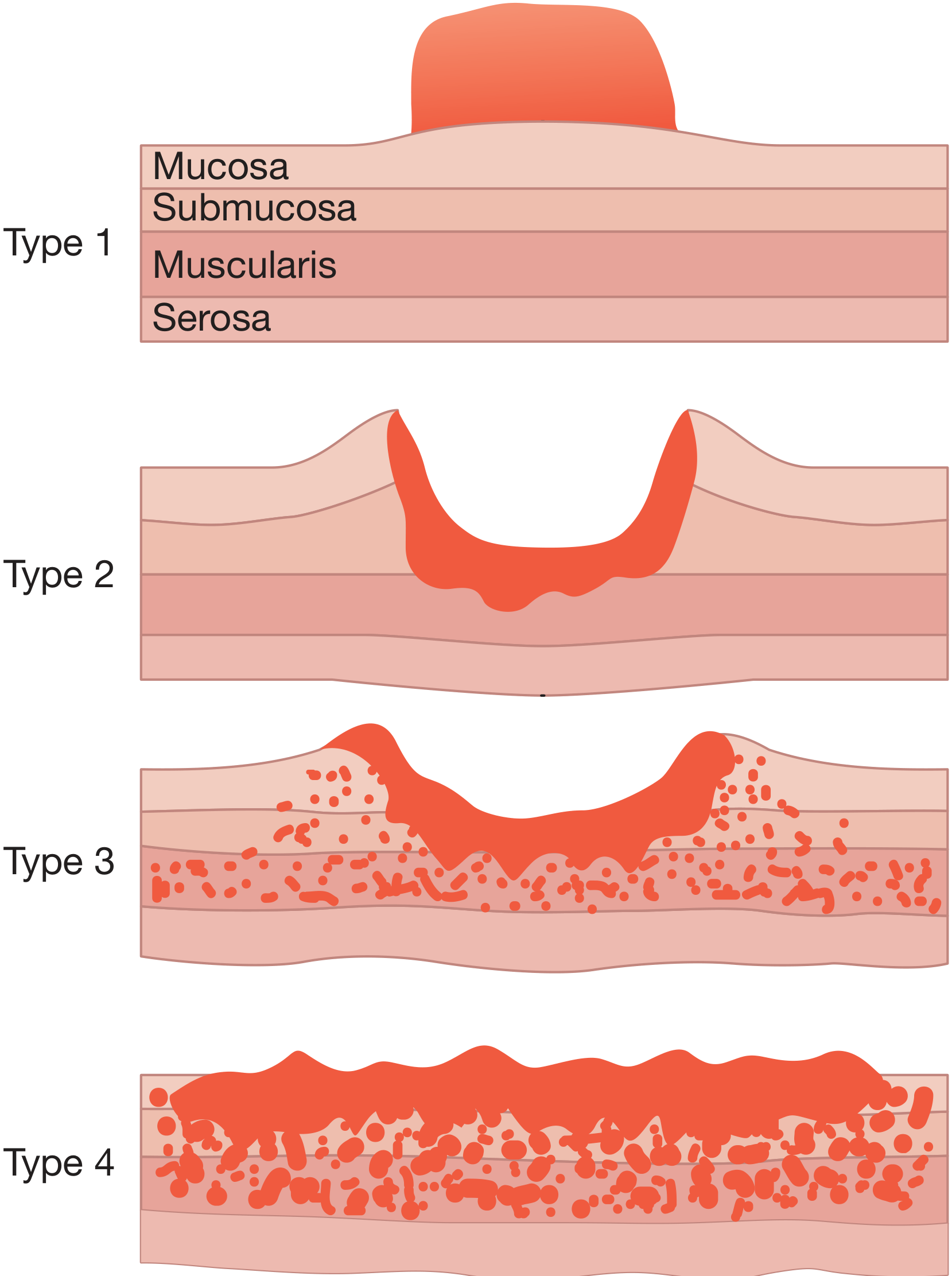
| Type | Description |
|---|---|
| Type 1 | Polypoid - well-defined, protruding mass |
| Type 2 | Ulcerating with sharp margins - crater with raised edges |
| Type 3 | Infiltrating and ulcerating - ulcer with ill-defined infiltrating margins |
| Type 4 | Diffuse infiltrating (Linitis plastica / "leather bottle stomach") - no clear margin, diffuse wall thickening |
Bailey and Love's Short Practice of Surgery, 28th Ed.
Linitis plastica (Type 4 / Borrmann IV) is a scirrhous diffuse tumour in which the stomach appears as a narrowed, rigid structure. It is the most aggressive form and has the worst prognosis.
STAGING - AJCC/UICC TNM System (8th Edition, 2017)
The staging system used universally is the AJCC/UICC TNM classification (8th edition). An important change in this edition: tumours involving the oesophago-gastric junction (EGJ) with the epicentre >2 cm into the proximal stomach are now staged as gastric cancers, while those ≤2 cm into the proximal stomach are staged as oesophageal cancers.
Grainger & Allison's Diagnostic Radiology; Bailey and Love's Short Practice of Surgery, 28th Ed.
T - Primary Tumour
| Stage | Description |
|---|---|
| Tx | Primary tumour cannot be assessed |
| T0 | No evidence of primary tumour |
| Tis | Carcinoma in situ: intraepithelial tumour without invasion of lamina propria; high-grade dysplasia |
| T1 | Tumour involves lamina propria, muscularis mucosae, or submucosa |
| T1a | Invades lamina propria or muscularis mucosae |
| T1b | Invades submucosa |
| T2 | Invades muscularis propria |
| T3 | Involves subserosa (subserosal connective tissue) |
| T4 | Perforates serosa or invades adjacent structures |
| T4a | Perforates serosa (visceral peritoneum) |
| T4b | Invades adjacent structures (pancreas, colon, liver, etc.) |
N - Regional Lymph Nodes
| Stage | Description |
|---|---|
| Nx | Cannot be assessed |
| N0 | No regional lymph node metastasis |
| N1 | Metastasis in 1-2 regional lymph nodes |
| N2 | Metastasis in 3-6 regional lymph nodes |
| N3 | Metastasis in 7+ regional lymph nodes |
| N3a | 7-15 lymph nodes involved |
| N3b | 16 or more lymph nodes involved |
M - Distant Metastasis
| Stage | Description |
|---|---|
| M0 | No distant metastasis |
| M1 | Distant metastasis present (includes retropancreatic, mesenteric, para-aortic nodes; liver metastases; peritoneal seedlings) |
Overall Stage Grouping (UICC 8th Edition)
| Stage | T | N | M |
|---|---|---|---|
| IA | T1 | N0 | M0 |
| IB | T1 / T2 | N1 / N0 | M0 |
| IIA | T1 / T2 / T3 | N2 / N1 / N0 | M0 |
| IIB | T1 / T2 / T3 / T4a | N3 / N2 / N1 / N0 | M0 |
| IIIA | T2 / T3 / T4a | N3 / N2 / N1 | M0 |
| IIIB | T3 / T4a / T4b | N3 / N2 / N0-1 | M0 |
| IIIC | T4a / T4b | N3 / N2-3 | M0 |
| IV | Any T | Any N | M1 |
Bailey and Love's Short Practice of Surgery, 28th Ed. (Table 67.6)
Spread of Gastric Cancer
| Route | Details |
|---|---|
| Direct | Penetrates muscularis → serosa → adjacent organs (pancreas, colon, liver) |
| Lymphatic | To perigastric and then para-aortic nodes; may reach supraclavicular nodes (Troisier's/Virchow's sign) |
| Blood-borne | First to liver, then lung and bone; uncommon without prior nodal disease |
| Transperitoneal | Once serosa is reached; leads to ascites, peritoneal seedlings; ovarian metastases (Krukenberg's tumour); umbilical metastasis (Sister Joseph's nodule); pelvic "shelf" on rectal exam (Blumer's shelf) |
Key Prognostic Factors
- Depth of invasion (T stage) and nodal status (N stage) are the most important prognostic factors in resectable gastric cancer.
- At least 15 lymph nodes must be sampled from a resected specimen for adequate staging.
- Molecular biomarkers (HER2/ERBB2 amplification ~20-25%, PD-L1 status, MSI/dMMR, Claudin 18.2) now guide systemic therapy selection.
Harrison's Principles of Internal Medicine, 22E; Grainger & Allison's Diagnostic Radiology
Imaging for Staging
- MDCT (multi-detector CT) is the primary modality; criteria revised for 8th edition TNM
- MRI - limited experience; T1 WI shows intermediate signal in carcinoma; T2 WI shows low signal; abnormal focal thickening ≥6 mm is significant
- EUS (endoscopic ultrasound) - useful for T and N staging, especially early disease
- FDG-PET - used for detecting distant metastases
Grainger & Allison's Diagnostic Radiology
Can you make ppt presentation for the same topic
Reading File
Reading File
Reading File
Running Command
mkdir -p /home/daytona/workspace/gastric-cancer-ppt && ls /home/daytona/workspace/gastric-cancer-ppt
Writing File
~/gastric-cancer-ppt/generate.js
const pptxgen = require("pptxgenjs");

const pres = new pptxgen();
pres.layout = "LAYOUT_16x9";
pres.title = "Stomach Cancer: Types and Staging";
pres.author = "Medical Education";

// ── Color Palette ──────────────────────────────────────
const C = {
  darkBg:    "0D1B2A",   // deep navy - title/section slides
  midBg:     "1B3A5C",   // medium navy
  accent:    "E63946",   // vivid red (oncology feel)
  accentSoft:"C1121F",   // darker red
  gold:      "F4A261",   // warm gold for highlights
  white:     "FFFFFF",
  offWhite:  "F1F1F1",
  lightGray: "D8DEE9",
  textDark:  "0D1B2A",
  teal:      "2A9D8F",
  tealLight: "52B788",
};

// ── Helper: slide background ───────────────────────────
function darkSlide(pres) {
  const s = pres.addSlide();
  s.background = { color: C.darkBg };
  return s;
}
function lightSlide(pres) {
  const s = pres.addSlide();
  s.background = { color: C.offWhite };
  return s;
}
function midSlide(pres) {
  const s = pres.addSlide();
  s.background = { color: C.midBg };
  return s;
}

// ── SLIDE 1: Title ─────────────────────────────────────
{
  const s = darkSlide(pres);

  // Red accent bar left
  s.addShape(pres.shapes.RECTANGLE, { x: 0, y: 0, w: 0.18, h: 5.625, fill: { color: C.accent }, line: { type: "none" } });

  // Red diagonal top-right accent
  s.addShape(pres.shapes.RECTANGLE, { x: 7.5, y: 0, w: 2.5, h: 0.12, fill: { color: C.accent }, line: { type: "none" } });

  // Main title
  s.addText("STOMACH CANCER", {
    x: 0.4, y: 1.0, w: 9.2, h: 1.2,
    fontSize: 48, bold: true, color: C.white,
    fontFace: "Calibri", charSpacing: 4,
  });

  // Subtitle
  s.addText("Types & Staging", {
    x: 0.4, y: 2.25, w: 7, h: 0.7,
    fontSize: 28, bold: false, color: C.gold,
    fontFace: "Calibri",
  });

  // Divider
  s.addShape(pres.shapes.RECTANGLE, { x: 0.4, y: 3.05, w: 5.5, h: 0.05, fill: { color: C.lightGray }, line: { type: "none" } });

  // Subtext
  s.addText("AJCC/UICC TNM Classification (8th Edition) · Lauren Classification · Borrmann System", {
    x: 0.4, y: 3.2, w: 9.2, h: 0.5,
    fontSize: 12, color: C.lightGray, fontFace: "Calibri", italic: true,
  });

  // Bottom tag
  s.addText("Based on Harrison's | Bailey & Love | Grainger & Allison", {
    x: 0.4, y: 5.0, w: 9.2, h: 0.4,
    fontSize: 10, color: C.lightGray, fontFace: "Calibri",
  });
}

// ── SLIDE 2: Overview / Epidemiology ──────────────────
{
  const s = lightSlide(pres);

  // Top bar
  s.addShape(pres.shapes.RECTANGLE, { x: 0, y: 0, w: 10, h: 0.75, fill: { color: C.darkBg }, line: { type: "none" } });
  s.addText("OVERVIEW", { x: 0.4, y: 0.08, w: 9, h: 0.55, fontSize: 22, bold: true, color: C.white, fontFace: "Calibri", charSpacing: 3 });

  // Stat boxes
  const stats = [
    { val: "1.7M", label: "Global cases (2020)" },
    { val: "1.3M", label: "Annual deaths" },
    { val: ">95%", label: "Adenocarcinoma" },
    { val: "#5", label: "Worldwide cancer" },
  ];
  stats.forEach((st, i) => {
    const x = 0.3 + i * 2.4;
    s.addShape(pres.shapes.ROUNDED_RECTANGLE, { x, y: 0.95, w: 2.1, h: 1.4, fill: { color: C.accent }, line: { type: "none" }, rectRadius: 0.08 });
    s.addText(st.val, { x, y: 1.0, w: 2.1, h: 0.8, fontSize: 28, bold: true, color: C.white, align: "center", fontFace: "Calibri" });
    s.addText(st.label, { x, y: 1.8, w: 2.1, h: 0.45, fontSize: 11, color: C.white, align: "center", fontFace: "Calibri" });
  });

  // Key facts
  const facts = [
    "Incidence has steadily declined since the 1920s in Western countries",
    "GEJ (gastroesophageal junction) adenocarcinomas are markedly increasing",
    "H. pylori infection is the leading causative factor",
    "Tumours with epicentre >2 cm into the proximal stomach are staged as GASTRIC cancer (8th Ed.)",
    "Important risk genes: CDH1 (diffuse type), Lynch syndrome, FAP, Peutz-Jeghers",
    "Molecular biomarkers (HER2, PD-L1, MSI, Claudin 18.2) now guide therapy",
  ];
  s.addText(facts.map((f, i) => ({
    text: f,
    options: { bullet: { type: "bullet" }, breakLine: i < facts.length - 1, fontSize: 13, color: C.textDark, fontFace: "Calibri" }
  })), { x: 0.4, y: 2.55, w: 9.2, h: 2.8, valign: "top" });
}

// ── SLIDE 3: Section Divider – Types ──────────────────
{
  const s = midSlide(pres);
  s.addShape(pres.shapes.RECTANGLE, { x: 0, y: 0, w: 0.22, h: 5.625, fill: { color: C.gold }, line: { type: "none" } });
  s.addText("SECTION 1", { x: 0.5, y: 1.3, w: 9, h: 0.5, fontSize: 14, bold: false, color: C.gold, fontFace: "Calibri", charSpacing: 4 });
  s.addText("Types of\nStomach Cancer", { x: 0.5, y: 1.85, w: 9, h: 1.8, fontSize: 42, bold: true, color: C.white, fontFace: "Calibri" });
  s.addShape(pres.shapes.RECTANGLE, { x: 0.5, y: 3.7, w: 4, h: 0.05, fill: { color: C.gold }, line: { type: "none" } });
  s.addText("Histological · Macroscopic · Molecular", { x: 0.5, y: 3.85, w: 9, h: 0.4, fontSize: 14, color: C.lightGray, fontFace: "Calibri", italic: true });
}

// ── SLIDE 4: By Histology – Lauren Classification ─────
{
  const s = lightSlide(pres);

  s.addShape(pres.shapes.RECTANGLE, { x: 0, y: 0, w: 10, h: 0.75, fill: { color: C.darkBg }, line: { type: "none" } });
  s.addText("HISTOLOGICAL CLASSIFICATION — LAUREN SYSTEM", { x: 0.4, y: 0.1, w: 9, h: 0.5, fontSize: 18, bold: true, color: C.white, fontFace: "Calibri" });

  // Intestinal box
  s.addShape(pres.shapes.RECTANGLE, { x: 0.3, y: 0.9, w: 4.4, h: 4.4, fill: { color: C.midBg }, line: { type: "none" },
    shadow: { type: "outer", color: "000000", blur: 8, offset: 3, angle: 135, opacity: 0.2 } });
  s.addText("INTESTINAL TYPE", { x: 0.3, y: 0.9, w: 4.4, h: 0.55, fontSize: 15, bold: true, color: C.gold, align: "center", fontFace: "Calibri" });
  const intFacts = [
    "Cohesive gland-forming cells",
    "Well-differentiated",
    "Associated with H. pylori, atrophic gastritis, intestinal metaplasia",
    "More common in older males",
    "Distal stomach predominance",
    "Haematogenous spread (liver first)",
    "Better prognosis",
    "Incidence declining globally",
  ];
  s.addText(intFacts.map((f, i) => ({ text: f, options: { bullet: true, breakLine: i < intFacts.length - 1, fontSize: 12, color: C.white, fontFace: "Calibri" } })),
    { x: 0.45, y: 1.5, w: 4.1, h: 3.6, valign: "top" });

  // Diffuse box
  s.addShape(pres.shapes.RECTANGLE, { x: 5.3, y: 0.9, w: 4.4, h: 4.4, fill: { color: C.accentSoft }, line: { type: "none" },
    shadow: { type: "outer", color: "000000", blur: 8, offset: 3, angle: 135, opacity: 0.2 } });
  s.addText("DIFFUSE TYPE", { x: 5.3, y: 0.9, w: 4.4, h: 0.55, fontSize: 15, bold: true, color: C.white, align: "center", fontFace: "Calibri" });
  const difFacts = [
    "Poorly cohesive cells (signet ring cells)",
    "Lack of e-cadherin (CDH1 mutation)",
    "Diffuse wall infiltration",
    "Spreads via submucosal/subserosal lymphatics",
    "Penetrates gastric wall early",
    "Any age; often younger patients",
    "Associated with hereditary CDH1 mutations",
    "Worse prognosis; harder to resect",
  ];
  s.addText(difFacts.map((f, i) => ({ text: f, options: { bullet: true, breakLine: i < difFacts.length - 1, fontSize: 12, color: C.white, fontFace: "Calibri" } })),
    { x: 5.45, y: 1.5, w: 4.1, h: 3.6, valign: "top" });

  // VS badge
  s.addShape(pres.shapes.OVAL, { x: 4.6, y: 2.7, w: 0.8, h: 0.8, fill: { color: C.gold }, line: { type: "none" } });
  s.addText("VS", { x: 4.6, y: 2.7, w: 0.8, h: 0.8, fontSize: 14, bold: true, color: C.darkBg, align: "center", valign: "middle", fontFace: "Calibri" });
}

// ── SLIDE 5: Other Rare Histological Types ─────────────
{
  const s = lightSlide(pres);

  s.addShape(pres.shapes.RECTANGLE, { x: 0, y: 0, w: 10, h: 0.75, fill: { color: C.darkBg }, line: { type: "none" } });
  s.addText("OTHER TYPES OF GASTRIC TUMOURS", { x: 0.4, y: 0.1, w: 9, h: 0.5, fontSize: 18, bold: true, color: C.white, fontFace: "Calibri" });

  const types = [
    { name: "MALT Lymphoma", color: C.teal, facts: ["Mucosa-Associated Lymphoid Tissue", "Linked to H. pylori infection", "Can regress with H. pylori eradication", "Low-grade B-cell lymphoma"] },
    { name: "GIST", color: C.midBg, facts: ["Gastrointestinal Stromal Tumour", "Arises from interstitial cells of Cajal", "KIT / PDGFRA mutations", "Targeted therapy: Imatinib"] },
    { name: "Carcinoid / NETs", color: C.accentSoft, facts: ["Neuroendocrine tumours", "From enterochromaffin-like cells", "Often associated with hypergastrinaemia", "Usually indolent; graded G1-G3"] },
    { name: "Squamous Cell Ca.", color: "5A5A8A", facts: ["Very rare in the stomach", "Most arise at cardia/GEJ", "Similar features to oesophageal SCC", "Poor prognosis"] },
  ];

  types.forEach((t, i) => {
    const x = 0.25 + (i % 2) * 4.9;
    const y = 0.95 + Math.floor(i / 2) * 2.3;
    s.addShape(pres.shapes.RECTANGLE, { x, y, w: 4.5, h: 2.1, fill: { color: t.color }, line: { type: "none" },
      shadow: { type: "outer", color: "000000", blur: 6, offset: 2, angle: 135, opacity: 0.18 } });
    s.addText(t.name, { x, y, w: 4.5, h: 0.5, fontSize: 14, bold: true, color: C.white, align: "center", fontFace: "Calibri" });
    s.addText(t.facts.map((f, fi) => ({ text: f, options: { bullet: true, breakLine: fi < t.facts.length - 1, fontSize: 11.5, color: C.white, fontFace: "Calibri" } })),
      { x: x + 0.1, y: y + 0.5, w: 4.3, h: 1.5, valign: "top" });
  });
}

// ── SLIDE 6: Borrmann Classification ──────────────────
{
  const s = lightSlide(pres);

  s.addShape(pres.shapes.RECTANGLE, { x: 0, y: 0, w: 10, h: 0.75, fill: { color: C.darkBg }, line: { type: "none" } });
  s.addText("BORRMANN CLASSIFICATION — Advanced Gastric Cancer", { x: 0.4, y: 0.1, w: 9, h: 0.5, fontSize: 17, bold: true, color: C.white, fontFace: "Calibri" });

  const borrmann = [
    { type: "Type I", name: "Polypoid", desc: "Well-defined protruding mass. Sharp margins. No surrounding infiltration. Best prognosis among advanced types.", color: C.teal },
    { type: "Type II", name: "Ulcerating", desc: "Crater ulcer with raised, clearly defined margins. Tumour confined and well demarcated.", color: "3A86FF" },
    { type: "Type III", name: "Infiltrating + Ulcerating", desc: "Ulcer with ill-defined, infiltrating edges. Margins merge with surrounding gastric wall.", color: C.gold + "CC" },
    { type: "Type IV", name: "Linitis Plastica", desc: "Diffuse infiltration of all layers. 'Leather bottle stomach'. Worst prognosis. Often inoperable at diagnosis.", color: C.accent },
  ];

  borrmann.forEach((b, i) => {
    const x = 0.2 + i * 2.42;
    s.addShape(pres.shapes.RECTANGLE, { x, y: 0.9, w: 2.2, h: 4.45, fill: { color: b.color }, line: { type: "none" },
      shadow: { type: "outer", color: "000000", blur: 6, offset: 2, angle: 135, opacity: 0.2 } });
    s.addText(b.type, { x, y: 0.9, w: 2.2, h: 0.55, fontSize: 16, bold: true, color: C.white, align: "center", fontFace: "Calibri" });
    s.addText(b.name, { x, y: 1.45, w: 2.2, h: 0.45, fontSize: 12, bold: false, color: C.white, align: "center", italic: true, fontFace: "Calibri" });
    s.addShape(pres.shapes.RECTANGLE, { x: x + 0.1, y: 1.9, w: 2.0, h: 0.03, fill: { color: "FFFFFF" }, line: { type: "none" } });
    s.addText(b.desc, { x: x + 0.1, y: 2.0, w: 2.0, h: 3.2, fontSize: 11.5, color: C.white, fontFace: "Calibri", valign: "top" });
  });

  s.addText("Note: Types III & IV carry significantly worse prognosis due to deeper invasion and diffuse spread.", {
    x: 0.3, y: 5.3, w: 9.4, h: 0.25, fontSize: 10, color: C.textDark, italic: true, fontFace: "Calibri",
  });
}

// ── SLIDE 7: Early Gastric Cancer Classification ──────
{
  const s = lightSlide(pres);

  s.addShape(pres.shapes.RECTANGLE, { x: 0, y: 0, w: 10, h: 0.75, fill: { color: C.darkBg }, line: { type: "none" } });
  s.addText("EARLY GASTRIC CANCER — Japanese Endoscopic Classification", { x: 0.3, y: 0.1, w: 9.4, h: 0.5, fontSize: 17, bold: true, color: C.white, fontFace: "Calibri" });

  // Definition box
  s.addShape(pres.shapes.RECTANGLE, { x: 0.3, y: 0.85, w: 9.4, h: 0.6, fill: { color: C.midBg }, line: { type: "none" } });
  s.addText("Definition: Cancer limited to mucosa or submucosa, regardless of lymph node status", {
    x: 0.3, y: 0.85, w: 9.4, h: 0.6, fontSize: 13, color: C.gold, bold: true, align: "center", valign: "middle", fontFace: "Calibri",
  });

  const egc = [
    { type: "Type I", name: "Protruded", desc: "Polypoid lesion projecting into the lumen. Clearly elevated above surrounding mucosa.", color: C.teal },
    { type: "Type IIa", name: "Superficial Elevated", desc: "Slightly raised lesion, less than twice the height of surrounding mucosa.", color: "3A86FF" },
    { type: "Type IIb", name: "Flat", desc: "No elevation or depression. Detected by colour change or mucosal texture only.", color: "6A5ACD" },
    { type: "Type IIc", name: "Superficial Depressed", desc: "Slightly depressed. Most common subtype. Often with minimal ulceration.", color: C.gold },
    { type: "Type III", name: "Excavated", desc: "Deep ulcer/excavation. Must be distinguished from benign peptic ulceration.", color: C.accent },
  ];

  egc.forEach((e, i) => {
    const x = 0.2 + i * 1.93;
    s.addShape(pres.shapes.RECTANGLE, { x, y: 1.55, w: 1.78, h: 3.8, fill: { color: e.color }, line: { type: "none" },
      shadow: { type: "outer", color: "000000", blur: 5, offset: 2, angle: 135, opacity: 0.18 } });
    s.addText(e.type, { x, y: 1.55, w: 1.78, h: 0.5, fontSize: 15, bold: true, color: C.white, align: "center", fontFace: "Calibri" });
    s.addText(e.name, { x, y: 2.05, w: 1.78, h: 0.4, fontSize: 11, italic: true, color: C.white, align: "center", fontFace: "Calibri" });
    s.addShape(pres.shapes.RECTANGLE, { x: x + 0.1, y: 2.5, w: 1.58, h: 0.03, fill: { color: "FFFFFF" }, line: { type: "none" } });
    s.addText(e.desc, { x: x + 0.08, y: 2.6, w: 1.62, h: 2.6, fontSize: 11, color: C.white, fontFace: "Calibri", valign: "top" });
  });
}

// ── SLIDE 8: Section Divider – Staging ────────────────
{
  const s = darkSlide(pres);
  s.addShape(pres.shapes.RECTANGLE, { x: 0, y: 0, w: 0.22, h: 5.625, fill: { color: C.accent }, line: { type: "none" } });
  s.addText("SECTION 2", { x: 0.5, y: 1.3, w: 9, h: 0.5, fontSize: 14, bold: false, color: C.accent, fontFace: "Calibri", charSpacing: 4 });
  s.addText("Staging of\nStomach Cancer", { x: 0.5, y: 1.85, w: 9, h: 1.8, fontSize: 42, bold: true, color: C.white, fontFace: "Calibri" });
  s.addShape(pres.shapes.RECTANGLE, { x: 0.5, y: 3.7, w: 4, h: 0.05, fill: { color: C.accent }, line: { type: "none" } });
  s.addText("AJCC/UICC TNM 8th Edition (2017)", { x: 0.5, y: 3.85, w: 9, h: 0.4, fontSize: 14, color: C.lightGray, fontFace: "Calibri", italic: true });
}

// ── SLIDE 9: T Staging ────────────────────────────────
{
  const s = lightSlide(pres);

  s.addShape(pres.shapes.RECTANGLE, { x: 0, y: 0, w: 10, h: 0.75, fill: { color: C.darkBg }, line: { type: "none" } });
  s.addText("T STAGING — PRIMARY TUMOUR DEPTH", { x: 0.4, y: 0.1, w: 9, h: 0.5, fontSize: 18, bold: true, color: C.white, fontFace: "Calibri" });

  const tStages = [
    { stage: "Tis", depth: "Carcinoma in situ", detail: "Intraepithelial, no invasion of lamina propria. High-grade dysplasia.", color: C.teal },
    { stage: "T1a", depth: "Lamina propria / Muscularis mucosae", detail: "Invasion into lamina propria or muscularis mucosae.", color: C.tealLight },
    { stage: "T1b", depth: "Submucosa", detail: "Tumour invades submucosa.", color: "57CC99" },
    { stage: "T2", depth: "Muscularis propria", detail: "Tumour invades muscularis propria.", color: C.gold },
    { stage: "T3", depth: "Subserosa", detail: "Tumour involves subserosal connective tissue without serosa perforation.", color: "F4A261" },
    { stage: "T4a", depth: "Serosa perforated", detail: "Tumour perforates serosa (visceral peritoneum).", color: C.accent },
    { stage: "T4b", depth: "Adjacent structures", detail: "Tumour directly invades pancreas, colon, liver, spleen, or abdominal wall.", color: C.accentSoft },
  ];

  tStages.forEach((t, i) => {
    const y = 0.88 + i * 0.67;
    s.addShape(pres.shapes.RECTANGLE, { x: 0.2, y, w: 1.0, h: 0.55, fill: { color: t.color }, line: { type: "none" } });
    s.addText(t.stage, { x: 0.2, y, w: 1.0, h: 0.55, fontSize: 16, bold: true, color: C.white, align: "center", valign: "middle", fontFace: "Calibri" });
    s.addShape(pres.shapes.RECTANGLE, { x: 1.3, y, w: 3.6, h: 0.55, fill: { color: C.lightGray }, line: { type: "none" } });
    s.addText(t.depth, { x: 1.35, y, w: 3.5, h: 0.55, fontSize: 13, bold: true, color: C.textDark, valign: "middle", fontFace: "Calibri" });
    s.addShape(pres.shapes.RECTANGLE, { x: 5.0, y, w: 4.8, h: 0.55, fill: { color: C.white }, line: { color: C.lightGray, pt: 1 } });
    s.addText(t.detail, { x: 5.1, y, w: 4.6, h: 0.55, fontSize: 11.5, color: C.textDark, valign: "middle", fontFace: "Calibri" });
  });
}

// ── SLIDE 10: N & M Staging ───────────────────────────
{
  const s = lightSlide(pres);

  s.addShape(pres.shapes.RECTANGLE, { x: 0, y: 0, w: 10, h: 0.75, fill: { color: C.darkBg }, line: { type: "none" } });
  s.addText("N STAGING & M STAGING — Nodes & Metastasis", { x: 0.4, y: 0.1, w: 9, h: 0.5, fontSize: 18, bold: true, color: C.white, fontFace: "Calibri" });

  // N Staging box
  s.addShape(pres.shapes.RECTANGLE, { x: 0.25, y: 0.85, w: 5.5, h: 4.55, fill: { color: C.midBg }, line: { type: "none" } });
  s.addText("N — NODAL STATUS", { x: 0.25, y: 0.85, w: 5.5, h: 0.5, fontSize: 14, bold: true, color: C.gold, align: "center", fontFace: "Calibri" });

  const nStages = [
    { stage: "N0", label: "No nodal metastasis" },
    { stage: "N1", label: "1-2 regional lymph nodes" },
    { stage: "N2", label: "3-6 regional lymph nodes" },
    { stage: "N3a", label: "7-15 regional lymph nodes" },
    { stage: "N3b", label: "≥16 regional lymph nodes" },
  ];
  nStages.forEach((n, i) => {
    const y = 1.5 + i * 0.7;
    s.addShape(pres.shapes.RECTANGLE, { x: 0.45, y, w: 0.9, h: 0.52, fill: { color: C.accent }, line: { type: "none" } });
    s.addText(n.stage, { x: 0.45, y, w: 0.9, h: 0.52, fontSize: 15, bold: true, color: C.white, align: "center", valign: "middle", fontFace: "Calibri" });
    s.addText(n.label, { x: 1.5, y, w: 4.1, h: 0.52, fontSize: 13, color: C.white, valign: "middle", fontFace: "Calibri" });
  });

  s.addText("⚑ At least 15 nodes must be examined for adequate staging", {
    x: 0.3, y: 5.1, w: 5.3, h: 0.38, fontSize: 10.5, color: C.gold, fontFace: "Calibri", italic: true,
  });

  // M Staging box
  s.addShape(pres.shapes.RECTANGLE, { x: 5.9, y: 0.85, w: 3.85, h: 4.55, fill: { color: C.accentSoft }, line: { type: "none" } });
  s.addText("M — DISTANT METASTASIS", { x: 5.9, y: 0.85, w: 3.85, h: 0.5, fontSize: 13, bold: true, color: C.white, align: "center", fontFace: "Calibri" });

  s.addShape(pres.shapes.RECTANGLE, { x: 6.1, y: 1.5, w: 1.0, h: 0.5, fill: { color: C.darkBg }, line: { type: "none" } });
  s.addText("M0", { x: 6.1, y: 1.5, w: 1.0, h: 0.5, fontSize: 15, bold: true, color: C.white, align: "center", valign: "middle", fontFace: "Calibri" });
  s.addText("No distant metastasis", { x: 7.25, y: 1.5, w: 2.3, h: 0.5, fontSize: 12, color: C.white, valign: "middle", fontFace: "Calibri" });

  s.addShape(pres.shapes.RECTANGLE, { x: 6.1, y: 2.15, w: 1.0, h: 0.5, fill: { color: C.darkBg }, line: { type: "none" } });
  s.addText("M1", { x: 6.1, y: 2.15, w: 1.0, h: 0.5, fontSize: 15, bold: true, color: C.white, align: "center", valign: "middle", fontFace: "Calibri" });
  s.addText("Distant metastasis present", { x: 7.25, y: 2.15, w: 2.3, h: 0.5, fontSize: 12, color: C.white, valign: "middle", fontFace: "Calibri" });

  const m1sites = [
    "Retropancreatic / mesenteric / para-aortic lymph nodes",
    "Liver metastases",
    "Peritoneal seedlings / ascites",
    "Lung, bone (late haematogenous)",
  ];
  s.addText(m1sites.map((m, i) => ({ text: m, options: { bullet: true, breakLine: i < m1sites.length - 1, fontSize: 11, color: C.white, fontFace: "Calibri" } })),
    { x: 6.0, y: 2.75, w: 3.6, h: 2.5, valign: "top" });
}

// ── SLIDE 11: Overall Stage Grouping ─────────────────
{
  const s = lightSlide(pres);

  s.addShape(pres.shapes.RECTANGLE, { x: 0, y: 0, w: 10, h: 0.75, fill: { color: C.darkBg }, line: { type: "none" } });
  s.addText("OVERALL STAGE GROUPING — UICC 8th Edition", { x: 0.4, y: 0.1, w: 9, h: 0.5, fontSize: 18, bold: true, color: C.white, fontFace: "Calibri" });

  const stageGroups = [
    { stage: "IA",   tnm: "T1 · N0 · M0",                        color: C.teal,       prognosis: "~94% 5yr" },
    { stage: "IB",   tnm: "T1N1 or T2N0 · M0",                   color: C.tealLight,  prognosis: "~88% 5yr" },
    { stage: "IIA",  tnm: "T1N2, T2N1, T3N0 · M0",               color: "57CC99",     prognosis: "~72% 5yr" },
    { stage: "IIB",  tnm: "T1N3, T2N2, T3N1, T4aN0 · M0",        color: C.gold,       prognosis: "~54% 5yr" },
    { stage: "IIIA", tnm: "T2N3, T3N2, T4aN1 · M0",              color: "F4A261",     prognosis: "~37% 5yr" },
    { stage: "IIIB", tnm: "T3N3, T4aN2, T4bN0-1 · M0",           color: C.accent,     prognosis: "~23% 5yr" },
    { stage: "IIIC", tnm: "T4aN3, T4bN2-3 · M0",                 color: C.accentSoft, prognosis: "~15% 5yr" },
    { stage: "IV",   tnm: "Any T · Any N · M1",                   color: "6B2737",     prognosis: "<5% 5yr"  },
  ];

  stageGroups.forEach((sg, i) => {
    const y = 0.85 + i * 0.595;
    s.addShape(pres.shapes.RECTANGLE, { x: 0.2, y, w: 1.2, h: 0.52, fill: { color: sg.color }, line: { type: "none" } });
    s.addText(`Stage ${sg.stage}`, { x: 0.2, y, w: 1.2, h: 0.52, fontSize: 14, bold: true, color: C.white, align: "center", valign: "middle", fontFace: "Calibri" });
    s.addShape(pres.shapes.RECTANGLE, { x: 1.5, y, w: 6.3, h: 0.52, fill: { color: C.lightGray }, line: { type: "none" } });
    s.addText(sg.tnm, { x: 1.6, y, w: 6.1, h: 0.52, fontSize: 12.5, color: C.textDark, valign: "middle", fontFace: "Calibri", bold: true });
    s.addShape(pres.shapes.RECTANGLE, { x: 7.9, y, w: 1.9, h: 0.52, fill: { color: sg.color }, line: { type: "none" } });
    s.addText(sg.prognosis, { x: 7.9, y, w: 1.9, h: 0.52, fontSize: 12, color: C.white, align: "center", valign: "middle", fontFace: "Calibri" });
  });
}

// ── SLIDE 12: Routes of Spread ────────────────────────
{
  const s = lightSlide(pres);

  s.addShape(pres.shapes.RECTANGLE, { x: 0, y: 0, w: 10, h: 0.75, fill: { color: C.darkBg }, line: { type: "none" } });
  s.addText("ROUTES OF SPREAD & CLINICAL SIGNS", { x: 0.4, y: 0.1, w: 9, h: 0.5, fontSize: 18, bold: true, color: C.white, fontFace: "Calibri" });

  const routes = [
    {
      route: "Direct Extension",
      color: C.midBg,
      pts: ["Penetrates muscularis → serosa", "Adjacent organs: pancreas, colon, liver", "May cause fistulae or obstruction"],
    },
    {
      route: "Lymphatic Spread",
      color: C.teal,
      pts: ["Perigastric → para-aortic nodes", "Troisier's sign: left supraclavicular node (Virchow's node)", "Nodal positivity does not always imply systemic spread"],
    },
    {
      route: "Haematogenous",
      color: C.gold,
      pts: ["First to liver (portal drainage)", "Then lung, bone, adrenal", "Uncommon in absence of nodal disease"],
    },
    {
      route: "Transperitoneal",
      color: C.accent,
      pts: [
        "Once serosa is breached",
        "Krukenberg tumour (ovarian metastasis)",
        "Sister Joseph's nodule (umbilicus)",
        "Blumer's shelf (pelvic 'shelf' on rectal exam)",
        "Ascites; most effectively detected by laparoscopy",
      ],
    },
  ];

  routes.forEach((r, i) => {
    const x = 0.2 + (i % 2) * 5.0;
    const y = 0.9 + Math.floor(i / 2) * 2.35;
    s.addShape(pres.shapes.RECTANGLE, { x, y, w: 4.6, h: 2.15, fill: { color: r.color }, line: { type: "none" },
      shadow: { type: "outer", color: "000000", blur: 6, offset: 2, angle: 135, opacity: 0.18 } });
    s.addText(r.route, { x, y, w: 4.6, h: 0.48, fontSize: 14, bold: true, color: C.white, align: "center", fontFace: "Calibri" });
    s.addText(r.pts.map((p, pi) => ({ text: p, options: { bullet: true, breakLine: pi < r.pts.length - 1, fontSize: 11.5, color: C.white, fontFace: "Calibri" } })),
      { x: x + 0.12, y: y + 0.5, w: 4.36, h: 1.55, valign: "top" });
  });
}

// ── SLIDE 13: Imaging & Work-up for Staging ───────────
{
  const s = lightSlide(pres);

  s.addShape(pres.shapes.RECTANGLE, { x: 0, y: 0, w: 10, h: 0.75, fill: { color: C.darkBg }, line: { type: "none" } });
  s.addText("STAGING WORK-UP — Imaging Modalities", { x: 0.4, y: 0.1, w: 9, h: 0.5, fontSize: 18, bold: true, color: C.white, fontFace: "Calibri" });

  const modalities = [
    {
      name: "MDCT",
      role: "Primary modality",
      color: C.midBg,
      pts: [
        "Revised CT criteria align with 8th ed. TNM",
        "Assesses T, N, and M stages",
        "Abnormal wall thickening ≥6 mm",
        "Loss of trilaminar appearance",
        "Detects distant metastases (liver, lung)",
      ],
    },
    {
      name: "EUS",
      role: "Endoscopic Ultrasound",
      color: C.teal,
      pts: [
        "Best for T1-T2 staging (local depth)",
        "Useful for N1 assessment",
        "FNA of suspicious nodes possible",
        "Limited for T4 (suboptimal for distant disease)",
      ],
    },
    {
      name: "FDG-PET",
      role: "Positron Emission Tomography",
      color: "6C63FF",
      pts: [
        "Detects occult distant metastases",
        "Useful for re-staging after neoadjuvant therapy",
        "Signet ring / diffuse type: often FDG-negative",
        "Combined PET-CT preferred",
      ],
    },
    {
      name: "MRI",
      role: "Limited use; adjunct",
      color: C.gold,
      pts: [
        "T1 WI: intermediate signal in carcinoma",
        "T2 WI: low signal intensity",
        "Useful for liver metastasis characterisation",
        "Not routine for primary staging",
      ],
    },
    {
      name: "Laparoscopy",
      role: "For peritoneal staging",
      color: C.accent,
      pts: [
        "Most sensitive for peritoneal seedlings",
        "Peritoneal washings / cytology",
        "Performed before neoadjuvant therapy",
        "Stage IV peritoneal disease = M1",
      ],
    },
  ];

  modalities.forEach((m, i) => {
    const col = i < 3 ? i : i - 3;
    const row = i < 3 ? 0 : 1;
    const w = i < 3 ? 3.1 : 4.6;
    const x = i < 3 ? 0.2 + col * 3.27 : 0.2 + col * 4.85;
    const y = 0.9 + row * 2.4;
    const h = i < 3 ? 2.2 : 2.2;
    s.addShape(pres.shapes.RECTANGLE, { x, y, w, h, fill: { color: m.color }, line: { type: "none" },
      shadow: { type: "outer", color: "000000", blur: 5, offset: 2, angle: 135, opacity: 0.18 } });
    s.addText(m.name, { x, y, w, h: 0.45, fontSize: 14, bold: true, color: C.white, align: "center", fontFace: "Calibri" });
    s.addText(m.role, { x, y: y + 0.45, w, h: 0.35, fontSize: 11, italic: true, color: C.white, align: "center", fontFace: "Calibri" });
    s.addText(m.pts.map((p, pi) => ({ text: p, options: { bullet: true, breakLine: pi < m.pts.length - 1, fontSize: 10.5, color: C.white, fontFace: "Calibri" } })),
      { x: x + 0.1, y: y + 0.85, w: w - 0.2, h: h - 0.9, valign: "top" });
  });
}

// ── SLIDE 14: Molecular Markers & Targeted Therapy ────
{
  const s = lightSlide(pres);

  s.addShape(pres.shapes.RECTANGLE, { x: 0, y: 0, w: 10, h: 0.75, fill: { color: C.darkBg }, line: { type: "none" } });
  s.addText("MOLECULAR BIOMARKERS & TARGETED THERAPY", { x: 0.4, y: 0.1, w: 9, h: 0.5, fontSize: 18, bold: true, color: C.white, fontFace: "Calibri" });

  s.addText("Routine molecular testing required in all metastatic/advanced gastric cancers", {
    x: 0.4, y: 0.85, w: 9.2, h: 0.4, fontSize: 13, color: C.accentSoft, bold: true, fontFace: "Calibri",
  });

  const markers = [
    { marker: "HER2 / ERBB2", freq: "20-25%", assay: "IHC / FISH / NGS", therapy: "Trastuzumab + chemo ± Pembrolizumab; Trastuzumab-deruxtecan", color: C.midBg },
    { marker: "PD-L1", freq: "Variable", assay: "IHC (CPS score)", therapy: "Pembrolizumab / Nivolumab (first & second line)", color: C.teal },
    { marker: "MSI-H / dMMR", freq: "~5-10%", assay: "IHC / NGS", therapy: "Pembrolizumab monotherapy; Nivolumab + Ipilimumab", color: "6C63FF" },
    { marker: "Claudin 18.2", freq: "~40%", assay: "IHC", therapy: "Zolbetuximab (investigational) + FOLFOX/CAPOX", color: C.gold },
    { marker: "CDH1 (germline)", freq: "Hereditary", assay: "Germline sequencing", therapy: "Prophylactic gastrectomy; increased surveillance", color: C.accent },
  ];

  // Header row
  ["BIOMARKER", "PREVALENCE", "ASSAY", "THERAPY IMPLICATION"].forEach((h, i) => {
    const xs = [0.2, 2.5, 3.85, 5.5];
    const ws = [2.2, 1.25, 1.55, 4.35];
    s.addShape(pres.shapes.RECTANGLE, { x: xs[i], y: 1.35, w: ws[i], h: 0.42, fill: { color: C.darkBg }, line: { type: "none" } });
    s.addText(h, { x: xs[i], y: 1.35, w: ws[i], h: 0.42, fontSize: 11, bold: true, color: C.gold, align: "center", valign: "middle", fontFace: "Calibri" });
  });

  markers.forEach((m, i) => {
    const y = 1.85 + i * 0.7;
    const rowBg = i % 2 === 0 ? C.lightGray : "E8ECF2";
    s.addShape(pres.shapes.RECTANGLE, { x: 0.2, y, w: 9.6, h: 0.62, fill: { color: rowBg }, line: { type: "none" } });
    // Marker name badge
    s.addShape(pres.shapes.RECTANGLE, { x: 0.2, y, w: 2.2, h: 0.62, fill: { color: m.color }, line: { type: "none" } });
    s.addText(m.marker, { x: 0.2, y, w: 2.2, h: 0.62, fontSize: 12, bold: true, color: C.white, align: "center", valign: "middle", fontFace: "Calibri" });
    s.addText(m.freq, { x: 2.5, y, w: 1.25, h: 0.62, fontSize: 12, color: C.textDark, align: "center", valign: "middle", fontFace: "Calibri" });
    s.addText(m.assay, { x: 3.85, y, w: 1.55, h: 0.62, fontSize: 11, color: C.textDark, align: "center", valign: "middle", fontFace: "Calibri" });
    s.addText(m.therapy, { x: 5.5, y, w: 4.35, h: 0.62, fontSize: 11, color: C.textDark, valign: "middle", fontFace: "Calibri" });
  });
}

// ── SLIDE 15: Key Points Summary ─────────────────────
{
  const s = darkSlide(pres);

  s.addShape(pres.shapes.RECTANGLE, { x: 0, y: 0, w: 10, h: 0.75, fill: { color: C.accent }, line: { type: "none" } });
  s.addText("KEY TAKE-HOME POINTS", { x: 0.4, y: 0.1, w: 9, h: 0.5, fontSize: 20, bold: true, color: C.white, fontFace: "Calibri", charSpacing: 3 });

  const points = [
    { num: "01", text: "Adenocarcinoma accounts for >95% of gastric cancers; subclassified by Lauren (intestinal vs. diffuse) and Borrmann systems." },
    { num: "02", text: "Diffuse type is aggressive with early wall penetration via submucosal lymphatics; strongly linked to CDH1 mutations." },
    { num: "03", text: "Staging uses AJCC/UICC TNM 8th Ed. Key change: EGJ tumours with epicentre >2 cm into stomach = gastric cancer." },
    { num: "04", text: "T stage (depth of invasion) and N stage (number of nodes) are the dominant prognostic factors in resectable disease." },
    { num: "05", text: "≥15 lymph nodes must be examined from resected specimens for adequate nodal staging." },
    { num: "06", text: "Peritoneal spread (M1) is best detected by laparoscopy + cytology; renders the tumour incurable." },
    { num: "07", text: "Molecular testing (HER2, PD-L1, MSI, Claudin 18.2) is mandatory in all advanced/metastatic gastric cancers to guide systemic therapy." },
  ];

  points.forEach((p, i) => {
    const y = 0.9 + i * 0.66;
    s.addShape(pres.shapes.OVAL, { x: 0.25, y, w: 0.5, h: 0.5, fill: { color: C.accent }, line: { type: "none" } });
    s.addText(p.num, { x: 0.25, y, w: 0.5, h: 0.5, fontSize: 12, bold: true, color: C.white, align: "center", valign: "middle", fontFace: "Calibri" });
    s.addText(p.text, { x: 0.88, y: y + 0.02, w: 8.9, h: 0.5, fontSize: 12.5, color: C.white, fontFace: "Calibri", valign: "middle" });
  });
}

// ── WRITE FILE ─────────────────────────────────────────
pres.writeFile({ fileName: "/home/daytona/workspace/gastric-cancer-ppt/Stomach_Cancer_Types_Staging.pptx" })
  .then(() => console.log("✅ Done: Stomach_Cancer_Types_Staging.pptx"))
  .catch(e => { console.error("❌ Error:", e); process.exit(1); });
Running Command
cd /home/daytona/workspace/gastric-cancer-ppt && node generate.js 2>&1
There's a minor color warning (8-digit hex used instead of 6-digit). Let me fix that quickly and regenerate:
Editing File
~/gastric-cancer-ppt/generate.js
Successfully replaced 1 instance(s) of the string in '/home/daytona/workspace/gastric-cancer-ppt/generate.js'
Running Command
cd /home/daytona/workspace/gastric-cancer-ppt && node generate.js 2>&1
Running Command
ls -lh /home/daytona/workspace/gastric-cancer-ppt/Stomach_Cancer_Types_Staging.pptx
Your presentation is ready! Download it here:
Stomach Cancer Types Staging
Presentation · PPTX
The deck is 15 slides with a medical/oncology color theme (deep navy, vivid red, gold accents):
| Slide | Content |
|---|---|
| 1 | Title slide |
| 2 | Epidemiology & overview (stat boxes) |
| 3 | Section divider - Types |
| 4 | Lauren Classification - Intestinal vs. Diffuse (side-by-side comparison) |
| 5 | Other tumour types: MALT lymphoma, GIST, NETs, SCC |
| 6 | Borrmann Classification (Types I-IV, visual columns) |
| 7 | Early Gastric Cancer - Japanese endoscopic classification (Types I, IIa, IIb, IIc, III) |
| 8 | Section divider - Staging |
| 9 | T Staging - tumour depth with colour-coded rows |
| 10 | N & M Staging |
| 11 | Overall Stage Grouping (IA → IV with 5-year survival estimates) |
| 12 | Routes of spread + clinical signs (Krukenberg, Virchow, Blumer, etc.) |
| 13 | Staging imaging modalities (MDCT, EUS, PET, MRI, Laparoscopy) |
| 14 | Molecular biomarkers & targeted therapy table (HER2, PD-L1, MSI, Claudin 18.2, CDH1) |
| 15 | Key take-home points summary |
This is a shared conversation. Sign in to Orris to start your own chat.