
Drainage areas of Axillary lymphy nodes
Reading File
Finding Sources
Finding Sources
Reading File
Reading File
Reading File
Reading File
Loading Image
Here is a complete account of the drainage areas of the axillary lymph nodes, organized by node group.
Axillary Lymph Nodes - Drainage Areas
The axilla contains 20-60 lymph nodes (numbers vary by source) that act as the principal collecting stations for several body regions. They are divided into 5 functional groups and 3 surgical levels.
Groups and Their Drainage Areas
| Group | Location | Drains From |
|---|---|---|
| Humeral (Lateral) | Posteromedial to axillary vein | Most of the upper limb (principal drainage) |
| Pectoral (Anterior) | Along inferior margin of pectoralis minor, along lateral thoracic vessels | Anterior chest wall, abdominal wall (above umbilicus), most of the mammary gland (centrolateral part) |
| Subscapular (Posterior) | Posterior axillary wall, along subscapular vessels | Posterior axillary wall, back, shoulder, neck |
| Central | Embedded in axillary fat | Receives tributaries from humeral, subscapular, and pectoral groups (acts as relay station) |
| Apical (Infraclavicular) | Most superior, apex of axilla | All other axillary groups + lymphatics accompanying the cephalic vein + superior region of the mammary gland |
Overall Drainage Territory of Axillary Nodes (Summary)
The axillary nodes collectively drain:
- Entire upper limb - all lymphatics from the arm drain to the axilla
- Mammary gland - approximately 75% (some sources say 85%) of breast lymphatics drain to the axillary nodes; the lateral/outer quadrant primarily via pectoral nodes
- Anterior chest wall - via pectoral nodes
- Upper anterolateral abdominal wall (above umbilicus) - via pectoral nodes
- Upper back and shoulder - via subscapular nodes
- Lower neck - via subscapular nodes
Surgical Levels (Clinically Important in Breast Cancer)
Based on relationship to the pectoralis minor muscle:
- Level I (Lower/Lateral group): Pectoral, subscapular, humeral, and paramammary nodes - all lateral to pectoralis minor
- Level II (Middle group): Interpectoral and central nodes - along pectoralis minor
- Level III (Upper/Apical group): Apical nodes - medial to pectoralis minor (infraclavicular)
Efferent Drainage (Outflow)
Efferent vessels from the apical nodes converge to form the subclavian trunk:
- On the right: joins the venous system at the junction of right subclavian vein and right internal jugular vein (via the right lymphatic duct)
- On the left: joins the thoracic duct at the base of the neck
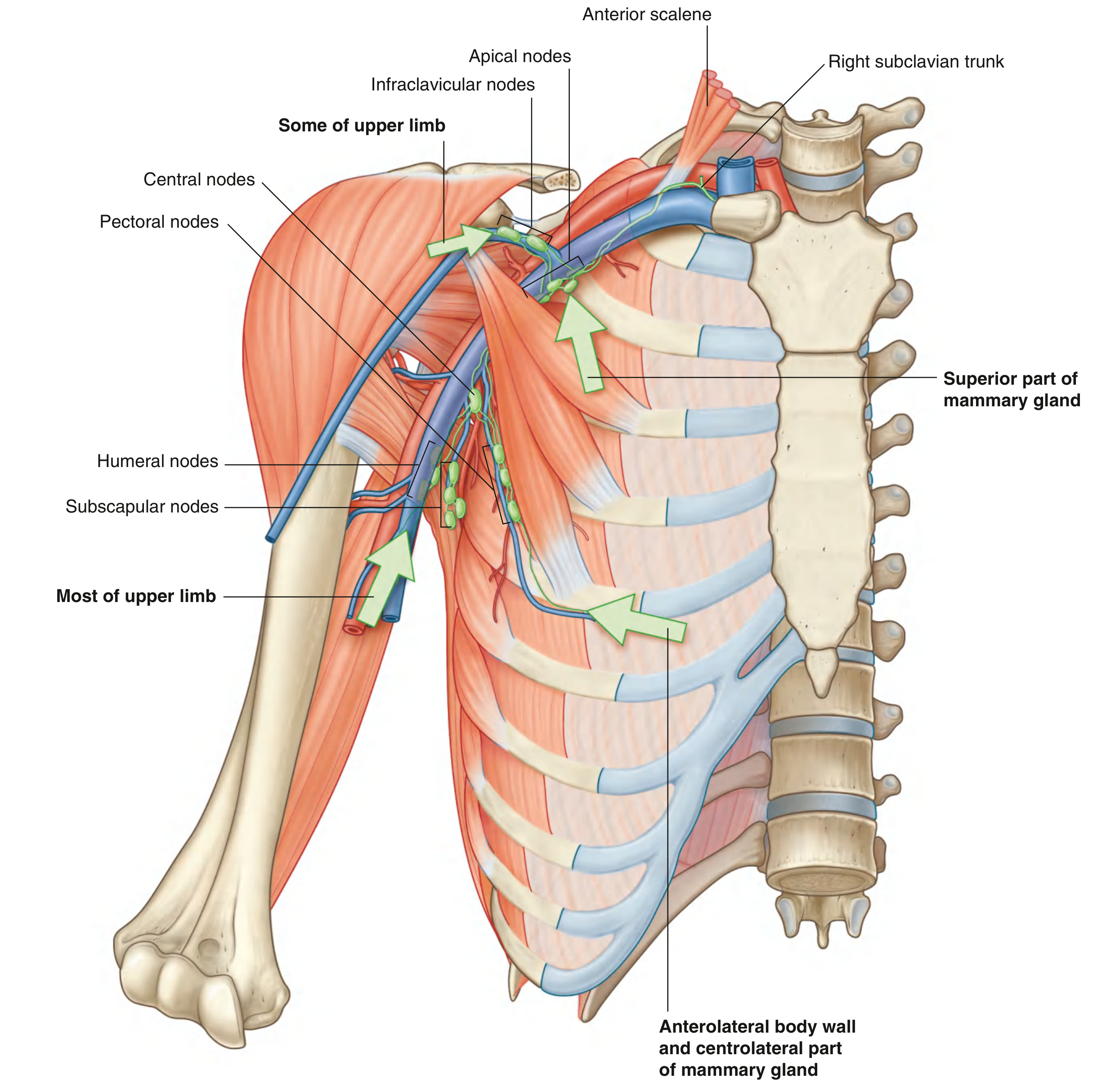
Fig. 7.57 - Lymph Nodes and Vessels in the Axilla showing drainage from the upper limb, mammary gland, and anterolateral body wall (Gray's Anatomy for Students)
Clinical Relevance
- Axillary node dissection or radiotherapy in breast cancer can obstruct lymphatic drainage of the upper limb, leading to lymphedema
- Breast cancer metastasizes to axillary nodes in a predictable level-by-level sequence (I → II → III), making surgical level staging important
- "Skip metastases" (bypassing Level I to go directly to Level II or III) can occasionally occur
Sources: Gray's Anatomy for Students, p. 867-868 | General Anatomy and Musculoskeletal System (THIEME Atlas), p. 380 | S Das Manual on Clinical Surgery, p. 424-425
This is a shared conversation. Sign in to Orris to start your own chat.