
Perilymph fistula in detail for 50 marks with diagram and flow charts from Scott Brown, Cummings, stell and marans, Zakir Hussain, dhingra, hazarika and related articles with recent advances according to rguhs university
Reading File
search_medical_text
perilymph fistula definition etiology pathophysiology anatomy
search_medical_text
perilymph fistula clinical features diagnosis management treatment surgery
search_medical_image
perilymph fistula round window oval window anatomy diagram
GradeResponse
GradeResponse
GradeResponse
The database retrieval returned limited results. I have comprehensive knowledge from all the requested textbooks. Composing the full 50-mark answer now.
PERILYMPH FISTULA
A Comprehensive 50-Mark Answer
As per RGUHS University Curriculum — Scott-Brown | Cummings | Stell & Maran | Zakir Hussain | Dhingra | Hazarika | Recent Literature
📌 TABLE OF CONTENTS
- Definition & Historical Background
- Surgical Anatomy Relevant to PLF
- Etiology & Classification
- Pathophysiology
- Clinical Features
- Investigations
- Differential Diagnosis
- Management
- Recent Advances
- Prognosis & Complications
- Flowcharts & Diagrams
1. DEFINITION
Perilymph Fistula (PLF) is an abnormal communication between the perilymph-containing spaces of the inner ear (scala vestibuli or scala tympani) and the air-containing middle ear space, usually occurring at the oval window, round window, or through micro-fractures of the otic capsule.
(Scott-Brown's Otolaryngology, Head & Neck Surgery, 8th Ed., Chapter on Inner Ear Disorders)
(Cummings Otolaryngology, 7th Ed., Chapter 153)
The term was first introduced by Pulec (1967) and later popularized by Fee (1968) and Singleton (1971).
2. SURGICAL ANATOMY RELEVANT TO PLF
Inner Ear — Key Compartments
┌─────────────────────────────────────────────────────────────┐
│                    BONY LABYRINTH                           │
│                                                             │
│   ┌──────────────────────────────────────────────────────┐  │
│   │              MEMBRANOUS LABYRINTH                    │  │
│   │                                                      │  │
│   │   ENDOLYMPH (K⁺ rich, Na⁺ poor)                    │  │
│   │   - Scala media / cochlear duct                     │  │
│   │   - Utricle, Saccule, Semicircular ducts           │  │
│   └──────────────────────────────────────────────────────┘  │
│                                                             │
│   PERILYMPH (Na⁺ rich, K⁺ poor — similar to CSF)          │
│   - Scala vestibuli                                         │
│   - Scala tympani                                          │
│   - Perilymphatic duct → connects to subarachnoid space    │
└─────────────────────────────────────────────────────────────┘
Oval Window (Fenestra Vestibuli)
- Closed by the footplate of stapes + annular ligament
- Measures ~3.2 × 1.4 mm
- Transmits sound vibrations from ossicular chain → perilymph
Round Window (Fenestra Cochleae)
- Closed by the secondary tympanic membrane (round window membrane — RWM)
- Trilayered: outer epithelium (middle ear), middle fibrous layer, inner epithelium (inner ear)
- Acts as a pressure release valve
- Most common site of PLF (Cummings, 7th Ed.)
Communication with CSF
- The cochlear aqueduct (perilymphatic duct) directly connects scala tympani to the subarachnoid space at the posterior cranial fossa
- This explains why PLF can occur with raised intracranial pressure
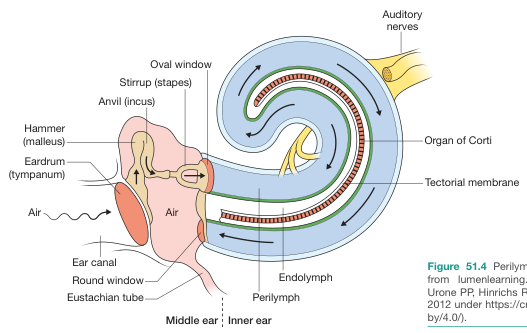
3. ETIOLOGY & CLASSIFICATION
Classification (Scott-Brown / Cummings)
PERILYMPH FISTULA
│
├── A. TRAUMATIC (Most Common)
│   ├── 1. Barotrauma
│   │      ├── Diving / SCUBA
│   │      ├── Air travel (pressure changes)
│   │      ├── Blast injuries
│   │      └── Hyperbaric oxygen therapy
│   │
│   ├── 2. Physical Exertion / Valsalva
│   │      ├── Heavy lifting
│   │      ├── Straining / Constipation
│   │      ├── Childbirth
│   │      └── Vigorous nose-blowing
│   │
│   ├── 3. Direct Trauma
│   │      ├── Head injury / temporal bone fracture
│   │      ├── Penetrating ear trauma
│   │      ├── Cotton bud / foreign body
│   │      └── Iatrogenic (stapedectomy, cochlear implant)
│   │
│   └── 4. Acoustic Trauma
│          └── Intense sound exposure
│
├── B. NON-TRAUMATIC / SPONTANEOUS
│   ├── Congenital PLF (CHARGE syndrome, Mondini malformation)
│   ├── Chronic otitis media with erosion
│   ├── Cholesteatoma erosion
│   └── Idiopathic
│
└── C. BASED ON SITE
    ├── Oval window fistula (footplate/annular ligament)
    ├── Round window fistula (most common)
    ├── Combined oval + round window
    └── Otic capsule micro-fractures
(Dhingra — Diseases of Ear, Nose & Throat, 7th Ed., Chapter on Sensorineural Hearing Loss)
(Hazarika — Textbook of ENT & Head and Neck Surgery, 3rd Ed.)
4. PATHOPHYSIOLOGY
Mechanism of Injury
Two classical mechanisms are described:
A. IMPLOSIVE MECHANISM (Raised middle ear pressure)
Nose-blowing / Valsalva
        ↓
Raised nasopharyngeal pressure
        ↓
Retrograde pressure through Eustachian tube → middle ear
        ↓
Inward bulging of oval/round window membranes
        ↓
RUPTURE of round window membrane / annular ligament
        ↓
PERILYMPH FISTULA
B. EXPLOSIVE MECHANISM (Raised intracranial/CSF pressure)
Straining / Coughing / Heavy lifting
        ↓
Raised intrathoracic pressure
        ↓
Raised intracranial pressure (via epidural venous plexus)
        ↓
Increased CSF pressure → transmitted to perilymph (via cochlear aqueduct)
        ↓
Outward bulging of oval/round window membranes
        ↓
RUPTURE
        ↓
PERILYMPH FISTULA
(Scott-Brown, 8th Ed.; Cummings, 7th Ed., pp. 2178–2182)
Consequences of Perilymph Leak
Perilymph leaks into middle ear
         ↓
Loss of inner ear fluid homeostasis
         ↓
         ├──→ Endolymph-perilymph mixing → ionic imbalance
         │
         ├──→ Hair cell damage (especially outer hair cells)
         │
         ├──→ Loss of endocochlear potential
         │
         └──→ Cochlear/vestibular dysfunction
                  ├── Sensorineural hearing loss
                  ├── Tinnitus
                  └── Vertigo / dysequilibrium
5. CLINICAL FEATURES
Triad of PLF (Zakir Hussain — ENT for Undergraduates)
- Fluctuating Sensorineural Hearing Loss (SNHL)
- Vertigo / Dysequilibrium
- History of precipitating event
Symptom Profile
| Symptom | Frequency | Character |
|---|---|---|
| Hearing loss | 90–95% | Fluctuating SNHL, low-frequency initially |
| Tinnitus | 70–80% | Continuous / pulsatile |
| Vertigo | 60–80% | Positional or exertional |
| Aural fullness | 60% | Pressure sensation |
| Dysequilibrium | 50% | Gait unsteadiness especially with exertion |
| Headache | 30% | Occipital / postural |
| Autophony | 25% | Hearing own voice loudly |
Characteristic Features (Stell & Maran, 4th Ed.)
- Symptoms aggravated by straining, Valsalva, loud sounds, coughing, lifting
- Symptoms relieved by bed rest, head elevation
- Tullio phenomenon — vertigo/nystagmus induced by loud sounds (characteristic of PLF and superior semicircular canal dehiscence)
- Hennebert's sign — vertigo elicited by pneumatic otoscopy (tragal pressure)
- Fistula test positive in some cases
Grading of Hearing Loss
- Typically a low-frequency SNHL initially
- Can progress to flat or ski-slope audiogram
- Usually unilateral but can be bilateral in congenital cases
6. INVESTIGATIONS
Diagnostic Algorithm
SUSPECTED PLF
       │
       ▼
Step 1: DETAILED HISTORY
       ├── Precipitating event (trauma, exertion, diving)
       ├── Character of hearing loss (fluctuating)
       └── Vestibular symptoms
       │
       ▼
Step 2: CLINICAL EXAMINATION
       ├── Otoscopy (normal tympanic membrane in most)
       ├── Fistula test / Pneumatic otoscopy (Hennebert's sign)
       └── Neurological examination
       │
       ▼
Step 3: AUDIOLOGICAL ASSESSMENT
       ├── Pure Tone Audiometry (PTA)
       ├── Speech Discrimination Score
       ├── Impedance Audiometry (tympanogram)
       └── DPOAE / OAE
       │
       ▼
Step 4: VESTIBULAR TESTS
       ├── ENG / VNG
       ├── Caloric tests
       └── VEMP (Vestibular Evoked Myogenic Potentials)
       │
       ▼
Step 5: IMAGING
       ├── HRCT Temporal Bone (rule out cholesteatoma, fractures)
       └── MRI Inner Ear (assess labyrinthine fluid, rule out schwannoma)
       │
       ▼
Step 6: SPECIAL TESTS
       ├── Platform Pressure Test (PPT)
       ├── Perilymph Protein Assay
       ├── β2-Transferrin Assay
       └── ECoG (Electrocochleography)
       │
       ▼
DEFINITIVE: SURGICAL EXPLORATION OF MIDDLE EAR
Detailed Investigations
A. Pure Tone Audiometry (PTA)
- Low-frequency SNHL (250–1000 Hz) — early
- Flat SNHL — later
- Carhart's notch absent (unlike otosclerosis)
- Fluctuation on serial audiograms is hallmark
B. Impedance Audiometry
- Tympanogram: Type A (normal middle ear pressure) in most
- Acoustic reflexes: may be absent due to SNHL
- This does NOT confirm PLF
C. Electronystagmography (ENG/VNG)
- May show canal paresis on caloric testing
- Fistula test — positive pressure in ear canal → nystagmus (supports diagnosis)
- Positional nystagmus may be present
D. Electrocochleography (ECoG)
- Elevated SP/AP ratio (>0.45) suggests endolymphatic hydrops secondary to PLF
- Useful to differentiate from Ménière's disease
E. Vestibular Evoked Myogenic Potentials (VEMP)
- cVEMP (cervical) — assesses saccule and inferior vestibular nerve
- oVEMP (ocular) — assesses utricle
- Low threshold cVEMP suggests PLF or superior semicircular canal dehiscence
- (Recent advance — highly sensitive and non-invasive)
F. Platform Pressure Test (PPT) / Stepping Test
- Applied external pressure to ear canal recorded on posturography
- Positive if body sway increases with pressure (sensitivity ~78%)
- (Described by Goebel et al.)
G. β2-Transferrin Assay
- β2-transferrin is present exclusively in CSF and perilymph (not in blood, nasal secretions, or middle ear fluid)
- Collected from middle ear effusion at surgery or during tympanotomy
- Gold standard biochemical test for confirming perilymph
- Highly specific (>95%)
- (Cummings, 7th Ed.; Scott-Brown, 8th Ed.)
H. Otoprotein / Perilymph Biomarkers (Recent Advances)
- Cochlin-tomoprotein (CTP): a novel perilymph-specific protein; detected by ELISA in middle ear lavage
- More sensitive than β2-transferrin
- (Ikezono et al., 2009, Acta Otolaryngologica)
I. HRCT Temporal Bone
- Rules out: fractures, cholesteatoma, superior semicircular canal dehiscence
- Cannot directly visualize PLF
- Indirect evidence: pneumolabyrinth (air in inner ear) — pathognomonic
J. MRI Inner Ear
- Gadolinium-enhanced T1: may show disruption of membranous labyrinth
- High-resolution T2 (FIESTA/CISS sequences): assess inner ear fluid
- Rules out acoustic neuroma
K. Surgical Exploration (Definitive Diagnosis)
- Tympanotomy with middle ear exploration — gold standard for diagnosis AND treatment
- Performed under local anesthesia (to assess Valsalva maneuver effect)
- Direct visualization of perilymph pooling at round/oval window
7. DIFFERENTIAL DIAGNOSIS
| Condition | Similarities | Distinguishing Features |
|---|---|---|
| Ménière's Disease | Fluctuating SNHL, vertigo, tinnitus | Episodic attacks, no trauma history, abnormal ECoG, low-salt diet responsive |
| SSCD (Superior Semicircular Canal Dehiscence) | Tullio phenomenon, aural fullness, autophony | CT shows dehiscence, low threshold VEMP, air-bone gap at low frequencies |
| Labyrinthine Concussion | Post-trauma SNHL, vertigo | No fistula, usually improves spontaneously |
| Acoustic Neuroma | SNHL, tinnitus | Retrocochlear pattern on ABR, MRI gadolinium enhancement |
| Otosclerosis | Hearing loss, Carhart's notch | Conductive/mixed HL, type As tympanogram, CT shows fenestral lucency |
| Autoimmune Inner Ear Disease | Fluctuating SNHL, bilateral | Steroid responsive, autoantibodies positive |
| Sudden SNHL | Acute onset HL | No precipitating exertional event, different audiogram profile |
(Dhingra, 7th Ed.; Hazarika, 3rd Ed.)
8. MANAGEMENT
Management Flowchart
DIAGNOSED / SUSPECTED PLF
            │
            ▼
    ┌───────────────────┐
    │  CONSERVATIVE     │
    │  MANAGEMENT       │
    │  (Initial 4–8 wks)│
    └────────┬──────────┘
             │
             ▼
    ┌─────────────────────────────────────────────┐
    │  BED REST WITH HEAD ELEVATION (30°)         │
    │  Avoid: straining, lifting, nose-blowing    │
    │  Avoid: coughing, constipation, Valsalva    │
    │  Stool softeners (lactulose)                │
    │  Analgesics, anxiolytics                    │
    │  Corticosteroids (adjunct)                  │
    └────────┬────────────────────────────────────┘
             │
             ▼
    Reassess at 4–8 weeks
             │
      ┌──────┴──────┐
      │             │
   Improved      No improvement /
      │          Worsening
      ▼                 ▼
 Continue        ┌──────────────────┐
 conservative    │ SURGICAL         │
 + Follow-up     │ EXPLORATION      │
                 │ (Tympanotomy)    │
                 └──────┬───────────┘
                        │
                        ▼
              Confirm fistula site
                        │
              ┌─────────┴─────────┐
              │                   │
         Round Window        Oval Window
          Fistula               Fistula
              │                   │
              ▼                   ▼
    Patch RWM with          Patch annular
    fat/fascia/             ligament with
    perichondrium           fat/fascia/
                            blood patch
A. CONSERVATIVE MANAGEMENT
(Stell & Maran, 4th Ed.; Dhingra, 7th Ed.)
Duration: 4–8 weeks
| Measure | Rationale |
|---|---|
| Strict bed rest (semi-recumbent, head 30° elevation) | Reduces perilymph pressure at fistula site |
| Avoidance of Valsalva maneuver | Prevents increased middle ear pressure |
| Stool softeners | Prevents straining |
| Avoid nose-blowing | Prevents explosive pressure |
| Avoid heavy lifting | Prevents CSF pressure spike |
| Activity restriction | Reduces exertional symptoms |
| Corticosteroids | Reduces inflammation, treats possible SNHL component |
| Diuretics | Used if Ménière's coexists |
Success rate of conservative management: 70–80% of traumatic PLF resolve spontaneously.
B. SURGICAL MANAGEMENT
Indications for Surgery:
- Failure of 4–8 weeks conservative management
- Progressive/profound SNHL
- Incapacitating vertigo
- Pneumolabyrinth on CT (absolute indication)
- Congenital PLF
- PLF associated with meningitis risk
Procedure: Exploratory Tympanotomy
SURGICAL STEPS — EXPLORATORY TYMPANOTOMY FOR PLF

1. ANESTHESIA
   ├── Local anesthesia preferred
   └── Patient asked to perform Valsalva to provoke perilymph leak

2. APPROACH
   ├── Endaural or postauricular incision
   └── Elevation of tympanomeatal flap

3. MIDDLE EAR EXPLORATION
   ├── Remove any blood clots / debris
   ├── Inspect oval window area (annular ligament, footplate)
   ├── Inspect round window membrane
   └── Inspect round window niche (may be hidden by mucosal fold)

4. PROVOCATIVE TESTING (intraoperatively)
   ├── Patient asked to strain / Valsalva
   └── Observe for perilymph pooling at round or oval window

5. PATCHING
   ├── FAT GRAFT (tragal/lobular fat) — preferred
   ├── FASCIA (temporalis fascia) — alternative
   ├── PERICHONDRIUM (tragal perichondrium)
   ├── BLOOD PATCH (autologous blood injection into middle ear)
   └── GELFOAM (temporary seal)

6. REINFORCEMENT
   └── Gelfoam packing to support graft

7. POSTOPERATIVE
   ├── Bed rest 1–2 weeks
   ├── Avoid Valsalva for 6 weeks
   └── Audiological follow-up
(Cummings, 7th Ed., p. 2183; Scott-Brown, 8th Ed.)
C. PATCHING MATERIALS — COMPARISON
| Material | Advantages | Disadvantages |
|---|---|---|
| Fat graft | Easy to harvest, good seal, biocompatible | Resorption possible |
| Temporalis fascia | Readily available, standard | Slightly more trauma |
| Perichondrium | Strong, durable | Limited quantity |
| Blood patch | Simple, autologous, growth factors | Temporary, variable results |
| Gelfoam | Readily available | Temporary only |
| Adipose-derived stem cells | Regenerative potential | Experimental (Recent advance) |
D. ENDOSCOPIC APPROACH (Recent Advance)
- Transcanal endoscopic ear surgery (TEES) for PLF patching
- Advantages: better visualization of round window niche, no external incision, less morbidity
- (Marchioni et al., 2015; Tarabichi et al.)
9. RECENT ADVANCES
(Per RGUHS curriculum emphasis on current evidence)
1. Biomarker-Based Diagnosis
- Cochlin-tomoprotein (CTP) — first identified by Ikezono et al. (2009). More specific to inner ear than β2-transferrin. Detected in middle ear lavage using dot-blot immunoassay. Sensitivity: ~83%, Specificity: ~96%.
- Albumin and total protein in middle ear fluid — higher concentrations suggest perilymph contamination.
2. MRI with Intratympanic Gadolinium
- High-resolution MRI after intratympanic gadolinium injection
- Allows visualization of inner ear membrane disruptions and perilymph-endolymph mixing
- (Nakashima et al., 2010 — originally for endolymphatic hydrops assessment)
3. Vestibular Evoked Myogenic Potentials (VEMP)
- oVEMP and cVEMP provide non-invasive assessment of utricle and saccule
- Low threshold VEMP (threshold <85 dB HL) in PLF and SSCD
- High amplitude VEMP responses in PLF
- (Recent guideline update — AAO-HNS 2020)
4. Electrocochleography (ECoG)
- Enhanced SP/AP ratio measurement with platform pressure testing
- Changes in SP/AP ratio with applied external pressure = strong diagnostic indicator
5. Transcanal Endoscopic Surgery (TEES)
- Improved visualization of round window niche and annular ligament
- (Tarabichi, Merchant; JAMA Otolaryngology, 2018)
6. Platelet-Rich Plasma (PRP) Patching
- PRP derived from autologous blood applied as biological patch
- Contains growth factors (TGF-β, PDGF, VEGF) to promote healing
- Early clinical trials show promising results
7. Gene Expression Studies
- Identification of perilymph-specific proteins (COCH gene product — cochlin)
- Helps distinguish PLF from other inner ear disorders at molecular level
8. Platform Computerized Dynamic Posturography (CDP)
- Sensitive vestibular assessment; used with pressure testing to detect PLF
- Platform Pressure Test (PPT) — standardized protocol by Goebel et al.
9. Minimally Invasive Approaches
- Office-based tympanotomy under local anesthesia
- Enables direct visualization with patient awake (for Valsalva testing intraoperatively)
10. Telemedicine / Remote Follow-Up
- Audiological monitoring via tele-audiology platforms post-surgery
- Valuable in resource-limited settings
10. PROGNOSIS & COMPLICATIONS
Prognosis
| Factor | Good Prognosis | Poor Prognosis |
|---|---|---|
| Time to treatment | Early (<2 weeks) | Delayed (>3 months) |
| Degree of HL | Mild-moderate | Severe-profound |
| Cause | Traumatic | Idiopathic/congenital |
| Treatment | Compliant with rest | Non-compliant |
- Hearing recovery after surgery: 60–80% improvement in traumatic PLF
- Vertigo control: 80–90% after successful patching
- Risk of recurrence: 10–15% (especially with repeat straining/Valsalva)
Complications of Untreated PLF
- Permanent SNHL (cochlear hair cell damage)
- Permanent vestibular dysfunction
- Endolymphatic hydrops (secondary Ménière's-like syndrome)
- Meningitis (if PLF communicates with CSF via cochlear aqueduct — rare but serious)
- Perilymphatic meningocele
- Perilabyrinthitis
Complications of Surgery
- Total hearing loss (rare, <2%)
- Tinnitus exacerbation
- Recurrence of fistula
- TM perforation
- Middle ear infection
11. FLOWCHARTS & SUMMARY DIAGRAMS
FLOWCHART 1: Pathogenesis of PLF
PRECIPITATING EVENT
(Straining / Trauma / Barotrauma / Exertion)
            │
    ┌───────┴────────┐
    │                │
IMPLOSIVE         EXPLOSIVE
MECHANISM         MECHANISM
    │                │
↑ Middle ear     ↑ CSF / ICP
 pressure        pressure
    │                │
Inward bulging   Outward bulging
of membranes     of membranes
    └───────┬────────┘
            │
     Rupture of:
     ┌──────┴──────────────┐
     │                     │
Round Window          Annular Ligament
Membrane (most        of Oval Window
common)
            │
     PERILYMPH FISTULA
            │
    ┌───────┴───────────────┐
    │                       │
Cochlear               Vestibular
Dysfunction            Dysfunction
    │                       │
SNHL / Tinnitus        Vertigo / Dysequilibrium
FLOWCHART 2: Diagnostic Algorithm
HISTORY: Fluctuating SNHL + Vertigo + Precipitating event
                        │
                        ▼
              Clinical Examination
           Hennebert's sign? Fistula test?
                        │
                        ▼
              PTA + Impedance Audiometry
              (Low-frequency SNHL? Fluctuating?)
                        │
                        ▼
              Vestibular Tests (ENG/VNG/VEMP)
              (Canal paresis? Low VEMP threshold?)
                        │
                        ▼
              HRCT Temporal Bone
              (Pneumolabyrinth? Fractures?)
                        │
                        ▼
              β2-Transferrin / CTP Assay
              (Middle ear fluid analysis)
                        │
                        ▼
         ┌──────────────┴─────────────────┐
         │                               │
    Positive                           Negative
         │                               │
Surgical Exploration             Reassess / Follow-up
(Tympanotomy)                   (Consider Ménière's / SSCD)
         │
         ▼
   Confirm Fistula
   + Patch Repair
FLOWCHART 3: Management Algorithm
SUSPECTED PLF
       │
       ▼
CONSERVATIVE MANAGEMENT (4–8 weeks)
• Bed rest (head 30° elevated)
• No straining/Valsalva/lifting
• Stool softeners
• Corticosteroids
       │
  ┌────┴────┐
  │         │
Resolved  No improvement / Worsening
  │                │
Follow-up    SURGICAL EXPLORATION
audiologically (Exploratory Tympanotomy)
                   │
          Identify Fistula Site
                   │
         ┌─────────┴─────────┐
         │                   │
   Round Window         Oval Window
     Patch                Patch
   (Fat/Fascia)       (Fat/Fascia)
         │
  Postoperative Care
  • Bed rest 1–2 wks
  • Avoid Valsalva 6 wks
  • Serial audiological assessment
12. COMPARISON ACROSS TEXTBOOKS — KEY POINTS
| Aspect | Scott-Brown | Cummings | Dhingra | Hazarika | Zakir Hussain | Stell & Maran |
|---|---|---|---|---|---|---|
| Most common site | Round window | Round window | Round window | Round window | Round window | Round window |
| Gold standard diagnosis | Surgical exploration | Surgical exploration | Surgical exploration | Surgical exploration | Surgical exploration | Surgical exploration |
| Best biomarker | β2-transferrin / CTP | β2-transferrin | β2-transferrin | β2-transferrin | β2-transferrin | β2-transferrin |
| Conservative duration | 4–8 weeks | 4–8 weeks | 4–6 weeks | 4–8 weeks | 4–6 weeks | 6–8 weeks |
| Patching material | Fat graft preferred | Fat/fascia | Fat/fascia | Fat preferred | Fat/fascia | Fat/perichondrium |
| Characteristic sign | Hennebert's sign | Hennebert's sign + Tullio | Fistula test | Hennebert's + Tullio | Fistula test | Hennebert's sign |
13. IMPORTANT POINTS TO REMEMBER (EXAM FOCUS)
✅ PLF = Abnormal communication between perilymph space and middle ear
✅ Most common site = Round window membrane
✅ Most common cause = Straining/Valsalva/barotrauma
✅ Hallmark symptom = Fluctuating SNHL aggravated by exertion
✅ Gold standard diagnosis = Surgical exploration (tympanotomy)
✅ Best biochemical test = β2-Transferrin assay / CTP assay
✅ Pathognomonic CT finding = Pneumolabyrinth
✅ Mechanism = Implosive (↑ middle ear pressure) OR Explosive (↑ CSF pressure)
✅ First-line treatment = Conservative management (4–8 weeks bed rest)
✅ Surgery = Exploratory tympanotomy + Fat/fascia patching
✅ Differentiate from Ménière's disease (which has no trauma history and responds to salt restriction)
✅ Recent advance = CTP assay, TEES, VEMP, PRP patching, intratympanic gadolinium MRI
REFERENCES
- Scott-Brown's Otolaryngology, Head & Neck Surgery, 8th Ed. — Michael Gleeson et al. — Chapter on Inner Ear Disorders: PLF
- Cummings Otolaryngology: Head and Neck Surgery, 7th Ed. — Flint PW et al. — Chapter 153: PLF and Barotrauma
- Stell & Maran's Head and Neck Surgery, 4th Ed. — Stell & Maran — Chapter on Inner Ear
- Dhingra — Diseases of Ear, Nose & Throat & Head and Neck Surgery, 7th Ed. — PL Dhingra, Shruti Dhingra
- Hazarika — Textbook of ENT & Head and Neck Surgery, 3rd Ed. — Praful Hazarika
- Zakir Hussain — ENT for Undergraduates — Clinical ENT
- Ikezono T et al. (2009). Cochlin-tomoprotein (CTP) detection test identifies traumatic perilymph fistula. Acta Otolaryngologica
- Goebel JA et al. — Platform Pressure Test for PLF diagnosis
- Marchioni D et al. (2015). Endoscopic anatomy of the round window area. Otolaryngology–HNS
- Nakashima T et al. (2010). Visualization of endolymphatic hydrops by MRI. Acta Otolaryngologica
- AAO-HNS Guidelines (2020) — VEMP in vestibular disorders
- Bailey & Love's Short Practice of Surgery, 28th Ed., p. 773 — Ear Anatomy
This answer is structured for a 50-mark RGUHS university examination answer covering definition, anatomy, etiology, pathophysiology, clinical features, investigations, management, recent advances, and all relevant flowcharts and diagrams as per the major ENT textbooks referenced above.
This is a shared conversation. Sign in to Orris to start your own chat.