
Ech
Hey! How can I help you today?
Ecg
That's pretty broad! Let me know what you'd like to explore about ECGs.
Asking for Preferences
What aspect of ECGs are you interested in?
Reading File
Finding Sources
Searching Images
12-lead ECG anatomy leads placement diagram
Finding Sources
Finding Sources
Reading File
Finding Sources
Reading File
Loading Image
Loading Image
Here's a structured guide to reading a 12-lead ECG, using a systematic approach so you never miss anything.
How to Read a 12-lead ECG
Step 0 — Understand the Paper & Leads
ECG paper:
- Small box = 1 mm = 0.04 s (horizontal) / 0.1 mV (vertical)
- Large box = 5 mm = 0.2 s
- 5 large boxes = 1 second
The 12 leads view the heart from different angles:
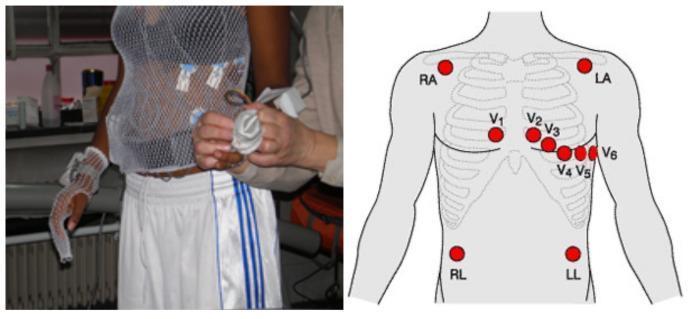
Electrode placement:
| Group | Leads | View |
|---|---|---|
| Limb (frontal plane) | I, II, III | Left/right/inferior |
| Augmented limb | aVR, aVL, aVF | Right arm, left arm, left foot |
| Precordial (horizontal plane) | V1–V6 | Right → left ventricle |
Precordial placement:
- V1 & V2: 4th intercostal space, right/left of sternum
- V4: 5th intercostal space, midclavicular line
- V3: between V2 & V4
- V5 & V6: anterior/mid-axillary line (same level as V4)
Step 1 — Rate
Quick method (large boxes between R-R interval):
| Large boxes | Rate (bpm) |
|---|---|
| 1 | 300 |
| 2 | 150 |
| 3 | 100 |
| 4 | 75 |
| 5 | 60 |
| 6 | 50 |
Formula: Rate = 300 ÷ (number of large boxes)
Normal = 60–100 bpm
Step 2 — Rhythm
Ask three questions:
- Where is the pacemaker? (Should be SA node → normal sinus rhythm)
- Is it regular? (Are R-R intervals equal?)
- Normal sequence? P wave → QRS → T in every beat?
Normal sinus rhythm: upright P in II, each P followed by QRS, rate 60–100.
Step 3 — Waves, Intervals & Segments
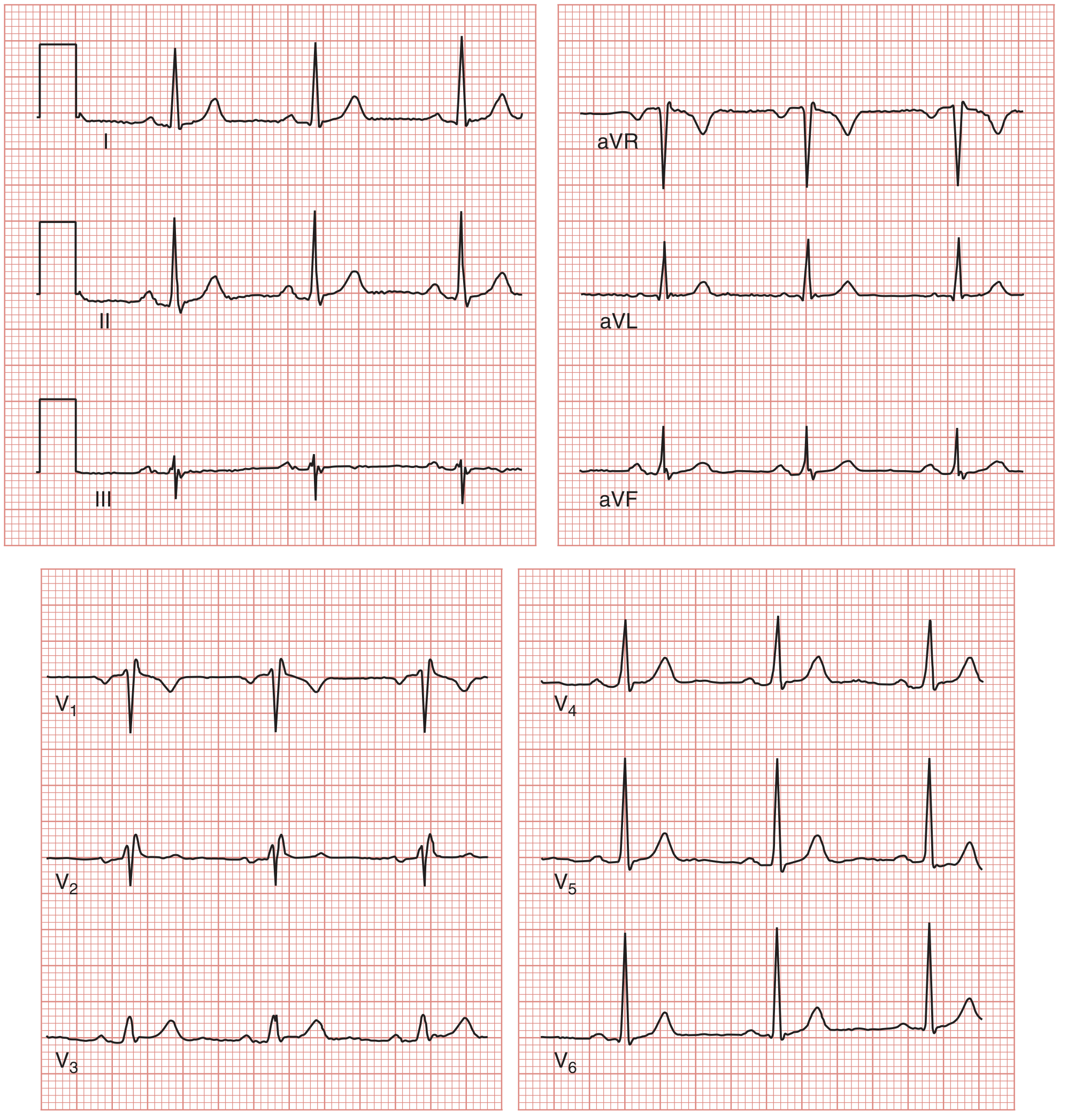
| Component | What it represents | Normal duration |
|---|---|---|
| P wave | Atrial depolarization | < 0.12 s, upright in II |
| PR interval | AV node conduction (P onset → QRS onset) | 0.12–0.20 s (3–5 small boxes) |
| QRS complex | Ventricular depolarization | < 0.12 s (< 3 small boxes) |
| ST segment | Plateau of ventricular action potential | Isoelectric (flat) |
| T wave | Ventricular repolarization | Upright in most leads |
| QT interval | QRS onset → T wave end | Rate-dependent; roughly < 0.44 s |
Step 4 — Axis
Normal QRS axis: −30° to +90° (frontal plane).
Quick check:
- Both leads I and aVF positive → normal axis
- Lead I positive, aVF negative → left axis deviation (LAD)
- Lead I negative, aVF positive → right axis deviation (RAD)
Causes of LAD: left ventricular hypertrophy, left bundle branch block, inferior MI.
Causes of RAD: right ventricular hypertrophy, pulmonary embolism, lateral MI.
Causes of RAD: right ventricular hypertrophy, pulmonary embolism, lateral MI.
Step 5 — Hypertrophy
Left ventricular hypertrophy (LVH): S in V1 + R in V5 or V6 ≥ 35 mm (Sokolow-Lyon)
Right ventricular hypertrophy (RVH): Dominant R in V1, right axis deviation
Step 6 — ST & T Wave Changes
| Finding | Suggests |
|---|---|
| ST elevation | STEMI, pericarditis, Brugada |
| ST depression | NSTEMI, ischemia, digoxin effect |
| T wave inversion | Ischemia, LVH, PE (V1–V4) |
| Peaked T waves | Hyperkalemia, hyperacute STEMI |
Step 7 — Bundle Branch Blocks
- RBBB: QRS ≥ 0.12 s + RSR' ("rabbit ears") in V1, wide S in I & V6
- LBBB: QRS ≥ 0.12 s + broad notched R in I, V5, V6; no septal Q waves
Summary Mnemonic: RRIAWST
Rate → Rhythm → Intervals → Axis → Waves (hypertrophy) → ST changes → Twave/Bundle branch blocks
Source: Medical Physiology (Boron & Boulpaep), Box 21-2 & Figure 21-11
Want me to go deeper on any step — like ST changes in MI, arrhythmia recognition, or axis calculation?
This is a shared conversation. Sign in to Orris to start your own chat.