
Tell me about bradycardia
Reading File
Now let me search the medical library for bradycardia content in parallel with a PubMed search.
Finding Sources
Searching PubMed
bradycardia management treatment
Good results. Now let me read the most comprehensive sources in parallel - Guyton (physiology), Braunwald's (cardiology), Rosen's (emergency), and Sabiston (surgery).
Reading File
Reading File
Reading File
Reading File
Excellent content gathered. Let me also fetch the ECG image from Guyton and get more from Braunwald's on management.
Loading Image
Reading File
I have comprehensive content from multiple authoritative sources. Here is the full answer:
Bradycardia
Definition
Bradycardia is a heart rate of fewer than 60 beats/min. Braunwald's Heart Disease uses a slightly stricter cutoff of less than 50 beats/min for the ECG diagnosis of sinus bradycardia in adults. The two thresholds reflect the distinction between a borderline-low normal rate (50-60 bpm) and a clearly pathological one.
ECG appearance (sinus bradycardia): Normal P-wave morphology, upright in leads I, II, and aVF; constant PR interval > 120 ms; P wave precedes every QRS; P-P interval equals R-R interval; rate < 60 bpm.
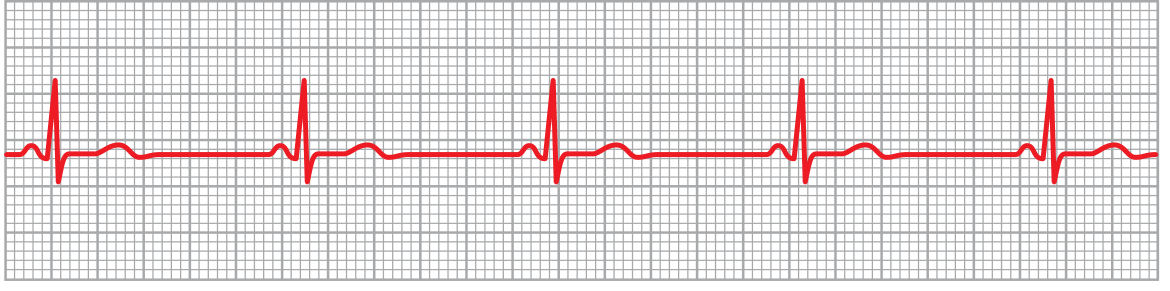
Types
| Type | Key Feature |
|---|---|
| Sinus bradycardia | Normal P waves; rate < 60 (or < 50) bpm |
| Junctional bradycardia | AV node as pacemaker; no normal atrial activity |
| Ventricular bradycardia | Escape rhythm from ventricle; wide QRS, very slow rate |
| AV block (1st/2nd/3rd degree) | Conduction failure between atria and ventricles |
| Sick sinus syndrome (SSS) | SA node disease; may alternate with tachycardia ("brady-tachy syndrome") |
Causes
Physiological (non-pathological)
- Athletes: Well-trained hearts pump a large stroke volume per beat, triggering baroreceptor-mediated vagal feedback. Exercise training also downregulates the "funny current" (I_f) channels of the SA node, reducing intrinsic pacemaker activity.
- High resting vagal tone in young adults
- Sleep
Pathological
- Vagal stimulation: Carotid sinus syndrome (hypersensitive baroreceptors - even mild neck pressure can trigger extreme bradycardia and syncope), vasovagal syncope, hemoperitoneum
- Cardiac: Acute inferior wall MI (SA node involvement), sick sinus syndrome, cardiomyopathy, fibrotic degeneration (most common in elderly)
- Systemic: Hypothermia, hypoxia, severe sepsis
- Neurological: High cervical spinal cord injury (disrupts sympathetic outflow, leaving vagal tone unopposed)
- Drugs: Beta-blockers, calcium channel blockers, dexmedetomidine, digoxin
- Connective tissue diseases (associated with sick sinus syndrome)
Clinical Presentation
- Often asymptomatic - many patients with sinus bradycardia (especially athletes) need no treatment
- Symptomatic bradycardia: fatigue, dizziness, pre-syncope, syncope, dyspnea, chest pain
- Hemodynamic compromise: hypotension, altered consciousness - this is the key trigger for intervention
- When the rate drops below 40 bpm, a junctional escape rhythm may emerge
- Carotid sinus syndrome: bradycardia so profound it can stop the heart for 5-10 seconds, causing loss of consciousness
AV Blocks (a major cause of bradycardia)
| Degree | Mechanism | PR Interval | Treatment Need |
|---|---|---|---|
| 1st degree | Conduction delay | PR > 200 ms, every P conducted | Usually none |
| 2nd degree Mobitz I (Wenckebach) | Progressive PR lengthening until a beat is dropped | Lengthens then resets | Usually none if stable |
| 2nd degree Mobitz II | Fixed PR, intermittent dropped beats | Constant PR | Context-dependent; pacing often needed |
| 3rd degree (complete) | No atrio-ventricular relationship | None (P and QRS dissociated) | Pacing usually required |
Management
General Principle
If bradycardia is not causing hemodynamic compromise, no treatment is needed. The priority in pathological cases is always reversal of the underlying cause.
Acute Pharmacological Treatment
- Atropine 1 mg IV every 3-5 minutes, up to 3 mg total - first-line for symptomatic sinus bradycardia
- Not effective in junctional/ventricular bradycardia (acts on the AV node)
- Not effective in post-cardiac transplant patients (denervated heart)
- Not effective for dexmedetomidine-induced bradycardia (alpha-2 agonist mechanism bypasses muscarinic blockade)
- Dopamine or epinephrine infusion - second line
- Isoproterenol 2-10 mcg/min - preferred in post-heart transplant patients (works via beta-1 receptor, not vagal pathways)
Special Situations
- Cervical spinal cord injury: Atropine + vasopressors (treat neurogenic shock simultaneously)
- Dexmedetomidine-induced: Vasopressors until drug clears; pacing if hypotension is refractory
- Inferior wall MI: Atropine is appropriate
- Junctional/ventricular bradycardia: Temporary pacing if cardiac output falls
Electrical / Device Treatment
- Emergency cutaneous (transcutaneous) pacing - rarely needed for sinus bradycardia; useful for refractory cases
- Permanent pacemaker - for sick sinus syndrome with symptomatic bradycardia; also allows safe use of AV nodal blocking drugs for the tachycardic component of brady-tachy syndrome
Summary Points
- Rate < 60 bpm (some sources < 50 bpm for true sinus bradycardia)
- Physiological in athletes due to increased stroke volume and downregulated SA node I_f channels
- Pathological causes range from vagal stimulation and drug effects to MI, hypothermia, and intrinsic SA node disease
- Treat if symptomatic or hemodynamically unstable - atropine is the first-line drug
- Know the exceptions - transplanted hearts, dexmedetomidine, and junctional/ventricular rhythms do NOT respond to atropine
- Permanent pacing is the definitive treatment for sick sinus syndrome and recurrent high-degree AV block
Sources: Guyton and Hall Textbook of Medical Physiology; Braunwald's Heart Disease; Rosen's Emergency Medicine; Sabiston Textbook of Surgery
This is a shared conversation. Sign in to Orris to start your own chat.