
Treatment of acute diarrhea in an 55 year old male
Reading File
Now let me search the medical library and PubMed in parallel for acute diarrhea management.
Finding Sources
Finding Sources
Searching PubMed
"acute diarrhea" AND management
Good results found. Let me now read the key sections from Harrison's and Sleisenger in parallel.
Reading File
Reading File
Let me read the management algorithm from Harrison's and the treatment table from Sleisenger.
Reading File
Reading File
Now let me read the actual treatment/management section from Harrison's which has the algorithm, and the antibiotic section from Rosen's.
Reading File
Reading File
Let me now read the actual treatment/empiric antibiotic section from Harrison's and the specific treatment recommendations from Rosen's.
Reading File
Reading File
Let me read the treatment section from Rosen's and get the Harrison's management algorithm section.
Reading File
Finding Sources
Let me find the actual treatment section in Rosen's block 3 and the Harrison's acute diarrhea treatment section.
Reading File
Finding Sources
Now let me read the key treatment sections from Harrison's and Goldman-Cecil.
Reading File
Reading File
Let me now read the treatment section of Goldman-Cecil and the Harrison's treatment section.
Reading File
Reading File
I now have comprehensive information to compile a thorough answer. Let me also get the Goldman-Cecil antibiotic section and fetch the Harrison's algorithm image.
Reading File
Loading Image
I now have all the information needed for a comprehensive response. Here is the complete treatment guide for acute diarrhea in a 55-year-old male:
Treatment of Acute Diarrhea in a 55-Year-Old Male
Management Algorithm (Harrison's, 2025)
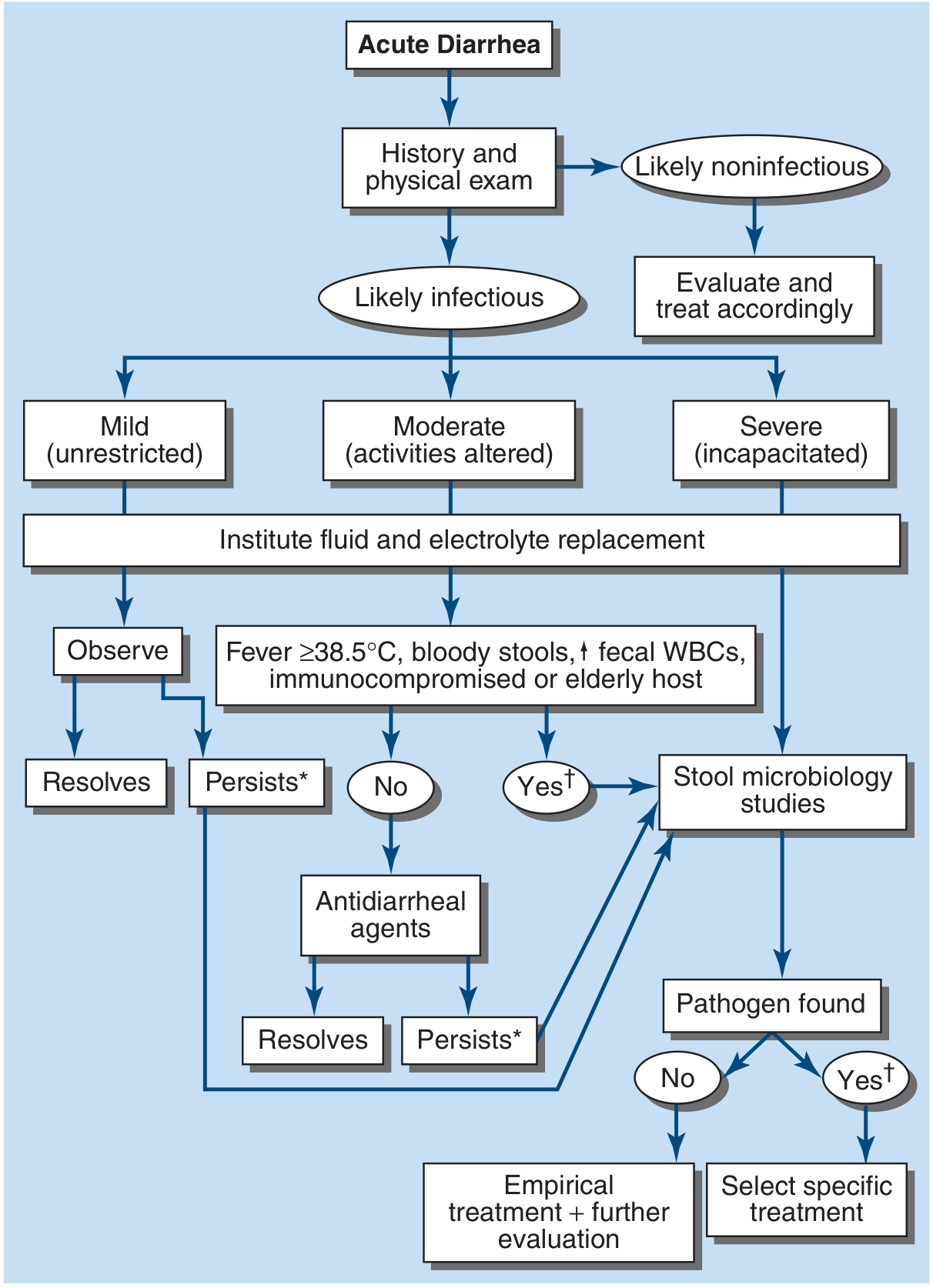
1. Initial Assessment
Acute diarrhea is defined as ≥3 loose/watery stools per 24 hours, lasting up to 14 days. Over 90% of cases are infectious (viral > bacterial > parasitic). The first step is assessing severity and volume status.
Signs of dehydration/hypovolemia to check:
- Tachycardia, hypotension, dry mucosa, poor skin turgor
- Decreased urine output, diaphoresis, mental status changes
Indicators requiring full evaluation (stool microbiology, labs):
- Profuse diarrhea with dehydration
- Overtly bloody stools
- Fever ≥38.5°C (101°F)
- Duration >48 hours without improvement
- Recent antibiotic use (raises C. difficile concern)
- Severe abdominal pain in a patient >50 years
- Immunocompromised state
At 55 years, this patient is not in the elderly (≥70) high-risk bracket, but he should be evaluated if any of the above apply. - Harrison's Principles of Internal Medicine 22E, p. 350
2. Fluid and Electrolyte Replacement (Most Important Step)
Death from acute diarrhea is due to dehydration - rehydration is always the first priority.
| Severity | Approach |
|---|---|
| Mild | Oral fluids - water, broth, dilute juices; avoid excess sugar, caffeine, high-fat content |
| Mild-Moderate | Oral Rehydration Solution (ORS) - isotonic, glucose-electrolyte based; adults may need ~1000 mL/hour |
| Severe / Profuse | IV rehydration with lactated Ringer's or normal saline + K⁺ and HCO₃⁻ as needed |
Reduced-osmolarity ORS (Na⁺ 75 mmol/L, osmolarity 245 mmol/L) is better tolerated than standard solutions in non-cholera diarrhea. - Goldman-Cecil Medicine, p. 1461
Diet: Continue feeding as tolerated. The BRAT diet (bananas, rice, apples, toast) or bland, low-fiber foods are reasonable early on.
3. Symptomatic (Antidiarrheal) Therapy
Antimotility Agents
-
Loperamide (Imodium): First-line for symptomatic relief in non-febrile, non-bloody diarrhea
- Dose: 4 mg orally initially, then 2 mg after each loose stool (max 16 mg/24 hours)
- Safe and effective for traveler's diarrhea when given with antibiotics
- Contraindicated in bloody diarrhea (dysentery), high fever, or suspected C. difficile - paralysis of intestinal motility prolongs infection
-
Diphenoxylate + atropine (Lomotil): Alternative, but higher abuse potential
Antisecretory / Adsorbent Agents
-
Bismuth subsalicylate (Pepto-Bismol): 525 mg every 30-60 minutes x 5 doses (may repeat day 2)
- Effective for vomiting and diarrhea, including traveler's diarrhea
- Avoid in patients with renal impairment or immunocompromised (risk of bismuth encephalopathy)
-
Racecadotril (100 mg orally TID): Enkephalinase inhibitor - antisecretory effect without immobilizing gut motility; useful if available
Harrison's Principles of Internal Medicine 22E, p. 350; Goldman-Cecil Medicine, p. 1461; Rosen's Emergency Medicine, p. 3687
4. Antibiotic Therapy
Most acute diarrhea does NOT require antibiotics. Empiric antibiotics are indicated in specific scenarios:
Indications for Empiric Antibiotics in this 55-year-old:
- Moderate-to-severe febrile diarrhea (temp ≥38.5°C) with fecal leukocytes
- Bloody stools (dysentery pattern)
- Traveler's diarrhea
- Immunocompromised state
- Persistent diarrhea >48 hours without improvement
- Suspected sepsis
Empiric Regimens:
| Scenario | Drug | Dose & Duration |
|---|---|---|
| General/Traveler's diarrhea | Ciprofloxacin | 500 mg PO BID × 3-5 days |
| General/Traveler's diarrhea | Levofloxacin | 500 mg PO OD × 3 days |
| Traveler's diarrhea (single dose) | Azithromycin | 1000 mg PO single dose |
| Suspected Campylobacter | Azithromycin | 500 mg/day PO × 3 days |
| Uncomplicated traveler's diarrhea | Rifaximin | 200 mg PO TID × 3 days (not for invasive disease) |
| Suspected Giardia | Metronidazole | 250 mg PO QID × 7 days |
| C. difficile (first-line) | Vancomycin (oral) | 125 mg PO QID × 10 days |
| C. difficile (second-line) | Fidaxomicin | 200 mg PO BID × 10 days |
Rosen's Emergency Medicine, pp. 3691-3695; Harrison's, p. 350; Goldman-Cecil, p. 1461
Note on fluoroquinolone resistance: Azithromycin is preferred over fluoroquinolones for Campylobacter (increasing quinolone resistance) and is first choice in Southeast Asian traveler's diarrhea. - Harrison's Principles of Internal Medicine 22E
5. Specific Pathogen-Directed Therapy
| Pathogen | Preferred Antibiotic |
|---|---|
| Salmonella (non-typhoidal) | Fluoroquinolone or azithromycin (only if severe/immunocompromised; antibiotics may prolong carriage) |
| Shigella | Ciprofloxacin or azithromycin |
| Campylobacter | Azithromycin |
| C. difficile | Oral vancomycin 125 mg QID × 10 days |
| Giardia | Metronidazole 250 mg QID × 7 days OR nitazoxanide 500 mg BID × 3 days |
| Cryptosporidium | Nitazoxanide 500 mg BID × 3 days |
| Traveler's diarrhea (ETEC) | Rifaximin or ciprofloxacin |
STEC (E. coli O157:H7) - avoid antibiotics as they may precipitate hemolytic-uremic syndrome (HUS).
6. Special Considerations for a 55-Year-Old Male
- Medications: Review current meds - antibiotics (C. difficile risk), PPIs, metformin, ACE inhibitors, ARBs (olmesartan - sprue-like enteropathy), laxatives, and >700 other drugs can cause diarrhea
- C. difficile vigilance: Always consider in any patient with recent antibiotic or hospitalization history, even without traditional risk factors
- Comorbidities: Diabetes, cardiovascular disease, or immunosuppression increase risk of serious complications - lower threshold for antibiotics and IV fluids
- Electrolytes: Check serum electrolytes and renal function if moderate-to-severe dehydration is suspected
7. When to Hospitalize
- Signs of hemodynamic compromise (persistent tachycardia, hypotension)
- Inability to maintain oral hydration
- Severe metabolic disturbance (acidosis, acute kidney injury)
- High fever with systemic sepsis
- Bloody diarrhea with signs of invasive disease
- Fecal impaction / toxic megacolon
8. Probiotics
Evidence for probiotics in adult acute diarrhea remains unclear. A 2025 meta-analysis (PMID 40739406) showed benefit in children, but large adult trials are lacking. They can be considered as an adjunct but are not standard of care.
Summary of approach: For most cases in a 55-year-old with mild-to-moderate non-febrile, non-bloody diarrhea - start with oral rehydration + loperamide + dietary modification and observe. Reserve antibiotics for febrile/bloody diarrhea, traveler's diarrhea, immunocompromised patients, or when sepsis is suspected. Always consider C. difficile if there is recent antibiotic exposure.
This is a shared conversation. Sign in to Orris to start your own chat.