
Metabolism of vitamin A
Reading File
Now let me search the library for vitamin A metabolism content in parallel.
Finding Sources
Finding Sources
Excellent sources found. Let me read the most relevant sections in parallel - Harper's Biochemistry (most detailed on metabolism), Robbins Pathology, and Harrison's.
Reading File
Reading File
Reading File
Excellent content retrieved. Let me now read more of the Harper's biochemistry section (the most detailed source) and also fetch the key metabolic diagram image.
Reading File
Loading Image
Reading File
Now let me get the Harper's section on vitamin A vision cycle and the Robbins vitamin A metabolism figure, and the rest of the Harper's content.
Reading File
Reading File
I now have comprehensive content from multiple authoritative textbooks. Let me also fetch the visual cycle diagram.
Loading Image
I now have all the content needed for a comprehensive answer. Let me compile it.
Metabolism of Vitamin A
1. Forms and Nomenclature
Vitamin A is a generic name for a group of fat-soluble compounds with similar biological activity:
| Form | Chemical Group | Primary Role |
|---|---|---|
| Retinol | -CH₂OH | Transport & storage form |
| Retinaldehyde (retinal) | -CHO | Vision (visual cycle) |
| Retinoic acid | -COOH | Gene regulation, differentiation |
| Retinyl esters | Esterified retinol | Storage in liver |
The term retinoids covers both natural and synthetic compounds structurally related to vitamin A. Provitamin A carotenoids (found in plants) are precursors that the body converts to retinol - the most important is β-carotene.
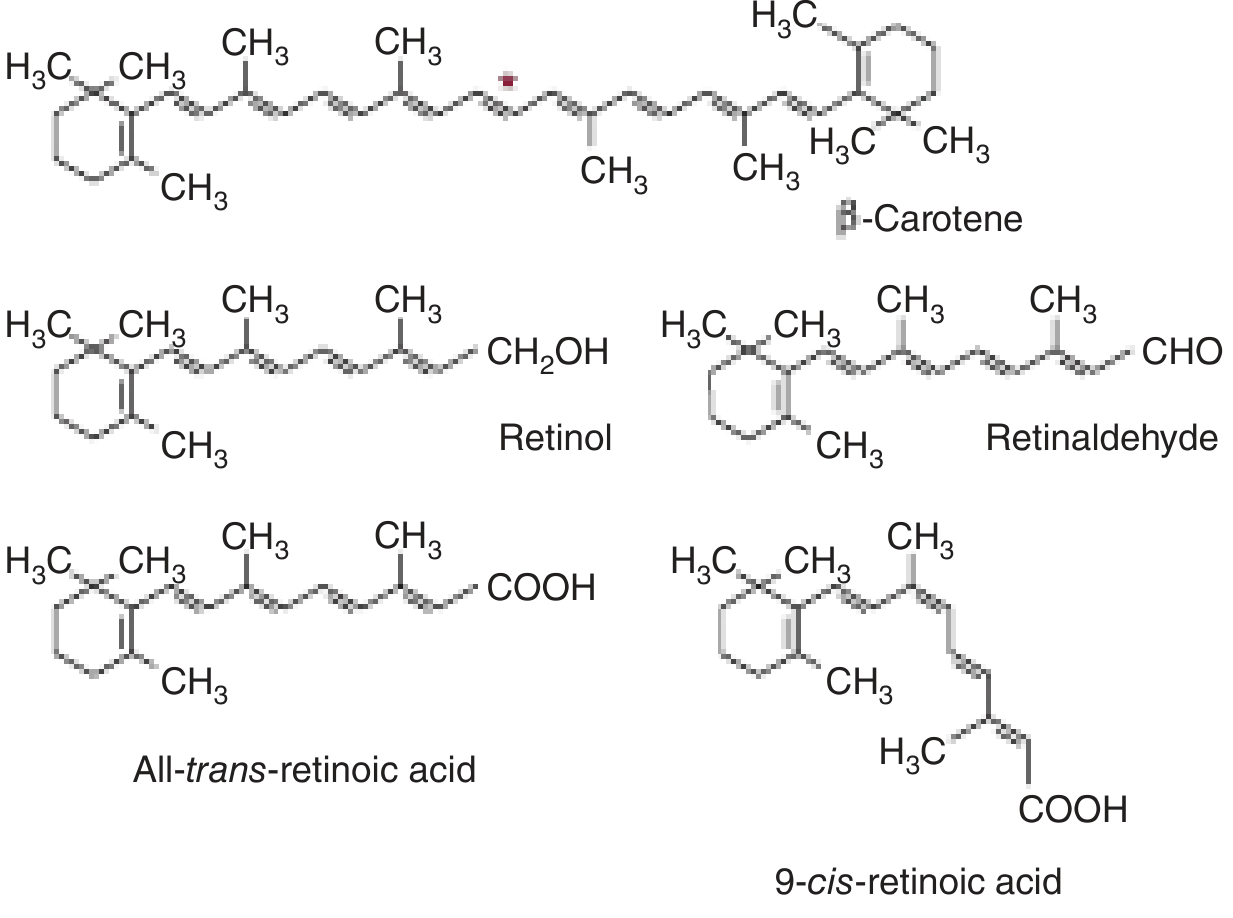
Figure: β-Carotene and the major vitamin A vitamers. The asterisk marks the site of symmetrical cleavage by carotene dioxygenase. (Harper's Illustrated Biochemistry, 32nd Ed.)
2. Dietary Sources
- Preformed vitamin A (retinyl esters): liver, fish, eggs, milk, butter - animal-origin foods only
- Provitamin A carotenoids: yellow/orange/green vegetables (carrots, squash, spinach) - contribute ~30% of dietary vitamin A
- β-carotene is the most important provitamin A in the diet
Equivalency:
- 1 Retinol Activity Equivalent (RAE) = 1 μg all-trans-retinol = 12 μg dietary β-carotene = 24 μg α-carotene or β-cryptoxanthin
- 1 IU = 0.3 μg retinol; 1 μg retinol = 3.33 IU
3. Absorption
Vitamin A is fat-soluble; absorption requires:
- Bile (for emulsification)
- Pancreatic enzymes
- Some dietary antioxidant activity
In the intestinal mucosa:
- Dietary retinyl esters are hydrolyzed to free retinol
- β-Carotene is cleaved by carotene dioxygenase at the central double bond, yielding retinaldehyde, which is then reduced to retinol
- A second isoform of carotene dioxygenase performs asymmetric cleavage, producing apo-carotenals → oxidized to retinoic acid only (cannot serve as retinol source)
- Retinol is then re-esterified in the enterocyte
Because intestinal carotene dioxygenase activity is low, a significant fraction of ingested β-carotene enters the circulation intact (unconverted).
4. Transport from Gut to Liver
- Retinyl esters are packaged into chylomicrons in intestinal epithelial cells
- Chylomicrons travel via lymphatics into the bloodstream
- Retinyl esters are taken up by the liver via the apolipoprotein E (ApoE) receptor
5. Hepatic Storage
- >90% of body vitamin A reserves are stored in the liver
- Stored predominantly as retinyl esters in perisinusoidal stellate (Ito) cells
- These reserves are sufficient to support body needs for at least 6 months in healthy individuals
6. Transport from Liver to Peripheral Tissues
For mobilization from the liver:
- Retinyl esters are hydrolyzed back to free retinol
- Retinol binds to Retinol-Binding Protein (RBP), which is synthesized in the liver
- The retinol-RBP complex then binds to transthyretin (formerly prealbumin) in the circulation, forming a trimolecular complex
This trimolecular complex is important because it:
- Prevents retinol from being filtered by the kidney glomerulus
- Protects the body from retinol toxicity
- Allows uptake via specific cell-surface RBP receptors
Uptake in peripheral cells occurs via surface RBP receptors; after retinol is internalized, RBP is recycled back into the bloodstream.
7. Intracellular Handling
Once inside cells, retinol binds to cellular retinol-binding proteins (CRBPs), which act as:
- Sequestering agents
- Transporting agents
- Co-ligands for enzymatic reactions
Cells also contain retinoic acid-binding proteins (CRABPs), which shuttle retinoic acid to the nucleus and regulate its metabolism.
Intracellular retinol can be:
- Stored as retinyl ester in peripheral tissues
- Oxidized to retinaldehyde (by retinol dehydrogenases)
- Further oxidized to retinoic acid (irreversible)
8. The Visual Cycle (Retinaldehyde Function)
Retinaldehyde is the active form for vision. The sequence in the retina:
- In the pigment epithelium: all-trans-retinol → isomerized to 11-cis-retinol → oxidized to 11-cis-retinaldehyde
- 11-cis-retinaldehyde binds to a lysine residue on opsin (via Schiff base linkage) → forms rhodopsin (rods) or iodopsin (cones)
- Light absorption causes isomerization of retinaldehyde from 11-cis → all-trans configuration, and a conformational change in opsin
- This generates a series of intermediates: Photorhodopsin → Bathorhodopsin → Lumirhodopsin → Metarhodopsin I → Metarhodopsin II → Metarhodopsin III
- Metarhodopsin II activates transducin (a G-protein), which activates phosphodiesterase, converting cGMP → 5'GMP
- Reduced cGMP closes Na⁺ channels → hyperpolarization → nerve impulse
- Final hydrolysis releases all-trans-retinaldehyde + opsin (bleached state)
- All-trans-retinaldehyde is recycled back through the pigment epithelium to regenerate 11-cis-retinaldehyde
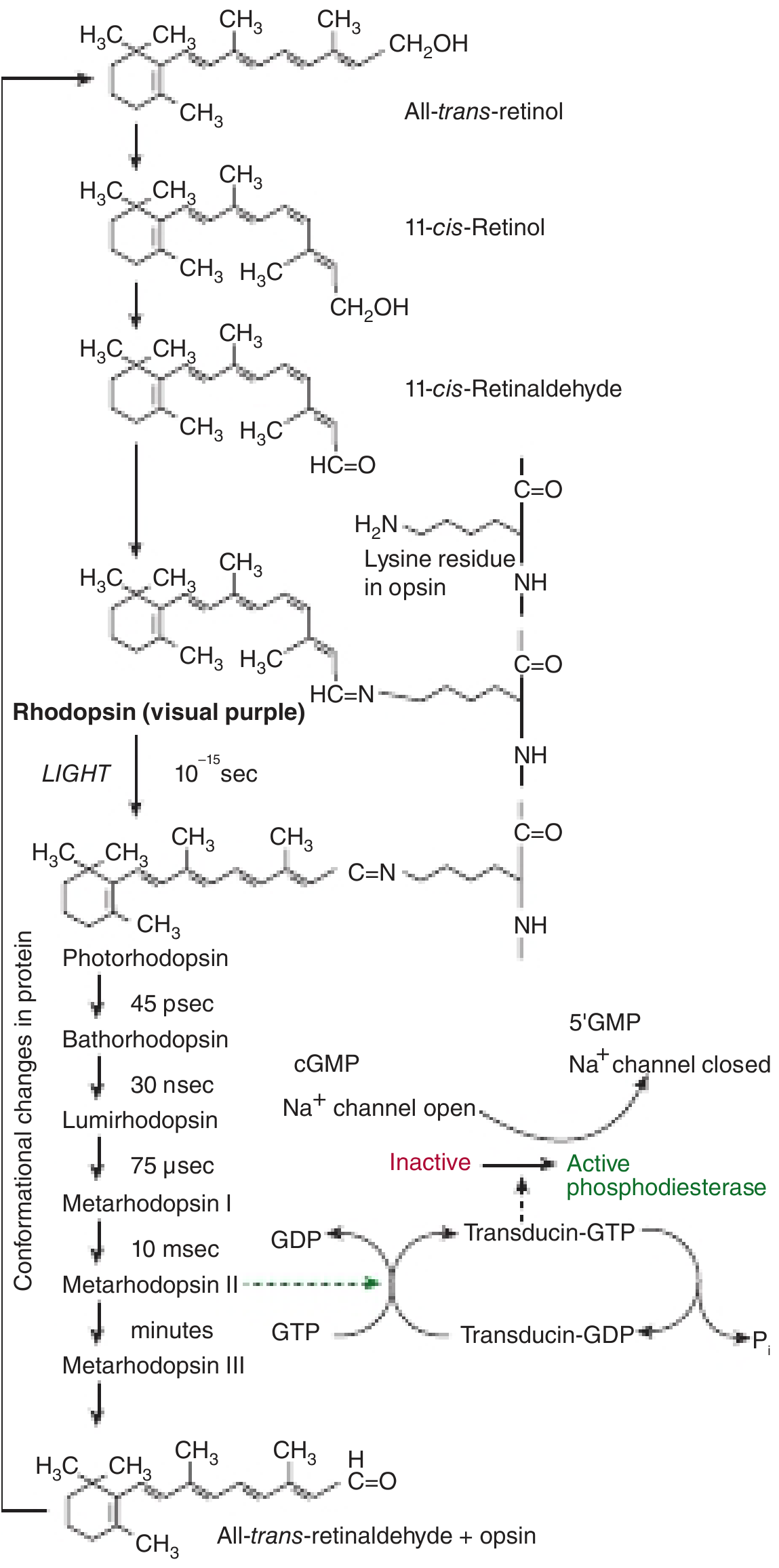
Figure: The role of retinaldehyde in the visual cycle. (Harper's Illustrated Biochemistry, 32nd Ed.)
9. Retinoic Acid and Gene Regulation
Retinoic acid is the transcriptionally active form of vitamin A. Two families of nuclear receptors mediate its actions:
| Receptor | Ligand | Function |
|---|---|---|
| RAR (Retinoic Acid Receptor) | All-trans-retinoic acid OR 9-cis-retinoic acid | Forms RAR/RXR heterodimers |
| RXR (Retinoid X Receptor) | 9-cis-retinoic acid only | Forms heterodimers with RAR, VDR, thyroid hormone receptor, PPARs |
Mechanism:
- RAR/RXR heterodimers bind to Retinoic Acid Response Elements (RAREs) on DNA
- Can either stimulate or repress gene transcription depending on context
- Target genes include: growth factor receptors, tumor suppressor genes, secreted proteins
Key interactions of RXR:
- RXR + RAR → regulates differentiation
- RXR + Vitamin D Receptor (VDR) → bone metabolism
- RXR + Thyroid Hormone Receptor → thyroid response
- RXR + PPARs → fatty acid/carbohydrate metabolism, adipogenesis, insulin sensitivity
This is why both excess and deficiency of vitamin A impair vitamin D and thyroid hormone function - through disruption of available RXR for heterodimerization.
10. Metabolic Effects of Retinoids
- Inhibit adipogenesis and stimulate lipid breakdown
- RXR-PPAR heterodimers mediate effects on adipogenesis (this is also the pathway targeted by thiazolidinediones like rosiglitazone)
- Enhance resistance to infection by regulating differentiation of immune cells (T cells, natural killer cells, phagocytes)
- Play a role in iron utilization and humoral immunity
11. Catabolism and Excretion
- Retinoic acid undergoes hepatic oxidation (via CYP enzymes) to more polar metabolites
- These are conjugated (often as glucuronides) and excreted in bile and urine
- Retinol oxidation to retinoic acid is irreversible - cells cannot convert retinoic acid back to retinol or retinaldehyde
- Retinaldehyde ↔ retinol conversion is reversible
12. Summary Flow
Diet
├── Retinyl esters (animal foods)
│   └── Hydrolysis in gut → Retinol
└── β-Carotene (plant foods)
    └── Carotene dioxygenase in intestine → Retinaldehyde → Retinol

Intestine → Retinyl esters → Chylomicrons → Lymph → Blood → Liver (ApoE receptor)

Liver (Ito cells):
  ├── Storage as retinyl esters (>90% of body stores)
  └── Secretion: Retinol + RBP + Transthyretin → Circulation → Peripheral cells

Peripheral cells:
  Retinol
  ├── → Retinaldehyde (reversible, retinol dehydrogenase)
  │   └── → 11-cis-Retinaldehyde → Rhodopsin (VISION)
  └── → Retinoic acid (irreversible)
      └── → Nuclear RAR/RXR receptors → Gene transcription
              (differentiation, growth, immunity, lipid metabolism)
Sources: Harper's Illustrated Biochemistry 32nd Ed.; Robbins & Cotran Pathologic Basis of Disease; Robbins & Kumar Basic Pathology; Harrison's Principles of Internal Medicine 22nd Ed.
This is a shared conversation. Sign in to Orris to start your own chat.