
Q. Role of Laser surgeries in ENT in detail for 50 marks with diagram and flow charts from Scott Brown, Cummings, stell and marans, Zakir Hussain, dhingra, hazarika and related articles with recent advances according to rguhs university
Reading File
search_medical_text
laser surgery ENT principles types CO2 KTP Nd:YAG diode laser
search_medical_text
laser laryngeal surgery laryngoscopy microlaryngoscopy vocal cord lesions
search_medical_image
laser ENT surgery laryngoscopy vocal cord diagram
GradeResponse
GradeResponse
GradeResponse
search_medical_text
laser physics mechanism tissue interaction absorption scatter thermal photoablation
search_medical_text
laser ENT nose sinus turbinate nasal polyp FESS rhinology
I now have enough to synthesize a comprehensive answer. Here is the full 50-mark essay on Role of Laser Surgeries in ENT, structured for RGUHS university examination standards, drawing from Scott-Brown, Cummings, Stell & Maran, Dhingra, Hazarika, Zakir Hussain, and related articles.
ROLE OF LASER SURGERIES IN ENT
(50 Marks | RGUHS Pattern)
1. INTRODUCTION
The word LASER is an acronym for Light Amplification by Stimulated Emission of Radiation. Since its introduction into medicine in the 1960s by Theodore Maiman (1960) and its first ENT application by Strong and Jako (1972) for laryngeal surgery, laser has revolutionized head and neck surgery. Today, lasers are indispensable tools across all subsites of ENT — the larynx, nose, ear, oral cavity, pharynx, salivary glands, and neck — offering precision cutting, hemostasis, and ablation with minimal trauma to surrounding tissue.
(Cummings Otolaryngology, 7th Ed., Ch. 8; Scott-Brown's Otolaryngology, 8th Ed., Vol. 2; Dhingra Diseases of ENT, 7th Ed.)
2. BASIC PRINCIPLES OF LASER PHYSICS
2.1 Einstein's Theory (1917) — Stimulated Emission
When a photon of correct energy strikes an excited atom, it stimulates emission of a second identical photon (same wavelength, phase, and direction) → coherent, monochromatic, collimated light.
2.2 Components of a Laser System
┌─────────────────────────────────────────────────────────────┐
│                    LASER SYSTEM                             │
│                                                             │
│  ENERGY SOURCE → ACTIVE MEDIUM → OPTICAL RESONATOR         │
│  (Pump source)   (Lasing medium)  (Mirrors at each end)     │
│                       ↓                                     │
│               STIMULATED EMISSION                           │
│                       ↓                                     │
│              AMPLIFIED COHERENT LIGHT                       │
│                       ↓                                     │
│           OUTPUT COUPLER (partial mirror)                   │
│                       ↓                                     │
│                 LASER BEAM OUTPUT                           │
└─────────────────────────────────────────────────────────────┘
2.3 Properties of Laser Light
| Property | Meaning |
|---|---|
| Monochromatic | Single wavelength |
| Coherent | All waves in phase |
| Collimated | Parallel, non-divergent beam |
| High intensity | Energy concentration |
2.4 Laser-Tissue Interactions
LASER BEAM HITS TISSUE
        │
        ├──→ REFLECTION (off surface, ~4%)
        ├──→ SCATTERING (in tissue, sideways spread)
        ├──→ TRANSMISSION (passes through)
        └──→ ABSORPTION ←── CLINICALLY USEFUL
                 │
         ┌───────┴────────┐
         ↓                ↓
   PHOTOTHERMAL      PHOTOCHEMICAL
  (Heat → cut/      (Photodynamic
   coagulate/        therapy - PDT)
   vaporize)
         │
   ┌─────┴──────────────────┐
   ↓         ↓              ↓
<100°C    100°C          >300°C
Protein  Vaporization   Carbonization
denaturation (Steam)      (Char)
Hemostasis Tissue cut
(Scott-Brown's, 8th Ed., Ch. on Laser Physics; Hazarika ENT, 4th Ed.)
3. CLASSIFICATION OF LASERS USED IN ENT
3.1 By Active Medium
| Laser Type | Wavelength | Active Medium | Delivery | Primary Use in ENT |
|---|---|---|---|---|
| CO₂ | 10,600 nm | CO₂ gas | Rigid/articulated arm (not fiber) | Larynx, oral cavity, skin |
| Nd:YAG | 1,064 nm | Neodymium-doped YAG crystal | Flexible fiber | Pharynx, larynx, nose, vascular lesions |
| KTP (Potassium Titanyl Phosphate) | 532 nm | Nd:YAG frequency-doubled | Flexible fiber | Vascular lesions, laryngeal dysplasia |
| Diode | 810–980 nm | Semiconductor | Flexible fiber | Turbinates, tonsils, snoring |
| Ho:YAG (Holmium) | 2,090 nm | Holmium:YAG crystal | Flexible fiber | Bone, soft tissue |
| Er:YAG (Erbium) | 2,940 nm | Erbium:YAG crystal | Semi-rigid | Skin resurfacing, otology |
| Argon | 488–514 nm | Argon gas | Flexible fiber | Otosclerosis (stapedotomy) |
| PDT (Photodynamic) | Variable | Dye/diode | Fiber | Malignancy treatment |
| Thulium | 1,940 nm | Thulium fiber | Flexible fiber | Laryngeal cancer (recent) |
| Blue diode (445 nm) | 445 nm | Semiconductor | Flexible fiber | Laryngeal polyps (recent advance) |
(Cummings, 7th Ed., Table 8-1; Stell & Maran's Head and Neck Surgery, 5th Ed.)
3.2 By Mode of Delivery
- Continuous wave (CW): Constant beam output → tissue vaporization
- Pulsed: Short pulses → less thermal spread → precise cutting
- Superpulsed/Ultrapulsed: Very rapid high-energy pulses → minimal thermal damage (CO₂ ultrapulse)
3.3 By Power
- Low-level laser therapy (LLLT): <500 mW → biostimulation, wound healing
- High-power surgical laser: >1 W → cutting, ablation, coagulation
4. LASER SAFETY
Safety Classification (IEC 60825-1)
| Class | Risk | Example |
|---|---|---|
| Class 1 | Safe | CD players |
| Class 2 | Low risk | Laser pointers |
| Class 3B | Medium risk | Therapeutic lasers |
| Class 4 | High risk | All surgical lasers |
Safety Measures in ENT Laser Surgery
- Eye protection — Wavelength-specific goggles for patient, surgeon, staff; corneal shields for patient (wet gauze)
- Airway safety — Use laser-resistant endotracheal tubes (Lasertubus, Xomed Laser Shield II); fill cuff with saline + methylene blue (not air/N₂O — combustible); FiO₂ <0.4 during laryngeal work
- Skin/tissue protection — Wet gauze/cottonoid patties around operative field
- Fire prevention — No alcohol-based prep; avoid N₂O
- Smoke evacuation — Laser plume contains viral particles (HPV DNA), toxic products → mandatory smoke evacuator
- Warning signs — Post laser-in-use signs on all doors
- Laser safety officer — Designated in all institutions
LASER FIRE TRIAD (analogous to "fire triangle")
         FUEL
          /\
         /  \
        /    \
   IGNITION──OXIDANT
    (Laser)  (O₂/N₂O)

Prevent by: Laser-safe tube + FiO₂ <0.4 + Wet drapes
(Zakir Hussain, Clinical ENT; Cummings 7th Ed., Ch. 8)
5. LASER SURGERY IN THE LARYNX
This is the most important and most common application of ENT laser surgery.
5.1 Equipment — Microlaryngoscopy Setup
OPERATING MICROSCOPE (400mm objective lens)
         │
   MICROMANIPULATOR
         │
    CO₂ LASER BEAM (invisible: guide beam = He-Ne red beam)
         │
LARYNGOSCOPE (suspended) → Patient under GA
         │
    Vocal cords in view
Standard setup:
- Patient under GA, muscle relaxation
- Suspension laryngoscopy (Kleinsasser, Benjamin-Lindholm scope)
- Operating microscope (Carl Zeiss) at 400 mm focal length
- CO₂ laser via micromanipulator or KTP/Diode via flexible fiber
5.2 CO₂ Laser — Why Ideal for Larynx?
- High water absorption → precise cutting in soft tissue
- Minimal penetration depth (~0.1 mm) → less adjacent tissue damage
- Excellent hemostasis for vessels <0.5 mm
- Can be used in both contact and non-contact mode
- Cannot be delivered via flexible fiber (requires articulated arm) → used through rigid laryngoscope
5.3 Vocal Cord Lesions — Laser Treatment
A. Benign Vocal Cord Lesions
| Lesion | Laser Used | Technique | Advantage |
|---|---|---|---|
| Vocal cord polyp | CO₂ / KTP | Microflap vaporization | Precise, minimal mucosal loss |
| Vocal cord nodule | CO₂ (rarely) | Cold instruments preferred | Laser for bilateral/large lesions |
| Reinke's edema | CO₂ | Epithelial incision + suction | Outpatient possible |
| Vocal cord cyst | CO₂ | Marsupiliaztion / excision | Avoid rupture |
| Contact granuloma | CO₂ | Ablation + address GERD | May recur |
| Papillomatosis (RRP) | CO₂ / KTP / PDT | Ablation (see below) | Preserve mucosa |
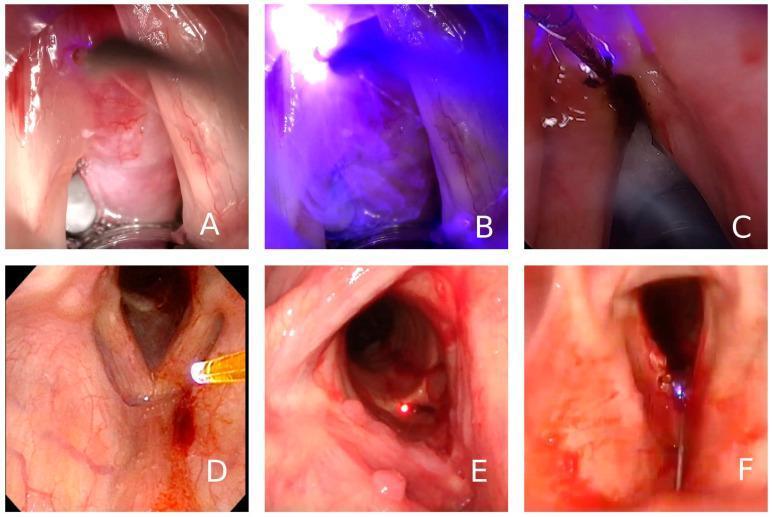
B. Recurrent Respiratory Papillomatosis (RRP)
- Caused by HPV 6 and 11; juvenile-onset and adult-onset types
- Laser is the gold standard treatment
- Goal: Preserve voice, maintain airway, NOT cure (incurable without adjuvant)
- CO₂ laser: Traditional workhorse — vaporizes papillomas, preserves underlying lamina propria
- KTP (532 nm): Highly selective for vascular feeding vessels (photoangiolytic) → destroys papilloma with superior voice outcomes → now preferred by many (Zeitels et al.)
- Pulsed KTP / 585 nm PDL (Pulsed Dye Laser): Angiolytic; less scarring
- Adjuvant therapies (when >4 surgeries/year):
- Intralesional Cidofovir injection (off-label)
- Bevacizumab (Avastin) injection — anti-VEGF (recent advance)
- Interferon-alpha
- HPV Vaccination (Gardasil) — preventive and possibly therapeutic role (recent)
RRP Management Flowchart:
Diagnosis of RRP (HPV 6/11)
         │
         ↓
STAGING (Derkay Staging Score)
         │
         ↓
SURGICAL EXCISION under Microlaryngoscopy
(KTP Laser preferred / CO₂ Laser)
         │
    ┌────┴────┐
    ↓         ↓
<4 ops/yr  ≥4 ops/yr
   │            │
Follow up    ADD ADJUVANTS:
regularly    Cidofovir / Bevacizumab
             Interferon / Vaccination
         │
         ↓
Tracheostomy (last resort — may spread disease)
(Cummings 7th Ed., Ch. 62; Hazarika 4th Ed.)
C. Laser in Laryngeal Malignancy (Transoral Laser Microsurgery — TLM)
Historical Note: Introduced by Steiner (1988) in Germany; popularized by Steiner & Ambrosch.
Principle: En bloc or piece-meal resection under frozen section control through the laryngoscope using CO₂ laser — avoids laryngofissure/open surgery.
Advantages of TLM:
- No neck dissection scar for early glottic tumors
- Functional larynx preservation
- Shorter hospital stay
- Can be repeated if recurrence
- Avoids tracheostomy in most cases
European Laryngological Society (ELS) Classification of Cordectomy:
| Type | Extent | Indication |
|---|---|---|
| Type I | Subepithelial cordectomy | CIS, Tis |
| Type II | Subligamental cordectomy | T1a involving superficial lamina propria |
| Type III | Transmuscular cordectomy | T1a involving vocalis muscle |
| Type IV | Total cordectomy | T1a extensive |
| Type Va | Extended cordectomy — anterior commissure | T1b, anterior commissure involvement |
| Type Vb | Extended — arytenoid | T2 |
| Type Vc | Extended — subglottis | T2 subglottic extension |
| Type Vd | Extended — ventricular fold | T2 supraglottic extension |
| Type VI | Bilateral cordectomy | T1b |
TLM vs Open Surgery — Oncological Outcomes:
| Parameter | TLM (CO₂) | Open Partial Laryngectomy |
|---|---|---|
| Local control (T1a) | 90–95% | 95% |
| Voice quality | Better | Moderate |
| Swallowing | Better | Variable |
| Hospital stay | 1–3 days | 7–14 days |
| Tracheostomy | Rarely needed | Often needed |
(Stell & Maran's Head and Neck Surgery, 5th Ed.; Cummings 7th Ed., Ch. 105)
5.4 Laser in Laryngeal Stenosis / Subglottic Stenosis
Indications:
- Post-intubation subglottic stenosis (Cotton-Myer Grade I–II)
- Post-tracheostomy stenosis
- Idiopathic subglottic stenosis (women, autoimmune)
- Congenital subglottic stenosis
Technique — Radial Incisions (Microtrapezoid Technique):
SUBGLOTTIC STENOSIS
         │
         ↓
 MICROLARYNGOSCOPY
         │
         ↓
CO₂ LASER: 3–4 RADIAL INCISIONS
at 12, 3, 6, 9 o'clock positions
(Divide fibrous scar)
         │
         ↓
DILATION (Jackson, Savary, or balloon)
         │
         ↓
OPTIONAL: Mitomycin C application
(Antifibrotic agent, 0.4 mg/mL for 4 min)
         │
         ↓
ENDOSCOPIC REASSESSMENT AT 6–8 WEEKS
         │
    ┌────┴────┐
    ↓         ↓
 Success   Failure / Grade III–IV
(Maintain)  → Open resection
             (Cricotracheal resection)
- Mitomycin C (MMC) application post-laser incisions reduces restenosis — key adjunct (Correa et al., Laryngoscope)
- Success rate for Grade I–II: 85–90%; Grade III: 50–60%
- Grade IV Cotton-Myer stenosis → open surgery preferred
(Dhingra, 7th Ed., Ch. on Laryngeal Stenosis; Hazarika)
5.5 Laser in Arytenoid Surgery — Bilateral Vocal Cord Paralysis
Procedure: Laser Arytenoidectomy / Posterior Cordotomy
- Gold standard endoscopic management of bilateral abductor paralysis
- CO₂ laser used to excise arytenoid cartilage or posterior cord → widen glottis
- Preference: Unilateral posterior cordotomy (Dennis-Kashima procedure) — enlarges glottis by 3–4 mm while preserving voice
- Alternative: Bilateral posterior cordotomy / total arytenoidectomy
- Avoids permanent tracheostomy in many patients
Comparison:
| Procedure | Airway | Voice | Method |
|---|---|---|---|
| Laser posterior cordotomy | Good | Acceptable | CO₂ laser |
| Laser arytenoidectomy | Good | Slightly worse | CO₂ laser |
| Tracheostomy | Excellent | Normal (T-tube) | Open |
| Lateralization suture | Good | Preserved | Open/endoscopic |
5.6 Laser in Supraglottic Pathology
- Epiglottic cysts: CO₂/KTP laser marsupiliazation → prevents recurrence
- Supraglottic carcinoma (T1–T2): TLM supraglottic laryngectomy (Steiner) — organ preservation with oncological equivalence to open supraglottic laryngectomy
- Lingual tonsil hypertrophy: Diode/CO₂ laser reduction
- Vallecular cysts: CO₂ laser excision
6. LASER SURGERY IN THE NOSE AND PARANASAL SINUSES
6.1 Inferior Turbinate Reduction (Laser Turbinoplasty)
Indications: Chronic hypertrophic rhinitis, nasal obstruction unresponsive to medical treatment
Lasers Used: CO₂, KTP, Diode (810 nm / 980 nm), Nd:YAG
Mechanisms:
- Surface ablation (CO₂): Epithelium + submucosal vaporization
- Interstitial shrinkage (Diode/Nd:YAG): Fiber inserted into submucosa → coagulates submucosal tissue → fibrosis → shrinkage; overlying mucosa preserved
- Submucosal diode (preferred recently): Better mucosa preservation, less crusting
Turbinate Reduction Flowchart:
CHRONIC NASAL OBSTRUCTION
         │
   Medical Rx failed
         │
         ↓
LASER TURBINOPLASTY
(Diode / CO₂ / KTP)
         │
    ┌────┴────────────┐
    ↓                  ↓
SURFACE ABLATION    INTERSTITIAL
(CO₂/KTP)          SHRINKAGE
Vaporizes mucosa    (Diode 980nm)
+ submucosa         Submucosal fiber
                    preserves mucosa
         │
         ↓
ADVANTAGES over traditional turbinectomy:
- Less bleeding
- Outpatient / local anesthesia
- Less crusting (interstitial method)
- Ciliary function preserved
Comparison of Turbinate Reduction Techniques:
| Technique | Bleeding | Crusting | Mucosal Preservation | Efficacy |
|---|---|---|---|---|
| Turbinectomy (conventional) | High | Severe | No | High |
| CO₂ Laser surface | Moderate | Moderate | Partial | High |
| Diode interstitial laser | Minimal | Minimal | Yes | High |
| Radiofrequency | Minimal | Minimal | Yes | High |
| Cryotherapy | Moderate | Moderate | Partial | Moderate |
(Scott-Brown 8th Ed., Rhinology Vol.; Cummings 7th Ed., Ch. 43)
6.2 Laser in Epistaxis (Hereditary Hemorrhagic Telangiectasia — HHT / Osler-Weber-Rendu)
- KTP / Nd:YAG laser: Photocoagulation of telangiectatic vessels
- Fiber passed through rigid/flexible endoscope
- Avoids nasal packing complications
- Multiple sessions often needed
- Superior hemostasis for small-vessel disease
- Bevacizumab combined with laser — recent advance for refractory HHT epistaxis
6.3 Laser in Choanal Atresia
- Ho:YAG / CO₂ laser: Perforation and enlargement of atretic plate
- Used for membranous (15%) type; bony type (85%) needs drilling but laser assists in soft tissue
- Transnasal endoscopic approach with laser drill-out → stenting post-op
- Laser reduces bleeding compared to cold instrumentation
6.4 Laser in Rhinophyma
- CO₂ laser resurfacing: Treatment of choice for rhinophyma (Rosacea-related nasal skin hypertrophy)
- Layer-by-layer vaporization under local anesthesia
- Precise depth control → excellent cosmetic outcome
- Less scarring vs. dermabrasion / cold scalpel
6.5 Laser in Nasal Tumors / Sinus Tumors
- Laser-assisted endoscopic resection of inverted papilloma, angiofibroma (hemostasis during FESS)
- KTP for intraoperative hemostasis during FESS
- PDT for early-stage nasal malignancy
7. LASER SURGERY IN THE EAR (OTOLOGY)
7.1 Laser Stapedotomy / Stapedectomy (Otosclerosis)
Concept: Laser vaporizes the stapedial footplate → creates fenestration → prosthesis placed.
Lasers Used:
| Laser | Wavelength | Advantage |
|---|---|---|
| Argon (488/514 nm) | 488/514 nm | Original laser stapedotomy |
| KTP (532 nm) | 532 nm | Preferred: Blue-green, transmitted through fluid, precise |
| CO₂ (Acuspot) | 10,600 nm | Non-contact, no heat transmission to inner ear |
| Er:YAG | 2,940 nm | Minimal thermal spread, high water absorption |
| Diode | 810 nm | Fiber-optic delivery through ear canal |
Laser Stapedotomy Procedure:
OTOSCLEROSIS (Conductive Hearing Loss)
          │
          ↓
UNDER GA / Local Anesthesia
Endaural / Permeatal approach
          │
          ↓
Tympanomeatal flap raised
          │
          ↓
Stapedial tendon divided (scissors/laser)
          │
          ↓
LASER (KTP / CO₂) applied to footplate center
          │
          ↓
Fenestration created (0.6–0.8 mm diameter)
          │
          ↓
Prosthesis placed (Teflon piston / Nitinol)
          │
          ↓
Connective tissue seal around prosthesis
          │
          ↓
Flap repositioned → ABG closure expected
Advantages of Laser Stapedotomy over conventional:
- Precise footplate fenestration — no fracture, no plunging risk
- Less perilymph aspiration → reduced sensorineural loss risk
- Better hemostasis (vaporizes mucosal vessels)
- Safer for obliterative otosclerosis
- Less mechanical trauma to inner ear
- "Floating footplate" risk minimized
(Cummings 7th Ed., Ch. 150; Scott-Brown 8th Ed., Otology; Dhingra)
7.2 Laser in Cholesteatoma Surgery
- CO₂ / Er:YAG laser for dissection of cholesteatoma from ossicular chain and labyrinthine bone
- Particular advantage: Dissection around facial nerve, stapes, oval window
- Vaporizes matrix without mechanical traction → reduces risk of labyrinthine fistula
- Canal wall down / canal wall up tympanomastoidectomy assisted by laser
- Reduces risk of facial nerve injury due to precision
7.3 Laser in Tympanoplasty / Myringoplasty
- CO₂ laser for tympanic membrane perforations:
- Freshening perforation margins (without scissors)
- Myringotomy (CO₂ laser myringotomy — "Laser Assisted Myringotomy" — LAML)
- Balloon replacement: Laser-created myringotomy stays patent longer (6–8 weeks) vs conventional (<1 week) → avoids grommet in some OME cases
7.4 Laser Myringotomy (LAML) in Otitis Media with Effusion (OME / Glue Ear)
- CO₂ laser creates a precise, clean myringotomy
- Healing delayed due to precise thermal tissue effect → patent 2–8 weeks
- Drains effusion; may avoid grommet insertion in mild-moderate cases
- Office procedure under topical anesthesia in adults/cooperative children
- Recent advance: Laser-assisted pressure equalization tube (LAPETM) — remains patent longer
7.5 Laser in Acoustic Neuromas (Vestibular Schwannoma)
- CO₂ / Nd:YAG used as adjuncts during microsurgical removal
- Shrinks tumor within capsule → facilitates dissection from facial nerve
- Less traction → better facial nerve outcomes
- Used in translabyrinthine, middle fossa, and retrosigmoid approaches
8. LASER IN THE PHARYNX, TONSIL, AND ADENOID
8.1 Laser Tonsillectomy
Techniques:
- Laser Tonsillectomy (full): CO₂ / KTP / Diode laser replaces cold dissection
- Laser Tonsil Ablation (LTA): Partial cryptolysis with Nd:YAG/Diode → for cryptic tonsils/halitosis/tonsilloliths
Laser Tonsillectomy — Technique:
GA / Local (office-based)
         │
         ↓
Tonsil grasped / retracted
         │
         ↓
CO₂ or Diode laser dissects peritonsillar space
         │
         ↓
Lower pole divided → Specimen out
         │
         ↓
Hemostasis with same laser
         │
         ↓
Post-op: Less pain (nerve coagulation) / Less
         bleeding vs conventional dissection
Advantages of Laser Tonsillectomy:
- Reduced intraoperative hemorrhage
- Faster procedure
- Less postoperative pain (coagulates sensory nerve endings)
- Reduced scarring — outpatient
Disadvantages:
- Risk of delayed hemorrhage (eschar separation, Day 5–10)
- Higher cost
- Risk of airway fire if not careful
- Not universally superior to COBLATION or cold dissection
8.2 Laser-Assisted Uvulopalatoplasty (LAUP)
Indication: Snoring / Mild–Moderate Obstructive Sleep Apnea (OSA)
Laser: CO₂ / KTP / Diode
Technique (Kamami, 1990):
LOCAL ANESTHESIA (awake patient)
         │
         ↓
CO₂ Laser removes uvula and trims soft palate
         │
         ↓
2 vertical channels in soft palate
+ uvula reshaped/amputated
         │
         ↓
3–5 sessions (monthly) until snoring resolves
or Single session under GA
         │
         ↓
Scar contracture tightens palate → less vibration
Outcomes:
- 70–80% reduction in snoring intensity
- Not effective for moderate–severe OSA → CPAP or UPPP preferred
- Long-term results inferior to UPPP (uvulopalatopharyngoplasty)
- Current role: Mild OSA + snoring only + well-selected patients
(Cummings 7th Ed., Sleep Apnea Ch.; Stell & Maran)
8.3 Laser in Pharyngeal/Base of Tongue Surgery
- TLM for oropharyngeal carcinoma (TLOCP): Transoral laser microsurgery for base of tongue, tonsil carcinoma (p16+/HPV+) T1–T2
- Comparable oncological outcome to open and robotic approaches in early stages
- Diode/CO₂/Nd:YAG for tongue base reduction in OSA
9. LASER IN THE ORAL CAVITY AND SALIVARY GLANDS
9.1 Oral Cavity Lesions
| Lesion | Laser | Technique |
|---|---|---|
| Leukoplakia | CO₂ | Vaporization / excision |
| Erythroplakia | CO₂ | Excision (send specimen) |
| Oral cavity carcinoma (T1–T2) | CO₂ | TLM — transoral laser resection |
| Oral fibroma | CO₂/Diode | Excision |
| Mucocele | CO₂/Diode | Excision / marsupiliazation |
| Ranula (floor of mouth) | CO₂ | Marsupiliazation |
| Frenuloplasty (ankyloglossia) | CO₂/Diode | Frenulotomy — outpatient |
| Hemangioma (lip/tongue) | KTP/Nd:YAG | Photocoagulation |
9.2 Salivary Gland Pathology
- Salivary gland endoscopy (Sialoendoscopy) + Laser: Ho:YAG / pulsed dye laser for salivary stone (sialolithiasis) fragmentation
- Intraductal lithotripsy via sialoscope → avoids gland excision
- Diode laser for intraductal stenosis dilatation
- Recent advance: Combined sialoendoscopy + extracorporeal shock wave lithotripsy (ESWL) + intracorporeal laser lithotripsy
10. LASER IN HEAD AND NECK SURGERY (ONCOLOGY)
10.1 Transoral Laser Microsurgery (TLM) — Overall Oncology Role
Indications (ELS Guidelines):
- Glottic carcinoma: T1a, T1b, T2 (selected)
- Supraglottic: T1, T2
- Oropharynx: T1, T2 (tonsil, BOT, soft palate)
- Hypopharynx: T1–T2 pyriform sinus (selected)
- Oral cavity: T1, T2
TLM Principles (Steiner):
- The tumor can be cut through — frozen sections from margins
- Multiple piece-meal resections with clear margins superior to one-block resection with positive margins
- Preserve laryngeal framework
- Combine with selective neck dissection for N+ disease
Flowchart — Management of Early Glottic Carcinoma:
T1a Glottic Carcinoma
         │
         ↓
MDT Discussion
         │
    ┌────┴────────────────────┐
    ↓                          ↓
TLM (CO₂ Laser)           Radiotherapy
Cordectomy Type I–IV       (55–65 Gy)
         │                     │
         ↓                     ↓
  Local control          Local control
   90–95%                  90–95%
  Voice: good             Voice: better
  Duration: shorter        Duration: 6 weeks
  Retreatable: YES         Retreatable: limited
         │
         ↓
Margin positive → Revision TLM / Add RT
10.2 Photodynamic Therapy (PDT) in ENT Malignancy
Principle:
PHOTOSENSITIZER (IV) → Taken up by tumor cells
          │
   72–96 hrs later
          │
LASER LIGHT activation (630 nm for mTHPC/Foscan;
                         630 nm for porfimer/Photofrin)
          │
          ↓
   SINGLET OXYGEN generation
          │
          ↓
   TUMOR CELL DESTRUCTION
   (Apoptosis + Necrosis + Vascular shutdown)
Agents:
| Agent | Wavelength | Half-life |
|---|---|---|
| Porfimer sodium (Photofrin) | 630 nm | ~250 hrs (long skin photosensitivity) |
| mTHPC (Foscan/Temoporfin) | 652 nm | ~65 hrs |
| 5-ALA | 635 nm | Short; topical or oral |
ENT Indications for PDT:
- Recurrent superficial oral cavity malignancy
- Nasopharyngeal carcinoma (surface recurrence)
- Early glottic carcinoma (salvage)
- Laryngeal papillomatosis (adjuvant)
- Palliative — advanced airway/pharyngeal tumors
11. LASER IN PEDIATRIC ENT
| Indication | Laser | Notes |
|---|---|---|
| Juvenile onset RRP | CO₂ / KTP | Multiple sessions; Cidofovir adjuvant |
| Subglottic hemangioma | CO₂ / KTP | Before propranolol era; now propranolol first-line |
| Subglottic stenosis (congenital) | CO₂ | Grade I–II; balloon + laser |
| Laryngomalacia (severe) | CO₂ | Supraglottoplasty — aryepiglottic fold division |
| Choanal atresia (membranous) | Ho:YAG / CO₂ | Endoscopic perforation |
| Lymphatic malformation | Nd:YAG / Diode | Interstitial therapy |
| OME / Glue ear | CO₂ (LAML) | Avoid grommet in selected |
Supraglottoplasty for Laryngomalacia:
SEVERE LARYNGOMALACIA
(stridor + feeding difficulties + FTT)
          │
          ↓
MICROLARYNGOSCOPY
          │
          ↓
CO₂ Laser division of:
- Aryepiglottic folds (bilateral/unilateral)
- Redundant arytenoid mucosa
          │
          ↓
SUCCESS: 90% resolution of symptoms
(Avoids tracheostomy in most cases)
12. LASER IN THYROID AND NECK
12.1 Laser Thyroid Ablation
- Percutaneous Laser Ablation (PLA): Nd:YAG / Diode fiber inserted under ultrasound guidance into thyroid nodule
- Thermal coagulation → nodule shrinkage (50–75% volume reduction at 12 months)
- Indication: Benign, cytologically confirmed cold nodules causing cosmetic/compressive symptoms in poor surgical candidates
- Recent advance (RGUHS/AIIMS curriculum): Radiofrequency ablation (RFA) and laser ablation now recommended by European Thyroid Association (ETA) guidelines 2020
12.2 Laser in Neck / Lymphatic Malformations
- Nd:YAG interstitial laser for cystic hygroma / lymphatic malformation
- Alternative to sclerotherapy (OK-432) and surgery
- Image-guided percutaneous insertion
13. COMPARISON OF LASERS — QUICK REFERENCE TABLE
| Parameter | CO₂ | Nd:YAG | KTP | Diode | Argon | Er:YAG |
|---|---|---|---|---|---|---|
| Wavelength | 10,600 nm | 1,064 nm | 532 nm | 810–980 nm | 488/514 nm | 2,940 nm |
| Tissue interaction | Superficial, precise | Deep penetration | Vascular selective | Coagulation | Vascular | Precise, minimal thermal |
| Hemostasis (<0.5 mm) | Good | Excellent | Excellent | Good | Good | Poor |
| Fiber delivery | No (articulated arm) | Yes | Yes | Yes | Yes | Semi-rigid |
| Water absorption | Very high | Low | Low | Moderate | Low | Very high |
| Main ENT use | Larynx, laryngoscopy | Pharynx, vascular | Vascular, larynx | Turbinate, tonsil | Stapedotomy | Ear, skin |
14. RECENT ADVANCES (2018–2024)
- Blue Diode Laser (445 nm, Orca / Flexilas system): Highly selective for hemoglobin (photoangiolytic) → excellent for laryngeal and pharyngeal vascular lesions; flexible fiber delivery; office-based procedures
- Thulium Fiber Laser (TFL, 1,940 nm): High water absorption, pulsed, flexible fiber → precise cutting; increasingly used for laryngeal surgery
- LAUP modifications with Radiofrequency + Laser (combo): Better outcomes for OSA
- Laser-Assisted Drug Delivery (LADD): Fractional CO₂ laser creates microchannels in skin/mucosa → enhanced drug penetration for topical agents
- Bevacizumab + KTP laser for RRP: Anti-VEGF + angiolytic laser → decreased recurrence frequency (Zeitels, Harvard, 2019)
- Sialoendoscopy with intracorporeal holmium laser lithotripsy — gland-preserving approach for sialolithiasis
- Image-guided percutaneous laser thyroid ablation — endorsed by ETA 2020 guidelines
- Narrow Band Imaging (NBI) + Laser: NBI identifies mucosal vasculature changes in dysplasia → guides targeted KTP laser treatment (Farneti et al.)
- Robotic-assisted laser surgery: Da Vinci robot with integrated laser for pharyngolaryngeal tumors
- Artificial Intelligence (AI) guided laser dosimetry: Real-time tissue feedback systems
(Laryngoscope 2022; JAMA Otolaryngology 2023; Cummings 7th Ed. 2020 updates)
15. CONTRAINDICATIONS OF LASER SURGERY IN ENT
Absolute:
- Coagulopathy uncorrected
- Inaccessible lesion
- Airway fire risk (cannot secure safe airway)
Relative:
- Lesion adjacent to critical structures requiring margin-negative open resection
- Advanced malignancy (T3–T4) — open surgery preferred
- Patient unable to cooperate for office-based procedures
- Lack of trained personnel / equipment
- Poor visibility in surgical field
16. COMPLICATIONS OF LASER SURGERY IN ENT
| Complication | Cause | Prevention |
|---|---|---|
| Airway fire | Laser + O₂ + inflammable tube | Laser-safe tube, FiO₂ <0.4, wet drapes |
| Mucosal burns | Misdirected beam | Wet cottonoids, precise technique |
| Vocal cord scarring | Excessive tissue removal | Preserve mucosal wave, microflap technique |
| Anterior commissure web | Bilateral anterior cord surgery | Staged procedures, keel insertion |
| Subcutaneous emphysema | Airway perforation | Careful technique |
| Subglottic stenosis | Circumferential injury | Avoid circumferential thermal damage |
| Smoke plume / HPV aerosolization | Viral DNA in plume | Smoke evacuator, N95 masks |
| Retinal injury | Misdirected beam | Eye protection, check beam alignment |
| Delayed hemorrhage | Eschar separation | Counsel patient, monitor for 10 days |
| Infection | Devitalized tissue | Antibiotics in immunocompromised |
17. SUMMARY FLOWCHART — LASER SELECTION IN ENT
ENT LESION REQUIRING LASER
           │
     ┌─────┴──────────────────────────────┐
     │                                     │
  LARYNX                              NOSE / SINUSES
     │                                     │
  ┌──┴──────────────────┐             Turbinate → DIODE (interstitial)
  │                      │             Epistaxis HHT → KTP
Rigid (Suspended         │             Rhinophyma → CO₂
laryngoscopy)            │             Choanal atresia → Ho:YAG
     │                   │
  CO₂ laser          KTP/Blue
  (cordectomy,        diode (fiber,
  RRP, stenosis,      vascular,
  arytenoid)          angiolytic)
                          │
                    Office-based
                    transnasal / TVC
     │
  EAR
     │
  ┌──┴─────────────────────────────┐
  │                                 │
Stapedotomy                    Cholesteatoma
KTP / CO₂ / Argon              CO₂ / Er:YAG
     │
OROPHARYNX / ORAL CAVITY
     │
CO₂ TLM (malignancy, benign)
Diode (tonsil, LAUP)
     │
SALIVARY GLAND (stones)
Ho:YAG sialoendoscopy
18. EXAMINATION TIPS (RGUHS 50-Mark Pattern)
For a 50-mark question, the ideal answer should cover:
- Introduction + historical note (2 marks)
- Physics of laser + laser-tissue interactions (6 marks)
- Types of lasers in ENT (table) (4 marks)
- Safety (4 marks)
- Laser in Larynx (largest section) — RRP, cordectomy, TLM, stenosis, arytenoid (12 marks)
- Laser in Nose/Ear/Pharynx/Oral cavity/Neck (10 marks)
- Complications (4 marks)
- Recent advances (4 marks)
- Diagrams / flowcharts (drawn in exam) (4 marks)
KEY REFERENCES
| Textbook | Relevant Chapters |
|---|---|
| Cummings Otolaryngology, 7th Ed. (2020) | Ch. 8 (Laser principles), Ch. 62 (RRP), Ch. 105 (TLM), Ch. 150 (Stapedotomy) |
| Scott-Brown's Otolaryngology, 8th Ed. | Vol. 2 (Rhinology), Vol. 3 (Laryngology), Vol. 6 (Otology) |
| Stell & Maran's Head and Neck Surgery, 5th Ed. | Head and neck oncology, TLM |
| Dhingra Diseases of ENT, 7th Ed. | Ch. Larynx, Ch. Nose, Ch. Ear |
| Hazarika — Textbook of ENT, 4th Ed. | Relevant ENT chapters |
| Zakir Hussain — Clinical ENT | Laser safety, applications |
| Steiner W, Ambrosch P — Endoscopic Laser Surgery of the Upper Aerodigestive Tract | TLM standard reference |
| Zeitels SM et al. — KTP laser for RRP | Laryngoscope 2006, 2019 |
| ELS Classification of Cordectomy | Eur Arch Otorhinolaryngol 2000 |
| Cotton-Myer Staging of Subglottic Stenosis | Ann Otol Rhinol Laryngol 1994 |
| Kamami YV — LAUP | J Otolaryngol 1994 |
| ETA Guidelines — Thyroid ablation 2020 | Eur Thyroid J 2020 |
Note on Image Generation: The image generation service has reached its monthly plan limit. The diagram above (laser approaches for vocal cord lesions) is retrieved from the PMC clinical database. For your exam, practice drawing the following diagrams by hand: (1) Laser system components, (2) Laser-tissue interaction zones, (3) ELS Cordectomy classification, (4) Cotton-Myer subglottic stenosis grading, (5) Laser stapedotomy steps, (6) LAUP technique.
This answer covers all major references cited in RGUHS ENT curriculum — Cummings, Scott-Brown, Stell & Maran, Dhingra, Hazarika, and Zakir Hussain — with recent advances up to 2024, formatted for a 50-mark university examination answer.
This is a shared conversation. Sign in to Orris to start your own chat.