
Abdominal incisions
Reading File
Abdominal incisions is a broad surgical anatomy topic. Let me search the medical library with parallel queries.
Searching sources...
Finding Sources
Finding Sources
I have two excellent sources. Let me read both the Schwartz's Surgery section (most comprehensive) and the Maingot's section in parallel.
Reading File
Reading File
Good content. Let me get more from Schwartz's (the rest of the incisions section) and fetch the key anatomy/incision diagram.
Reading File
Loading Image
Excellent content. Let me now get the incisions diagram and also the Maingot's section on specific incision types.
Reading File
Finding Sources
Loading Image
Now let me get the key incision diagram (Figure 35-4 showing all incision types) and also the Maingot's specific content on individual incisions.
Loading Image
Finding Sources
I now have comprehensive content from Schwartz's Principles of Surgery. Let me compile a thorough answer.
Abdominal Incisions
Abdominal Wall Anatomy - Foundation
Before choosing an incision, understanding the abdominal wall layers is essential. From superficial to deep:
- Skin
- Subcutaneous tissue - superficial fatty layer (Camper's fascia) + deep membranous layer (Scarpa's fascia)
- External oblique - fibers run inferomedially ("hands in pockets")
- Internal oblique - fibers run superomedially
- Transversus abdominis - fibers run transversely
- Transversalis fascia
- Extraperitoneal fat
- Parietal peritoneum
The rectus abdominis runs vertically in its sheath (linea semilunaris laterally, linea alba medially). The rectus sheath has an important landmark: the arcuate line (semicircular line of Douglas), below which all aponeurotic layers pass anterior to the rectus, leaving the posterior rectus uncovered by a fascial layer.
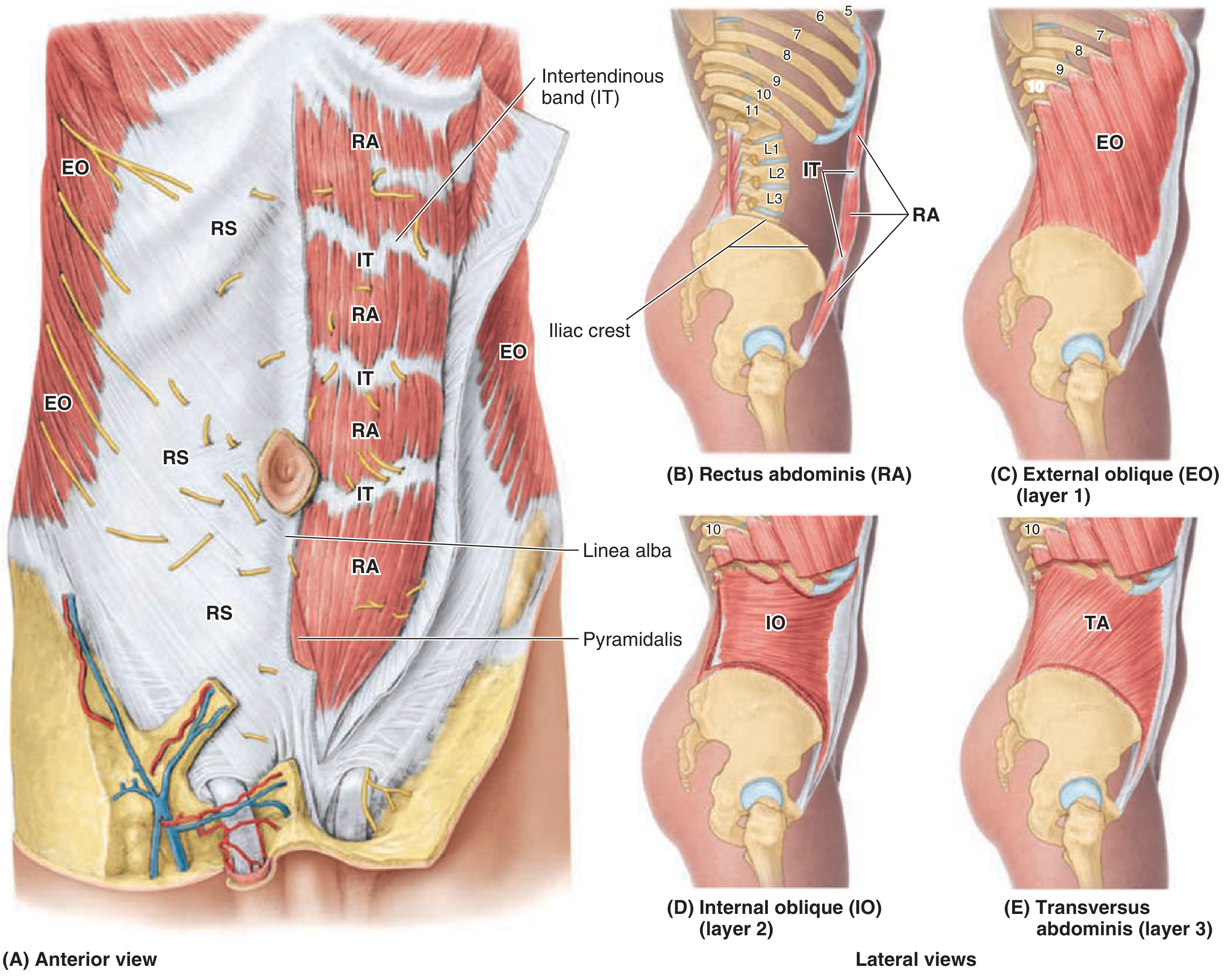
Anterior abdominal wall muscles with rectus sheath reflected on left side (Schwartz's Principles of Surgery)
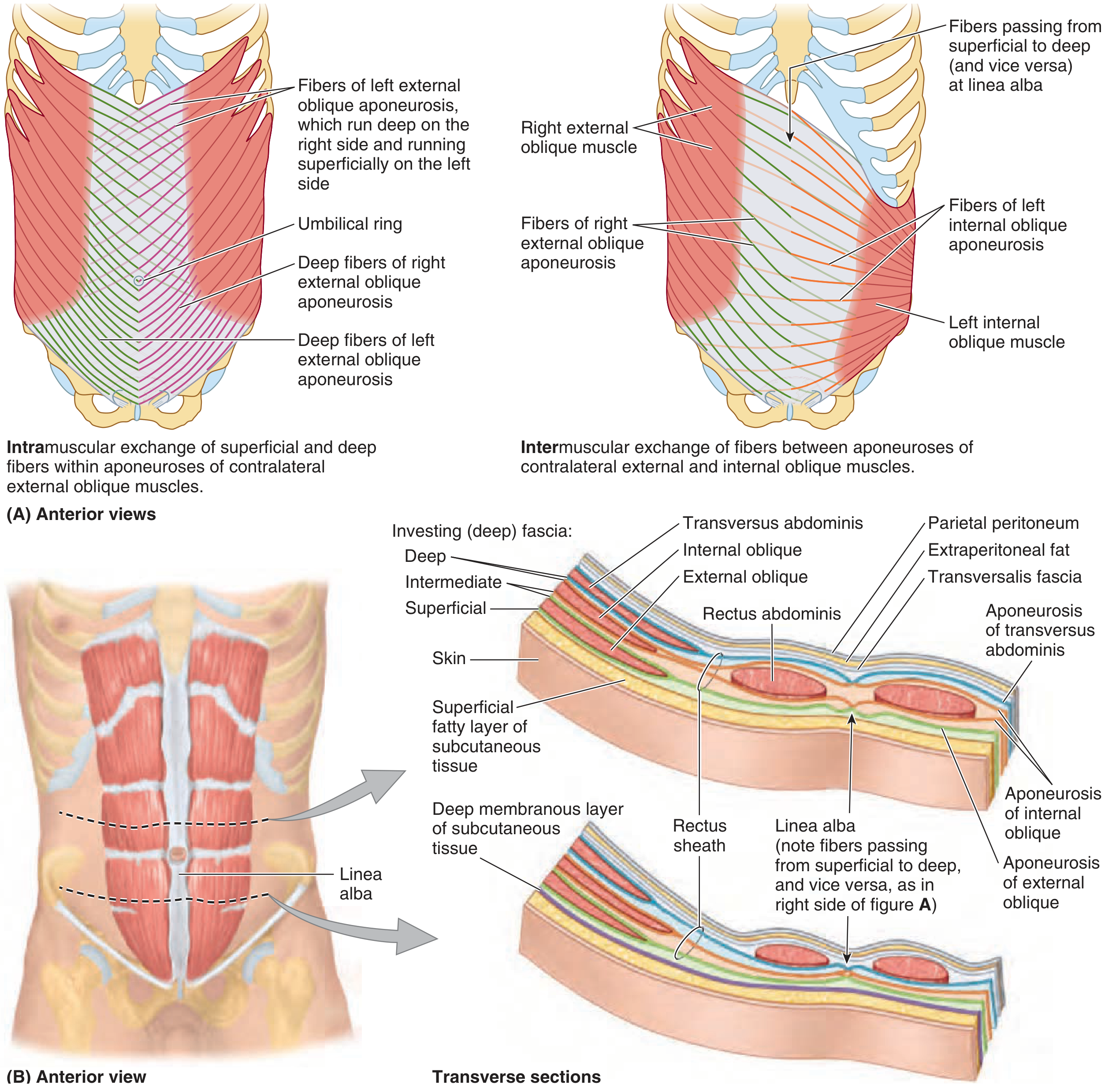
Cross-sectional anatomy above and below the arcuate line (Schwartz's Principles of Surgery)
General Principles
- Incisions should be located in proximity to the operative target
- The goal is adequate exposure with minimal perturbation of abdominal wall function
- Two general types: longitudinal vs. transverse/oblique
- No clear evidence of superiority between types; choice remains surgeon-dependent
- Transverse incisions may have lower incisional hernia rates but higher wound infection rates
Types of Abdominal Incisions
Here is the classic reference diagram showing all major incision positions:
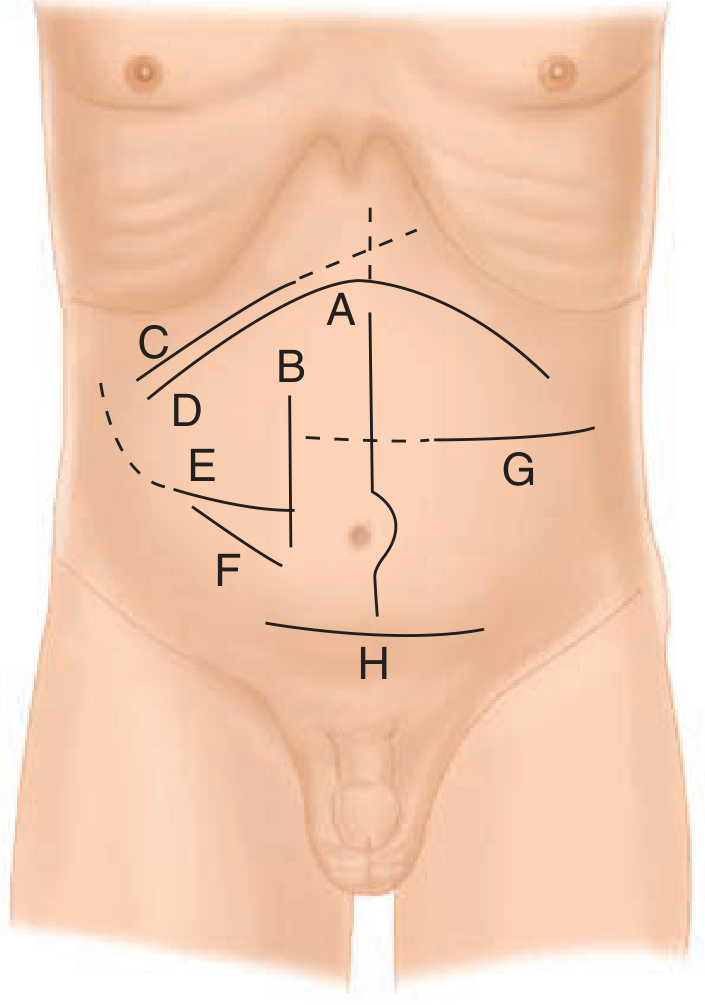
A. Midline | B. Paramedian | C. Right subcostal with saber-slash extension (dashed) | D. Bilateral subcostal/chevron with Mercedes-Benz extension (dashed) | E. Rocky-Davis | F. McBurney | G. Transverse | H. Pfannenstiel (Schwartz's Principles of Surgery, Fig. 35-4)
1. Midline Incision (Median Laparotomy)
| Feature | Details |
|---|---|
| Direction | Longitudinal, along linea alba |
| Layers cut | Skin, subcutaneous tissue, linea alba, peritoneum |
| Muscles cut | None (passes through avascular linea alba) |
| Access | Most intraabdominal organs; some retroperitoneal structures |
| Advantage | Quick, minimal bleeding, easily extensible, no nerve/vessel injury |
| Disadvantage | Higher incisional hernia risk than transverse |
| Variants | Upper midline (xiphoid to umbilicus), lower midline (umbilicus to pubis), full midline |
Closure: Fascia is reapproximated using sutures placed 1 cm from the edge, 1 cm apart. Recent European RCTs show reduced hernia rates with shorter stitch width (5-8 mm). Prophylactic mesh is under investigation.
2. Paramedian Incision
| Feature | Details |
|---|---|
| Position | Lateral to midline, through rectus sheath or pararectus |
| Variants | Through-and-through rectus (medial), pararectus (lateral to sheath) |
| Disadvantage | Restricts access to contralateral abdomen/pelvis; risks damage to rectus musculature, vessels (epigastric vessels), and nerves |
| Use | Largely superseded by midline in modern practice |
3. Transverse Incision
| Feature | Details |
|---|---|
| Direction | Horizontal |
| Advantage | Follows Langer's lines (better cosmesis), less respiratory compromise, lower hernia rate |
| Disadvantage | Limited exposure; muscles must be divided or split |
| Use | Pediatric surgery; specific upper/lower abdominal access |
4. Subcostal Incision (Kocher's Incision)
| Feature | Details |
|---|---|
| Position | Parallel and 2-3 cm below costal margin |
| Layers | Skin, external oblique, internal oblique, transversus, transversalis fascia |
| Access | Liver, gallbladder, spleen, pancreas, adrenal glands |
| Right subcostal | Cholecystectomy, right hepatectomy |
| Left subcostal | Splenectomy, left adrenalectomy |
| Closure | Two layers: deep (internal oblique + transversus + transversalis fascia) and superficial (anterior rectus sheath + external oblique aponeurosis) |
| Extension | "Saber slash" = right subcostal extended medially; bilateral subcostal = chevron incision |
Bilateral subcostal (Chevron/Roof-top incision): Used for liver transplantation, bilateral adrenalectomy, pancreaticoduodenectomy. A Mercedes-Benz modification adds a midline extension superiorly for access to upper abdomen or lower mediastinum.
5. McBurney's Incision
| Feature | Details |
|---|---|
| Position | Oblique, centered at McBurney's point (1/3 of the way from ASIS to umbilicus) |
| Type | Muscle-splitting (grid-iron) incision |
| Access | Appendix |
| Advantage | Muscle fibers of external oblique, internal oblique, and transversus are split (not cut) along their fiber direction - preserves function |
| Extension | Weir's extension (medially) or Rutherford-Morrison extension (laterally and superiorly) for better access |
Rocky-Davis incision is a transverse variant at the same point, allowing muscle splitting in a cosmetically superior transverse direction.
6. Pfannenstiel Incision
| Feature | Details |
|---|---|
| Position | Transverse skin incision in suprapubic region (2-3 cm above pubic symphysis) |
| Steps | Transverse skin + subcutaneous incision → transverse incision of anterior rectus sheath → sheath dissected off rectus muscles superiorly and inferiorly → rectus muscles separated in midline → longitudinal access through transversalis fascia/peritoneum |
| Access | Pelvis - uterus, bladder, iliac vessels, rectum |
| Use | Cesarean section, hysterectomy, bladder surgery, prostatectomy |
| Closure | Peritoneum + rectus muscles + anterior rectus sheath |
| Advantage | Excellent cosmesis; low hernia rate; strong closure |
| Disadvantage | Limited access outside pelvis; slower than midline |
7. Gridiron vs. Lanz Incision
| Gridiron (McBurney) | Lanz | |
|---|---|---|
| Direction | Oblique (along EO fibers) | Transverse (horizontal) |
| Position | McBurney's point | Right iliac fossa (more transverse) |
| Cosmesis | Poorer | Better |
| Access | Adequate for appendix | Adequate for appendix |
Laparoscopic Port Site Incisions
- Port placement must be carefully planned based on approach angles, working distances to operative site, and distances between ports
- A nasogastric tube and Foley catheter should decompress stomach and bladder to reduce entry injury
- Hasson (open) technique: Direct visualization, systematic opening of each fascial layer - preferred in patients with prior surgery
- Veress needle (closed) technique: Blind entry confirmed by saline drop test or intraabdominal pressure measurement
- Retrospective data suggests fewer complications with Hasson, but small RCTs show no significant difference
Complications of Abdominal Incisions
| Complication | Notes |
|---|---|
| Hematoma/Seroma | Early; risk higher with oblique/muscle-dividing incisions |
| Surgical site infection (SSI) | Most common early complication of open abdominal surgery |
| Fascial dehiscence | Early (days 5-8); risk factors: infection, malnutrition, obesity, steroids, diabetes |
| Incisional hernia | Most common late/long-term complication |
| Nerve injury | Cutaneous nerves of abdominal wall (dermatomal distribution T7-L1) |
Closure of Abdominal Incisions
Risk factors for wound failure: diabetes mellitus, malnutrition, obesity, corticosteroid use.
Fascial Closure Options:
| Method | Description |
|---|---|
| Mass closure | Single layer closing all fascial layers en masse (±peritoneum) - preferred for efficiency |
| Layered closure | Separate anterior + posterior aponeurotic sheaths; some evidence of higher dehiscence |
| Continuous vs. interrupted | Continuous is faster; some debate on superiority |
| Suture material | Slowly absorbable (PDS - 180 days, Maxon - 180 days) preferred over rapidly absorbable (Vicryl 60-90 days) or nonabsorbable |
Suture material resorption times (Maingot's Abdominal Operations):
| Material | Resorption (days) |
|---|---|
| Catgut | 15 |
| Chromic catgut | 90 |
| Polyglycolic acid (Dexon) | 20 |
| Polyglactin (Vicryl) | 60-90 |
| Polydioxanone (PDS) | 180 |
| Polyglyconate (Maxon) | 180 |
| Nylon, Polypropylene, Polyethylene | Non-resorbable |
Quick Reference Summary
| Incision | Use | Key Feature |
|---|---|---|
| Midline | Universal access | Avascular linea alba; fastest entry |
| Paramedian | Limited modern use | Muscle risks |
| Subcostal (Kocher's) | Liver, GB, spleen | Parallel to costal margin |
| Chevron/Roof-top | Liver transplant, bilateral adrenal | Bilateral subcostal |
| McBurney/Gridiron | Appendectomy | Muscle-splitting |
| Rocky-Davis | Appendectomy | Transverse muscle-splitting |
| Pfannenstiel | OB/GYN, bladder, pelvis | Cosmetic; strong closure |
| Transverse | Pediatric, specific access | Follows Langer's lines |
Sources: - Schwartz's Principles of Surgery, 11th Ed., Ch. 35 | - Maingot's Abdominal Operations, Ch. 6
This is a shared conversation. Sign in to Orris to start your own chat.