
Proper Inguinal hernia treatment, Umbilical hernia, Gastroschisis, Omphagocele
inguinal hernia treatment repair surgery management
Bailey and Love's Short Practice of Surgery 28th Edition
Page 1089
umbilical hernia gastroschisis omphalocele treatment management pediatric
Bailey and Love's Short Practice of Surgery 28th Edition
Page 1094
inguinal hernia Lichtenstein mesh repair open laparoscopic TEP TAPP
gastroschisis omphalocele newborn surgical repair staged closure silo
Abdominal Wall Conditions: Treatment Overview
1. Inguinal Hernia
Types
| Type | Description |
|---|---|
| Direct | Passes through Hesselbach's triangle (medial to inferior epigastric vessels); acquired, due to weakness of the posterior wall |
| Indirect | Passes through the internal inguinal ring alongside the spermatic cord; congenital patent processus vaginalis |
| Femoral | Below the inguinal ligament; higher risk of strangulation |
Conservative Management
- Asymptomatic direct hernias in elderly or high-risk patients: watchful waiting is acceptable (Bailey & Love, p. 1089)
- Surgical trusses are not recommended
- Patient should be counselled to seek early review if hernia enlarges or becomes symptomatic
Surgical Management (Elective)
Open Repair
| Technique | Description |
|---|---|
| Lichtenstein (tension-free mesh) | Gold standard for open repair; polypropylene mesh reinforces posterior inguinal canal wall; low recurrence (~1%) |
| Shouldice repair | 4-layer running suture repair; preferred in some centres without mesh; recurrence ~1–2% in expert hands |
| Bassini / Darn repair | Older sutured repairs; higher recurrence rates; largely superseded |
Laparoscopic Repair
| Technique | Full Name | Approach |
|---|---|---|
| TEP | Totally Extraperitoneal | Mesh placed in preperitoneal space without entering peritoneum |
| TAPP | Transabdominal Preperitoneal | Peritoneum entered; mesh placed preperitoneally |
Indications for Emergency Surgery
- Incarcerated hernia (irreducible, obstructed) → urgent reduction or surgery
- Strangulated hernia (ischaemic bowel) → emergency surgery; bowel resection may be needed
Complications of Repair
- Haematoma/seroma
- Wound infection
- Chronic groin pain (ilioinguinal nerve injury)
- Mesh infection/migration
- Recurrence (1–3%)
- Ischaemic orchitis / testicular atrophy (rare)
2. Umbilical Hernia
Pathophysiology
Paediatric Umbilical Hernia
- Most close spontaneously by age 2–4 years
- Surgical repair indicated if:
- Persists beyond age 4–5
- Defect >1.5–2 cm
- Symptomatic or incarcerated
Adult Umbilical Hernia
- Generally repaired electively due to risk of incarceration (bowel or omentum)
- Small defects (<1 cm): primary suture repair (Mayo's "vest-over-pants" technique)
- Larger defects (>1–2 cm): mesh repair (open or laparoscopic) — lower recurrence rates
Special Circumstances (Bailey & Love, p. 1094)
- Pregnancy-related: often develop postpartum; strong recommendation to avoid surgery during/before pregnancy unless complicated
- Patients advised: weight loss, abdominal muscle exercises; may resolve spontaneously within months
- Rectus divarication (diastasis recti) often co-exists and should be addressed
Complications of Repair
- Recurrence (higher with suture-only repairs in large defects)
- Wound infection
- Mesh-related complications (chronic pain, erosion)
3. Gastroschisis
Definition
Key Distinguishing Features
| Feature | Gastroschisis |
|---|---|
| Sac | Absent |
| Location | Right paraumbilical |
| Associated anomalies | Rare (mostly intestinal — atresia ~10–15%) |
| Bowel appearance | Thickened, matted, "peel" due to chemical peritonitis from amniotic fluid exposure |
| Maternal associations | Young mothers, low socioeconomic status |
Prenatal Management
- Diagnosed on antenatal ultrasound (typically 18–20 weeks)
- Serial ultrasound to monitor bowel and fetal growth
- Delivery at a tertiary centre with neonatal surgical facilities
- Timing: typically 37–38 weeks (or earlier if bowel compromise); caesarean section not mandatory
Postnatal Immediate Care
- Wrap exposed bowel in warm saline-soaked gauze then cling wrap/bowel bag to prevent heat and fluid loss
- Nasogastric decompression
- IV fluid resuscitation (significant third-space losses)
- IV antibiotics (broad-spectrum)
- Keep neonate warm; nurse on side to prevent mesenteric tension
Surgical Repair
Primary (Immediate) Closure
- If the abdominal cavity can accommodate bowel without raising intra-abdominal pressure (IAP)
- Performed in the NICU or OR
- Sutureless/umbilical cord closure techniques increasingly used
Staged Closure with Silo
- Used when primary closure would cause abdominal compartment syndrome (IAP >20 mmHg)
- Spring-loaded silo placed at bedside in NICU without anaesthesia
- Bowel gradually reduced over 5–10 days by gravity
- Formal fascia closure once bowel fully reduced
Postoperative Issues
- Prolonged ileus (weeks) — TPN required until gut function returns
- Risk of short bowel syndrome if intestinal atresia/ischaemia present
- Necrotising enterocolitis
4. Omphalocele (Exomphalos)
Definition
Key Distinguishing Features
| Feature | Omphalocele |
|---|---|
| Sac | Present (amnion-peritoneal membrane) |
| Location | Central / umbilical |
| Contents | Bowel, liver (in large defects), stomach |
| Associated anomalies | Very common (50–70%) — cardiac, chromosomal (Trisomy 13, 18, Beckwith-Wiedemann syndrome) |
| Bowel appearance | Normal (protected by sac) |
Classification
| Type | Defect Size | Key Feature |
|---|---|---|
| Minor / Small | <5 cm | Bowel only; primary repair often possible |
| Major / Giant | >5 cm or contains liver | Complex staged repair needed |
Associated Syndromes
- Beckwith-Wiedemann Syndrome (macroglossia, gigantism, hypoglycaemia)
- Pentalogy of Cantrell (cardiac + diaphragmatic + sternal + pericardial defects + omphalocele)
- OEIS complex (Omphalocele, Exstrophy, Imperforate anus, Spinal defects)
- Chromosomal anomalies (Trisomy 13/18): thorough workup before surgery
Prenatal Management
- Antenatal diagnosis on ultrasound (often earlier than gastroschisis)
- Fetal echocardiography and chromosomal analysis (amniocentesis) essential
- Multidisciplinary counselling
Postnatal Immediate Care
- Do NOT rupture the sac — it protects the viscera
- Keep sac moist and protected
- IV access, nasogastric tube, IV fluids
- Thorough assessment for associated anomalies (echo, renal US, genetics)
- Treat hypoglycaemia (Beckwith-Wiedemann)
Surgical Repair
Small Omphalocele — Primary Repair
- Sac excised
- Viscera reduced and fascia primarily closed
- Performed once neonate is stabilised
Giant Omphalocele — Staged Approaches
| Approach | Description |
|---|---|
| Staged fascial/skin closure | Gradual stretching of abdominal wall over weeks |
| "Paint and wait" (conservative) | Apply escharotic agents (silver sulfadiazine, betadine) to sac → scar tissue granulates → delayed surgical repair months later |
| Tissue expanders | Slowly enlarge abdominal domain before definitive repair |
| Component separation | Releases oblique muscles to achieve tension-free midline closure |
Prognosis
- Gastroschisis: generally good survival (>90%) if no major atresia; bowel function recovery may take weeks
- Omphalocele: prognosis driven by associated anomalies — isolated omphalocele has good outcomes; Trisomy 13/18 carries poor prognosis
Quick Comparison: Gastroschisis vs. Omphalocele
| Feature | Gastroschisis | Omphalocele |
|---|---|---|
| Sac | Absent | Present |
| Location | Right of umbilicus | At umbilicus |
| Bowel appearance | Matted, thickened | Normal |
| Associated anomalies | Rare | Common (50–70%) |
| Chromosomal anomalies | Uncommon | Common (Trisomy 13, 18) |
| Maternal age | Young | Any |
| Immediate priority | Wrap bowel, fluid resus | Protect sac, assess anomalies |
| Repair strategy | Primary or silo | Primary or staged/"paint & wait" |
| Prognosis driver | Bowel viability | Associated anomalies |
Which treatment different of inguinal hernia in male and female
inguinal hernia treatment differences male female gender sex
Bailey and Love's Short Practice of Surgery 28th Edition
Page 277
inguinal hernia female anatomy round ligament
female inguinal hernia indirect direct canal of Nuck round ligament repair
Bailey and Love's Short Practice of Surgery 28th Edition
Page 1080
Inguinal Hernia: Male vs. Female Differences
1. Anatomical Basis of the Difference
| Feature | Male | Female |
|---|---|---|
| Structure traversing inguinal canal | Spermatic cord (testicular vessels, vas deferens) | Round ligament of uterus |
| Hernia type predominance | Indirect AND direct | Almost exclusively indirect |
| Pelvic shape risk | Narrower pelvis | Wider pelvis → lower overall risk |
| Overall incidence | Much higher (M:F ~6:1 in adults; 6:1 in paediatric population) | Much lower |
2. Type of Hernia
| Male | Female | |
|---|---|---|
| Direct hernia | Common (posterior wall weakness) | Rare |
| Indirect hernia | Common | The predominant type |
| Femoral hernia | Less common | More common (wider femoral ring due to broader pelvis) — must always be excluded |
Clinical pearl: In a female presenting with a groin lump, femoral hernia must be actively excluded before assuming it is inguinal — femoral hernias are proportionally far more common in women and carry a higher strangulation risk.
3. Surgical Approach Differences
In Males
- The spermatic cord must be carefully identified and preserved during repair
- Structures at risk: vas deferens, testicular vessels → injury can cause ischaemic orchitis or testicular atrophy
- Mesh repair (Lichtenstein or laparoscopic TEP/TAPP) is standard
- The cord is encircled and retracted throughout the dissection
In Females
- The round ligament is present instead of the spermatic cord
- The round ligament can be divided during repair without significant consequence (it has no critical function in adults), which actually simplifies the repair technically
- Division allows a tighter closure of the internal ring
- Mesh repair is still preferred for adults
- The canal of Nuck (female analogue of the processus vaginalis) may persist and form a cyst or hydrocele of the canal of Nuck — this must be addressed at the time of hernia repair
4. Paediatric Differences
| Male | Female | |
|---|---|---|
| Urgency of repair | Semi-urgent (incarceration risk) | More urgent — ovary can prolapse into the sac and twist (torsion), causing permanent loss of the ovary |
| Contents of sac | Bowel, omentum | Bowel, omentum, ovary (common), fallopian tube |
| Special finding | Occasionally undescended testis in sac | Androgen insensitivity syndrome must be considered if a gonad (testis) is found in a phenotypic girl — do NOT remove without genetic workup |
In girls, prolapsed ovaries into the hernia sac require prompt repair to prevent torsion and loss of ovarian function (Bailey & Love, p. 277).
5. Mesh Considerations
- Mesh use is standard in both sexes for adult repair
- In women of reproductive age: some surgeons prefer laparoscopic repair (TEP/TAPP) to avoid mesh contact with reproductive structures and reduce chronic groin pain
- In males: mesh must not compress the vas deferens (risk of obstruction and infertility) — proper placement is critical
- Young males (especially those desiring future fertility): some advocate non-mesh (pure tissue) repair to avoid any risk to the vas, though this remains debated
6. Summary Table
| Aspect | Male | Female |
|---|---|---|
| Incidence | Much higher | Much lower |
| Dominant hernia type | Indirect + direct | Almost entirely indirect |
| Femoral hernia risk | Lower | Higher — always exclude |
| Key structure in canal | Spermatic cord — must preserve | Round ligament — can divide |
| Repair complexity (cord) | Higher (cord preservation) | Lower (cord absent) |
| Paediatric urgency | Semi-urgent | More urgent (ovarian torsion risk) |
| Special paediatric finding | Undescended testis | Androgen insensitivity if gonad found |
| Complication unique to sex | Orchitis, testicular atrophy, vas injury | Canal of Nuck cyst, ovarian torsion |
Difference and similarities Gastroschisis, Omphagocele
gastroschisis omphalocele comparison differences similarities pathology management
Caring for Infants and Children With Trisomy 13 and Trisomy 18
Page 7
gastroschisis omphalocele comparison abdominal wall defect newborn
Hugging Face pmc clinical VQA raw
Page 0
gastroschisis embryology pathophysiology bowel injury amniotic fluid prognosis
Bailey and Love's Short Practice of Surgery 28th Edition
Page 291
omphalocele exomphalos associated anomalies chromosomal syndromes surgical repair staged
Gastroschisis vs. Omphalocele
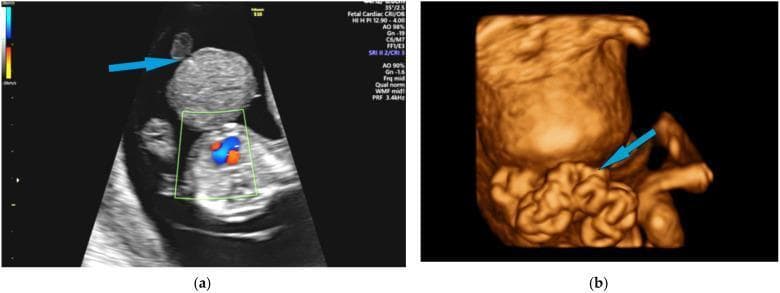
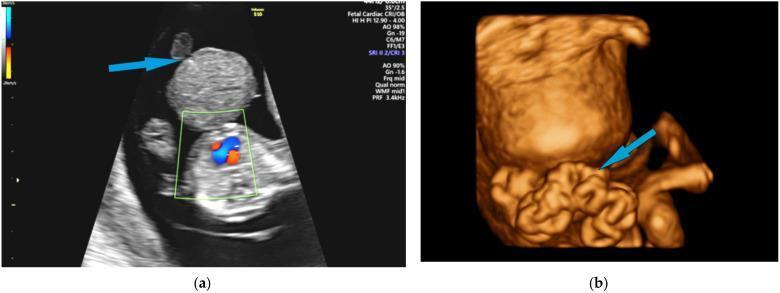
Prenatal Ultrasound Comparison
Side-by-Side Comparison Table
| Feature | Gastroschisis | Omphalocele |
|---|---|---|
| Covering sac | Absent — bowel exposed directly to amniotic fluid | Present — amnion + peritoneum membrane |
| Location of defect | Right of umbilicus (paraumbilical) | Central — at the umbilicus |
| Umbilical cord insertion | Normal — inserts separately to the left of defect | Inserts into the apex of the sac |
| Defect size | Usually small (2–4 cm) | Variable — small to giant (>5 cm) |
| Contents | Small bowel, large bowel, stomach, bladder; rarely gonads | Bowel, liver (in large defects), stomach |
| Bowel appearance | Thickened, matted, shortened — "peel" from chemical peritonitis due to amniotic fluid exposure | Normal — protected by sac |
| Associated anomalies | Rare (~10–15%) — mainly intestinal atresia from in-utero vascular compromise | Very common (50–70%) — cardiac, renal, chromosomal, syndromic |
| Chromosomal anomalies | Uncommon | Common — Trisomy 13, 18, 21 |
| Associated syndromes | None specific | Beckwith-Wiedemann, Pentalogy of Cantrell, OEIS complex |
| Maternal risk factors | Young/teenage mothers, smoking, recreational drugs, genitourinary infection (Bailey & Love, p. 291) | Older maternal age, chromosomal predisposition |
| Incidence trend | Increasing (especially in young mothers) | Stable |
| Prenatal diagnosis | Easily diagnosed on antenatal USS; elevated AFP | Diagnosed antenatally; requires fetal echo + karyotype |
Embryological Origins
| Gastroschisis | Omphalocele | |
|---|---|---|
| Mechanism | Disruption of right umbilical vein or right lateral fold → paraumbilical abdominal wall defect | Failure of physiological gut return into abdomen by 12 weeks (failure of lateral folds to fuse at midline) |
| Physiological basis | Vascular accident / ischaemia | Developmental/folding failure |
Similarities
- Both are congenital abdominal wall defects — viscera herniate outside the body
- Both are diagnosed prenatally on routine ultrasound (elevated maternal AFP in both)
- Both require delivery at a tertiary centre with neonatal surgical facilities
- Vaginal delivery is appropriate for both (caesarean not routinely required)
- Both require immediate postnatal stabilisation: IV access, nasogastric decompression, IV fluids, IV antibiotics, temperature maintenance
- Both are ultimately treated surgically — primary closure or staged repair
- Both may require TPN/PN postoperatively during gut recovery
- Both involve multidisciplinary care: neonatology, paediatric surgery, NICU nursing
Management Comparison
Immediate Postnatal Care
| Step | Gastroschisis | Omphalocele |
|---|---|---|
| Protect viscera | Wrap bowel in cling film / plastic wrap + warm saline gauze | Do NOT rupture the sac — keep moist and covered |
| NG tube | Yes | Yes |
| IV fluids | Yes — large volume (massive third-space losses from exposed bowel) | Yes — moderate |
| Antibiotics | Yes (broad-spectrum) | Yes |
| Associated anomaly workup | Intestinal atresia check | Echocardiogram, renal USS, karyotype — mandatory |
| Hypoglycaemia management | Routine | Active — Beckwith-Wiedemann risk |
Surgical Repair
| Approach | Gastroschisis | Omphalocele |
|---|---|---|
| Primary closure | First choice if bowel fits without raising IAP | For small defects once stabilised |
| Staged silo | Spring-loaded silo at bedside → gradual reduction over 5–10 days; formal closure after (Bailey & Love, p. 291) | Staged fascial closure with tissue expanders |
| "Paint and wait" | Not applicable | For giant omphalocele — escharotic agents (silver sulfadiazine) applied to sac → granulation → delayed repair months later |
| Sutureless repair | Umbilical cord flap closure (increasingly used) | N/A |
| Bowel resection | If atresia or necrosis present | Rarely needed |
Postoperative
| Gastroschisis | Omphalocele | |
|---|---|---|
| PN duration | ~4 weeks or longer while intestinal motility recovers (Bailey & Love, p. 291) | Shorter (bowel function usually normal) |
| Prolonged ileus | Yes — significant | Minimal |
| Main postoperative risk | Short bowel syndrome, NEC, prolonged ileus | Complications related to associated anomalies (cardiac, pulmonary hypoplasia) |
Prognosis
| Gastroschisis | Omphalocele | |
|---|---|---|
| Survival | >90% in isolated cases | Depends on associated anomalies |
| Main determinant | Bowel viability and gut function recovery | Severity of co-existing cardiac/chromosomal anomalies |
| Long-term issues | Short bowel syndrome, intestinal dysmotility | Respiratory issues (giant omphalocele → pulmonary hypoplasia), syndromic complications |
| Prognosis with Trisomy 13/18 | N/A | Very poor — thorough counselling before surgical commitment |
Memory Aid
Gastroschisis = Gut out, Guts exposed, Good chromosomes (rarely associated), to the Right, No sacOmphalocele = Ombilical, Owned by a sac, Often has other anomalies, On the midline