

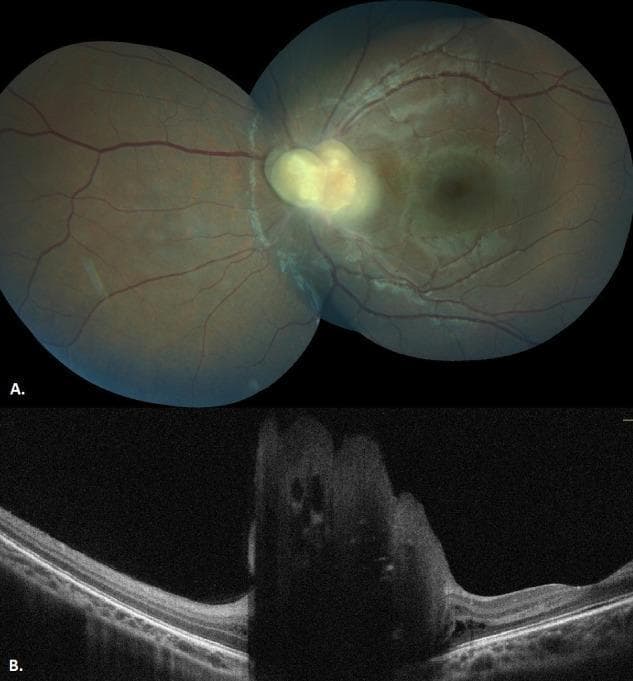
This is the fundus photo of patient. What is the diagnosis
Reading File
Searching for relevant information on the fundus findings visible in this image — a large white-yellow elevated lesion at the optic disc area with lipid exudates.
search_medical_image
optic disc tumor white elevated lesion retinoblastoma astrocytic hamartoma optic nerve
Hugging Face pmc clinical VQA raw
Page 0
search_medical_text
white elevated optic disc lesion retinal tumor diagnosis fundus examination
Ocular Surveillance of von Hippel-Lindau Disease
Page 1
GradeResponse
GradeResponse
Diagnosis: Retinal Astrocytic Hamartoma
The fundus image — captured through an indirect ophthalmoscopy lens — shows a large, white-yellow, elevated, lobulated ("mulberry-like") lesion centered over/near the optic disc, with surrounding hard lipid exudates. This is the classic appearance of a retinal astrocytic hamartoma.
Key Findings in This Image
| Finding | Significance |
|---|---|
| White-yellow, elevated, lobulated mass at/near optic disc | Classic astrocytic hamartoma appearance |
| "Mulberry-like" or "cottage cheese" texture | Calcification within the hamartoma |
| Hard exudates (yellow deposits) adjacent to lesion | Secondary exudation from the tumor |
| Overlying/obscuring retinal vessels | Superficial inner retinal layer origin |
What is a Retinal Astrocytic Hamartoma?
A benign, glial (astrocytic) tumor arising from the nerve fiber layer of the retina or optic disc. It can be:
- Flat and translucent (early/young lesion)
- Elevated, white-yellow, calcified with mulberry appearance (mature/classic lesion — as seen here)
Critical Association: Tuberous Sclerosis Complex (TSC)
Retinal astrocytic hamartomas are pathognomonic of Tuberous Sclerosis Complex (TSC) when bilateral or multiple, and are found in ~50% of TSC patients. However, they can also occur:
- Sporadically (isolated, unilateral)
- In neurofibromatosis type 1 (rare)
TSC workup is mandatory if this is a new finding, especially in younger patients. Screen for:
- Brain MRI (cortical tubers, subependymal nodules)
- Skin (ash-leaf spots, shagreen patches, facial angiofibromas)
- Renal angiomyolipomas
- Cardiac rhabdomyomas (especially in children)
Differential Diagnoses to Exclude
| Condition | Distinguishing Features |
|---|---|
| Retinoblastoma | Typically in children <5 years; leukocoria; more aggressive growth |
| Optic disc drusen | Buried, smaller, bilateral; no lobulated mass |
| Retinal hemangioblastoma (VHL) | Red/orange vascular tumor; dilated feeder vessels; associated with VHL disease |
| Choroidal osteoma | Yellow-white, peripapillary; geographic; calcified on US |
| Myelinated nerve fibers | Feathery white streaks along nerve fiber bundles; flat |
Management
- No treatment needed for stable, asymptomatic lesions
- Annual fundus monitoring for growth or exudation
- OCT of the lesion (shows hyporeflective cystic spaces and posterior shadowing from calcification)
- Systemic evaluation for TSC if not previously done
- Refer to a vitreoretinal specialist or ocular oncologist for confirmation
Important: While the image is strongly suggestive of astrocytic hamartoma, formal diagnosis requires slit-lamp biomicroscopy, OCT, B-scan ultrasonography, and correlation with the patient's systemic history.
Searching for relevant information on the fundus findings visible in this image — a large white-yellow elevated lesion at the macular area
search_medical_image
white yellow elevated macular lesion fundus exudates macular disease
Hugging Face pmc clinical VQA raw
Page 0
search_medical_text
large white yellow elevated lesion macula fundus diagnosis differential
Harrison's Principles of Internal Medicine, Twenty First Edition
Page 5936
GradeResponse
GradeResponse
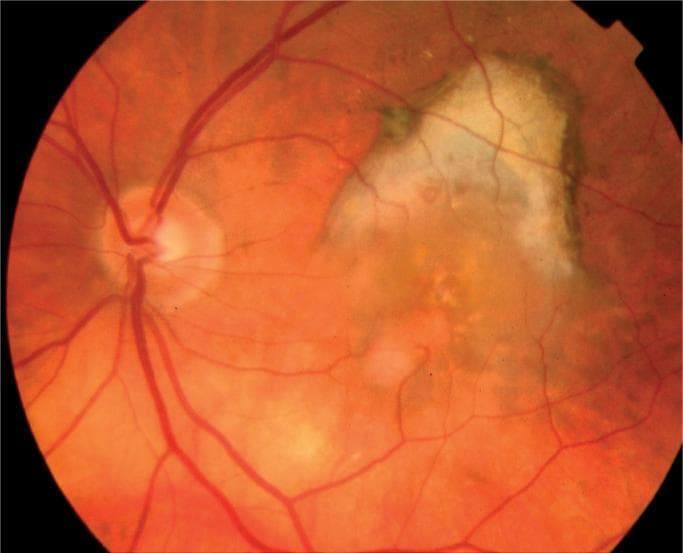
Thank you for the clarification. Re-examining the image with the lesion centered in the macular region (not the optic disc), the diagnosis shifts significantly.
Revised Diagnosis: Advanced Neovascular (Wet) Age-Related Macular Degeneration (nAMD)
The fundus image shows a large, elevated, white-yellow heterogeneous lesion centered at the macula with surrounding hard lipid exudates and evidence of subretinal exudative material — the classic presentation of advanced wet AMD with subretinal fibrosis.
Key Findings & Their Interpretation
| Finding | Significance |
|---|---|
| Large, elevated white-yellow macular mass | Subretinal fibrosis / disciform scar from chronic CNV |
| Hard lipid exudates (yellow deposits) around lesion | Chronic exudation from choroidal neovascularization (CNV) |
| Heterogeneous lesion (pale + pigmented areas) | Mixed fibrosis, exudate, and pigmentary changes |
| Displaced/obscured macular vessels | Severe architectural distortion |
| Older adult patient (as visible in image) | Consistent with AMD demographics |
Pathophysiology
In wet AMD:
- Abnormal choroidal new vessels (CNV) breach Bruch's membrane
- These vessels leak fluid, blood, and lipid → subretinal/intraretinal exudation
- Chronic, untreated CNV leads to subretinal fibrosis (disciform scar)
- The end result — a large white-yellow elevated macular scar — is exactly what is seen here
This stage is often called a "disciform scar" — representing end-stage wet AMD.
Differential Diagnoses
| Condition | Distinguishing Features |
|---|---|
| Wet AMD with disciform scar ✅ | Age >50, macular location, exudates, fibrosis, gradual central vision loss |
| Central Serous Chorioretinopathy (CSCR) | Younger patients, serous detachment, no thick fibrosis |
| Polypoidal Choroidal Vasculopathy (PCV) | Orange polyps near disc, more common in Asian/African patients; can mimic AMD |
| Choroidal neovascularization (other causes) | Myopia, angioid streaks, POHS — requires history |
| Astrocytic hamartoma | Located at optic disc, mulberry calcified appearance |
| Choroidal melanoma | Elevated pigmented lesion, orange lipofuscin, B-scan dome shape |
Staging: This Appears to Be Late/End-Stage Wet AMD
- Early AMD: Drusen only
- Intermediate AMD: Large drusen, pigmentary changes
- Late AMD (wet): CNV, subretinal fluid/hemorrhage, exudates
- End-stage (disciform): Large fibrovascular scar — as seen here
Investigations to Confirm
| Investigation | Expected Finding |
|---|---|
| OCT macula | Subretinal/intraretinal fluid, fibrovascular PED, hyperreflective subretinal material |
| FFA (Fluorescein Angiography) | Late leakage, fibrotic scar with blocked fluorescence |
| ICGA (Indocyanine Green) | Polyps if PCV; CNV characterization |
| B-scan ultrasound | Rules out choroidal mass |
Management
Since this appears to be a disciform (end-stage) scar, the prognosis for central vision in this eye is poor. However:
- Confirm activity with OCT — if fluid is still present, anti-VEGF therapy (Ranibizumab, Bevacizumab, Aflibercept, Faricimab) may halt further progression
- Protect the fellow eye: Check for early AMD signs; counsel on Amsler grid monitoring and AREDS2 supplementation (Vitamins C, E, Zinc, Lutein, Zeaxanthin)
- Low vision rehabilitation for the affected eye
- Urgent referral to a vitreoretinal specialist
The patient should be advised that while central vision in this eye may be severely compromised, treatment of the fellow eye (if affected) can preserve functional vision.
This is a shared conversation. Sign in to Orris to start your own chat.