
Action and function of estrogen
Reading File
Now I'll search the medical library in parallel for estrogen's actions and functions.
Finding Sources
Finding Sources
Good results. Let me now read the most authoritative sources - Goodman & Gilman's (pharmacology), Lippincott Pharmacology, and Costanzo Physiology - in parallel.
Reading File
Reading File
Reading File
I have the mechanism of action. Now let me fetch the detailed physiological actions of estrogen from Costanzo and Goodman & Gilman's estrogen receptors section.
Reading File
Reading File
Finding Sources
Excellent data. I have the full table of estrogen actions from Costanzo (Table 10.2) and the receptor details from Goodman & Gilman's. Let me read more of the Costanzo table and also get the Katzung estrogens section for the pharmacological effects.
Reading File
Reading File
I now have rich, comprehensive information. Let me also fetch the mechanism of action diagram for a visual aid.
Loading Image
I have all the information needed for a comprehensive, well-structured answer. Here is the complete response:
Estrogen: Actions and Functions
Types of Estrogen
Three major naturally occurring estrogens exist:
| Estrogen | Source | Relative Potency |
|---|---|---|
| Estradiol (E2) | Ovary (principal form in premenopausal women) | Most potent |
| Estrone (E1) | Metabolite/precursor of estradiol; primary circulating form after menopause (from DHEA conversion in adipose tissue) | ~1/3 of estradiol |
| Estriol (E3) | Placenta (major estrogen during pregnancy) | Least potent |
- Lippincott Illustrated Reviews: Pharmacology, p. 832
Mechanism of Action
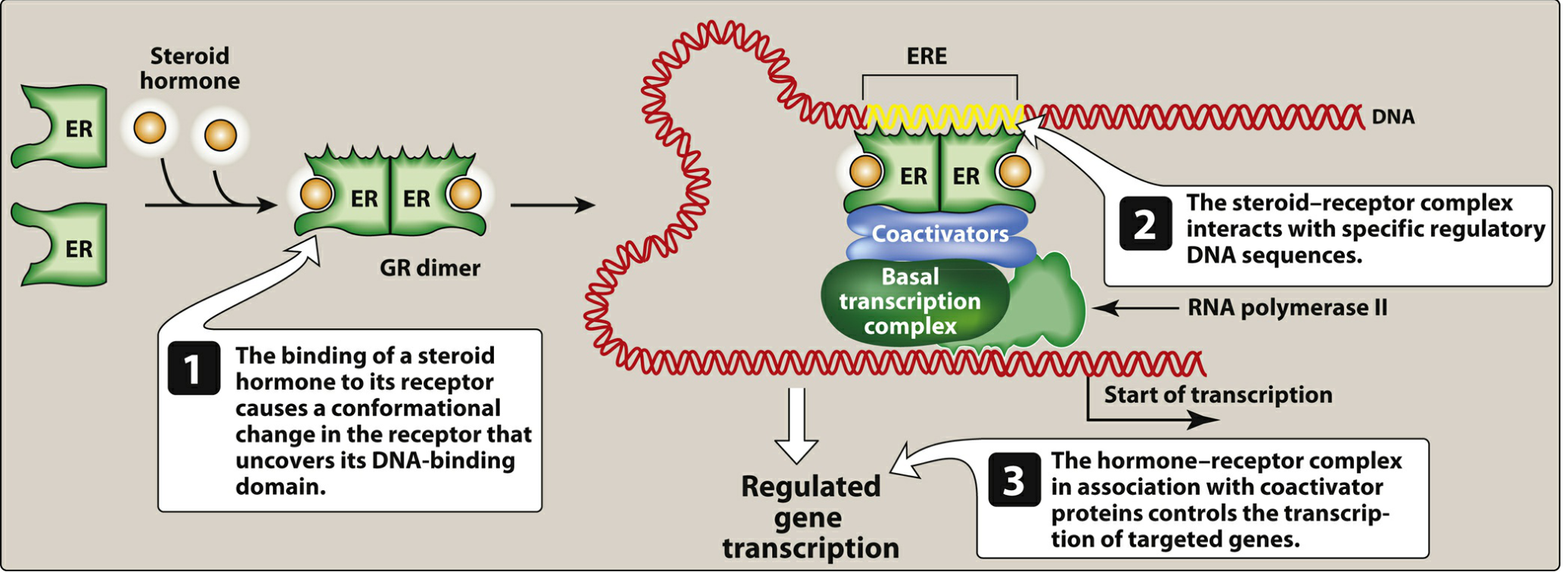
Estrogen acts primarily through a genomic (nuclear receptor) pathway:
- Free estradiol dissociates from sex hormone-binding globulin (SHBG) or albumin in plasma.
- It diffuses across the cell membrane and binds with high affinity to nuclear estrogen receptors (ERα or ERβ), which are inactive monomers bound to heat shock protein 90 (HSP90).
- Hormone binding causes a conformational change - HSPs dissociate, the receptor dimerizes (homodimers ERα/ERα, ERβ/ERβ, or ERα/ERβ heterodimers), and the dimer binds to estrogen response elements (EREs) on DNA.
- Together with coactivator proteins, the complex activates RNA polymerase II, initiating transcription of target genes and synthesis of specific proteins.
A non-genomic (rapid) pathway also exists via a G protein-coupled estrogen receptor (GPER/GPR30) at the membrane, producing faster effects not requiring gene transcription.
- Goodman & Gilman's Pharmacological Basis of Therapeutics, p. [block13]
- Lippincott Illustrated Reviews: Pharmacology, p. 832
Estrogen Receptor Subtypes
| Receptor | Encoded by | Predominant Locations |
|---|---|---|
| ERα | ESR1 | Uterus, vagina, ovaries, mammary gland, hypothalamus, endothelium, vascular smooth muscle |
| ERβ | ESR2 | Prostate, ovaries, lung, brain, bone |
Both receptors can form homo- or heterodimers. ERβ, when co-expressed with ERα, often inhibits ERα-mediated transcriptional activation - this has implications in breast cancer biology.
- Goodman & Gilman's Pharmacological Basis of Therapeutics
Physiological Actions of Estrogen
1. Female Reproductive Tract
- Maturation and maintenance of the uterus, fallopian tubes, cervix, and vagina.
- In the uterus: causes cell proliferation, cell growth, and increased contractility; stimulates growth of the endometrium, glands, stroma, and spiral arteries during the follicular (proliferative) phase.
- In the cervix: makes mucus copious, watery, and elastic ("ferning" pattern on glass slide), allowing sperm penetration.
- In the fallopian tubes: stimulates ciliary activity and contractility to aid sperm transport.
- In the vagina: stimulates epithelial cell proliferation.
2. Secondary Sexual Characteristics at Puberty
- Responsible for development of female secondary sex characteristics: growth of the uterus, vagina, labia, pubic/axillary hair distribution, female fat distribution (hips/thighs/buttocks), and female body contour.
3. Breast Development
- Required for development of the breasts; stimulates ductal and stromal growth, fat deposition.
- Works in coordination with progesterone and prolactin for full lactation capability.
4. Hypothalamic-Pituitary Feedback
- Negative feedback during most of the follicular phase: suppresses GnRH (hypothalamus) and FSH/LH (anterior pituitary).
- Positive feedback at midcycle: when estradiol levels rise above ~200 pg/mL, it up-regulates GnRH receptors on the anterior pituitary and causes the LH/FSH surge, triggering ovulation.
- Up-regulates progesterone receptors in target tissues, preparing them to respond to progesterone (the follicular phase "primes" the luteal phase).
5. Bone
-
Reduces bone resorption by decreasing the bone-resorbing action of PTH.
-
Estrogen receptors are present on bone cells; estrogen has direct effects on bone remodeling.
-
Deficiency (as at menopause) leads to accelerated bone loss and osteoporosis.
-
Men with aromatase deficiency or absent ER show osteopenia and failure of epiphyseal closure, confirming estrogen's role in bone in both sexes.
-
Katzung's Basic and Clinical Pharmacology, 16th Edition
6. Cardiovascular Effects
- Increases HDL cholesterol, decreases LDL cholesterol (favorable lipid profile).
- Direct effects on vascular endothelium and smooth muscle.
- Note: The Women's Health Initiative demonstrated that hormone replacement therapy (HRT) significantly increases risks of heart disease and breast cancer; HRT is now reserved for short-term relief of vasomotor symptoms.
7. Skin and Connective Tissue
- Maintains skin thickness and collagen content; estrogen deficiency after menopause accelerates collagen loss.
8. CNS Effects
- Higher estrogen levels transiently increase CNS sensitivity to serotonin.
- Sexual dimorphisms in brain function partially reflect acute and reversible actions of sex steroid concentrations.
- Involved in thermoregulation - estrogen withdrawal leads to vasomotor instability ("hot flashes").
9. Metabolic Effects
- Increases hepatic production of sex hormone-binding globulin (SHBG), coagulation factors, and vitamin D-binding protein (DBP).
- Increases 1,25(OH)₂D levels in vivo (indirect effect via changes in PTH, calcium, and phosphate).
Summary Table: Actions of Estrogen on Target Tissues
| System | Key Actions |
|---|---|
| Uterus | Proliferation of endometrium, increased contractility, spiral artery growth |
| Cervix | Watery, elastic, "ferning" mucus |
| Vagina | Epithelial proliferation |
| Fallopian tubes | Ciliary activity, motility |
| Breast | Ductal development, fat deposition |
| Bone | Inhibits resorption, maintains density, epiphyseal closure |
| HPG axis | Negative feedback (usually), positive feedback at midcycle (LH surge) |
| Cardiovascular | ↑HDL, ↓LDL, vascular effects |
| CNS | ↑Serotonin sensitivity, thermoregulation |
| Liver | ↑SHBG, coagulation factors, DBP |
| Adipose | Fat distribution to female pattern |
- Costanzo Physiology, 7th Edition, Table 10.2
Therapeutic Uses
- Contraception - combined with a progestogen (oral, transdermal, vaginal).
- Menopausal hormone therapy - vasomotor symptoms, urogenital atrophy (short-term use preferred due to risks).
- Osteoporosis prevention - established efficacy, though now largely superseded by bisphosphonates and SERMs due to adverse effects.
Selective Estrogen Receptor Modulators (SERMs) (e.g., raloxifene, tamoxifen) were developed to capture bone/cardiovascular benefits while minimizing risks at breast and uterus - exploiting tissue-specific differences in ERα and ERβ expression.
- Lippincott Illustrated Reviews: Pharmacology, p. 832-833
- Katzung's Basic and Clinical Pharmacology, 16th Edition
This is a shared conversation. Sign in to Orris to start your own chat.