
Polar body in fertilization function
Reading File
Searching for information on polar bodies and their role in fertilization.
search_medical_text
polar body formation function fertilization meiosis oocyte
Harrison's Principles of Internal Medicine, Twenty First Edition
Page 13270
search_medical_image
polar body oocyte meiosis fertilization diagram

Hugging Face pmc clinical VQA raw
Page 0
GradeResponse
GradeResponse
Polar Bodies in Fertilization
Polar bodies are small, non-functional cells produced during female meiosis. Their primary role is to discard excess chromosomes while preserving as much cytoplasm as possible in the egg — ensuring the oocyte retains the nutrients and organelles needed to support early embryonic development.
Formation
| Stage | Event | Product |
|---|---|---|
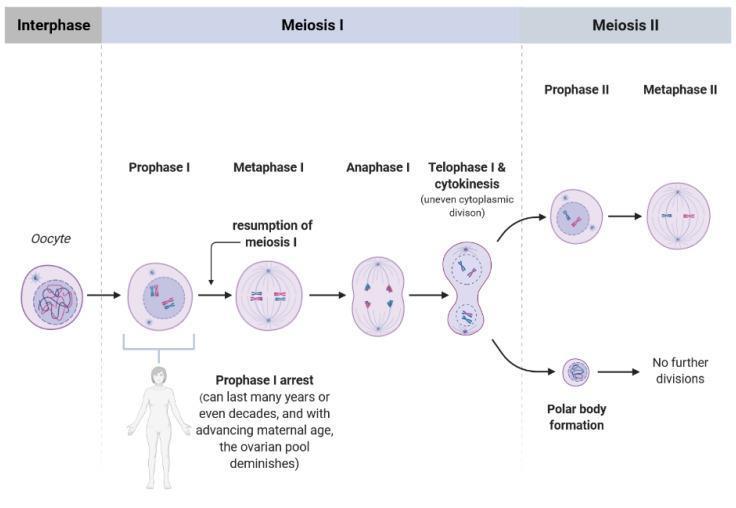
| Meiosis I (Telophase I) | Homologous chromosomes segregate; unequal cytokinesis | Large secondary oocyte + 1st polar body (haploid, 2 chromatids each) |
| Meiosis II (Telophase II) | Sister chromatids separate; triggered only by fertilization | Mature ovum + 2nd polar body (haploid, 1 chromatid each) |
The diagram below illustrates this process:
Key Functions of Polar Bodies
1. Halving the Chromosome Number (Haploidization)
The oocyte must reduce from diploid (2n = 46) to haploid (n = 23) before fusion with the sperm. Rather than splitting the cytoplasm evenly (which would destroy the egg's developmental potential), the cell "dumps" the extra chromosomal sets into polar bodies.
2. Preserving Ooplasm (Cytoplasmic Conservation)
The unequal division is critical. Virtually all of the cytoplasm — including mitochondria, yolk, maternal mRNA, and developmental proteins — is retained in the oocyte. Polar bodies receive minimal cytoplasm and cannot support development.
3. Triggering Meiosis II Completion
The secondary oocyte arrests at Metaphase II and only completes meiosis II upon fertilization by a sperm. The 2nd polar body is extruded as a direct result of sperm entry. If fertilization does not occur, meiosis II is never completed.
4. Restoring the Diploid Number at Fertilization
Once meiosis II is complete and the 2nd polar body is extruded, the mature egg (now haploid, n = 23) fuses its pronucleus with the sperm pronucleus, restoring the diploid state (2n = 46) in the zygote.
Clinical Significance
- Polar body biopsy for PGT (Preimplantation Genetic Testing): The 1st polar body can be biopsied from an oocyte before or just after fertilization in IVF. Since it carries the chromosomes excluded from the egg, analyzing it can indirectly reveal the chromosomal or genetic content of the oocyte — allowing detection of aneuploidies or inherited mutations before embryo transfer (Harrison's, p. 13270).
- Indicator of meiotic completion: Presence of the 2nd polar body in the perivitelline space confirms that fertilization has occurred and meiosis II is complete.
- Maternal age: As shown in the diagram, prophase I arrest can last decades. Prolonged arrest is associated with declining oocyte quality and increased risk of meiotic errors (non-disjunction), contributing to age-related aneuploidy (e.g., trisomy 21).
Summary
Polar bodies are not functionless byproducts — they are the mechanism by which the oocyte achieves haploidy without sacrificing cytoplasmic volume, and the 2nd polar body's extrusion is both a consequence and a marker of successful fertilization.
This is a shared conversation. Sign in to Orris to start your own chat.