
You are a doctor with a patient with history of 15 years of diabetes and not on any medication , recently started on some ayurvedic treatment.Fasting blood sugar is 270 and post prandial is 379 . Need to explain the patient in layman terms to start medication and the side effects of increased blood sugar
Reading File
Finding Sources
Finding Sources
Finding Sources
Reading File
Reading File
Reading File
Loading Image
Finding Sources
I now have enough information from authoritative textbooks (Harrison's, Robbins, Goodman & Gilman) to give a thorough, layman-friendly explanation. Here is how you can explain this to your patient:
Doctor's Explanation to Patient (Layman Language)
First, What Do Your Numbers Mean?
Your fasting sugar (before eating) is 270 mg/dL and after food it is 379 mg/dL. Normal fasting sugar is below 100 and post-meal below 140.
In simple terms: Your blood is carrying almost 3 times the normal amount of sugar. Think of your blood vessels as water pipes — when you pour too much thick, sticky syrup into a pipe, it starts clogging and corroding the pipe walls from inside. That is exactly what excess sugar does to your body for the last 15 years.
Why Ayurvedic Treatment Alone Is Not Enough Right Now
Ayurvedic herbs and lifestyle changes can support your health, but your sugar levels show that they have not brought your sugar under control. Your body urgently needs more powerful tools. Ayurveda can continue alongside modern medicine, but it cannot replace it at these levels.
What Is Happening Inside Your Body Right Now
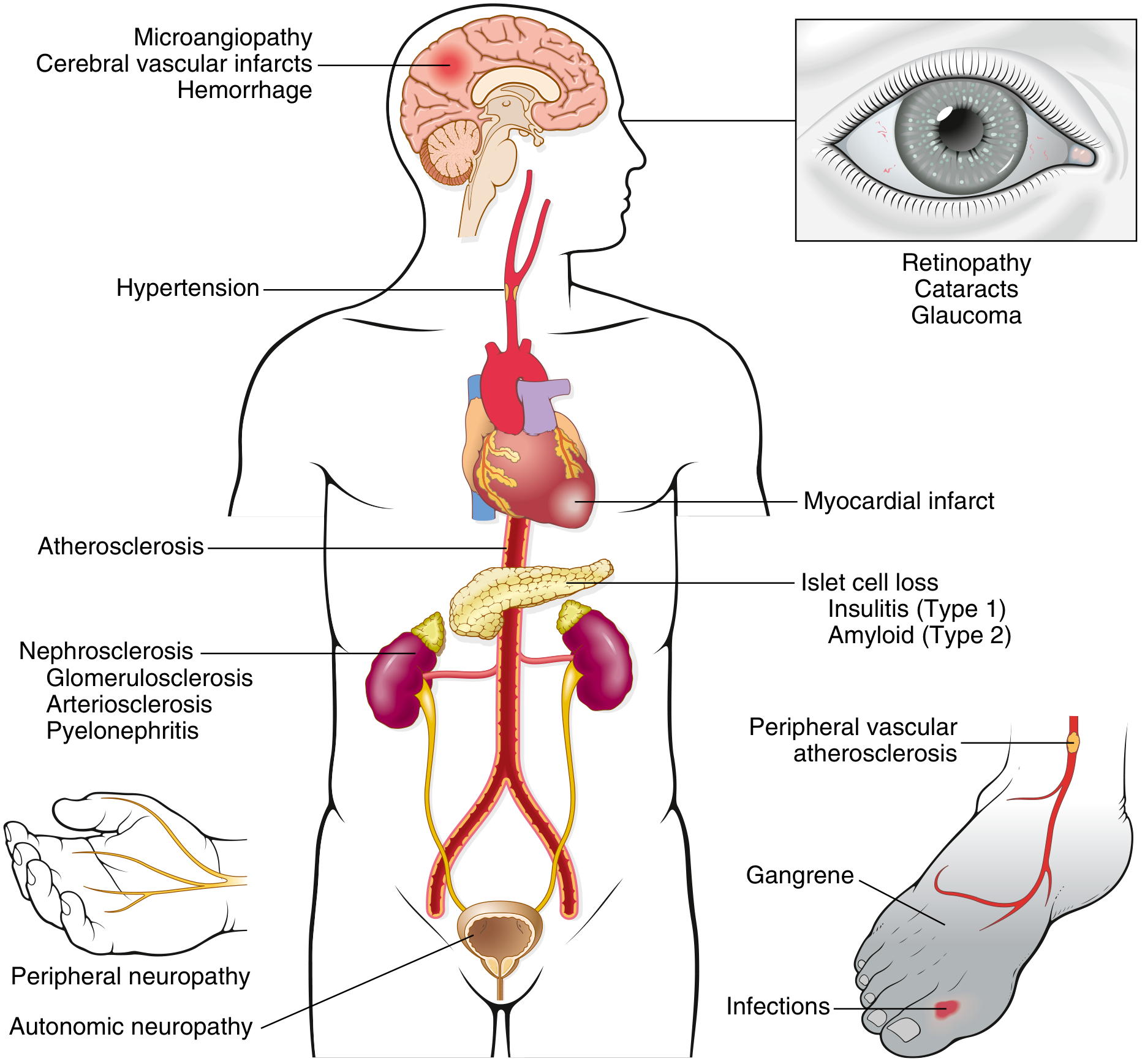
Every organ system is being silently damaged by high sugar — Robbins Basic Pathology
High sugar for a long time damages your body through a process called glucotoxicity — meaning sugar itself is toxic to your organs in high amounts. There are 3 main ways this happens:
- Sugar sticks to proteins — Excess sugar attaches to proteins in your blood vessels and organs, making them stiff and damaged (like rust on a pipe). These are called Advanced Glycation End Products (AGEs).
- Your blood vessels get inflamed — This inflames the inner lining of arteries, causing them to narrow and harden.
- Nerve fibers get poisoned — High sugar floods nerve cells with a toxic byproduct (sorbitol), slowly killing the nerves in your feet, hands, and organs.
(Harrison's Principles of Internal Medicine 22E, p. 3265; Robbins Basic Pathology)
Damage Already Happening in Your Body — Explained Simply
| What Doctors Call It | What It Means For You |
|---|---|
| Diabetic Retinopathy | Tiny blood vessels in your eyes are leaking or growing abnormally → you could go blind |
| Diabetic Nephropathy | Your kidneys are being slowly destroyed → could lead to kidney failure and dialysis |
| Diabetic Neuropathy | Nerves in your feet and hands are dying → burning, numbness, wounds that don't heal |
| Heart Attack risk | Arteries to the heart are getting clogged → 2–4× higher risk of heart attack compared to non-diabetics |
| Stroke | Brain blood vessels are damaged → risk of paralysis |
| Diabetic Foot / Gangrene | Poor circulation + nerve damage → wounds get infected and don't heal → possible amputation |
| Infections | High sugar is like food for bacteria → you get sick more easily and take longer to recover |
"Diabetes has been a leading cause of new blindness in adults, renal failure, and non-traumatic lower extremity amputation." — Harrison's Principles of Internal Medicine 22E
Why Starting Medication is Urgent
You have had diabetes for 15 years. The damage to your small blood vessels (eyes, kidneys, nerves) usually begins silently in the first 10 years. At 15 years without proper control, this damage is likely already underway even if you feel fine today. Many patients feel no symptoms until the damage is severe.
The good news: Multiple large clinical trials (the DCCT and UKPDS) have proven that controlling your blood sugar now significantly reduces or delays all these complications. It is not too late to protect what you still have.
The Medicine: Metformin (Your Likely First Choice)
Your doctor will most probably start you on Metformin — the most widely used, safest, and best-studied medicine for Type 2 diabetes worldwide for over 50 years. Given your current sugar levels, insulin or combination therapy may also be considered.
How Metformin Works (Simply):
- It tells your liver to stop releasing extra sugar into your blood overnight (which is why your fasting sugar is high)
- It makes your body's cells more sensitive to insulin, so the insulin you already produce works better
- It does not cause weight gain — in fact, it may cause mild weight loss
Common Side Effects of Metformin:
- Nausea, stomach cramps, loose stools — very common (10–25% of people) when you first start. This usually goes away within a few weeks. Starting at a low dose and taking it with food reduces this significantly.
- Low Vitamin B12 levels — with long-term use, your doctor will check this every 1–2 years
- Lactic acidosis — extremely rare; only a concern if you develop a serious illness, kidney problems, or need a CT scan with contrast dye (you would be told to temporarily stop the medicine then)
What Metformin Does NOT Do:
- It does not cause low blood sugar (hypoglycemia) on its own
- It does not harm your heart — in fact, it may protect it
(Goodman & Gilman's Pharmacological Basis of Therapeutics)
What Happens If You Don't Take Medication
| Timeline | Risk |
|---|---|
| Now | Sugar continues to damage nerves, kidneys, and eyes silently |
| 2–5 years | Vision loss, protein in urine (early kidney failure), foot numbness |
| 5–10 years | Possible dialysis, heart attack, foot ulcers, possible amputation |
| Long-term | Significantly shortened life expectancy |
Studies show that for every decade earlier that diabetes is poorly controlled, a person loses 3–4 years of life expectancy (Harrison's 22E).
What You Should Do Starting Today
- Start your prescribed medication — take it with meals to reduce stomach upset
- Continue eating well — reduce rice, white bread, sweets, sugary drinks
- Walk 30 minutes daily — exercise lowers blood sugar naturally
- Check your sugar regularly — track your progress
- Get these tests done: HbA1c, kidney function (creatinine), urine microalbumin, eye check-up, foot examination
- Your ayurvedic treatment — discuss with your doctor which herbs you are taking, as some can interact with medications or affect kidney function
The bottom line for your patient: "Your sugar is dangerously high and your body has been silently fighting for 15 years. Medication will not make you weak — it will protect your eyes, kidneys, heart, and feet. Think of it as a shield, not a defeat."
This is a shared conversation. Sign in to Orris to start your own chat.