
About Preeclampsia
Reading File
Now I'll search the medical library and PubMed in parallel for comprehensive preeclampsia coverage.
Finding Sources
Searching PubMed
"preeclampsia"[MeSH Terms] AND management
Searching the Web
preeclampsia 2024 2025 guidelines diagnosis management
Now let me read the most authoritative sources — Creasy & Resnik's Maternal-Fetal Medicine and Goldman-Cecil, plus search for images in parallel.
Reading File
Reading File
Finding Sources
Searching PubMed
"preeclampsia"[MeSH Terms] AND "pathogenesis"
Now let me read the comprehensive preeclampsia chapter from Creasy & Resnik and Harrison's, plus the anesthesia pathophysiology section.
Reading File
Reading File
Reading File
Now let me read more of the comprehensive Creasy & Resnik chapter (pathophysiology, management, treatment) and get images.
Reading File
Reading File
Searching Images
preeclampsia pathophysiology placental ischemia angiogenic factors diagram
Now let me read the core pathophysiology and management sections from Creasy & Resnik.
Reading File
Reading File
I now have comprehensive information from multiple authoritative sources. Let me compile the full answer.
Preeclampsia
Definition & Epidemiology
Preeclampsia is a pregnancy-specific disorder defined as new-onset hypertension (BP ≥140/90 mmHg on two occasions ≥4 hours apart) after 20 weeks of gestation, accompanied by proteinuria (≥300 mg protein/24-hour urine, or protein:creatinine ratio ≥0.3) or signs of end-organ damage in the absence of proteinuria.
- Affects 5–7% of all pregnancies globally
- A leading cause of maternal and perinatal morbidity/mortality worldwide
- In the absence of treatment, ~1 in 100 cases progresses to eclampsia (generalized tonic-clonic seizures)
Harrison's Principles of Internal Medicine 22E, p. 3942; Creasy & Resnik's Maternal-Fetal Medicine, pp. 1055–1140
Diagnostic Criteria
Hypertension
- Systolic BP ≥140 mmHg OR diastolic BP ≥90 mmHg on two readings ≥4 hours apart
- An incremental rise of 30 mmHg systolic / 15 mmHg diastolic is no longer part of the diagnostic criteria (no increased adverse outcome risk in this group)
Proteinuria (any one of):
- ≥300 mg protein in 24-hour urine collection
- Protein:creatinine ratio ≥0.3
- Dipstick 2+ (only if quantitative methods unavailable — false positives/negatives common)
Without proteinuria, preeclampsia is diagnosed if hypertension co-exists with:
| Finding | Threshold |
|---|---|
| Thrombocytopenia | Platelets <100,000/μL |
| Elevated transaminases | >2× upper limit of normal |
| Renal insufficiency | Creatinine >1.1 mg/dL (no other renal disease) |
| Pulmonary edema | Clinical/radiological |
| New-onset cerebral or visual disturbances | — |
Creasy & Resnik's Maternal-Fetal Medicine, p. 1055
Severe Features
The diagnosis of preeclampsia with severe features requires any of the following:
- BP ≥160/110 mmHg on two occasions ≥4 hours apart (unless antihypertensives already initiated)
- New-onset cerebral or visual disturbances
- Pulmonary edema
- Persistent epigastric or RUQ pain unresponsive to medication
- Liver enzymes >2× normal
- Thrombocytopenia (platelets <100,000/μL)
- Progressive renal insufficiency (creatinine >1.1 mg/dL)
⚠️ ACOG recommends abandoning the term "mild" preeclampsia — even without severe features, significant morbidity and mortality risk remain.
Pathophysiology
The precise mechanism remains incompletely understood but involves several converging pathways:
1. Abnormal Placentation & Uteroplacental Ischemia
- Defective trophoblastic invasion of spiral arteries → failure of normal vascular remodeling → high-resistance, low-flow uteroplacental circulation
- Placental ischemia is the primary driver
2. Angiogenic Imbalance
- Excess production of sFlt-1 (soluble fms-like tyrosine kinase 1) — an anti-angiogenic factor
- Decreased PlGF (placental growth factor) — a pro-angiogenic factor
- sFlt-1/PlGF ratio ≥40 is associated with increased risk of developing severe features within 2 weeks
- sFlt-1 acts by binding and neutralizing VEGF and PlGF → endothelial dysfunction
3. Endothelial Dysfunction & Systemic Inflammation
- Endothelial activation → increased vascular permeability, vasospasm
- Leukocyte activation (neutrophils, monocytes) and platelet activation
- Exaggerated maternal inflammatory response with pro-inflammatory cytokines
4. Oxidative Stress
- Reactive oxygen species (ROS) from NADPH oxidase, eNOS uncoupling, mitochondrial dysfunction
- Lipid peroxidation and large VWF multimer formation → prothrombotic state
5. Immunological Mechanisms
- Impaired HLA-G/HLA-C interactions between extravillous trophoblasts and maternal NK cells/macrophages → deficient spiral artery remodeling
- Early-onset preeclampsia (before 34 weeks): dominated by defective placentation
- Late-onset preeclampsia (≥34 weeks): normal initial remodeling, but placental demands exceed uterine perfusion capacity over time
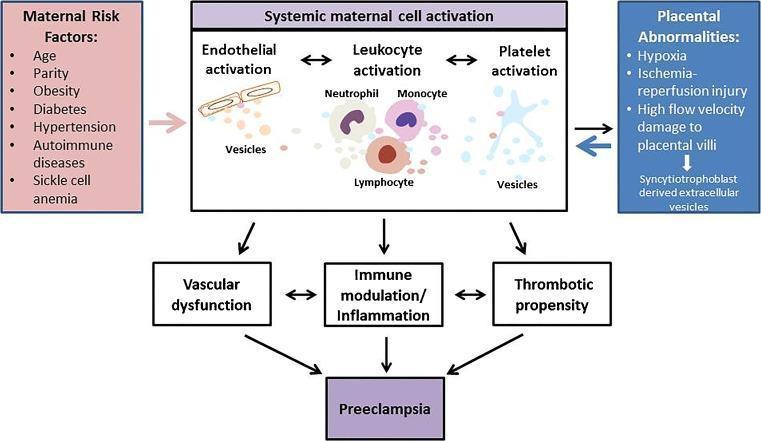
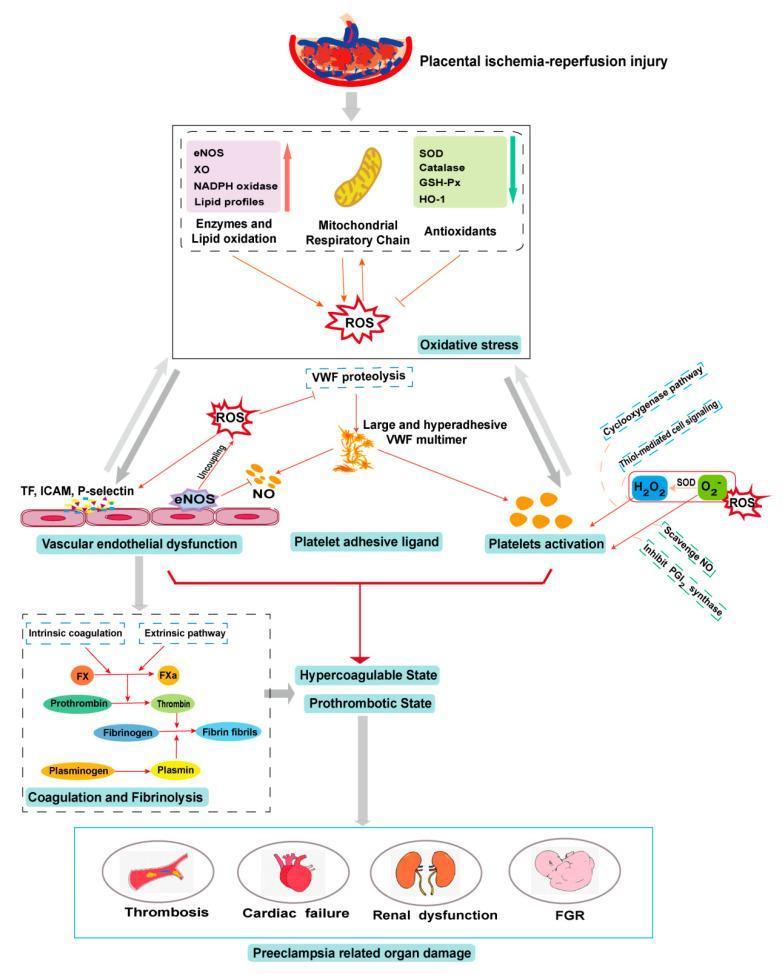
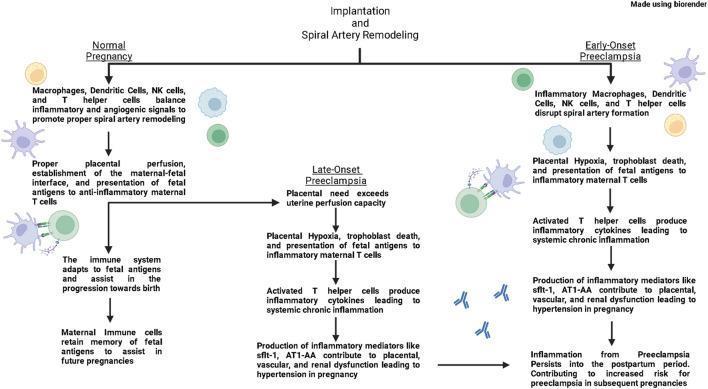
Barash, Cullen & Stoelting's Clinical Anesthesia 9e, p. 3508; Creasy & Resnik's Maternal-Fetal Medicine, p. 1060; Harrison's 22E, p. 3942
Organ-System Pathology
Neurological
- Loss of cerebral vascular autoregulation → focal hypoperfusion despite elevated MAP
- Posterior Reversible Encephalopathy Syndrome (PRES): vasogenic, parietooccipital edema — typically reversible
- Petechial hemorrhage after convulsions
- White matter lesions and cognitive dysfunction in long-term follow-up
- Symptoms: headache, blurred vision, scotomata, diplopia, hyperreflexia, cortical blindness, convulsions
- Cerebral hemorrhage is a leading cause of death
Liver
- Gross lesions visible in 60% of eclamptic women
- Periportal hemorrhage (early) → hepatic infarction (late, from intense vasospasm)
- HELLP syndrome: Hemolysis, Elevated Liver enzymes, Low Platelets — a severe subtype with high morbidity
Kidney
- Glomerular endotheliosis (pathognomonic lesion): enlarged endothelial cells occlude capillary lumens, reduced GFR
- Glomerular changes include decreased size, reduced capillary diameter, increased cytoplasmic endothelial-mesangial volume
- Results in proteinuria, oliguria, anuria, and rising creatinine
Cardiovascular
- Hypovolemia paradoxically (fluid shifts from intravascular to extravascular space)
- Mean plasma volume up to 30–40% below normal in severe disease
- Pulmonary edema in ~2% of severe cases (from fluid overload, cardiac failure, aspiration, or magnesium sulfate)
- Airway edema — important for anesthetic management (risk of difficult intubation)
Hematologic
- Thrombocytopenia (platelets 100–150 × 10⁹/L typically)
- Elevated fibrin degradation products; fibrinogen usually normal (unless abruption)
- PT/PTT prolongation indicates consumption of procoagulant factors
Metabolic
- Exaggerated insulin resistance → elevated triglycerides, LDL, fatty acids; reduced HDL
- These changes may predate clinical disease and resolve postpartum
Fetal
- Reduced placental intervillous blood flow → chronic fetal hypoxia
- IUGR, preterm birth, increased perinatal mortality — risks correlate with severity
Risk Factors
| Category | Risk Factors |
|---|---|
| Prior history | Previous preeclampsia (strongest risk factor) |
| Medical conditions | Chronic hypertension, renal disease, DM (especially with vascular disease), SLE, antiphospholipid syndrome |
| Obstetric | Nulliparity, multiple gestation (twin 6.7%, triplet 12.7%, quadruplet 20%), molar pregnancy |
| Body habitus | Obesity (3× risk — linear relationship with BMI) |
| Other | Advanced maternal age, donor oocyte pregnancies, new paternity |
Creasy & Resnik's Maternal-Fetal Medicine, pp. 1056–1058
HELLP Syndrome
A severe subtype of preeclampsia with:
- Hemolysis (microangiopathic hemolytic anemia)
- Elevated liver enzymes (transaminases >2× normal)
- Low platelets (<100,000/μL)
Complications: coagulopathy, CVAs, hepatic capsule rupture, placental abruption, DIC.
Eclampsia
- Preeclampsia + new-onset generalized tonic-clonic seizures with no other identified cause
- Occurs in ~1% of untreated preeclampsia cases
- Risk of seizures correlates poorly with BP level
- Managed with magnesium sulfate (first-line anticonvulsant and seizure prophylaxis)
Management
Definitive Treatment
Delivery of the fetus and placenta — the only cure.
Delivery Timing by Severity
| Scenario | Recommendation |
|---|---|
| Without severe features | Delivery at 37 weeks (expectant management until then) |
| With severe features ≥34 weeks | Delivery indicated |
| With severe features <34 weeks | Expectant management in tertiary center if no indications for earlier delivery |
| Indications for delivery before 34 weeks | Unrelenting symptoms, lab deterioration, refractory severe BP, severe IUGR, abruption |
Antihypertensive Therapy
- Goal: prevent cerebral hemorrhage, myocardial ischemia, renal injury while maintaining uteroplacental flow
- ACOG: treat BP ≥160/110 mmHg within 30–60 minutes
| Drug | Route | Notes |
|---|---|---|
| Labetalol | IV | First-line for acute management |
| Hydralazine | IV | First-line for acute management |
| Nifedipine (extended-release) | Oral | Acute or maintenance |
- ACE inhibitors / ARBs are contraindicated (stillbirth, fetal anomalies)
Seizure Prophylaxis & Treatment
- Magnesium sulfate (MgSO₄) — standard of care for seizure prevention in severe preeclampsia and treatment of eclampsia
- Loading dose 4–6 g IV, then maintenance 1–2 g/hr
Expectant Management Components
- Frequent BP monitoring and lab surveillance
- Serial fetal surveillance (biophysical profile, umbilical artery Doppler)
- Limited physical activity
- Corticosteroids (betamethasone 12 mg IM × 2 doses) if delivery anticipated before 34 weeks
Aspirin Prophylaxis
- Low-dose aspirin 81 mg/day initiated between 12–16 weeks (by 28 weeks at the latest)
- Recommended for high-risk women
- Reduces preeclampsia incidence by ~50% in diabetic women; reduces IUGR by ~20%
- Endorsed by ACOG, SMFM, and ADA
Long-Term Consequences
Women with prior preeclampsia have significantly elevated long-term risks:
- Chronic hypertension
- Cardiovascular disease (2–4× increased risk)
- Chronic kidney disease
- Diabetes mellitus
- White matter lesions and cognitive dysfunction
Cardiovascular risk-reduction interventions should be initiated at postpartum health encounters.
Harrison's 22E, p. 3942; Barash, Cullen & Stoelting's Clinical Anesthesia 9e, pp. 3508–3512
Summary Table: Preeclampsia vs Severe Features
| Feature | Without Severe Features | With Severe Features |
|---|---|---|
| BP | 140–159 / 90–109 mmHg | ≥160/110 mmHg |
| Proteinuria | ≥300 mg/24h | Any amount |
| Platelets | Normal | <100,000/μL |
| Creatinine | Normal or mildly elevated | >1.1 mg/dL |
| Liver enzymes | Normal or mildly elevated | >2× ULN |
| CNS symptoms | None | Headache, visual changes |
| Pulmonary edema | Absent | Present |
| Delivery timing | 37 weeks | Immediate or ≥34 weeks |
Sources: Creasy & Resnik's Maternal-Fetal Medicine, 8e; Harrison's Principles of Internal Medicine 22E; Barash, Cullen & Stoelting's Clinical Anesthesia 9e; Goldman-Cecil Medicine, International Ed.
This is a shared conversation. Sign in to Orris to start your own chat.