
Anatomical planes, positions and terms Bones and cartilage Joints Muscles Basics please
Reading File
Now let me search the library for all four topics in parallel.
Finding Sources
Finding Sources
Finding Sources
Finding Sources
Finding Sources
Finding Sources
Finding Sources
The THIEME Atlas and Imaging Anatomy books look ideal. Let me read the key sections in parallel.
Reading File
Reading File
Reading File
Excellent content. Now let me read the THIEME Atlas sections on anatomical planes/positions and muscles, and continue the Imaging Anatomy bones/joints content.
Reading File
Reading File
Reading File
Now let me find the anatomical planes/positions section and muscle section in the THIEME Atlas:
Finding Sources
Reading File
Reading File
Now let me get the anatomical planes section from THIEME Atlas and the muscle/cartilage sections:
Reading File
Reading File
Reading File
Now let me get the anatomical planes section from the THIEME Atlas (it should be in the "Overview of the Human Body" section) and cartilage content:
Reading File
Reading File
I now have solid source material for all four topics. Let me fetch a couple of the key diagrams to include, then compose the full answer.
Loading Image
Loading Image
I now have excellent source material and diagrams. Here is the complete overview across all four topics.
Basic Anatomy: A Starter Guide
1. Anatomical Planes, Positions, and Terms
Standard Anatomical Position
The reference starting point for all anatomical description. The body stands erect, feet together, arms at the sides with palms facing forward (supinated). All directional terms are defined relative to this position regardless of how the body is actually oriented.
The Three Cardinal Planes
| Plane | Also Called | What It Divides |
|---|---|---|
| Sagittal | Median (when exactly midline) | Left / Right halves |
| Frontal | Coronal | Anterior (front) / Posterior (back) halves |
| Transverse | Horizontal / Axial | Superior (upper) / Inferior (lower) halves |
A parasagittal plane is any sagittal plane that does not pass through the midline.
Key Directional Terms
| Term | Meaning | Opposite |
|---|---|---|
| Anterior / Ventral | Toward the front | Posterior / Dorsal |
| Superior / Cranial | Toward the head | Inferior / Caudal |
| Medial | Toward the midline | Lateral |
| Proximal | Closer to the origin/trunk | Distal |
| Superficial | Toward the surface | Deep |
| Ipsilateral | Same side | Contralateral |
Body Positions
- Supine - lying on the back (face up)
- Prone - lying on the front (face down)
- Lateral decubitus - lying on one side
Movement Terms
| Term | Definition |
|---|---|
| Flexion | Decreasing the angle of a joint |
| Extension | Increasing the angle |
| Abduction | Moving away from midline |
| Adduction | Moving toward midline |
| Rotation (medial/lateral) | Turning around the long axis |
| Circumduction | Cone-like movement combining all above |
| Pronation / Supination | Forearm rotation (palm down / palm up) |
| Dorsiflexion / Plantarflexion | Foot up / foot down |
| Inversion / Eversion | Sole turns in / turns out |
| Opposition | Thumb to finger tip (unique to hand) |
2. Bones and Cartilage
The Skeleton at a Glance
The adult skeleton has 206 bones. They are organized as:
- Axial skeleton - 74 bones (skull, vertebral column, ribs, sternum)
- Appendicular skeleton - 126 bones (limb girdles + limbs)
- Auditory ossicles - 6 (malleus, incus, stapes - 3 per ear)
- Plus numerous small sesamoid bones near joints (e.g. patella)
- Imaging Anatomy, Bones, Joints, Vessels and Nerves
Classification of Bones by Shape
| Type | Features | Examples |
|---|---|---|
| Long bones | Shaft (diaphysis) + 2 epiphyses | Femur, humerus, metacarpals, phalanges |
| Short bones | Roughly cuboidal, equal dimensions | Carpals, tarsals |
| Flat bones | Thin, curved, protective | Skull, scapula, sternum |
| Irregular bones | Complex shape | Vertebrae, hyoid |
| Sesamoid bones | Embedded in tendons | Patella |
Anatomy of a Long Bone
- Diaphysis - the tubular shaft; thick cortex encloses the medullary canal
- Metaphysis - flared zone between shaft and epiphysis
- Epiphysis - rounded end; covered in hyaline cartilage at the joint surface
- Growth plate (physis) - cartilaginous plate between metaphysis and epiphysis; responsible for longitudinal growth; closes at 18-23 years for most bones
- Periosteum - outer fibrous membrane covering all bone surfaces except intra-articular surfaces; contains stem cells for repair
Bone Tissue Types
| Type | Structure | Location |
|---|---|---|
| Cortical (compact) | Dense, Haversian systems (osteons) | Diaphysis shell (80% of skeletal mass) |
| Cancellous (trabecular/spongy) | Honeycomb lattice of plates/rods | Metaphysis, epiphysis, vertebral bodies |
Haversian systems are cylindrical columns ~4 cm long with concentric lamellae of osteocytes around a central Haversian canal carrying vessels and nerves.
Bone Cells
| Cell | Function |
|---|---|
| Osteoblast | Synthesizes new bone matrix (osteoid), then mineralizes it |
| Osteocyte | Mature osteoblast embedded in bone; maintains matrix, acts as mechanosensor |
| Osteoclast | Giant multinucleated cell derived from monocyte-macrophage lineage; resorbs bone via acid + lysosomal enzymes (cathepsin K, TRAP) |
Bone remodeling cycle (ongoing throughout life):
- Resorption by osteoclasts (~2 weeks)
- Reversal phase (~4-5 weeks)
- Formation by osteoblasts (~4-6 months)
About 10% of the adult skeleton is remodeled each year.
Cartilage
Cartilage is avascular - it relies on diffusion for nutrition, which is why it heals poorly compared to bone.
| Type | Matrix | Location | Key Feature |
|---|---|---|---|
| Hyaline cartilage | Type II collagen + proteoglycans | Joint surfaces, costal cartilage, trachea, epiphyseal plate | Smooth, glassy; most abundant |
| Fibrocartilage | Dense type I + II collagen | Intervertebral discs, pubic symphysis, menisci | High tensile strength |
| Elastic cartilage | Type II collagen + elastin fibers | Ear pinna, epiglottis | Flexible, resilient |
3. Joints
Two Main Categories
All joints (articulations) fall into two groups:
- Synovial joints - bones separated by a fluid-filled cavity (most limb joints)
- Solid (fibrous or cartilaginous) joints - no cavity, bones held by connective tissue
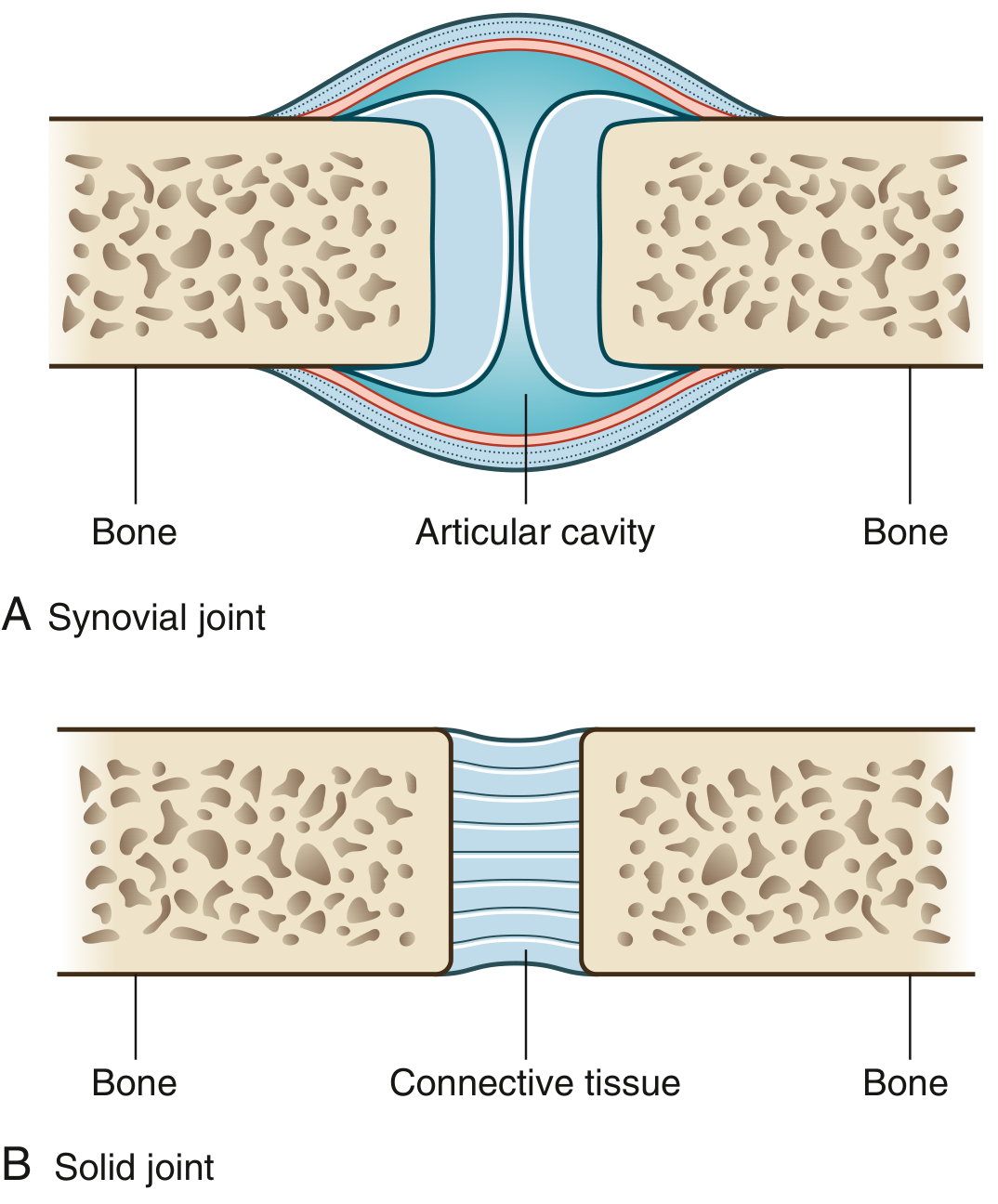
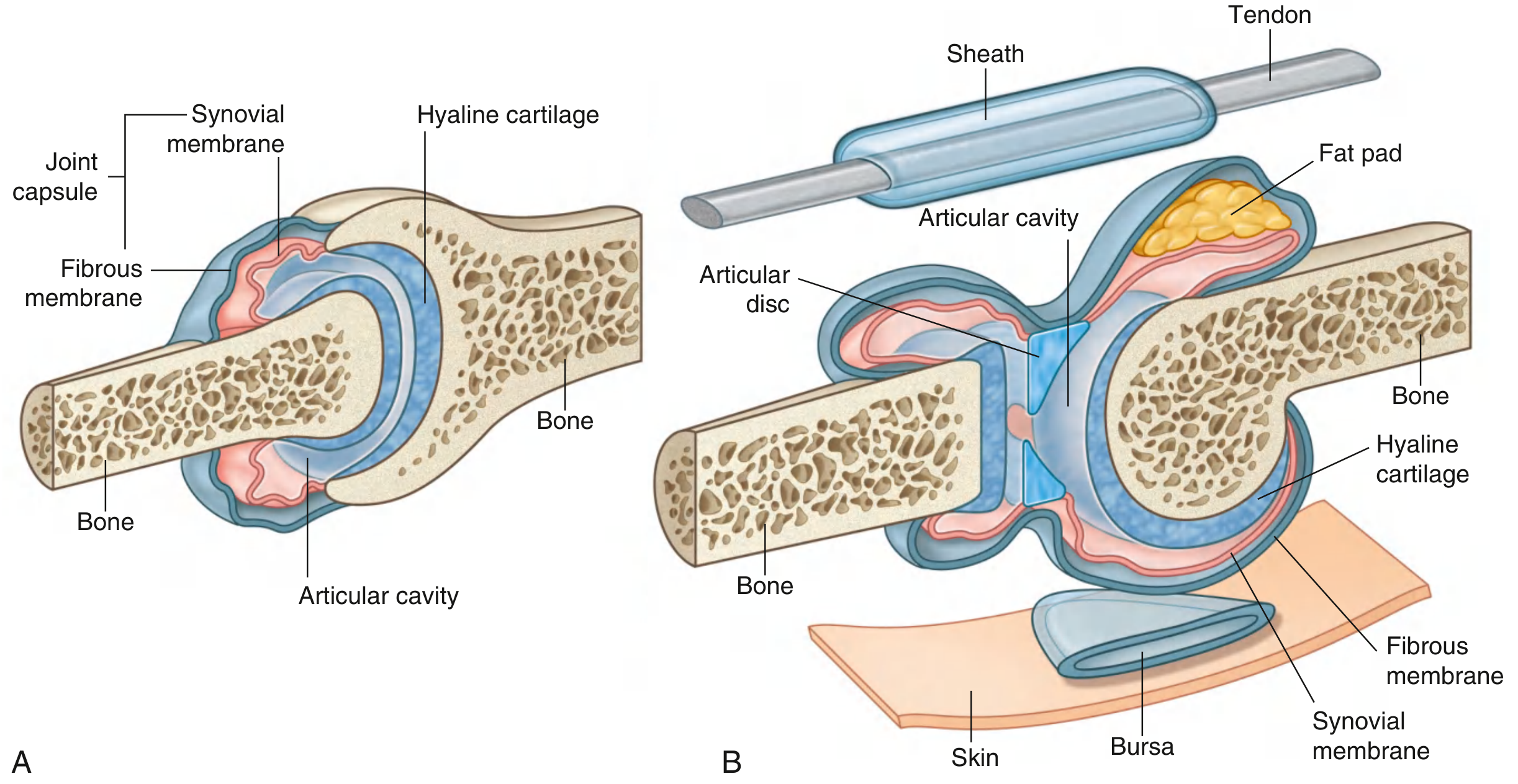
Synovial Joints (in detail)
These are the freely moving joints of the body. Key features:
- Hyaline cartilage caps the articulating bone surfaces (explains the apparent "gap" on plain X-ray)
- Joint capsule with two layers:
- Inner synovial membrane - highly vascular, produces synovial fluid for lubrication
- Outer fibrous membrane - dense connective tissue; thickens into ligaments
- Articular disc (fibrocartilage) - present in some joints (knee menisci, TMJ disc); absorbs compression and increases range of motion
- Fat pads - fill recesses and move in/out as joint shape changes
- Bursae - closed synovial sacs outside joints that reduce friction between tendons/bones
Synovial Joint Subtypes by Shape/Movement
| Type | Movements | Example |
|---|---|---|
| Plane (gliding) | Gliding only | Acromioclavicular, intercarpal |
| Hinge | Flexion/Extension only | Elbow (humeroulnar), ankle |
| Pivot | Rotation only | Atlantoaxial, proximal radioulnar |
| Condylar (ellipsoid) | Flex/Ext + Abd/Add | Wrist (radiocarpal), MCP joints |
| Saddle | Biaxial, opposing concave/convex surfaces | 1st carpometacarpal (thumb) |
| Ball-and-socket | Multiaxial (all movements) | Hip, shoulder (glenohumeral) |
Solid Joints
| Subtype | Held By | Example |
|---|---|---|
| Suture | Fibrous tissue | Skull sutures |
| Gomphosis | Periodontal ligament | Teeth in sockets |
| Syndesmosis | Interosseous ligament | Distal tibiofibular joint |
| Synchondrosis | Hyaline cartilage | Epiphyseal growth plates |
| Symphysis | Fibrocartilage | Pubic symphysis, intervertebral discs |
Clinical note - Osteoarthritis: The most common joint disease. Hyaline cartilage loses water and proteoglycan content, becoming fragile. Progressive cartilage loss exposes subchondral bone, leading to cyst formation and osteophytes (bony spurs). Affects weight-bearing joints most. - Gray's Anatomy for Students
4. Muscles
Three Types of Muscle Tissue
| Type | Control | Location | Key Feature |
|---|---|---|---|
| Skeletal muscle | Voluntary | Attached to skeleton | Striated, multinucleated, fast |
| Cardiac muscle | Involuntary | Heart wall | Striated, branched, intercalated discs |
| Smooth muscle | Involuntary | Vessel walls, gut, uterus | Non-striated, spindle-shaped |
Skeletal Muscle Structure (from outside in)
- Epimysium - fibrous sheath around the whole muscle
- Perimysium - surrounds bundles (fascicles) of fibers
- Endomysium - surrounds each individual muscle fiber
- Sarcomere - the functional contractile unit (Z-disc to Z-disc); contains actin (thin) and myosin (thick) filaments
Muscle Attachments
- Tendon - dense fibrous cord attaching muscle to bone (type I collagen); transmits pulling force
- Aponeurosis - flat fibrous sheet (e.g. abdominal muscles)
- Origin - the fixed, less-mobile attachment (usually proximal)
- Insertion - the moving attachment (usually distal)
Muscle Fiber Types
| Feature | Type I ("Slow-twitch") | Type II ("Fast-twitch") |
|---|---|---|
| Speed | Slow (~100 ms twitch) | Fast (~30 ms twitch) |
| Metabolism | Aerobic / oxidative | Anaerobic / glycolytic |
| Fatigue | Slow to fatigue | Fatigues quickly |
| Myoglobin | Rich (red) | Sparse (white) |
| Mitochondria | Abundant | Few |
| Motor unit size | Large | Small |
| Main role | Posture, endurance | Power, speed |
| Found in | Intercostals, trapezius, soleus | Quadriceps, biceps brachii |
| Athlete type | Long-distance runners, cyclists | Sprinters, weight lifters |
- THIEME Atlas of General Anatomy and Musculoskeletal System
Muscle Architecture
- Parallel (fusiform) - fibers run along the line of pull; good range of motion (e.g. biceps brachii)
- Pennate - fibers run obliquely to the tendon; fibers acting in parallel sum their forces, so pennate muscles generate more force over a shorter range
- Unipennate - one side (e.g. flexor digitorum longus)
- Bipennate - both sides of a central tendon (e.g. rectus femoris)
- Multipennate - multiple directions (e.g. deltoid)
Muscle Blood Supply
At rest, skeletal muscle receives ~25% of cardiac output (5-10 mL/min/100 g). During exercise, blood flow can increase several-fold via vasodilation. Muscle has a dense capillary network within the endomysium, richer in slow-twitch than fast-twitch fibers.
- Imaging Anatomy, Bones, Joints, Vessels and Nerves / THIEME Atlas of General Anatomy
Sources:
- Gray's Anatomy for Students - Joints section
- Imaging Anatomy: Bones, Joints, Vessels and Nerves (THIEME) - Bones, Cartilage, Muscles
- General Anatomy and Musculoskeletal System - THIEME Atlas of Anatomy - Planes, Muscle fiber types
This is a shared conversation. Sign in to Orris to start your own chat.