
Beau line
Reading File
Searching for information on Beau's lines now.
search_medical_text
Beau lines nail transverse grooves causes
Harrison's Principles of Internal Medicine, Twenty First Edition
Page 1658
GradeResponse
GradeResponse
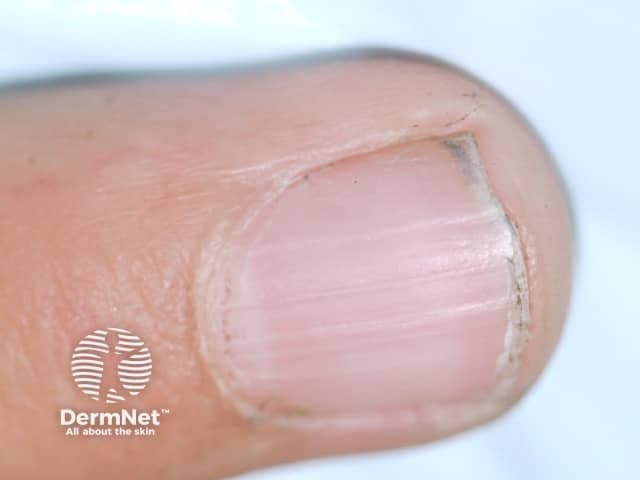
Beau's Lines
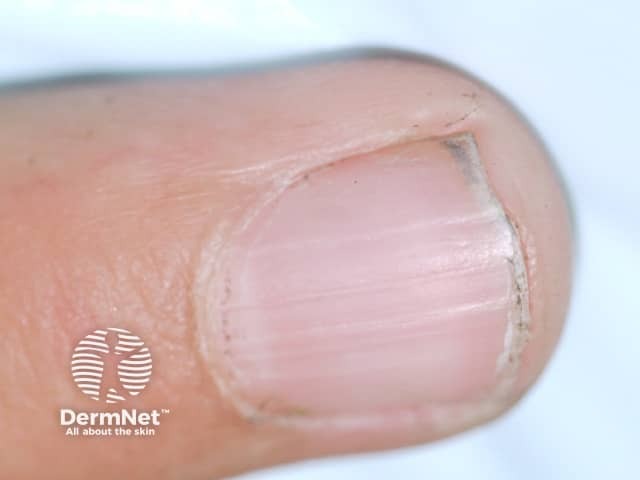
Beau's lines are transverse (horizontal) depressions or grooves that traverse the nail plate, representing a temporary interruption of nail matrix activity.
Pathophysiology
The nail matrix pauses or slows its keratinization in response to a systemic or local insult. As the nail grows out, a transverse groove becomes visible. The distance of the groove from the proximal nail fold can be used to estimate when the insult occurred (nails grow ~3 mm/month).
Causes
| Category | Examples |
|---|---|
| Systemic illness / febrile illness | High fever, severe infection, sepsis |
| Major physiologic stress | Major surgery, trauma, childbirth |
| Nutritional deficiencies | Zinc deficiency, malnutrition |
| Medications / chemotherapy | Drug-induced toxic effect on the matrix |
| Chronic systemic disease | Diabetes, peripheral vascular disease, renal failure |
| Local trauma | Repeated injury to the proximal nail fold |
Drug-induced Beau's lines typically involve all 20 nails and resolve over months after drug withdrawal (Harrison's, p. 1658).
Key Clinical Points
- All nails affected simultaneously → systemic cause
- Single nail or few nails → local trauma or isolated event
- Timing: the groove appears ~1–2 months after the precipitating event (based on nail growth rate)
- Differential: distinguish from true onychomadesis (proximal nail plate detachment), of which Beau's lines are considered a milder form
- No treatment is required for the lines themselves; management focuses on identifying and addressing the underlying cause
vs. Similar Nail Findings
| Feature | Beau's Lines | Mees' Lines | Muehrcke's Lines |
|---|---|---|---|
| Appearance | Transverse groove/depression | Transverse white bands (in plate) | Paired white bands (in bed) |
| Moves with nail growth | Yes | Yes | No |
| Cause | Systemic stress, drugs | Arsenic, other heavy metals | Hypoalbuminemia |
In view of psoriasis
search_medical_text
Beau lines psoriasis nail changes
Harrison's Principles of Internal Medicine, Twenty First Edition
Page 10188
GradeResponse
GradeResponse
Beau's Lines in the Context of Psoriasis
In psoriasis, Beau's lines arise from psoriatic involvement of the nail matrix — the same inflammatory process that drives other nail changes can periodically disrupt matrix keratinization, producing transverse grooves.
How Psoriasis Causes Beau's Lines
The nail matrix is the primary target of psoriatic inflammation. When inflammation is intermittent or fluctuating in severity, it causes episodic pauses in nail plate production, resulting in Beau's lines. This is distinct from the continuous, diffuse matrix involvement that produces pitting.
| Matrix zone affected | Resulting nail sign |
|---|---|
| Proximal matrix (intermittent) | Beau's lines (transverse groove) |
| Proximal matrix (diffuse) | Pitting (shallow punctate depressions) |
| Proximal matrix (severe/total) | Onychomadesis (nail shedding) |
| Distal matrix | Leukonychia |
| Nail bed | Onycholysis, oil-drop sign, subungual hyperkeratosis |
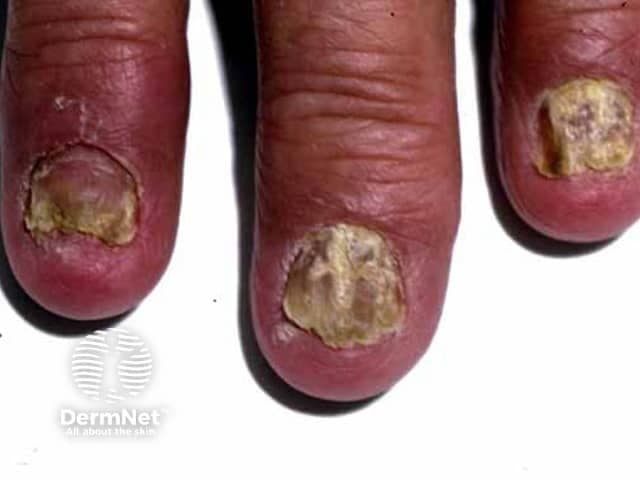
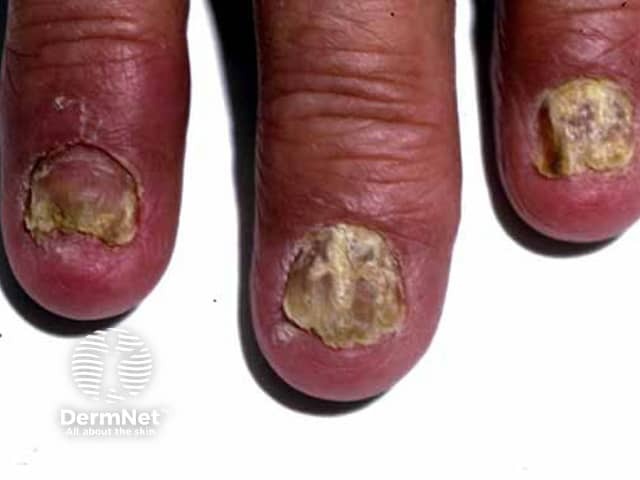
Full Spectrum of Psoriatic Nail Changes
- Pitting — most characteristic; shallow punctate depressions from proximal matrix disease
- Beau's lines — transverse grooves from episodic matrix inflammation
- Onychomadesis — complete proximal nail plate separation (severe matrix disease)
- Onycholysis — distal nail plate detachment (nail bed disease)
- Oil-drop / salmon patch sign — yellow-pink subungual discoloration; highly specific for psoriasis
- Subungual hyperkeratosis — thickening under the free edge
- Leukonychia — white discoloration of the nail plate
- Crumbling/dystrophy — advanced destruction of the plate
Clinical Significance
- Nail involvement occurs in ~50% of psoriatic patients and up to 80–90% of those with psoriatic arthritis (PsA) (Harrison's, p. 10188)
- Beau's lines in a psoriatic patient may signal a flare of disease activity — the timing of the groove from the cuticle estimates when the flare occurred
- Nail psoriasis is an independent risk factor for PsA — its presence should prompt screening for joint involvement
- Severe nail matrix disease (Beau's lines, onychomadesis) correlates with more active systemic inflammation
Differential for Beau's Lines in a Psoriatic Patient
Even in a known psoriatic, other causes must be considered:
- Concurrent systemic illness or febrile episode
- Drug effect (e.g., methotrexate, biologics can rarely affect the matrix)
- Trauma (isolated nail)
- Psoriatic flare (most likely if multiple nails involved simultaneously, in the setting of worsening skin disease)
This is a shared conversation. Sign in to Orris to start your own chat.