
Microscopic structure of liver histology 5m answer
I'll read the medical library skill first, then search for liver histology content.
Reading File
Now let me search the library for liver histology content in parallel:
Finding Sources
Finding Sources
Excellent finds. Let me read the most relevant sections in parallel:
Reading File
Reading File
Reading File
The third file (Yamada's block2) has the dedicated histology chapter. Let me read the "Histology" section (line 161 in the TOC) more deeply:
Reading File
Excellent content. Let me continue reading for more cell types and structural details, and also fetch the key histology diagram:
Reading File
Loading Image
I now have comprehensive content. Let me also read the sinusoidal cells section (Kupffer cells, stellate cells, etc.):
Reading File
I now have all the content needed for a thorough 5-mark answer. Let me compose the full structured response.
Microscopic Structure of the Liver
Yamada's Textbook of Gastroenterology, 7th ed.; Sleisenger & Fordtran's GI and Liver Disease
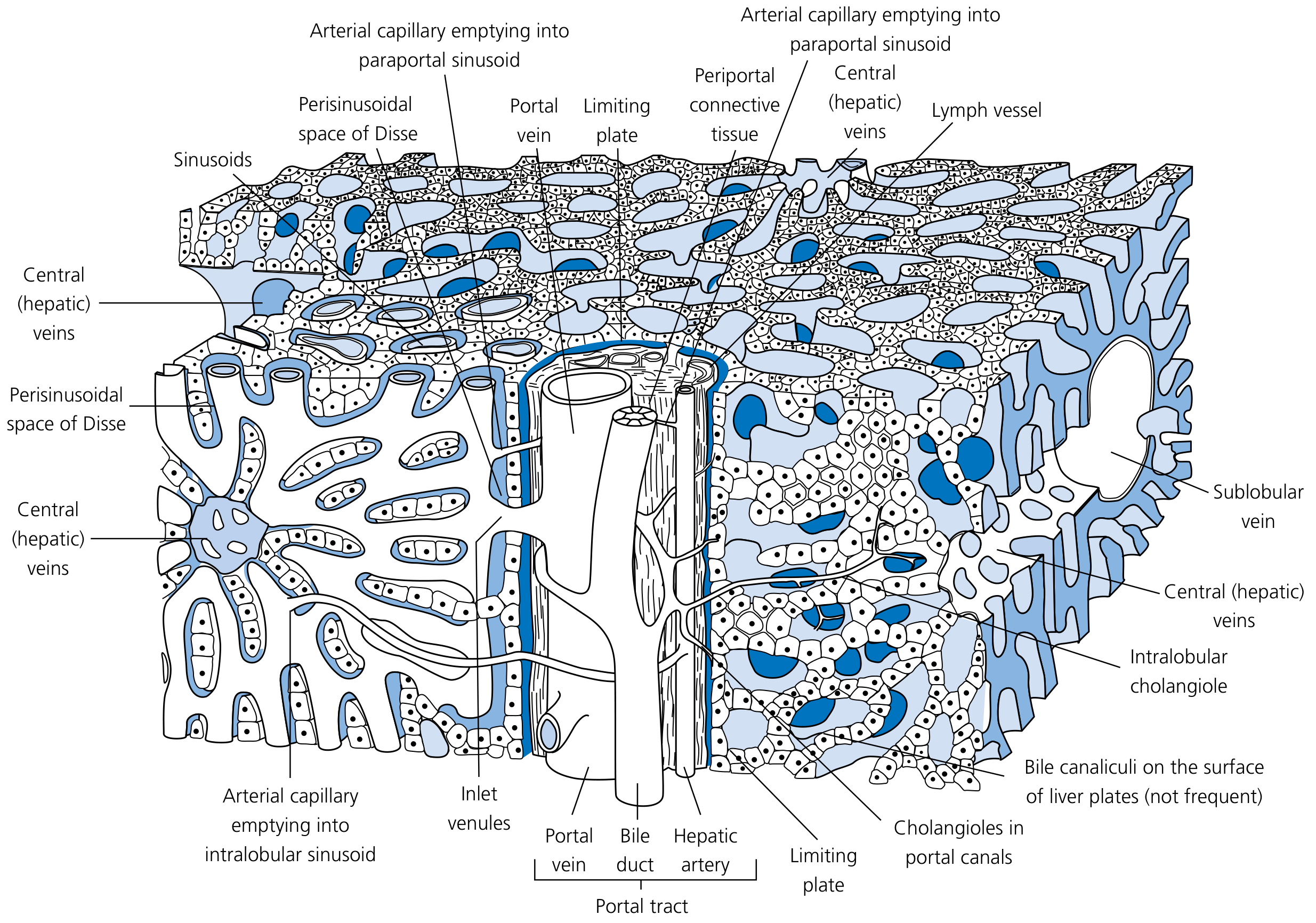
1. Hepatic Lobule - Structural Models
Two models describe the liver's microscopic organization:
Classic (Hexagonal) Lobule
- A hexagonal unit centered on a central vein (terminal hepatic venule), surrounded by six peripheral portal tracts at each corner.
- Hepatocyte plates radiate from the central vein toward the portal triads.
Rappaport Acinus (functional model)
- Based on blood supply; centers on the portal tract.
- Divided into three zones based on oxygen gradient:
- Zone 1 (periportal) - best oxygenated; first to receive portal blood; resistant to ischemia; first affected in viral hepatitis.
- Zone 2 (mid-zonal) - intermediate.
- Zone 3 (centrilobular/perivenular) - least oxygenated; most susceptible to ischemic/toxic injury; highest cytochrome P450 activity; first to show centrilobular necrosis in CCl4 toxicity or right heart failure.
2. Portal Tract (Portal Triad)
Each portal tract contains three structures - the "portal triad":
- Portal venule - largest of the three; ~3x the diameter of the arteriole or bile duct
- Hepatic arteriole - approximately the same caliber as the bile duct (useful diagnostically)
- Interlobular bile duct - lined by a single layer of cuboidal cells; contains cytokeratins 7 and 19
The portal tract is surrounded by a limiting plate - the interface between portal connective tissue and the hepatic parenchyma. Inflammatory cells crossing this plate produce "interface hepatitis."
3. Parenchyma - Hepatocytes
Hepatocytes make up ~80% of liver cells. Key features:
- Arranged in cords (trabeculae) 1-2 cells thick in adults, each flanked by sinusoids on both sides
- Nucleus: centrally placed, round, ~10 µm, with clumped chromatin and prominent nucleoli; binucleate forms seen in zone 3 of elderly
- Cytoplasm: contains abundant organelles:
- ~2200 mitochondria per hepatocyte (larger in zone 3, more numerous in zone 1)
- Rough ER - protein synthesis (albumin, coagulation factors)
- Smooth ER - fatty acid metabolism, drug detoxification via cytochrome P450 (highest in zone 3)
- Golgi apparatus - glycoprotein and lipoprotein processing
- Bile canaliculi: grooves (hemicanaliculi) between adjacent hepatocytes fuse to form canaliculi; surrounded by actin microfilaments enabling peristaltic bile propulsion; visible on scanning EM
4. Sinusoids and Space of Disse
- Sinusoids are wide, irregular vascular channels that carry mixed portal and arterial blood from the portal tracts toward the central vein.
- Lined by discontinuous, fenestrated endothelial cells (no basement membrane), allowing direct plasma-hepatocyte contact.
- The Space of Disse lies between the sinusoidal endothelium and the hepatocyte surface. It contains:
- Plasma (not blood cells)
- Reticulin fibers (type III collagen) maintaining the lobular framework
- Hepatic stellate cells (Ito cells/fat-storing cells) in a resting state
5. Sinusoidal Cell Types
| Cell Type | Location | Function |
|---|---|---|
| Kupffer cells | Lining sinusoids | Resident macrophages; phagocytosis of debris, bacteria, endotoxins |
| Hepatic stellate cells (Ito cells) | Space of Disse | Store vitamin A (lipid droplets) in resting state; activated → myofibroblasts → collagen synthesis → fibrosis |
| Pit cells | Sinusoid lumen | Large granular lymphocytes; liver-specific NK cells |
| Sinusoidal endothelial cells | Sinusoid lining | Fenestrated, no basal lamina; facilitate exchange |
6. Biliary Network
Bile flows counter to blood flow, from hepatocytes outward toward portal tracts:
- Bile canaliculi - between hepatocyte surfaces (not a separate structure)
- Canals of Hering - near the limiting plate; lined partly by hepatocytes and partly by biliary epithelium; serve as the hepatic stem cell niche
- Terminal bile ductules (cholangioles)
- Interlobular bile ducts in portal tracts (15-20 µm diameter; cuboidal epithelium; CK7/CK19 positive)
7. Stroma (Extracellular Matrix)
- Glisson capsule: dense hypocellular collagen encapsulating the entire liver; extends into portal tracts
- Reticulin framework (types I and III collagen > 95% of total): demonstrated by reticulin stain - useful for detecting architectural distortion in pathology
- Type IV collagen, laminin, fibronectin, and elastin complete the matrix
Key clinical correlations for exam:
- Zone 3 necrosis: ischemia, paracetamol toxicity, CCl4
- Zone 1 necrosis: phosphorus poisoning, eclampsia
- Interface hepatitis (breach of limiting plate): autoimmune hepatitis, chronic viral hepatitis
- Stellate cell activation: key step in hepatic fibrosis/cirrhosis
- Canals of Hering: site of hepatic progenitor cells; proliferate in ductular reaction
Sources: Yamada's Textbook of Gastroenterology, 7th ed. (pp. 239-244); Sleisenger & Fordtran's GI and Liver Disease
This is a shared conversation. Sign in to Orris to start your own chat.