
Ceramics in hip arthroplasty
Reading File
Ceramics in hip arthroplasty involve the use of alumina, zirconia, or composite ceramic materials for femoral heads and acetabular liners, offering excellent hardness, low friction, and resistance to wear - key advantages over metal-on-metal or metal-on-polyethylene bearings.
Searching sources...
Finding Sources
Searching PubMed
ceramic bearing hip arthroplasty
Finding Sources
Finding Sources
Reading Article
PMID: 39346065
Good - I found content in both Campbell's Operative Orthopaedics and Schwartz's Surgery. Let me read both sections now.
Reading File
Reading File
I found the image of a failed ceramic hip component. Now let me get the main Campbell's section on biomaterials/bearings for ceramics in depth.
Finding Sources
Loading Image
Excellent - found Miller's Review of Orthopaedics with implant material data. Let me now read that section and also the Campbell's biomaterials section for ceramics.
Reading File
Finding Sources
Reading File
Reading File
I found the excellent Miller's CoC section. Let me continue reading it and also get the stiffness/friction tables.
Reading File
Reading File
I now have sufficient content from multiple authoritative textbooks. Let me also fetch the ceramic fracture/stripe line image for completeness.
Loading Image
Reading File
I now have comprehensive data from three authoritative textbooks. Let me compile the full answer.
Ceramics in Hip Arthroplasty
Overview
Ceramics are used in total hip arthroplasty (THA) primarily as femoral head and/or acetabular liner (cup) material, forming either a ceramic-on-ceramic (CoC) or ceramic-on-polyethylene (CoP) bearing couple. They offer the lowest friction and wear of any current bearing surface combination.
Types of Ceramic Materials
Modern ceramic implants are based on aluminium oxide (alumina, Al₂O₃), zirconia (ZrO₂), or composite formulations:
| Implant Material | Young's Modulus (Stiffness) |
|---|---|
| Alumina ceramic (Al₂O₃) | Highest |
| Zirconia-reinforced alumina ceramic | Very high |
| Zirconia ceramic | Very high |
| Cobalt-chrome alloy | High |
| Stainless steel | Moderate-high |
| Titanium alloy | Moderate |
| Cortical bone | Low-moderate |
| UHMWPE (polyethylene) | Low |
| Cancellous bone / tendon | Lowest |
Alumina is the stiffest of all hip implant materials. This very high stiffness is responsible for both its low wear (hardness) and its brittleness (fracture risk).
- Miller's Review of Orthopaedics 9th Ed., Table 5.5
Bearing Friction
Alumina-on-alumina (CoC) has one of the lowest coefficients of friction of any bearing pair, surpassed only by native articular cartilage and, notably, ice-on-ice in some lab conditions:
| Bearing Couple | Coefficient of Friction |
|---|---|
| Articular cartilage | Lowest |
| Al₂O₃ on Al₂O₃ (CoC) | Very low |
| Cobalt-chrome on cobalt-chrome (MoM) | Low |
| Metal on polyethylene | Moderate |
- Miller's Review of Orthopaedics 9th Ed., Table 5.6
Generations of Ceramic Bearings
First-Generation Alumina
- Head fracture rate up to 13.4%
- Reasons: thick neck/skirt design leading to adverse head-neck ratio; coarse microstructure; low ceramic density; poor manufacturing technique; neck impingement was the dominant failure mode.
Third-Generation (Current Standard)
- Hot isostatic pressing (HIP) technique
- High ceramic density + fine microstructure
- Elimination of the skirt → improved head-neck ratio
- Fracture rates dramatically reduced
Modern Alumina Matrix Composite (AMC)
- Zirconia-reinforced alumina composites (e.g., BIOLOX delta)
- Very low reported fracture rates
- Used in both femoral heads and acetabular liners
Advantages of Ceramic Bearings
- Lowest wear rate - less linear and volumetric wear than metal-on-metal (MoM)
- Fewer particles generated compared to MoM
- Bioinert debris - no ionization of particles; no cancer risk; no dysplasia or metaplastic effects on local soft tissues
- No metal ion release - avoids the pseudotumors, solid-organ metal deposits, and hypersensitivity reactions seen with MoM
- Osteolysis reduction - biocompatible particles are less osteolytic than polyethylene or metal debris
- Miller's Review of Orthopaedics 9th Ed., Section: Ceramic-on-Ceramic Bearing
- Schwartz's Principles of Surgery 11th Ed., p. 1935
Disadvantages and Complications
1. Hip Squeaking
Reported in up to 10% of patients with CoC bearings. The mechanism is a "perfect storm" of:
- Implant malpositioning
- Lever-range wear
- Stripe line formation (arcuate roughened area on head/cup from repetitive subclinical subluxation - see diagram below)
- Implant resonance - vibratory resonance from lever range over the rough stripe amplified by the prosthetic construct to an audible frequency
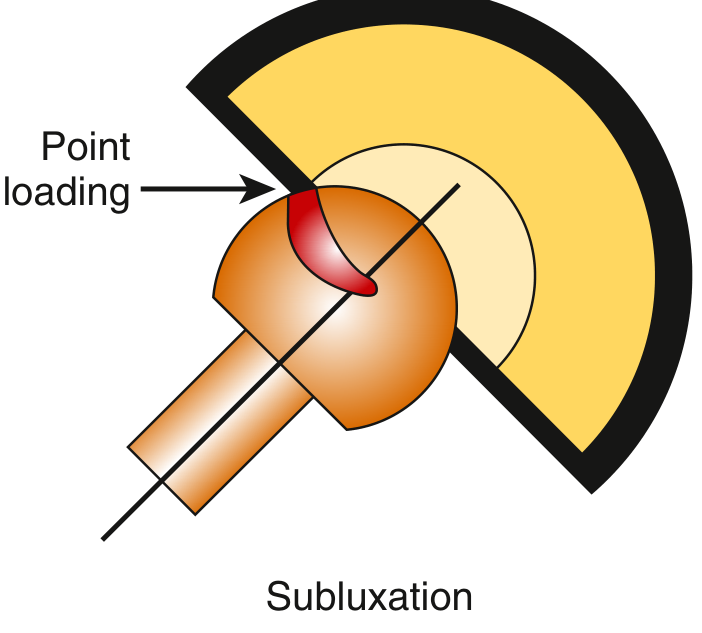
Stripe line: with repetitive subclinical subluxation, the prosthetic head rotates upon the cup edge under high contact stress, roughening the articular surface and disrupting lubrication. (Miller's Review of Orthopaedics, Fig. 5.42)
Treatment: Revision to a ceramic or metal head with a polyethylene liner (cup revision). The ceramic head is damaged by squeaking and must be changed.
2. Fracture
- Due to low fracture toughness (brittleness despite hardness)
- Treatment: Replace with another CoC bearing. Important: microscopic ceramic shards remain after fracture and are severely abrasive; if polyethylene is used instead after ceramic fracture, highly cross-linked polyethylene (HCLPE) is preferred over conventional PE to resist abrasive wear by residual ceramic debris.
- Modern AMC ceramics have very low fracture rates.
3. Head Size Limitation
- The ceramic liner must maintain minimum thickness within the metal shell, limiting achievable femoral head diameter
- Smaller heads = less stability and less optimal fluid film lubrication compared to large-diameter MoM bearings
4. Head Length Limitation
- No skirts allowed on modern ceramic heads (to maintain head-neck ratio)
- This can restrict hip offset options, potentially contributing to hip impingement or instability
5. Head Change on a Used Femoral Neck
-
Any ceramic head placed on a previously used (roughened) femoral neck requires an internal titanium adapter sleeve
-
A used neck is roughened by wear and corrosion; high-point contact from the roughened surface can cause burst fracture of a new ceramic head with repetitive loading
-
Miller's Review of Orthopaedics 9th Ed., Section: Ceramic-on-Ceramic Bearing, pp. 446-447
Ceramic-on-Ceramic vs. Ceramic-on-Polyethylene
Below is the failed ceramic-on-metal bearing for reference - note the metallic staining on the ceramic femoral head from third-body wear:
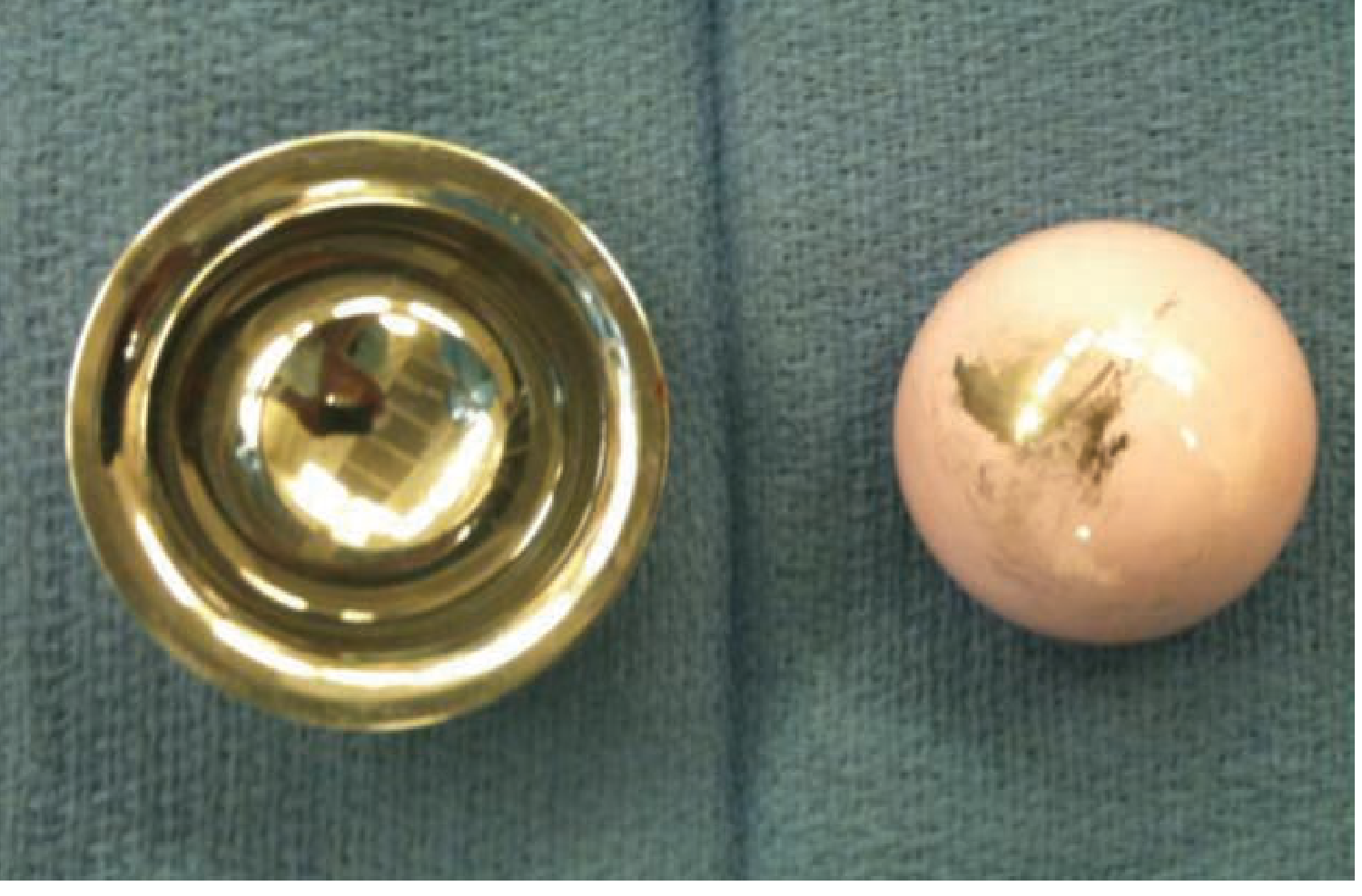
Failed ceramic-on-metal arthroplasty. The ceramic femoral head shows metallic staining from the metal acetabular component. (Schwartz's Principles of Surgery, Fig. 43-38)
A 2024 meta-analysis (Wu et al., PMID 39346065) including 1,946 patients found:
- No significant difference in dislocation, DVT, infection, wear debris/osteolysis, or revision rates between CoC and CoP
- Postoperative Harris Hip Score was higher in the CoC group, though evidence quality is moderate
- CoC is more commonly chosen for younger, healthier, more active patients
- Large multicentre trials with >15 years follow-up are still needed
Clinical Decision-Making Summary
| Feature | CoC | CoP (ceramic head + PE liner) |
|---|---|---|
| Wear rate | Lowest | Low (HCLPE similar medium-term) |
| Debris biocompatibility | Bioinert | PE particles - osteolytic |
| Fracture risk | Present (low with modern AMC) | Head: very low |
| Squeaking | Up to 10% | Not a concern |
| Stability (head size) | Limited by liner thickness | Larger heads easier |
| Typical patient | Young, active | Older, less active |
Metal-on-metal (MoM) bearings have largely been abandoned in THA due to metal ion deposition in solid organs, pseudotumor formation, and early failure risk. Ceramic bearings are the preferred hard-on-hard option when a hard bearing is desired.
- Schwartz's Principles of Surgery 11th Ed., p. 1935
- Campbell's Operative Orthopaedics 15th Ed. 2026, Bearings section
This is a shared conversation. Sign in to Orris to start your own chat.