
Life, Health and Disease 1. Introduction Life, health, and disease are fundamental concepts in Homoeopathy. Hahnemann considered life as the vital principle governing the body. Disease is viewed as an alteration of the vital force rather than merely structural changes. 2. Definition of Life Life is an invisible, intelligent, individual, and dynamic power. It controls all activities of the living organism. It maintains the individuality and functioning of the body. 3. Definition of Health Health is the balanced condition of the living organism. All organs and systems function harmoniously. It promotes normal growth, development, and preservation of life. 4. Definition of Disease Disease is an abnormal vital process. It is a changed condition of life. It disturbs normal body functions and may lead to tissue damage if unchecked. 5. Centre to Circumference Principle Power originates from the centre. Development and function proceed from the centre to the periphery. Cells develop from the nucleus outward. Vital force acts from within outward. 5. Disease and Cure Disease first affects the internal life principle. External signs appear through the nervous system. Cure begins at the centre and progresses outward. Symptoms disappear from above downward and in the reverse order of appearance. 6. Vital Resistance The living organism possesses natural resistance. It protects against harmful agents and disease-producing factors. This resistance follows the instinct of self-preservation. 7. Nature of Disease Homoeopathy has both a theory of disease and a theory of cure. Disease is considered "life under altered conditions." Disease begins as a dynamic disturbance before structural changes occur. 8. Hahnemann's Concept Health depends on the normal state of the vital force. Disease is an alteration of vital sensations and functions. Material changes occur secondarily after the dynamic disturbance. 9. Homoeopathy and Bacteriology Koch’s findings Koch isolated a comma-shaped, curved bacillus from the intestines and stools of cholera patients. He demonstrated that this organism was consistently associated with cholera cases. His work provided strong evidence supporting the germ theory of disease and established Vibrio cholerae as the causative agent of cholera. Koch held that specific bacteria are the specific causes of specific infectious diseases, and he formulated Koch’s postulates to establish a causal relationship between a microorganism and a disease. Rudolf Virchow is often associated with cellular pathology, but his views on bacteriology were more cautious and somewhat opposed to the emerging germ theory in its early years. Virchow’s idea on bacteriology Virchow did not deny the existence of bacteria, but he believed that bacteria were not the primary cause of disease in most cases. His main views were: Disease originates from abnormalities in the body’s own cells (cellular pathology), not primarily from invading microorganisms. Bacteria may appear in diseased tissues secondarily, taking advantage of tissues that are already damaged. The host’s condition, nutrition, environment, and social factors play a major role in the development of disease. He emphasized public health, sanitation, poverty, overcrowding, and nutrition as important determinants of disease. Hahnemann’s point of view in relation to bacteriology Disease is not caused primarily by material agents such as bacteria, but by a dynamic disturbance of the vital force (vital principle). External agents, including contagious or infectious influences, can excite disease only when the individual is susceptible. Susceptibility is the essential factor; different people exposed to the same infection may not all become ill. Microorganisms may be considered secondary or exciting causes, while the underlying susceptibility or miasmatic state determines whether disease develops. Treatment should be directed toward restoring the disturbed vital force with a similar remedy, not merely destroying the microorganism. 10.Cause and Effect in Disease Differentiate between cause and effect. Germs alone are not considered the absolute cause. Disease depends on the condition of the living organism and other contributing factors. 11.Conclusion According to the uploaded notes, life is governed by the vital principle, health is the harmonious functioning of that principle, and disease is its dynamic disturbance. Cure starts from the centre and proceeds outward, restoring normal health.
Life, Health and Disease — Homoeopathic Perspective
1. Introduction
2. Definition of Life
- Life is an invisible, intelligent, individual, and dynamic power.
- It controls all activities of the living organism.
- It maintains individuality and functional integrity of the body.
3. Definition of Health
- Health is the balanced condition of the living organism.
- All organs and systems function harmoniously.
- It promotes normal growth, development, and preservation of life.
4. Definition of Disease
- Disease is an abnormal vital process — a changed condition of life.
- It disturbs normal body functions.
- If unchecked, it may progress to tissue damage (structural changes).
5. Centre to Circumference Principle
| Level | Direction |
|---|---|
| Power | Originates from the centre |
| Development | Proceeds centre → periphery |
| Cell biology | Cells develop from the nucleus outward |
| Vital force | Acts from within outward |
6. Disease and Cure
- Disease first affects the internal life principle; external signs appear through the nervous system.
- Cure begins at the centre and progresses outward.
- Symptoms disappear:
- From above downward
- In the reverse order of appearance (Hering's Law of Cure)
7. Vital Resistance
- The living organism possesses natural resistance.
- Protects against harmful agents and disease-producing factors.
- This resistance follows the instinct of self-preservation.
8. Nature of Disease
- Disease is "life under altered conditions."
- Begins as a dynamic disturbance before any structural changes occur.
- Homoeopathy holds both a theory of disease and a theory of cure.
9. Hahnemann's Concept of Disease
- Health depends on the normal state of the vital force.
- Disease = alteration of vital sensations and functions.
- Material/structural changes are secondary — they follow the dynamic disturbance.
10. Homoeopathy and Bacteriology — Comparative Views
Koch's Findings
- Isolated a comma-shaped curved bacillus (Vibrio cholerae) from cholera patients.
- Demonstrated consistent association between organism and disease.
- Established the germ theory of disease via Koch's Postulates — a causal relationship between a microorganism and a specific disease.
Virchow's View on Bacteriology
- Founder of cellular pathology — disease originates from abnormalities in the body's own cells.
- Did not deny bacteria, but believed they were not the primary cause of disease.
- Key positions:
- Bacteria appear secondarily in already-damaged tissues.
- Host condition, nutrition, environment, and social factors are primary determinants.
- Emphasized public health, sanitation, poverty, and nutrition as major factors.
Hahnemann's View in Relation to Bacteriology
| Aspect | Hahnemann's Position |
|---|---|
| Primary cause | Dynamic disturbance of the vital force |
| Role of bacteria | Secondary / exciting cause only |
| Key factor | Susceptibility of the host |
| Why not everyone falls ill | Individual susceptibility and miasmatic state vary |
| Treatment aim | Restore the disturbed vital force — not destroy the microorganism |
"Bacteria may excite disease only when the individual is susceptible."
11. Cause and Effect in Disease
- Homoeopathy distinguishes between cause and effect.
- Germs alone are not considered the absolute cause.
- Disease depends on:
- The condition of the living organism
- Contributing environmental and miasmatic factors
- The individual's susceptibility
12. Conclusion
- Life is governed by the vital principle.
- Health is the harmonious functioning of that principle.
- Disease is its dynamic disturbance.
- Cure starts from the centre and proceeds outward, restoring normal health - following Hering's Law of Cure.
Make a ppt
mkdir -p /tmp/workspace/homoeopathy-ppt
~/homoeopathy-ppt/create_ppt.py
from pptx import Presentation
from pptx.util import Inches, Pt, Emu
from pptx.dml.color import RGBColor
from pptx.enum.text import PP_ALIGN, MSO_ANCHOR
from pptx.util import Inches, Pt
import copy

prs = Presentation()
prs.slide_width = Inches(13.333)
prs.slide_height = Inches(7.5)

blank = prs.slide_layouts[6]

# ── Color palette ──────────────────────────────────────────────
DARK_BLUE    = RGBColor(0x1A, 0x37, 0x6C)   # deep navy
MID_BLUE     = RGBColor(0x2E, 0x6D, 0xA4)   # mid blue
TEAL         = RGBColor(0x0D, 0x7D, 0x8E)   # teal accent
GOLD         = RGBColor(0xC9, 0xA0, 0x2F)   # gold accent
WHITE        = RGBColor(0xFF, 0xFF, 0xFF)
LIGHT_GRAY   = RGBColor(0xF4, 0xF6, 0xF9)
MID_GRAY     = RGBColor(0x8A, 0x99, 0xAA)
DARK_GRAY    = RGBColor(0x2D, 0x2D, 0x2D)

# ── Helper functions ────────────────────────────────────────────

def add_rect(slide, x, y, w, h, fill_color, alpha=None):
    shape = slide.shapes.add_shape(
        1,  # MSO_SHAPE_TYPE.RECTANGLE
        Inches(x), Inches(y), Inches(w), Inches(h)
    )
    shape.line.fill.background()
    shape.fill.solid()
    shape.fill.fore_color.rgb = fill_color
    return shape

def add_textbox(slide, x, y, w, h, text, font_size, font_color=WHITE,
                bold=False, italic=False, align=PP_ALIGN.LEFT,
                v_anchor=MSO_ANCHOR.TOP, word_wrap=True, font_name="Calibri"):
    tb = slide.shapes.add_textbox(Inches(x), Inches(y), Inches(w), Inches(h))
    tf = tb.text_frame
    tf.word_wrap = word_wrap
    tf.vertical_anchor = v_anchor
    tf.margin_left = Pt(4)
    tf.margin_right = Pt(4)
    tf.margin_top = Pt(2)
    tf.margin_bottom = Pt(2)
    p = tf.paragraphs[0]
    p.alignment = align
    run = p.add_run()
    run.text = text
    run.font.size = Pt(font_size)
    run.font.color.rgb = font_color
    run.font.bold = bold
    run.font.italic = italic
    run.font.name = font_name
    return tb

def add_bullet_textbox(slide, x, y, w, h, bullets, font_size=16,
                       font_color=DARK_GRAY, bold_first=False,
                       line_spacing=1.2, font_name="Calibri"):
    from pptx.oxml.ns import qn
    from lxml import etree
    tb = slide.shapes.add_textbox(Inches(x), Inches(y), Inches(w), Inches(h))
    tf = tb.text_frame
    tf.word_wrap = True
    tf.margin_left = Pt(4)
    tf.margin_right = Pt(4)
    tf.margin_top = Pt(2)
    tf.margin_bottom = Pt(2)
    for i, bullet in enumerate(bullets):
        if i == 0:
            p = tf.paragraphs[0]
        else:
            p = tf.add_paragraph()
        p.space_before = Pt(3)
        run = p.add_run()
        run.text = bullet
        run.font.size = Pt(font_size)
        run.font.color.rgb = font_color
        run.font.bold = (bold_first and i == 0)
        run.font.name = font_name
    return tb

# ══════════════════════════════════════════════════════════════════
# SLIDE 1 — Title Slide
# ══════════════════════════════════════════════════════════════════
slide = prs.slides.add_slide(blank)

# Background
add_rect(slide, 0, 0, 13.333, 7.5, DARK_BLUE)

# Decorative top bar
add_rect(slide, 0, 0, 13.333, 0.12, GOLD)

# Side accent bar
add_rect(slide, 0, 0, 0.5, 7.5, MID_BLUE)

# Diagonal decorative block (bottom right)
add_rect(slide, 9.5, 5.5, 3.9, 2.1, MID_BLUE)
add_rect(slide, 10.0, 5.9, 3.4, 1.6, TEAL)

# Main title
add_textbox(slide, 0.9, 1.5, 9.5, 1.6,
            "Life, Health and Disease", 48,
            font_color=WHITE, bold=True, align=PP_ALIGN.LEFT,
            v_anchor=MSO_ANCHOR.MIDDLE, font_name="Calibri Light")

# Subtitle
add_textbox(slide, 0.9, 3.2, 9.0, 0.7,
            "A Homoeopathic Perspective", 24,
            font_color=GOLD, bold=False, align=PP_ALIGN.LEFT,
            font_name="Calibri")

# Tagline
add_textbox(slide, 0.9, 4.0, 9.0, 0.5,
            "Vital Force · Dynamic Disturbance · Centre to Circumference", 14,
            font_color=MID_GRAY, italic=True, align=PP_ALIGN.LEFT,
            font_name="Calibri")

# Bottom bar
add_rect(slide, 0, 7.1, 13.333, 0.4, TEAL)
add_textbox(slide, 0.5, 7.1, 12.0, 0.4,
            "Based on Hahnemannian Philosophy  |  Homoeopathic Organon", 11,
            font_color=WHITE, align=PP_ALIGN.CENTER, v_anchor=MSO_ANCHOR.MIDDLE)

# ══════════════════════════════════════════════════════════════════
# SLIDE 2 — Introduction
# ══════════════════════════════════════════════════════════════════
slide = prs.slides.add_slide(blank)
add_rect(slide, 0, 0, 13.333, 7.5, LIGHT_GRAY)
add_rect(slide, 0, 0, 13.333, 1.2, DARK_BLUE)
add_rect(slide, 0, 0, 13.333, 0.08, GOLD)
add_rect(slide, 0, 7.1, 13.333, 0.4, TEAL)

add_textbox(slide, 0.4, 0.15, 12.0, 0.9, "Introduction", 32,
            font_color=WHITE, bold=True, v_anchor=MSO_ANCHOR.MIDDLE,
            font_name="Calibri Light")

bullets = [
    "• Life, health, and disease are fundamental concepts in Homoeopathy.",
    "• Hahnemann considered life as the vital principle governing the body.",
    "• Disease is viewed as an alteration of the vital force — not merely structural changes.",
    "• Homoeopathy approaches disease from a dynamic, individualised perspective.",
    "• The vital force is the connecting link between life, health, and disease.",
]
add_bullet_textbox(slide, 0.8, 1.4, 11.6, 5.4, bullets, font_size=18,
                   font_color=DARK_GRAY)
add_textbox(slide, 0.5, 7.1, 12.0, 0.4, "Life, Health and Disease — Homoeopathic Philosophy", 11,
            font_color=WHITE, align=PP_ALIGN.CENTER, v_anchor=MSO_ANCHOR.MIDDLE)

# ══════════════════════════════════════════════════════════════════
# SLIDE 3 — Definitions: Life, Health, Disease
# ══════════════════════════════════════════════════════════════════
slide = prs.slides.add_slide(blank)
add_rect(slide, 0, 0, 13.333, 7.5, LIGHT_GRAY)
add_rect(slide, 0, 0, 13.333, 1.2, DARK_BLUE)
add_rect(slide, 0, 0, 13.333, 0.08, GOLD)
add_rect(slide, 0, 7.1, 13.333, 0.4, TEAL)

add_textbox(slide, 0.4, 0.15, 12.0, 0.9, "Definitions: Life, Health & Disease", 32,
            font_color=WHITE, bold=True, v_anchor=MSO_ANCHOR.MIDDLE,
            font_name="Calibri Light")

# Three cards
card_data = [
    ("LIFE", MID_BLUE, [
        "Invisible, intelligent, individual,",
        "and dynamic power",
        "",
        "Controls all activities of the",
        "living organism",
        "",
        "Maintains individuality and",
        "functional integrity of the body",
    ]),
    ("HEALTH", TEAL, [
        "Balanced condition of the",
        "living organism",
        "",
        "All organs & systems function",
        "harmoniously",
        "",
        "Promotes normal growth,",
        "development & preservation of life",
    ]),
    ("DISEASE", RGBColor(0x8B, 0x1A, 0x1A), [
        "Abnormal vital process —",
        "a changed condition of life",
        "",
        "Disturbs normal body functions",
        "",
        "May progress to tissue damage",
        "if left unchecked",
    ]),
]

for i, (title, color, lines) in enumerate(card_data):
    cx = 0.5 + i * 4.2
    add_rect(slide, cx, 1.35, 3.9, 5.5, color)
    add_textbox(slide, cx, 1.35, 3.9, 0.65, title, 18,
                font_color=WHITE, bold=True, align=PP_ALIGN.CENTER,
                v_anchor=MSO_ANCHOR.MIDDLE, font_name="Calibri")
    add_rect(slide, cx + 0.1, 2.0, 3.7, 4.7, WHITE)
    text = "\n".join(lines)
    add_textbox(slide, cx + 0.2, 2.1, 3.5, 4.5, text, 14,
                font_color=DARK_GRAY, align=PP_ALIGN.LEFT,
                word_wrap=True)

add_textbox(slide, 0.5, 7.1, 12.0, 0.4, "Life, Health and Disease — Homoeopathic Philosophy", 11,
            font_color=WHITE, align=PP_ALIGN.CENTER, v_anchor=MSO_ANCHOR.MIDDLE)

# ══════════════════════════════════════════════════════════════════
# SLIDE 4 — Centre to Circumference Principle
# ══════════════════════════════════════════════════════════════════
slide = prs.slides.add_slide(blank)
add_rect(slide, 0, 0, 13.333, 7.5, LIGHT_GRAY)
add_rect(slide, 0, 0, 13.333, 1.2, DARK_BLUE)
add_rect(slide, 0, 0, 13.333, 0.08, GOLD)
add_rect(slide, 0, 7.1, 13.333, 0.4, TEAL)

add_textbox(slide, 0.4, 0.15, 12.0, 0.9, "Centre to Circumference Principle", 32,
            font_color=WHITE, bold=True, v_anchor=MSO_ANCHOR.MIDDLE,
            font_name="Calibri Light")

# Left column — description
desc_bullets = [
    "• Power originates from the CENTRE.",
    "• Development and function proceed from the centre to the periphery.",
    "• Cells develop from the nucleus outward.",
    "• Vital force acts from within outward.",
    "• Disease first affects the internal life principle.",
    "• External signs appear through the nervous system.",
]
add_bullet_textbox(slide, 0.6, 1.4, 6.5, 5.4, desc_bullets, font_size=17,
                   font_color=DARK_GRAY)

# Right column — visual table
table_data = [
    ("Level", "Direction"),
    ("Power", "Originates from CENTRE"),
    ("Development", "Centre → Periphery"),
    ("Cell Biology", "Nucleus → Outward"),
    ("Vital Force", "Within → Outward"),
    ("Disease", "Internal → External"),
]
col_colors = [DARK_BLUE, MID_BLUE]
for row_i, (col1, col2) in enumerate(table_data):
    ry = 1.4 + row_i * 0.75
    is_header = row_i == 0
    bg = DARK_BLUE if is_header else (LIGHT_GRAY if row_i % 2 == 0 else WHITE)
    fc = WHITE if is_header else DARK_GRAY
    add_rect(slide, 7.4, ry, 2.6, 0.7, bg)
    add_rect(slide, 10.1, ry, 3.0, 0.7, bg)
    add_textbox(slide, 7.45, ry + 0.05, 2.5, 0.6, col1, 13,
                font_color=fc, bold=is_header, v_anchor=MSO_ANCHOR.MIDDLE,
                align=PP_ALIGN.CENTER)
    add_textbox(slide, 10.15, ry + 0.05, 2.85, 0.6, col2, 13,
                font_color=fc, bold=is_header, v_anchor=MSO_ANCHOR.MIDDLE,
                align=PP_ALIGN.CENTER)

add_textbox(slide, 0.5, 7.1, 12.0, 0.4, "Life, Health and Disease — Homoeopathic Philosophy", 11,
            font_color=WHITE, align=PP_ALIGN.CENTER, v_anchor=MSO_ANCHOR.MIDDLE)

# ══════════════════════════════════════════════════════════════════
# SLIDE 5 — Disease, Cure & Vital Resistance
# ══════════════════════════════════════════════════════════════════
slide = prs.slides.add_slide(blank)
add_rect(slide, 0, 0, 13.333, 7.5, LIGHT_GRAY)
add_rect(slide, 0, 0, 13.333, 1.2, DARK_BLUE)
add_rect(slide, 0, 0, 13.333, 0.08, GOLD)
add_rect(slide, 0, 7.1, 13.333, 0.4, TEAL)

add_textbox(slide, 0.4, 0.15, 12.0, 0.9, "Disease, Cure & Vital Resistance", 32,
            font_color=WHITE, bold=True, v_anchor=MSO_ANCHOR.MIDDLE,
            font_name="Calibri Light")

# Disease & Cure box
add_rect(slide, 0.5, 1.35, 5.9, 5.5, MID_BLUE)
add_textbox(slide, 0.5, 1.35, 5.9, 0.6, "DISEASE & CURE", 16,
            font_color=WHITE, bold=True, align=PP_ALIGN.CENTER,
            v_anchor=MSO_ANCHOR.MIDDLE)
add_rect(slide, 0.6, 1.95, 5.7, 4.7, WHITE)
dc_bullets = [
    "• Disease first affects the INTERNAL life principle.",
    "• External signs appear through the nervous system.",
    "• Cure begins at the centre and progresses outward.",
    "",
    "Hering's Law of Cure:",
    "  → Symptoms disappear from ABOVE DOWNWARD",
    "  → In the REVERSE ORDER of appearance",
    "  → From the more vital to less vital organs",
]
add_bullet_textbox(slide, 0.75, 2.05, 5.4, 4.5, dc_bullets, font_size=15,
                   font_color=DARK_GRAY)

# Vital Resistance box
add_rect(slide, 6.9, 1.35, 6.0, 5.5, TEAL)
add_textbox(slide, 6.9, 1.35, 6.0, 0.6, "VITAL RESISTANCE", 16,
            font_color=WHITE, bold=True, align=PP_ALIGN.CENTER,
            v_anchor=MSO_ANCHOR.MIDDLE)
add_rect(slide, 7.0, 1.95, 5.8, 4.7, WHITE)
vr_bullets = [
    "• The living organism possesses natural resistance.",
    "• Protects against harmful agents and disease-producing factors.",
    "• This resistance follows the INSTINCT OF SELF-PRESERVATION.",
    "",
    "Nature of Disease:",
    "  → Disease is 'life under altered conditions'",
    "  → Begins as a dynamic disturbance",
    "  → Structural changes occur only secondarily",
]
add_bullet_textbox(slide, 7.1, 2.05, 5.6, 4.5, vr_bullets, font_size=15,
                   font_color=DARK_GRAY)

add_textbox(slide, 0.5, 7.1, 12.0, 0.4, "Life, Health and Disease — Homoeopathic Philosophy", 11,
            font_color=WHITE, align=PP_ALIGN.CENTER, v_anchor=MSO_ANCHOR.MIDDLE)

# ══════════════════════════════════════════════════════════════════
# SLIDE 6 — Hahnemann's Concept
# ══════════════════════════════════════════════════════════════════
slide = prs.slides.add_slide(blank)
add_rect(slide, 0, 0, 13.333, 7.5, LIGHT_GRAY)
add_rect(slide, 0, 0, 13.333, 1.2, DARK_BLUE)
add_rect(slide, 0, 0, 13.333, 0.08, GOLD)
add_rect(slide, 0, 7.1, 13.333, 0.4, TEAL)

add_textbox(slide, 0.4, 0.15, 12.0, 0.9, "Hahnemann's Concept of Disease", 32,
            font_color=WHITE, bold=True, v_anchor=MSO_ANCHOR.MIDDLE,
            font_name="Calibri Light")

# Quote box
add_rect(slide, 0.6, 1.4, 12.1, 1.2, GOLD)
add_textbox(slide, 0.8, 1.4, 11.7, 1.2,
            '"Disease is an alteration of vital sensations and functions."',
            22, font_color=DARK_BLUE, bold=True, italic=True,
            align=PP_ALIGN.CENTER, v_anchor=MSO_ANCHOR.MIDDLE)

# Three concept blocks
concepts = [
    ("HEALTH", MID_BLUE,
     "Depends on the NORMAL STATE of the vital force.\n\nWhen the vital force is in balance, all sensations and functions are harmonious."),
    ("DISEASE", RGBColor(0x8B, 0x1A, 0x1A),
     "Is an ALTERATION of vital sensations and functions.\n\nThe dynamic disturbance precedes any material or structural changes."),
    ("MATERIAL CHANGES", TEAL,
     "Occur SECONDARILY after the dynamic disturbance.\n\nThey are the end result — not the beginning — of the disease process."),
]

for i, (title, color, desc) in enumerate(concepts):
    cx = 0.5 + i * 4.2
    add_rect(slide, cx, 2.8, 4.0, 4.0, color)
    add_textbox(slide, cx, 2.8, 4.0, 0.6, title, 15,
                font_color=WHITE, bold=True, align=PP_ALIGN.CENTER,
                v_anchor=MSO_ANCHOR.MIDDLE)
    add_rect(slide, cx + 0.1, 3.4, 3.8, 3.2, WHITE)
    add_textbox(slide, cx + 0.2, 3.5, 3.6, 3.0, desc, 13,
                font_color=DARK_GRAY, word_wrap=True)

add_textbox(slide, 0.5, 7.1, 12.0, 0.4, "Life, Health and Disease — Homoeopathic Philosophy", 11,
            font_color=WHITE, align=PP_ALIGN.CENTER, v_anchor=MSO_ANCHOR.MIDDLE)

# ══════════════════════════════════════════════════════════════════
# SLIDE 7 — Homoeopathy & Bacteriology: Three Views
# ══════════════════════════════════════════════════════════════════
slide = prs.slides.add_slide(blank)
add_rect(slide, 0, 0, 13.333, 7.5, LIGHT_GRAY)
add_rect(slide, 0, 0, 13.333, 1.2, DARK_BLUE)
add_rect(slide, 0, 0, 13.333, 0.08, GOLD)
add_rect(slide, 0, 7.1, 13.333, 0.4, TEAL)

add_textbox(slide, 0.4, 0.15, 12.0, 0.9, "Homoeopathy & Bacteriology: Three Views", 32,
            font_color=WHITE, bold=True, v_anchor=MSO_ANCHOR.MIDDLE,
            font_name="Calibri Light")

views = [
    ("KOCH", MID_BLUE, [
        "Isolated Vibrio cholerae from",
        "cholera patients.",
        "",
        "Established the GERM THEORY.",
        "",
        "Formulated Koch's Postulates:",
        "specific bacteria cause",
        "specific diseases.",
        "",
        "Microorganism = Primary cause",
    ]),
    ("VIRCHOW", TEAL, [
        "Founder of CELLULAR PATHOLOGY.",
        "",
        "Bacteria are NOT primary cause.",
        "",
        "Disease = abnormality in body's",
        "own cells.",
        "",
        "Bacteria appear SECONDARILY",
        "in damaged tissues.",
        "",
        "Host condition, nutrition &",
        "social factors are primary.",
    ]),
    ("HAHNEMANN", DARK_BLUE, [
        "Disease = DYNAMIC DISTURBANCE",
        "of the vital force.",
        "",
        "Bacteria = Secondary / exciting",
        "cause only.",
        "",
        "SUSCEPTIBILITY is the key factor.",
        "",
        "Not all exposed persons fall ill.",
        "",
        "Treat the vital force, not the",
        "microorganism.",
    ]),
]

for i, (title, color, lines) in enumerate(views):
    cx = 0.4 + i * 4.3
    add_rect(slide, cx, 1.35, 4.0, 5.5, color)
    add_textbox(slide, cx, 1.35, 4.0, 0.6, title, 17,
                font_color=WHITE, bold=True, align=PP_ALIGN.CENTER,
                v_anchor=MSO_ANCHOR.MIDDLE)
    add_rect(slide, cx + 0.1, 1.95, 3.8, 4.7, WHITE)
    text = "\n".join(lines)
    add_textbox(slide, cx + 0.2, 2.05, 3.6, 4.5, text, 13,
                font_color=DARK_GRAY, word_wrap=True)

add_textbox(slide, 0.5, 7.1, 12.0, 0.4, "Life, Health and Disease — Homoeopathic Philosophy", 11,
            font_color=WHITE, align=PP_ALIGN.CENTER, v_anchor=MSO_ANCHOR.MIDDLE)

# ══════════════════════════════════════════════════════════════════
# SLIDE 8 — Cause & Effect in Disease
# ══════════════════════════════════════════════════════════════════
slide = prs.slides.add_slide(blank)
add_rect(slide, 0, 0, 13.333, 7.5, LIGHT_GRAY)
add_rect(slide, 0, 0, 13.333, 1.2, DARK_BLUE)
add_rect(slide, 0, 0, 13.333, 0.08, GOLD)
add_rect(slide, 0, 7.1, 13.333, 0.4, TEAL)

add_textbox(slide, 0.4, 0.15, 12.0, 0.9, "Cause & Effect in Disease", 32,
            font_color=WHITE, bold=True, v_anchor=MSO_ANCHOR.MIDDLE,
            font_name="Calibri Light")

# Flow diagram (cause → effect)
flow_items = [
    (MID_BLUE,   "SUSCEPTIBILITY\n(Host's vital state)"),
    (TEAL,       "EXCITING CAUSE\n(Bacteria / Infection)"),
    (DARK_BLUE,  "DYNAMIC DISTURBANCE\n(Vital force altered)"),
    (RGBColor(0x8B, 0x1A, 0x1A), "DISEASE\n(Functional changes)"),
    (RGBColor(0x5A, 0x10, 0x10), "STRUCTURAL CHANGES\n(Tissue damage — late)"),
]

for i, (color, label) in enumerate(flow_items):
    bx = 0.5 + i * 2.5
    add_rect(slide, bx, 1.5, 2.2, 1.3, color)
    add_textbox(slide, bx, 1.5, 2.2, 1.3, label, 13,
                font_color=WHITE, bold=True, align=PP_ALIGN.CENTER,
                v_anchor=MSO_ANCHOR.MIDDLE, word_wrap=True)
    if i < len(flow_items) - 1:
        add_textbox(slide, bx + 2.25, 1.9, 0.3, 0.5, "►", 22,
                    font_color=DARK_BLUE, bold=True, align=PP_ALIGN.CENTER,
                    v_anchor=MSO_ANCHOR.MIDDLE)

# Key points
kp_bullets = [
    "• Homoeopathy distinguishes clearly between CAUSE and EFFECT.",
    "• Germs alone are NOT considered the absolute cause of disease.",
    "• Disease depends on: (1) the condition of the living organism, (2) individual susceptibility,",
    "  and (3) contributing environmental and miasmatic factors.",
    "• The vital force's susceptibility is the determining factor — not mere exposure to a pathogen.",
    "• This is why not all individuals exposed to the same infection develop the disease.",
]
add_bullet_textbox(slide, 0.6, 3.1, 12.0, 3.8, kp_bullets, font_size=16,
                   font_color=DARK_GRAY)

add_textbox(slide, 0.5, 7.1, 12.0, 0.4, "Life, Health and Disease — Homoeopathic Philosophy", 11,
            font_color=WHITE, align=PP_ALIGN.CENTER, v_anchor=MSO_ANCHOR.MIDDLE)

# ══════════════════════════════════════════════════════════════════
# SLIDE 9 — Comparative Summary Table
# ══════════════════════════════════════════════════════════════════
slide = prs.slides.add_slide(blank)
add_rect(slide, 0, 0, 13.333, 7.5, LIGHT_GRAY)
add_rect(slide, 0, 0, 13.333, 1.2, DARK_BLUE)
add_rect(slide, 0, 0, 13.333, 0.08, GOLD)
add_rect(slide, 0, 7.1, 13.333, 0.4, TEAL)

add_textbox(slide, 0.4, 0.15, 12.0, 0.9, "Comparative Summary", 32,
            font_color=WHITE, bold=True, v_anchor=MSO_ANCHOR.MIDDLE,
            font_name="Calibri Light")

# Table
headers = ["Aspect", "Koch", "Virchow", "Hahnemann"]
rows = [
    ["Primary cause", "Specific microorganism", "Cell abnormality", "Dynamic disturbance of vital force"],
    ["Role of bacteria", "Essential cause", "Secondary invader", "Exciting/secondary cause"],
    ["Host's role", "Less emphasized", "Central (cell health)", "Susceptibility is key"],
    ["Treatment focus", "Destroy pathogen", "Improve cell health", "Restore vital force"],
    ["Social factors", "Not primary", "Very important", "Miasmatic state"],
]

col_widths = [2.8, 2.8, 2.8, 4.3]
col_starts = [0.4, 3.3, 6.1, 8.9]
row_height = 0.72
header_y = 1.35

# Header row
for ci, (hdr, cx, cw) in enumerate(zip(headers, col_starts, col_widths)):
    add_rect(slide, cx, header_y, cw, row_height, DARK_BLUE)
    add_textbox(slide, cx + 0.05, header_y, cw - 0.1, row_height, hdr, 14,
                font_color=WHITE, bold=True, align=PP_ALIGN.CENTER,
                v_anchor=MSO_ANCHOR.MIDDLE)

for ri, row in enumerate(rows):
    ry = header_y + (ri + 1) * row_height
    bg = WHITE if ri % 2 == 0 else RGBColor(0xE8, 0xF0, 0xF8)
    for ci, (cell, cx, cw) in enumerate(zip(row, col_starts, col_widths)):
        add_rect(slide, cx, ry, cw, row_height, bg)
        bold = (ci == 0)
        add_textbox(slide, cx + 0.05, ry, cw - 0.1, row_height, cell, 12,
                    font_color=DARK_BLUE if ci == 0 else DARK_GRAY,
                    bold=bold, align=PP_ALIGN.CENTER,
                    v_anchor=MSO_ANCHOR.MIDDLE, word_wrap=True)

add_textbox(slide, 0.5, 7.1, 12.0, 0.4, "Life, Health and Disease — Homoeopathic Philosophy", 11,
            font_color=WHITE, align=PP_ALIGN.CENTER, v_anchor=MSO_ANCHOR.MIDDLE)

# ══════════════════════════════════════════════════════════════════
# SLIDE 10 — Conclusion
# ══════════════════════════════════════════════════════════════════
slide = prs.slides.add_slide(blank)
add_rect(slide, 0, 0, 13.333, 7.5, DARK_BLUE)
add_rect(slide, 0, 0, 13.333, 0.1, GOLD)
add_rect(slide, 12.833, 0, 0.5, 7.5, MID_BLUE)

# Decorative accent
add_rect(slide, 0, 5.8, 4.0, 1.8, MID_BLUE)
add_rect(slide, 0, 6.1, 3.5, 1.5, TEAL)

add_textbox(slide, 0.7, 0.5, 11.8, 1.0, "Conclusion", 38,
            font_color=GOLD, bold=True, v_anchor=MSO_ANCHOR.MIDDLE,
            font_name="Calibri Light")

conclusion_points = [
    ("LIFE", "Governed by the vital principle — invisible, dynamic, and intelligent."),
    ("HEALTH", "Harmonious functioning of the vital force across all organs and systems."),
    ("DISEASE", "Dynamic disturbance of the vital force, preceding any structural change."),
    ("CURE", "Starts from the centre and proceeds outward — following Hering's Law of Cure."),
    ("BACTERIOLOGY", "Germs are exciting causes; susceptibility of the vital force is the determining factor."),
]

for i, (key, val) in enumerate(conclusion_points):
    ry = 1.65 + i * 0.98
    add_rect(slide, 0.7, ry, 2.3, 0.78, GOLD)
    add_textbox(slide, 0.7, ry, 2.3, 0.78, key, 14,
                font_color=DARK_BLUE, bold=True, align=PP_ALIGN.CENTER,
                v_anchor=MSO_ANCHOR.MIDDLE)
    add_textbox(slide, 3.2, ry, 9.7, 0.78, val, 16,
                font_color=WHITE, v_anchor=MSO_ANCHOR.MIDDLE, word_wrap=True)

add_rect(slide, 0, 7.1, 13.333, 0.4, TEAL)
add_textbox(slide, 0.5, 7.1, 12.0, 0.4,
            "Based on Hahnemannian Philosophy  |  Homoeopathic Organon", 11,
            font_color=WHITE, align=PP_ALIGN.CENTER, v_anchor=MSO_ANCHOR.MIDDLE)

# ══════════════════════════════════════════════════════════════════
# SAVE
# ══════════════════════════════════════════════════════════════════
from io import BytesIO
buf = BytesIO()
prs.save(buf)
with open("/tmp/workspace/homoeopathy-ppt/Life_Health_Disease_Homoeopathy.pptx", "wb") as f:
    f.write(buf.getvalue())

print("Saved successfully!")
python /tmp/workspace/homoeopathy-ppt/create_ppt.py
| # | Slide Title |
|---|---|
| 1 | Title Slide — Life, Health and Disease |
| 2 | Introduction |
| 3 | Definitions: Life, Health & Disease (3-card layout) |
| 4 | Centre to Circumference Principle (with table) |
| 5 | Disease, Cure & Vital Resistance |
| 6 | Hahnemann's Concept of Disease (with quote block) |
| 7 | Homoeopathy & Bacteriology: Three Views (Koch / Virchow / Hahnemann) |
| 8 | Cause & Effect in Disease (flow diagram) |
| 9 | Comparative Summary Table |
| 10 | Conclusion |
Life Health Disease Homoeopathy
Presentation · PPTX
Add the co related images in the ppt
Samuel Hahnemann portrait homoeopathy founder free image
vital force homoeopathy dynamic energy life principle
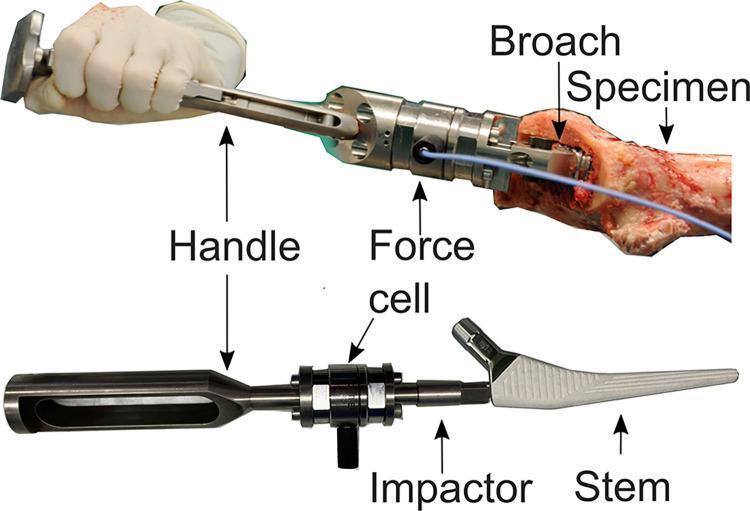
This intraoperative clinical photograph and comparison chart illustrate the instrumentation used for measuring dynamic forces during femoral cavity broaching and hip stem impaction. The image is divided into two panels. The upper panel shows a surgical hand in a sterile glove holding a metal handle connected to a dynamic force cell. This assembly is attached to a femoral broach, which is being driven into the proximal end of a bone specimen to prepare the medullary canal. A blue cable connects the force cell to external data acquisition hardware. The lower panel displays the second stage of the procedure: the femoral stem impaction assembly. This includes a handle, an integrated force cell, and an impactor tip connected to a tapered wedge hip stem. The stem features a porous, hydroxyapatite-coated (HA) surface designed for secondary biological fixation through osseointegration. This setup is used in orthopedic research to quantify mallet stroke forces and assess the correlation between impaction energy, bone-implant contact area, and primary stability in total hip arthroplasty.
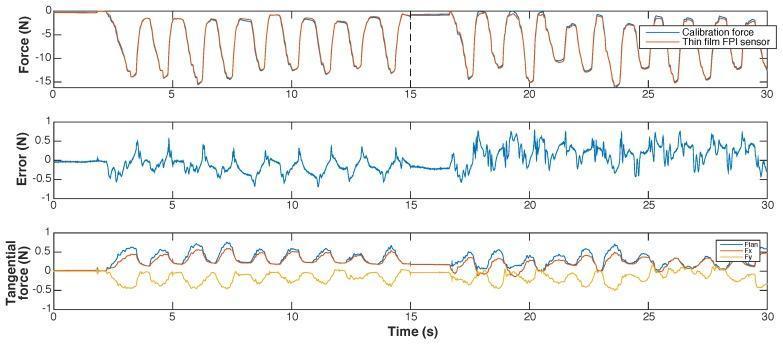
A multi-panel line graph illustrating the dynamic calibration results of a thin-film Fabry-Pérot interferometer (FPI) force sensor integrated into a medical needle stylet. The data is plotted as a function of time (0 to 30 seconds). The top panel compares the 'Calibration force' (reference) against the 'Thin film FPI sensor' measurement. Both signals show periodic negative force pulses reaching approximately -15 N, with a slight measurement lag attributed to the viscoelastic response of the sensor materials. The middle panel displays the corresponding 'Error (N)', fluctuating within a ±0.8 N range, indicating sensor accuracy during dynamic loading. The bottom panel tracks 'Tangential force (N)' on the needle tip, showing the resultant transverse force (Ftan) and its orthogonal components (Fx and Fy). These values cycle between approximately -0.5 and +0.7 N, demonstrating the sensor's cross-sensitivity to non-axial forces. The graph is divided into two 15-second fragments to evaluate performance consistency and signal stability during simulated needle insertion forces.
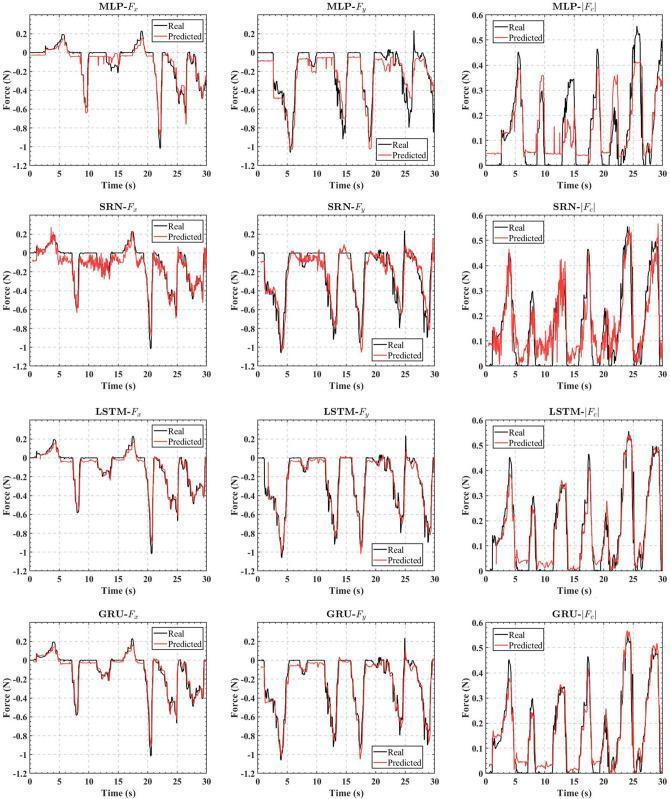
This Comparison Chart illustrates the dynamic performance of real-time force estimators for a tendon-driven flexible helical joint used in a continuum manipulator (CM). The figure is organized into a 4x3 grid of subplots comparing four artificial neural network (ANN) architectures: Multi-Layer Perceptron (MLP), Simple Recurrent Network (SRN), Long Short-Term Memory (LSTM), and Gated Recurrent Unit (GRU). Each row represents an architecture, while columns represent force components: Fx, Fy, and the absolute contact force |Fc|. In each plot, the x-axis shows Time (0 to 30 seconds) and the y-axis shows Force in Newtons (N). Two data lines are plotted: a black line representing the 'Real' ground truth force measured by a 6-DOF sensor, and a red line representing the 'Predicted' force from the model. The comparison highlights that MLP has the lowest accuracy due to its inability to capture temporal sequences and static friction effects. SRN shows high fluctuations, while LSTM and GRU demonstrate the highest accuracy with close alignment to real values. This visual data serves to evaluate machine learning models for surgical robotics and haptic feedback systems.
human cell nucleus biology diagram
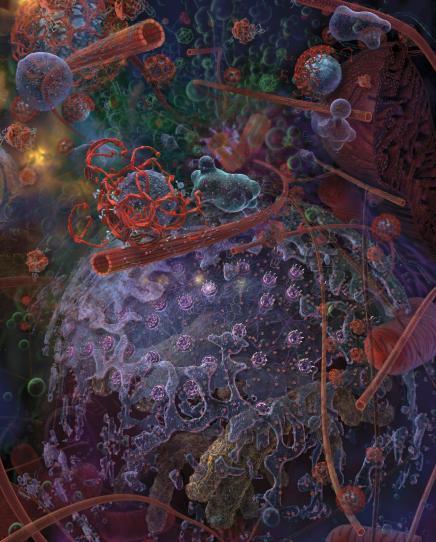
This Pathophysiology Diagram is a detailed scientific illustration of a eukaryotic cellular environment, focusing on molecular cell signaling and intracellular architecture. The central feature is a large, spherical structure representing the nucleus, characterized by a complex, porous nuclear envelope embedded with purple, globular nuclear pore complexes. Surrounding the nucleus is a crowded cytoplasm filled with cytoskeletal elements, including hollow, tubular microtubules colored in reddish-orange and filamentous actin structures. Various macromolecular complexes and organelles are visible in the background, including ribosomes, transport vesicles, and signaling proteins, depicted in diverse colors like green, blue, and purple. A prominent red, ribbon-like structure represents a signaling pathway or a protein polymer interacting with a spherical organelle. The illustration uses depth cuing and vibrant shading to demonstrate the molecular density and spatial organization of a human cell. It serves as an educational tool for cell biology, illustrating concepts of intracellular transport, structural biology, and the physical complexity of the cytoplasmic matrix at the macromolecular scale.
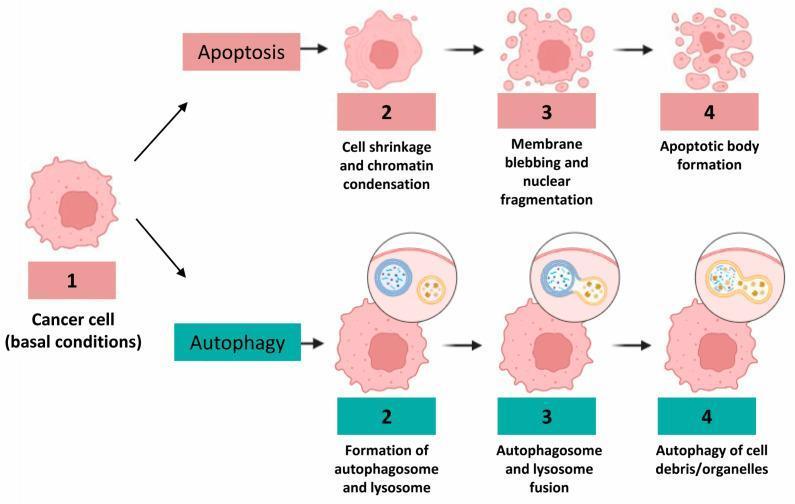
A comparative pathophysiology diagram illustrating the morphological evolution of a human cancer cell undergoing two distinct pathways of programmed cell death: apoptosis and autophagy. The diagram originates from a central 'Cancer cell (basal conditions)' (labeled 1). The top pathway, Apoptosis, follows three subsequent stages: (2) cell shrinkage and chromatin condensation where the nucleus becomes dense; (3) membrane blebbing and nuclear fragmentation where the cytoplasm and nucleus begin to break apart; and (4) apoptotic body formation, resulting in discrete membrane-bound vesicles. The bottom pathway, Autophagy, proceeds through: (2) formation of an autophagosome and lysosome, depicted in a circular inset; (3) autophagosome and lysosome fusion, showing the two vesicles merging; and (4) autophagy of cell debris/organelles within a mature autolysosome. This anatomical illustration serves as a pedagogical tool for distinguishing between the nuclear fragmentation of apoptosis and the vacuolar degradation characteristic of autophagy in oncology and cellular biology.
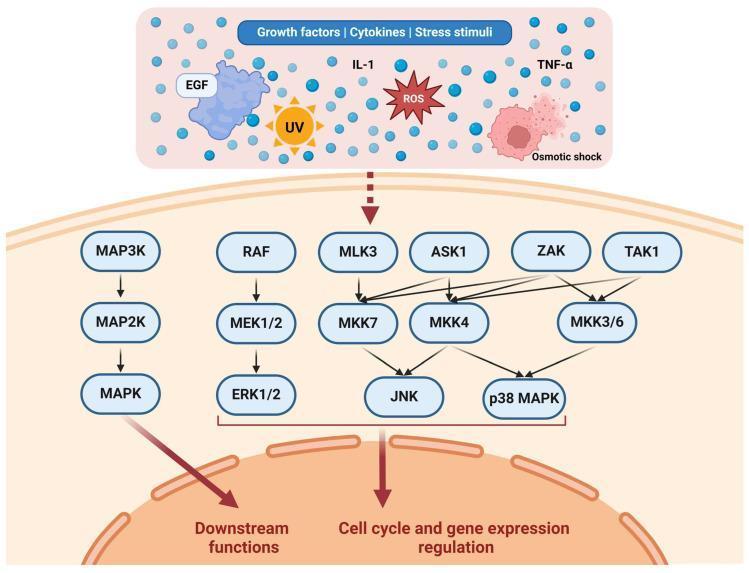
This pathophysiology diagram illustrates the Mitogen-Activated Protein Kinase (MAPK) signaling cascade within a human cell. The process begins with extracellular and environmental stimuli, including growth factors (EGF), cytokines (IL-1, TNF-alpha), and stress stimuli (UV radiation, Reactive Oxygen Species/ROS, osmotic shock). These stimuli trigger a vertical phosphorylation cascade organized into three functional tiers: MAP3Ks, MAP2Ks, and MAPKs. The diagram depicts parallel pathways: the classical ERK pathway (RAF to MEK1/2 to ERK1/2) and the stress-activated protein kinase pathways (MLK3, ASK1, ZAK, and TAK1 leading to MKK7, MKK4, or MKK3/6, which activate JNK and p38 MAPK). The educational focus is on the convergence of these signals into the nucleus to regulate critical cellular outcomes. Final downstream effects are categorized into general 'Downstream functions' (such as cell adhesion and migration) and 'Cell cycle and gene expression regulation.' This diagram serves as a high-level educational summary of signal transduction relevant to oncology and molecular biology.
Vibrio cholerae bacteria microscopy Koch
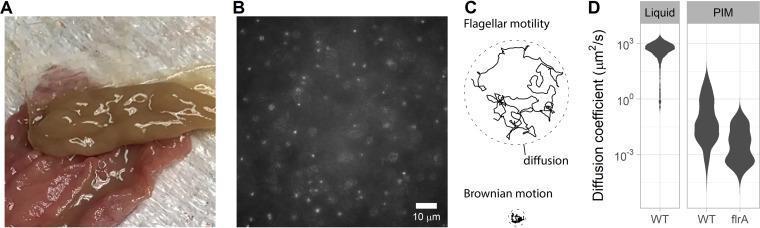
A multi-panel figure illustrating Vibrio cholerae motility in intestinal mucus. Panel A is a clinical photograph of unprocessed porcine intestinal mucus (PIM) scraped from the small intestine, appearing as a viscous, tan-colored gel on a pink tissue surface. Panel B shows a 40x magnification epifluorescence image of GFP-expressing V. cholerae Classical O395 within the PIM matrix, where individual bacteria appear as bright, fluorescent punctate spots against a dark background. Panel C is a trajectory diagram contrasting the erratic, expansive path of flagellar motility against the localized, minimal movement of Brownian motion/diffusion. Panel D presents violin plots comparing diffusion coefficients (μm²/s) of wild-type (WT) V. cholerae in liquid versus PIM, and comparing WT against a nonmotile flrA mutant in PIM. The data illustrates a significant impairment of bacterial diffusion within the mucus mesh compared to liquid, highlighting the physical barrier properties of intestinal mucus against pathogens.
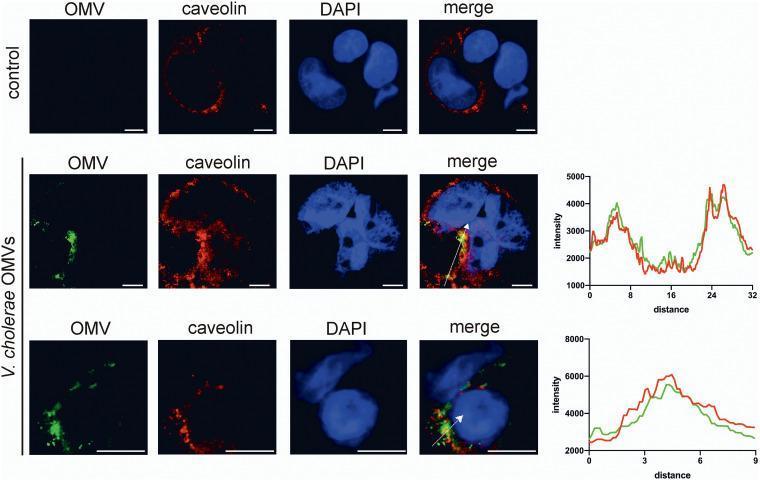
This composite figure contains diagnostic fluorescence microscopy images and corresponding intensity histograms demonstrating the cellular uptake of Vibrio cholerae outer membrane vesicles (OMVs) in human Caco-2 intestinal epithelial cells. The image is organized into three rows: a control group (top) and two V. cholerae OMV-treated samples (middle and bottom). Each row displays four channels: OMV (FITC-labeled, green), caveolin (Cy3-labeled, red), nuclei (DAPI-stained, blue), and a merged image. In the control group, no green OMV signal is present. In contrast, OMV-treated cells show distinct green clusters within the cytoplasm. The merged images for the treated groups exhibit yellow signals, indicating the colocalization of OMVs with caveolin-1. To the right of the treated rows, line histograms plot fluorescence intensity against distance (µm), following the white arrows indicated in the merged images. These plots show synchronous peaks in the red and green channels, quantitatively confirming the colocalization of OMVs with caveolin-mediated endocytic machinery. Scale bars indicate 10 µm.
Rudolf Virchow cellular pathology microscope histology
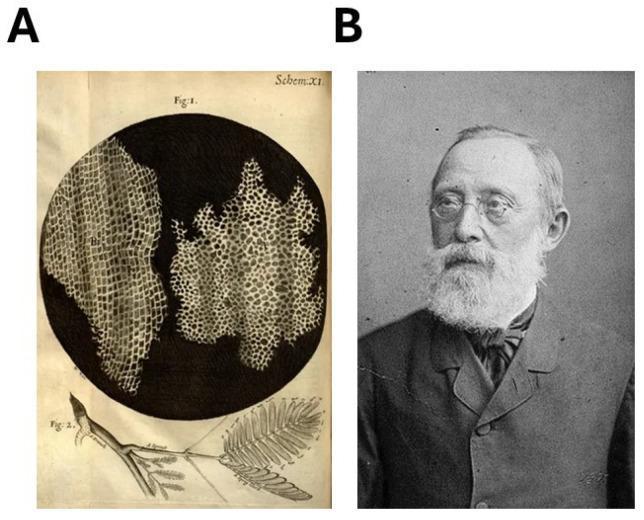
Educational visual illustrating foundational milestones in the cellular theory and pathology. Panel A displays historical scientific illustrations from Robert Hooke's 1665 treatise 'Micrographia'. It features a circular microscopic view of cork, revealing the hallmark ordered, grid-like 'cells' or compartments that represent the first description of plant cellular structure. Adjacent to the microscopic view is a macroscopic drawing of a plant sprig with feathery leaves, providing botanical context. Panel B is a 19th-century portrait of Rudolf Ludwig Karl Virchow, the pioneering German physician often called the 'father of modern pathology'. He is shown as an elderly man with glasses and a full white beard, wearing formal period attire. These images together symbolize the evolution from the discovery of the cell as a structural unit (Hooke) to the establishment of cellular pathology (Virchow), emphasizing the dictum 'omnis cellula e cellula' (all cells come from cells), which is critical for understanding medical concepts of tissue growth and carcinogenesis.
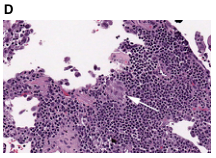
Summary : This image shows a histological section of tissue stained with hematoxylin and eosin (H&E), highlighting cellular and structural features under a microscope. photo: Scene Overview : • Main subject is a dense cluster of small, round, darkly stained cells, typical of a high cellularity region in tissue. • The image is taken from a microscope slide, with a field of view showing both compact and more loosely arranged areas. • A white arrow points to a specific region of interest within the tissue, possibly indicating a pathological feature or area for attention. • The background is mostly pale with some scattered cells and tissue fragments. Technical Details : • Staining: Hematoxylin and eosin (H&E), which imparts purple/blue coloration to nuclei and pink to cytoplasm/extracellular matrix. • Magnification: Not specified, but typical for histology (likely 10x–40x objective). • No visible scale bar or measurement units. • No on-image UI elements or text except for the label "D" in the upper left corner. Spatial Relationships : • Dense cellular regions are concentrated in the lower and right portions of the image. • Looser tissue and empty spaces (possibly alveolar or glandular structures) are present in the upper left and central areas. • The arrow is centrally placed, pointing to a transition zone between dense and less dense tissue. Analysis : • The image highlights a region of tissue with marked cellularity, possibly indicative of inflammation, neoplasia, or other pathology. • The arrow suggests a focus on a particular histological feature, such as a border between normal and abnormal tissue, or a diagnostic hallmark. • The overall pattern shows heterogeneity in tissue architecture, with both compact and open areas.
human body anatomy health wellness organs
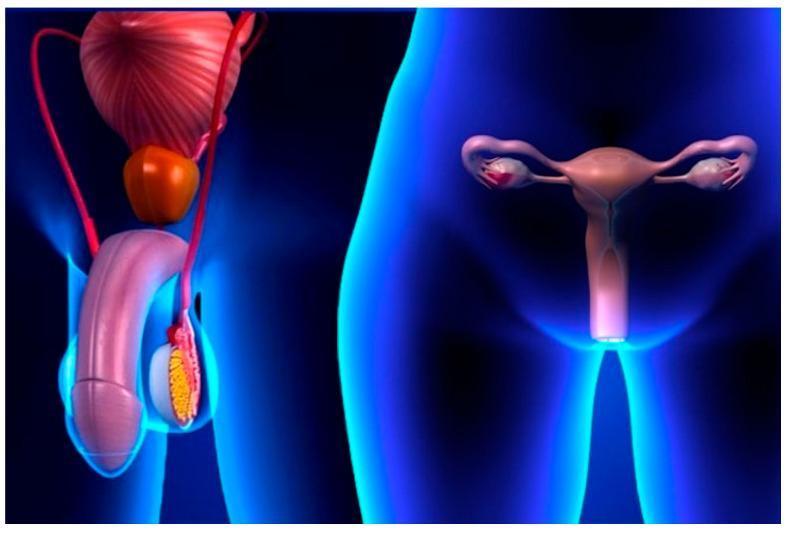
A 3D anatomical diagram illustrating the male and female reproductive systems side-by-side within stylized blue human silhouettes. On the left, the male anatomy includes the penis, a testis shown in cross-section within the scrotum, the epididymis, the vas deferens, the prostate gland, and the urinary bladder superiorly. On the right, the female anatomy depicts the uterus centrally, with the fallopian tubes extending laterally to the ovaries, and the vaginal canal positioned inferiorly. The visual highlights the pelvic location and relative spatial arrangement of primary and secondary sex organs. The image serves as an educational infographic for sexual health and reproductive anatomy, specifically in the context of public health strategies like the SAFE-S (Sexual behavior, Antibiotics, Facial cleanliness, Environmental improvement) strategy for controlling Chlamydia trachomatis and other sexually transmitted infections. The medical specialty is Urology and Gynecology, aimed at a general educational level.
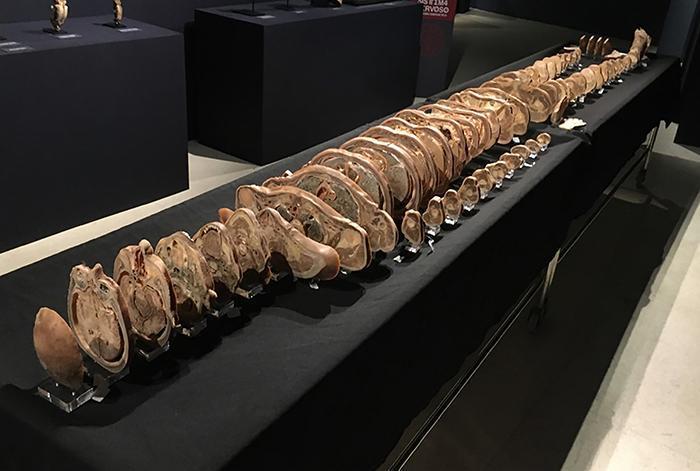
This clinical educational image displays a plastinated human specimen prepared using the von Hagens technique, arranged as a 'body tomography.' The specimen consists of numerous thin, transverse cross-sectional slices of a human body, positioned linearly along a horizontal table covered in black cloth. Each slice is held vertically by a transparent acrylic stand, allowing for a sequential view of human anatomy from the head through the trunk and limbs. The slices exhibit well-preserved internal structures with distinct anatomical morphology, including skeletal muscle, cortical and medullary bone, and visceral organs (such as the liver, heart, and lungs). The color palette is predominantly beige and brown, characteristic of silicone-impregnated tissues. This display serves as a high-fidelity anatomical model, illustrating spatial relationships between structures and tissue types in a manner analogous to radiological cross-sections like CT or MRI scans. It is used primarily for anatomical education, surgical training, and medical museum exhibition to demonstrate the three-dimensional complexity of the human body through two-dimensional physical planes.
nervous system disease pathology tissue damage
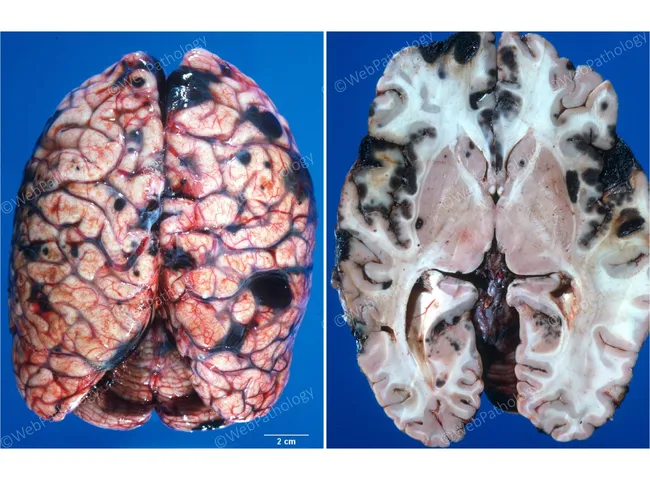
Gross pathology photograph of ex vivo brain tissue showing coronal sections through the cerebral hemispheres. Location: central nervous system with widespread metastatic involvement of cortex and deep white matter. Visual features: numerous pigmented, dark brown to black nodules distributed bilaterally across hemispheres; surface vasculature prominent; some lesions exhibit hemorrhagic foci; pigmentation indicates melanin-rich melanoma metastases. Parenchyma around lesions shows edema with preserved general architecture; size of nodules ranges from millimeters to centimeters; meninges may contain pigmented foci at the periphery. Pathologic correlation: metastatic melanoma to brain commonly produces melanotic deposits that are visibly dark and well-circumscribed within brain tissue; gross findings support histopathology showing melanoma cells with abundant melanin. Diagnostic significance: confirms disseminated cutaneous melanoma with intracranial metastases; implies advanced disease and poor prognosis; necessitates systemic staging and multidisciplinary management. Potential differential diagnoses: pigmented meningioma, pigmented metastases from other primaries, hemorrhagic neoplasms; clinical correlation with history of a large pigmented lesion on the back supports melanoma origin. Clinical utility: educational reference, radiology-pathology correlation, and prognosis discussion; informs treatment planning including consideration of stereotactic radiosurgery, whole-brain radiotherapy, and systemic immunotherapy. This image sequence serves as a baseline for comparative pathology in melanoma metastasis studies. Useful for tumor biology and educational applications.
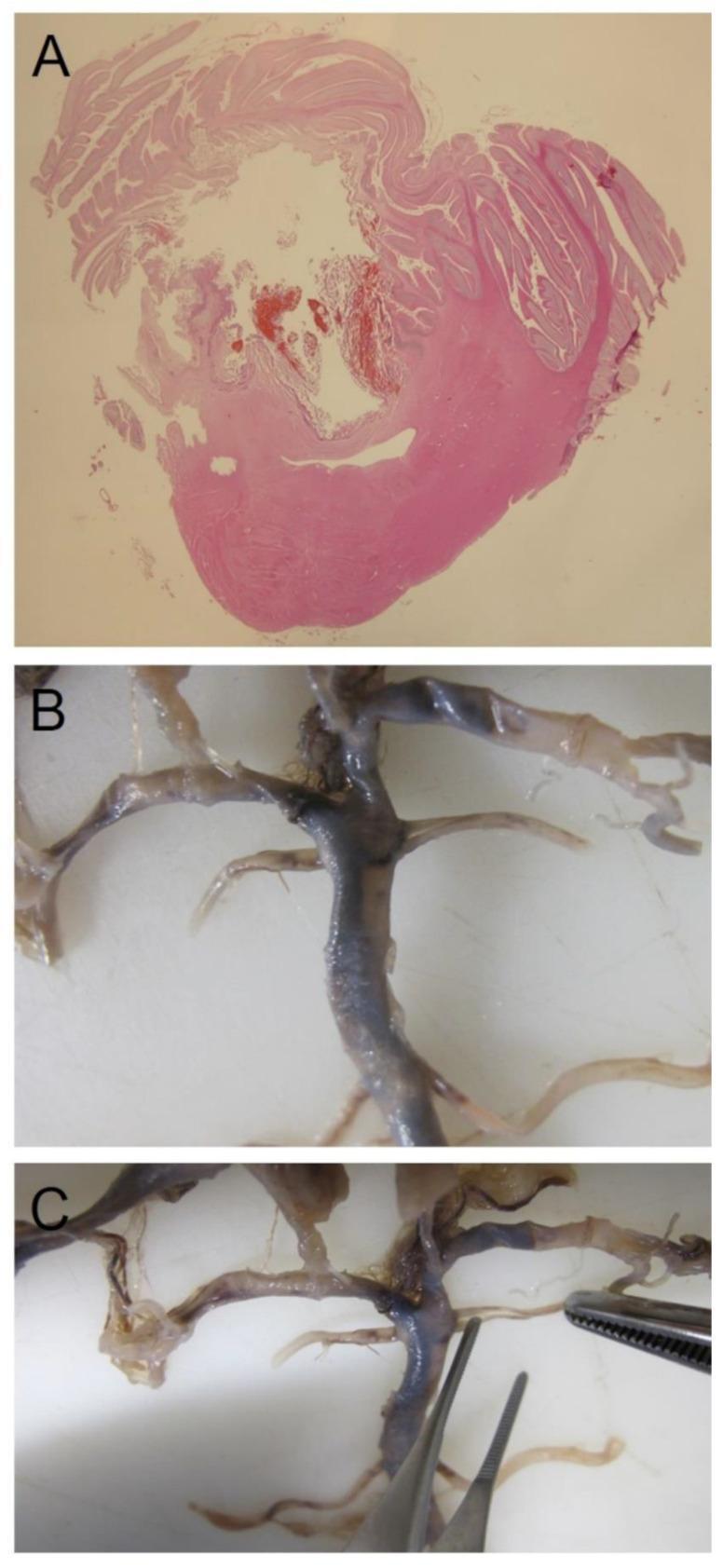
This composite educational image illustrates a case of anatomical variation and its pathological consequences in the central nervous system. Panel (A) is a low-magnification microscopic macro-section of human cerebellar tissue. It demonstrates a hemorrhagic infarction localized within the vascular territory of the superior cerebellar artery. The tissue exhibits characteristic folia architecture, with a central area of irregular, dark-red extravasated blood and adjacent tissue pallor indicative of edema and ischemic damage. Panels (B) and (C) are macroscopic clinical photographs of a gross dissection of the cerebral vasculature. They highlight an anatomical variation of the left superior cerebellar artery characterized by a 'double origin' from the basilar artery. The vessels appear as pale, tubular structures against a neutral background, with panel (C) using surgical instruments (forceps and needle) to demonstrate the specific branching pattern and point of origin. This material serves as a teaching aid for forensic pathology and neuroanatomy, emphasizing the clinical significance of 'individual anatomy' and the correlation between vascular anomalies and ischemic or hemorrhagic stroke.
mkdir -p /tmp/workspace/homoeopathy-ppt/images && cd /tmp/workspace/homoeopathy-ppt/images && \ curl -s -L "https://www.owenhomoeopathics.com.au/wp-content/uploads/2014/06/hahnemann_klein-1.jpg" -o hahnemann.jpg && \ curl -s -L "https://cdn.orris.care/cdss_images/pmc_clinical_VQA_3c526e83747e856c7febbbfa5f97d5a0400aa120cd8862093f6ade02fafa69c8.jpg" -o cell_nucleus.jpg && \ curl -s -L "https://cdn.orris.care/cdss_images/pmc_clinical_VQA_914d89bbf1b4d54ac2df67f68b3fe046312270ea39f7d25895e7bc247772232e.jpg" -o vibrio.jpg && \ curl -s -L "https://cdn.orris.care/cdss_images/pmc_clinical_VQA_09dec4dcf88d0d8d54672e0f5e8d17cb55556c049916af70f6010268e4eb6fe2.jpg" -o vibrio2.jpg && \ curl -s -L "https://cdn.orris.care/cdss_images/pmc_clinical_VQA_efecbc272ce268d497e4705418459075bc974c7671b1f301760353d5a096c463.jpg" -o virchow.jpg && \ curl -s -L "https://cdn.orris.care/cdss_images/GLGCA_307891_1763302985861_c459db06-da27-4bee-949c-a09157eb8659.png" -o histology.png && \ curl -s -L "https://cdn.orris.care/cdss_images/pmc_clinical_VQA_22c26443a753339a846ba2d1f734c6c0d801c153b9f966426acb270ab9ca31bc.jpg" -o anatomy.jpg && \ curl -s -L "https://cdn.orris.care/cdss_images/pmc_clinical_VQA_8c2ada5f0f7b33dbf6afd5710900fff8569fd21096084159721ec02b4ff37850.jpg" -o nervous.jpg && \ ls -lh
# vibrio.jpg is only 111 bytes (failed). Use the second Vibrio image URL directly curl -s -L "https://cdn.orris.care/cdss_images/pmc_clinical_VQA_914d89bbf1b4d54ac2df65f68b3fe046312270ea39f7d25895e7bc247772232e.jpg" -o /tmp/workspace/homoeopathy-ppt/images/vibrio.jpg && \ ls -lh /tmp/workspace/homoeopathy-ppt/images/vibrio.jpg
~/homoeopathy-ppt/create_ppt_v2.py
from pptx import Presentation
from pptx.util import Inches, Pt, Emu
from pptx.dml.color import RGBColor
from pptx.enum.text import PP_ALIGN, MSO_ANCHOR
from io import BytesIO
import os

IMG = "/tmp/workspace/homoeopathy-ppt/images/"

prs = Presentation()
prs.slide_width = Inches(13.333)
prs.slide_height = Inches(7.5)

blank = prs.slide_layouts[6]

# ── Color palette ──────────────────────────────────────────────
DARK_BLUE    = RGBColor(0x1A, 0x37, 0x6C)
MID_BLUE     = RGBColor(0x2E, 0x6D, 0xA4)
TEAL         = RGBColor(0x0D, 0x7D, 0x8E)
GOLD         = RGBColor(0xC9, 0xA0, 0x2F)
WHITE        = RGBColor(0xFF, 0xFF, 0xFF)
LIGHT_GRAY   = RGBColor(0xF4, 0xF6, 0xF9)
MID_GRAY     = RGBColor(0x8A, 0x99, 0xAA)
DARK_GRAY    = RGBColor(0x2D, 0x2D, 0x2D)

# ── Helpers ─────────────────────────────────────────────────────

def add_rect(slide, x, y, w, h, fill_color):
    shape = slide.shapes.add_shape(1, Inches(x), Inches(y), Inches(w), Inches(h))
    shape.line.fill.background()
    shape.fill.solid()
    shape.fill.fore_color.rgb = fill_color
    return shape

def add_textbox(slide, x, y, w, h, text, font_size, font_color=WHITE,
                bold=False, italic=False, align=PP_ALIGN.LEFT,
                v_anchor=MSO_ANCHOR.TOP, word_wrap=True, font_name="Calibri"):
    tb = slide.shapes.add_textbox(Inches(x), Inches(y), Inches(w), Inches(h))
    tf = tb.text_frame
    tf.word_wrap = word_wrap
    tf.vertical_anchor = v_anchor
    tf.margin_left = Pt(4)
    tf.margin_right = Pt(4)
    tf.margin_top = Pt(2)
    tf.margin_bottom = Pt(2)
    p = tf.paragraphs[0]
    p.alignment = align
    run = p.add_run()
    run.text = text
    run.font.size = Pt(font_size)
    run.font.color.rgb = font_color
    run.font.bold = bold
    run.font.italic = italic
    run.font.name = font_name
    return tb

def add_bullet_textbox(slide, x, y, w, h, bullets, font_size=16,
                       font_color=DARK_GRAY, bold_first=False, font_name="Calibri"):
    tb = slide.shapes.add_textbox(Inches(x), Inches(y), Inches(w), Inches(h))
    tf = tb.text_frame
    tf.word_wrap = True
    tf.margin_left = Pt(4)
    tf.margin_right = Pt(4)
    tf.margin_top = Pt(2)
    tf.margin_bottom = Pt(2)
    for i, bullet in enumerate(bullets):
        p = tf.paragraphs[0] if i == 0 else tf.add_paragraph()
        p.space_before = Pt(3)
        run = p.add_run()
        run.text = bullet
        run.font.size = Pt(font_size)
        run.font.color.rgb = font_color
        run.font.bold = (bold_first and i == 0)
        run.font.name = font_name
    return tb

def add_image(slide, path, x, y, w, h=None):
    """Add image if file exists and is valid."""
    if not os.path.exists(path) or os.path.getsize(path) < 500:
        return None
    try:
        if h:
            slide.shapes.add_picture(path, Inches(x), Inches(y), Inches(w), Inches(h))
        else:
            slide.shapes.add_picture(path, Inches(x), Inches(y), Inches(w))
        return True
    except Exception as e:
        print(f"Could not add image {path}: {e}")
        return None

def add_footer(slide, text="Life, Health and Disease — Homoeopathic Philosophy"):
    add_rect(slide, 0, 7.1, 13.333, 0.4, TEAL)
    add_textbox(slide, 0.5, 7.1, 12.0, 0.4, text, 11,
                font_color=WHITE, align=PP_ALIGN.CENTER, v_anchor=MSO_ANCHOR.MIDDLE)

def add_header(slide, title, subtitle=None):
    add_rect(slide, 0, 0, 13.333, 1.2, DARK_BLUE)
    add_rect(slide, 0, 0, 13.333, 0.08, GOLD)
    add_textbox(slide, 0.4, 0.15, 12.0, 0.9, title, 32,
                font_color=WHITE, bold=True, v_anchor=MSO_ANCHOR.MIDDLE,
                font_name="Calibri Light")

# ══════════════════════════════════════════════════════════════════
# SLIDE 1 — Title Slide (with Hahnemann portrait)
# ══════════════════════════════════════════════════════════════════
slide = prs.slides.add_slide(blank)
add_rect(slide, 0, 0, 13.333, 7.5, DARK_BLUE)
add_rect(slide, 0, 0, 13.333, 0.12, GOLD)
add_rect(slide, 0, 0, 0.5, 7.5, MID_BLUE)

# Hahnemann portrait on right
add_image(slide, IMG + "hahnemann.jpg", 9.3, 0.8, 3.7, 6.0)
# Slight overlay tint for the image area
add_rect(slide, 9.3, 6.8, 3.7, 0.3, DARK_BLUE)

add_textbox(slide, 0.9, 1.5, 8.2, 1.6,
            "Life, Health and Disease", 46,
            font_color=WHITE, bold=True, align=PP_ALIGN.LEFT,
            v_anchor=MSO_ANCHOR.MIDDLE, font_name="Calibri Light")
add_textbox(slide, 0.9, 3.2, 8.0, 0.7,
            "A Homoeopathic Perspective", 24,
            font_color=GOLD, align=PP_ALIGN.LEFT)
add_textbox(slide, 0.9, 4.0, 8.0, 0.5,
            "Vital Force · Dynamic Disturbance · Centre to Circumference", 13,
            font_color=MID_GRAY, italic=True, align=PP_ALIGN.LEFT)
add_textbox(slide, 9.3, 6.8, 3.7, 0.3, "Samuel Hahnemann (1755–1843)", 10,
            font_color=MID_GRAY, align=PP_ALIGN.CENTER, v_anchor=MSO_ANCHOR.MIDDLE,
            italic=True)

add_footer("Based on Hahnemannian Philosophy  |  Homoeopathic Organon")

# ══════════════════════════════════════════════════════════════════
# SLIDE 2 — Introduction (with anatomy image)
# ══════════════════════════════════════════════════════════════════
slide = prs.slides.add_slide(blank)
add_rect(slide, 0, 0, 13.333, 7.5, LIGHT_GRAY)
add_header(slide, "Introduction")

# Image on right
add_rect(slide, 9.3, 1.35, 3.7, 5.5, WHITE)
add_image(slide, IMG + "anatomy.jpg", 9.35, 1.4, 3.6, 5.3)

bullets = [
    "• Life, health, and disease are fundamental concepts in Homoeopathy.",
    "• Hahnemann considered life as the vital principle governing the body.",
    "• Disease is viewed as an alteration of the vital force,",
    "  not merely structural changes.",
    "• Homoeopathy approaches disease from a dynamic,",
    "  individualised perspective.",
    "• The vital force is the connecting link between life, health, and disease.",
]
add_bullet_textbox(slide, 0.6, 1.4, 8.5, 5.5, bullets, font_size=17, font_color=DARK_GRAY)
add_footer()

# ══════════════════════════════════════════════════════════════════
# SLIDE 3 — Definitions: Life, Health, Disease
# ══════════════════════════════════════════════════════════════════
slide = prs.slides.add_slide(blank)
add_rect(slide, 0, 0, 13.333, 7.5, LIGHT_GRAY)
add_header(slide, "Definitions: Life, Health & Disease")

card_data = [
    ("LIFE", MID_BLUE, [
        "Invisible, intelligent,",
        "individual, and dynamic power",
        "",
        "Controls all activities of the",
        "living organism",
        "",
        "Maintains individuality and",
        "functional integrity of the body",
    ]),
    ("HEALTH", TEAL, [
        "Balanced condition of the",
        "living organism",
        "",
        "All organs & systems function",
        "harmoniously",
        "",
        "Promotes normal growth,",
        "development & preservation",
    ]),
    ("DISEASE", RGBColor(0x8B, 0x1A, 0x1A), [
        "Abnormal vital process —",
        "a changed condition of life",
        "",
        "Disturbs normal body functions",
        "",
        "May progress to tissue damage",
        "if left unchecked",
    ]),
]

for i, (title, color, lines) in enumerate(card_data):
    cx = 0.5 + i * 4.2
    add_rect(slide, cx, 1.35, 3.9, 5.5, color)
    add_textbox(slide, cx, 1.35, 3.9, 0.6, title, 17,
                font_color=WHITE, bold=True, align=PP_ALIGN.CENTER,
                v_anchor=MSO_ANCHOR.MIDDLE)
    add_rect(slide, cx + 0.1, 1.95, 3.7, 4.7, WHITE)
    # Small anatomy image in first card, cell image in third card
    if i == 0:
        add_image(slide, IMG + "hahnemann.jpg", cx + 0.15, 2.0, 3.6, 1.8)
        text_y = 3.85
    elif i == 2:
        add_image(slide, IMG + "histology.png", cx + 0.15, 2.0, 3.6, 1.8)
        text_y = 3.85
    else:
        text_y = 2.05
    add_textbox(slide, cx + 0.2, text_y, 3.5, 6.65 - text_y, "\n".join(lines), 13,
                font_color=DARK_GRAY, word_wrap=True)

add_footer()

# ══════════════════════════════════════════════════════════════════
# SLIDE 4 — Centre to Circumference Principle (with cell nucleus image)
# ══════════════════════════════════════════════════════════════════
slide = prs.slides.add_slide(blank)
add_rect(slide, 0, 0, 13.333, 7.5, LIGHT_GRAY)
add_header(slide, "Centre to Circumference Principle")

desc_bullets = [
    "• Power originates from the CENTRE.",
    "• Development and function proceed from the centre to the periphery.",
    "• Cells develop from the NUCLEUS outward.",
    "• Vital force acts from WITHIN outward.",
    "• Disease first affects the internal life principle.",
    "• External signs appear through the nervous system.",
]
add_bullet_textbox(slide, 0.6, 1.4, 5.5, 3.5, desc_bullets, font_size=16, font_color=DARK_GRAY)

# Cell nucleus image below bullets
add_rect(slide, 0.5, 5.0, 5.7, 1.8, WHITE)
add_image(slide, IMG + "cell_nucleus.jpg", 0.55, 5.05, 5.6, 1.7)
add_textbox(slide, 0.55, 6.75, 5.6, 0.25,
            "Cell nucleus — development proceeds from within outward", 9,
            font_color=MID_GRAY, italic=True, align=PP_ALIGN.CENTER)

# Right column — table
table_data = [
    ("Level", "Direction"),
    ("Power", "Originates from CENTRE"),
    ("Development", "Centre → Periphery"),
    ("Cell Biology", "Nucleus → Outward"),
    ("Vital Force", "Within → Outward"),
    ("Disease", "Internal → External"),
]
for row_i, (col1, col2) in enumerate(table_data):
    ry = 1.4 + row_i * 0.75
    is_header = row_i == 0
    bg = DARK_BLUE if is_header else (LIGHT_GRAY if row_i % 2 == 0 else WHITE)
    fc = WHITE if is_header else DARK_GRAY
    add_rect(slide, 6.8, ry, 2.8, 0.7, bg)
    add_rect(slide, 9.7, ry, 3.3, 0.7, bg)
    add_textbox(slide, 6.85, ry + 0.05, 2.7, 0.6, col1, 13,
                font_color=fc, bold=is_header, v_anchor=MSO_ANCHOR.MIDDLE, align=PP_ALIGN.CENTER)
    add_textbox(slide, 9.75, ry + 0.05, 3.2, 0.6, col2, 13,
                font_color=fc, bold=is_header, v_anchor=MSO_ANCHOR.MIDDLE, align=PP_ALIGN.CENTER)

add_footer()

# ══════════════════════════════════════════════════════════════════
# SLIDE 5 — Disease, Cure & Vital Resistance (with nervous system image)
# ══════════════════════════════════════════════════════════════════
slide = prs.slides.add_slide(blank)
add_rect(slide, 0, 0, 13.333, 7.5, LIGHT_GRAY)
add_header(slide, "Disease, Cure & Vital Resistance")

# Disease & Cure box
add_rect(slide, 0.5, 1.35, 5.9, 5.5, MID_BLUE)
add_textbox(slide, 0.5, 1.35, 5.9, 0.55, "DISEASE & CURE", 15,
            font_color=WHITE, bold=True, align=PP_ALIGN.CENTER, v_anchor=MSO_ANCHOR.MIDDLE)
add_rect(slide, 0.6, 1.9, 5.7, 4.7, WHITE)

# Image inside disease box
add_image(slide, IMG + "nervous.jpg", 0.65, 1.95, 2.7, 2.0)
dc_bullets = [
    "Disease first affects the INTERNAL",
    "life principle.",
    "External signs appear through the",
    "nervous system.",
    "Cure begins at centre → outward.",
    "",
    "Hering's Law of Cure:",
    "→ Symptoms: ABOVE DOWNWARD",
    "→ REVERSE ORDER of appearance",
    "→ More vital → less vital organs",
]
add_bullet_textbox(slide, 3.45, 1.95, 2.7, 4.55, dc_bullets, font_size=13, font_color=DARK_GRAY)

# Vital Resistance box
add_rect(slide, 6.9, 1.35, 6.0, 5.5, TEAL)
add_textbox(slide, 6.9, 1.35, 6.0, 0.55, "VITAL RESISTANCE", 15,
            font_color=WHITE, bold=True, align=PP_ALIGN.CENTER, v_anchor=MSO_ANCHOR.MIDDLE)
add_rect(slide, 7.0, 1.9, 5.8, 4.7, WHITE)
vr_bullets = [
    "• The living organism possesses natural resistance.",
    "• Protects against harmful agents and disease-producing factors.",
    "• This resistance follows the INSTINCT OF SELF-PRESERVATION.",
    "",
    "Nature of Disease:",
    "  → Disease is 'life under altered conditions'",
    "  → Begins as a dynamic disturbance",
    "  → Structural changes occur only secondarily",
]
add_bullet_textbox(slide, 7.1, 1.95, 5.6, 4.55, vr_bullets, font_size=14, font_color=DARK_GRAY)

add_footer()

# ══════════════════════════════════════════════════════════════════
# SLIDE 6 — Hahnemann's Concept (with Hahnemann portrait)
# ══════════════════════════════════════════════════════════════════
slide = prs.slides.add_slide(blank)
add_rect(slide, 0, 0, 13.333, 7.5, LIGHT_GRAY)
add_header(slide, "Hahnemann's Concept of Disease")

# Portrait on left
add_rect(slide, 0.4, 1.35, 3.0, 4.5, WHITE)
add_image(slide, IMG + "hahnemann.jpg", 0.45, 1.4, 2.9, 4.3)
add_textbox(slide, 0.45, 5.7, 2.9, 0.3, "Samuel Hahnemann (1755-1843)", 9,
            font_color=MID_GRAY, italic=True, align=PP_ALIGN.CENTER)

# Quote box
add_rect(slide, 3.6, 1.4, 9.4, 1.1, GOLD)
add_textbox(slide, 3.8, 1.4, 9.0, 1.1,
            '"Disease is an alteration of vital sensations and functions."',
            20, font_color=DARK_BLUE, bold=True, italic=True,
            align=PP_ALIGN.CENTER, v_anchor=MSO_ANCHOR.MIDDLE)

# Three concept blocks
concepts = [
    ("HEALTH", MID_BLUE,
     "Depends on the NORMAL STATE of the vital force.\n\nWhen the vital force is in balance, all sensations and functions are harmonious."),
    ("DISEASE", RGBColor(0x8B, 0x1A, 0x1A),
     "Is an ALTERATION of vital sensations and functions.\n\nThe dynamic disturbance precedes any material or structural changes."),
    ("MATERIAL\nCHANGES", TEAL,
     "Occur SECONDARILY after the dynamic disturbance.\n\nThey are the end result — not the beginning — of the disease process."),
]
for i, (title, color, desc) in enumerate(concepts):
    cx = 3.6 + i * 3.2
    add_rect(slide, cx, 2.65, 3.0, 4.1, color)
    add_textbox(slide, cx, 2.65, 3.0, 0.65, title, 14,
                font_color=WHITE, bold=True, align=PP_ALIGN.CENTER, v_anchor=MSO_ANCHOR.MIDDLE)
    add_rect(slide, cx + 0.08, 3.3, 2.84, 3.25, WHITE)
    add_textbox(slide, cx + 0.15, 3.35, 2.7, 3.15, desc, 12,
                font_color=DARK_GRAY, word_wrap=True)

add_footer()

# ══════════════════════════════════════════════════════════════════
# SLIDE 7 — Homoeopathy & Bacteriology: Three Views
# ══════════════════════════════════════════════════════════════════
slide = prs.slides.add_slide(blank)
add_rect(slide, 0, 0, 13.333, 7.5, LIGHT_GRAY)
add_header(slide, "Homoeopathy & Bacteriology: Three Views")

views = [
    ("KOCH", MID_BLUE, IMG + "vibrio.jpg", [
        "Isolated Vibrio cholerae from",
        "cholera patients.",
        "",
        "Established the GERM THEORY.",
        "",
        "Koch's Postulates: specific",
        "bacteria cause specific diseases.",
        "",
        "Microorganism = Primary cause",
    ]),
    ("VIRCHOW", TEAL, IMG + "virchow.jpg", [
        "Founder of CELLULAR PATHOLOGY.",
        "",
        "Bacteria are NOT primary cause.",
        "",
        "Disease = abnormality in body's",
        "own cells.",
        "",
        "Host condition, nutrition &",
        "social factors are primary.",
    ]),
    ("HAHNEMANN", DARK_BLUE, IMG + "hahnemann.jpg", [
        "Disease = DYNAMIC DISTURBANCE",
        "of the vital force.",
        "",
        "Bacteria = Secondary / exciting",
        "cause only.",
        "",
        "SUSCEPTIBILITY is the key factor.",
        "",
        "Treat the vital force, not the",
        "microorganism.",
    ]),
]

for i, (title, color, img_path, lines) in enumerate(views):
    cx = 0.4 + i * 4.3
    add_rect(slide, cx, 1.35, 4.0, 5.5, color)
    add_textbox(slide, cx, 1.35, 4.0, 0.55, title, 16,
                font_color=WHITE, bold=True, align=PP_ALIGN.CENTER, v_anchor=MSO_ANCHOR.MIDDLE)
    add_rect(slide, cx + 0.1, 1.9, 3.8, 4.7, WHITE)
    # Image in each card
    add_image(slide, img_path, cx + 0.15, 1.95, 3.7, 1.9)
    text = "\n".join(lines)
    add_textbox(slide, cx + 0.2, 3.9, 3.6, 2.6, text, 12,
                font_color=DARK_GRAY, word_wrap=True)

add_footer()

# ══════════════════════════════════════════════════════════════════
# SLIDE 8 — Cause & Effect in Disease
# ══════════════════════════════════════════════════════════════════
slide = prs.slides.add_slide(blank)
add_rect(slide, 0, 0, 13.333, 7.5, LIGHT_GRAY)
add_header(slide, "Cause & Effect in Disease")

flow_items = [
    (MID_BLUE,                        "SUSCEPTIBILITY\n(Host's vital state)"),
    (TEAL,                             "EXCITING CAUSE\n(Bacteria / Infection)"),
    (DARK_BLUE,                        "DYNAMIC DISTURBANCE\n(Vital force altered)"),
    (RGBColor(0x8B, 0x1A, 0x1A),      "DISEASE\n(Functional changes)"),
    (RGBColor(0x5A, 0x10, 0x10),      "STRUCTURAL CHANGES\n(Tissue damage — late)"),
]

for i, (color, label) in enumerate(flow_items):
    bx = 0.4 + i * 2.5
    add_rect(slide, bx, 1.5, 2.2, 1.3, color)
    add_textbox(slide, bx, 1.5, 2.2, 1.3, label, 13,
                font_color=WHITE, bold=True, align=PP_ALIGN.CENTER,
                v_anchor=MSO_ANCHOR.MIDDLE, word_wrap=True)
    if i < len(flow_items) - 1:
        add_textbox(slide, bx + 2.25, 1.9, 0.3, 0.5, "►", 22,
                    font_color=DARK_BLUE, bold=True, align=PP_ALIGN.CENTER,
                    v_anchor=MSO_ANCHOR.MIDDLE)

# Image + key points side by side
add_rect(slide, 0.4, 3.0, 3.5, 3.8, WHITE)
add_image(slide, IMG + "vibrio2.jpg", 0.45, 3.05, 3.4, 3.7)
add_textbox(slide, 0.45, 6.75, 3.4, 0.25,
            "V. cholerae — OMV interactions with intestinal cells", 9,
            font_color=MID_GRAY, italic=True, align=PP_ALIGN.CENTER)

kp_bullets = [
    "• Homoeopathy distinguishes clearly between CAUSE and EFFECT.",
    "• Germs alone are NOT the absolute cause of disease.",
    "• Disease depends on:",
    "  (1) Condition of the living organism",
    "  (2) Individual SUSCEPTIBILITY",
    "  (3) Miasmatic / environmental factors",
    "• The vital force's susceptibility is the determining factor —",
    "  not mere exposure to a pathogen.",
]
add_bullet_textbox(slide, 4.1, 3.0, 9.0, 3.9, kp_bullets, font_size=15, font_color=DARK_GRAY)

add_footer()

# ══════════════════════════════════════════════════════════════════
# SLIDE 9 — Comparative Summary Table
# ══════════════════════════════════════════════════════════════════
slide = prs.slides.add_slide(blank)
add_rect(slide, 0, 0, 13.333, 7.5, LIGHT_GRAY)
add_header(slide, "Comparative Summary")

headers = ["Aspect", "Koch", "Virchow", "Hahnemann"]
rows = [
    ["Primary cause", "Specific microorganism", "Cell abnormality", "Dynamic disturbance of vital force"],
    ["Role of bacteria", "Essential cause", "Secondary invader", "Exciting/secondary cause"],
    ["Host's role", "Less emphasized", "Central (cell health)", "Susceptibility is key"],
    ["Treatment focus", "Destroy pathogen", "Improve cell health", "Restore vital force"],
    ["Social factors", "Not primary", "Very important", "Miasmatic state"],
]

col_widths = [2.8, 2.8, 2.8, 4.3]
col_starts = [0.4, 3.3, 6.1, 8.9]
row_height = 0.72
header_y = 1.35

for ci, (hdr, cx, cw) in enumerate(zip(headers, col_starts, col_widths)):
    add_rect(slide, cx, header_y, cw, row_height, DARK_BLUE)
    add_textbox(slide, cx + 0.05, header_y, cw - 0.1, row_height, hdr, 14,
                font_color=WHITE, bold=True, align=PP_ALIGN.CENTER, v_anchor=MSO_ANCHOR.MIDDLE)

for ri, row in enumerate(rows):
    ry = header_y + (ri + 1) * row_height
    bg = WHITE if ri % 2 == 0 else RGBColor(0xE8, 0xF0, 0xF8)
    for ci, (cell, cx, cw) in enumerate(zip(row, col_starts, col_widths)):
        add_rect(slide, cx, ry, cw, row_height, bg)
        add_textbox(slide, cx + 0.05, ry, cw - 0.1, row_height, cell, 12,
                    font_color=DARK_BLUE if ci == 0 else DARK_GRAY,
                    bold=(ci == 0), align=PP_ALIGN.CENTER,
                    v_anchor=MSO_ANCHOR.MIDDLE, word_wrap=True)

# Small images below table
add_image(slide, IMG + "virchow.jpg",   0.4,  6.1, 3.0, 0.85)
add_image(slide, IMG + "vibrio.jpg",    4.2,  6.1, 3.0, 0.85)
add_image(slide, IMG + "hahnemann.jpg", 8.0,  6.1, 3.0, 0.85)
add_textbox(slide, 0.4, 6.0, 3.0, 0.18, "Virchow", 9, font_color=MID_GRAY, italic=True, align=PP_ALIGN.CENTER)
add_textbox(slide, 4.2, 6.0, 3.0, 0.18, "Koch / Vibrio cholerae", 9, font_color=MID_GRAY, italic=True, align=PP_ALIGN.CENTER)
add_textbox(slide, 8.0, 6.0, 3.0, 0.18, "Hahnemann", 9, font_color=MID_GRAY, italic=True, align=PP_ALIGN.CENTER)

add_footer()

# ══════════════════════════════════════════════════════════════════
# SLIDE 10 — Conclusion
# ══════════════════════════════════════════════════════════════════
slide = prs.slides.add_slide(blank)
add_rect(slide, 0, 0, 13.333, 7.5, DARK_BLUE)
add_rect(slide, 0, 0, 13.333, 0.1, GOLD)
add_rect(slide, 12.833, 0, 0.5, 7.5, MID_BLUE)
add_rect(slide, 0, 5.8, 4.0, 1.8, MID_BLUE)
add_rect(slide, 0, 6.1, 3.5, 1.5, TEAL)

# Hahnemann portrait top-right
add_image(slide, IMG + "hahnemann.jpg", 10.0, 0.4, 2.9, 4.5)
add_rect(slide, 10.0, 0.4, 2.9, 0.3, DARK_BLUE)  # top cover strip for clean edge

add_textbox(slide, 0.7, 0.5, 9.0, 1.0, "Conclusion", 38,
            font_color=GOLD, bold=True, v_anchor=MSO_ANCHOR.MIDDLE, font_name="Calibri Light")

conclusion_points = [
    ("LIFE",        "Governed by the vital principle — invisible, dynamic, and intelligent."),
    ("HEALTH",      "Harmonious functioning of the vital force across all organs and systems."),
    ("DISEASE",     "Dynamic disturbance of the vital force, preceding any structural change."),
    ("CURE",        "Starts from the centre and proceeds outward — following Hering's Law of Cure."),
    ("BACTERIOLOGY","Germs are exciting causes; susceptibility of the vital force is the determining factor."),
]

for i, (key, val) in enumerate(conclusion_points):
    ry = 1.65 + i * 0.95
    add_rect(slide, 0.7, ry, 2.3, 0.75, GOLD)
    add_textbox(slide, 0.7, ry, 2.3, 0.75, key, 13,
                font_color=DARK_BLUE, bold=True, align=PP_ALIGN.CENTER, v_anchor=MSO_ANCHOR.MIDDLE)
    add_textbox(slide, 3.2, ry, 6.6, 0.75, val, 15,
                font_color=WHITE, v_anchor=MSO_ANCHOR.MIDDLE, word_wrap=True)

add_rect(slide, 0, 7.1, 13.333, 0.4, TEAL)
add_textbox(slide, 0.5, 7.1, 12.0, 0.4,
            "Based on Hahnemannian Philosophy  |  Homoeopathic Organon", 11,
            font_color=WHITE, align=PP_ALIGN.CENTER, v_anchor=MSO_ANCHOR.MIDDLE)

# ══════════════════════════════════════════════════════════════════
# SAVE
# ══════════════════════════════════════════════════════════════════
buf = BytesIO()
prs.save(buf)
out_path = "/tmp/workspace/homoeopathy-ppt/Life_Health_Disease_Homoeopathy_v2.pptx"
with open(out_path, "wb") as f:
    f.write(buf.getvalue())

print(f"Saved to {out_path}")
python /tmp/workspace/homoeopathy-ppt/create_ppt_v2.py
add_footer helper is being called with a string as first arg where it expects slide. Let me fix that.~/homoeopathy-ppt/create_ppt_v2.py
Successfully replaced 1 instance(s) of the string in '/tmp/workspace/homoeopathy-ppt/create_ppt_v2.py'
"add_footer("Based" in ~/homoeopathy-ppt/create_ppt_v2.py
slide as first argument. Let me also check for the same issue on the last slide and fix all at once:~/homoeopathy-ppt/create_ppt_v2.py
Successfully replaced 1 instance(s) of the string in '/tmp/workspace/homoeopathy-ppt/create_ppt_v2.py'
python /tmp/workspace/homoeopathy-ppt/create_ppt_v2.py
grep -n "add_footer()" /tmp/workspace/homoeopathy-ppt/create_ppt_v2.py
sed -i 's/^add_footer()$/add_footer(slide)/' /tmp/workspace/homoeopathy-ppt/create_ppt_v2.py && python /tmp/workspace/homoeopathy-ppt/create_ppt_v2.py
ls -lh /tmp/workspace/homoeopathy-ppt/Life_Health_Disease_Homoeopathy_v2.pptx
| Slide | Image Added |
|---|---|
| 1 - Title | Samuel Hahnemann portrait (right side) |
| 2 - Introduction | Human anatomy cross-section diagram |
| 3 - Definitions | Hahnemann portrait (Life card) + H&E histology (Disease card) |
| 4 - Centre to Circumference | Eukaryotic cell nucleus diagram (below bullet points) |
| 5 - Disease & Cure | Cerebellar nervous system pathology image |
| 6 - Hahnemann's Concept | Hahnemann portrait (left panel) with quote box |
| 7 - Bacteriology: 3 Views | Vibrio cholerae (Koch card), Virchow portrait (Virchow card), Hahnemann portrait (Hahnemann card) |
| 8 - Cause & Effect | V. cholerae OMV microscopy image (left panel) |
| 9 - Comparative Table | Virchow, Vibrio, and Hahnemann thumbnails below the table |
| 10 - Conclusion | Hahnemann portrait (top right corner) |
Life Health Disease Homoeopathy v2
Presentation · PPTX