
Telescoping of glandS in endometrium meaning
Reading File
Searching for information on telescoping of glands in endometrium.
search_medical_text
telescoping of glands endometrium histology
Management of Endometrial Intraepithelial Neoplasia or Atypical Endometrial Hyperplasia
Page 2
GradeResponse
GradeResponse
Telescoping of Glands in Endometrium
Telescoping is a histological artifact seen in endometrial biopsy specimens, not a true pathological process.
What It Means
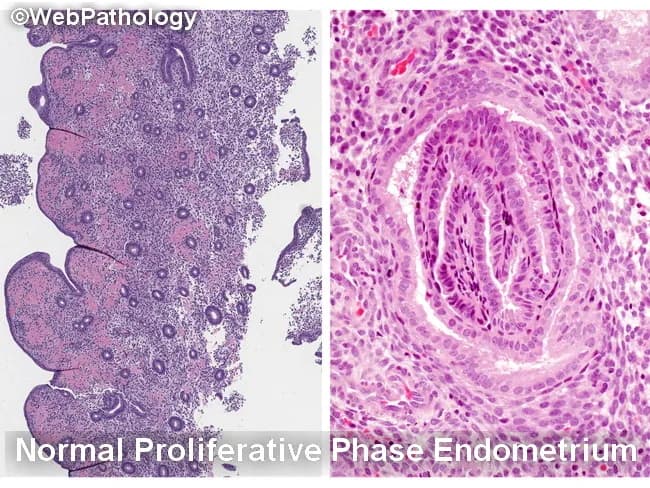
When an endometrial biopsy is taken, glandular tissue can be mechanically disrupted, causing one gland (or a fragment of glandular epithelium) to become invaginated or pushed inside another gland — like one telescope tube sliding into another. This creates the appearance of a "gland-within-a-gland."
Why It Matters Clinically
This is a sampling/processing artifact that can create false crowding of glands, mimicking:
| Condition | Why It Can Be Confused |
|---|---|
| Atypical Endometrial Hyperplasia (AEH) | Crowded gland architecture resembles true hyperplasia |
| Endometrial Intraepithelial Neoplasia (EIN) | Apparent gland-to-stroma ratio distortion |
| Well-differentiated endometrioid carcinoma | Cribriform-like pattern from telescoped fragments |
Key Distinguishing Features of Artifact vs. True Pathology
- In telescoping artifact, the cytology remains bland — no nuclear atypia, no mitotic activity
- The glandular fragments may appear disconnected or floating within other glands
- The surrounding stroma and overall specimen architecture remain normal
- True AEH/EIN shows cytologic atypia (prominent nucleoli, loss of nuclear polarity) in addition to architectural changes
Practical Importance
Pathologists must recognize telescoping to avoid overcalling benign or normal proliferative endometrium as hyperplasia or neoplasia. Clinical correlation with the patient's history, hormone status, and imaging is essential when artifacts are present.
As illustrated in gynecologic pathology references: "Artifacts such as glandular fragmentation, fragmentation- or telescoping-related crowding, and sample artifact can mimic AEH/EIN if the specimen is not intact." (Webpathology — Gynecologic Pathology)
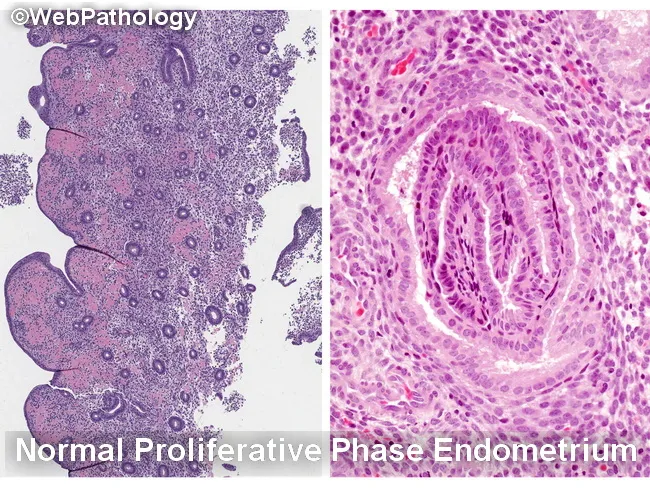
Bottom line: Telescoping of glands = biopsy artifact where one gland is displaced into another, creating spurious crowding that should not be mistaken for endometrial hyperplasia or carcinoma.
This is a shared conversation. Sign in to Orris to start your own chat.