

Analysis x-ray
Reading File
Searching for chest X-ray interpretation guidelines and relevant findings to support analysis of this AP chest radiograph.
search_medical_text
chest X-ray AP interpretation systematic approach findings
Harrison's Principles of Internal Medicine, Twenty First Edition
Page 8247
search_medical_image
normal chest X-ray AP view findings lung fields
Hugging Face pmc clinical VQA raw
Page 0
GradeResponse
GradeResponse
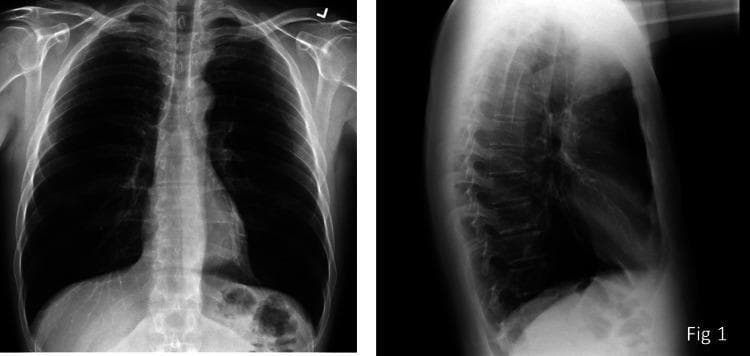
Chest X-Ray Analysis
Patient Details (from film label): Mr. Indrajeet, 32 years, Male | Date: 02/04/2026 | Chest AP (Self-referred)
Systematic Review
1. Technical Adequacy
- AP projection (not PA), which means the heart may appear slightly magnified — this must be accounted for when assessing cardiac size
- Rotation appears minimal — the spinous processes are roughly centered between the medial clavicular heads
- Penetration is adequate — vertebral bodies are just visible behind the cardiac shadow
2. Airway
- Trachea appears midline with no visible deviation
- Carina angle appears within normal limits
3. Bones & Soft Tissues
- Ribs appear intact bilaterally — no visible fractures
- Clavicles appear normal
- Soft tissue swelling: none apparent
4. Cardiac Silhouette
- Heart size appears within normal limits for an AP view — cardiothoracic ratio visually does not appear significantly enlarged
- Cardiac contours (right heart border, left heart border, aortic knuckle) are reasonably defined
5. Mediastinum
- Superior mediastinum appears normal in width
- No obvious widening to suggest aortic pathology or lymphadenopathy
6. Lung Fields
| Region | Right Lung | Left Lung |
|---|---|---|
| Upper zone | Relatively clear | Relatively clear |
| Mid zone | Bronchovascular markings present | Bronchovascular markings present |
| Lower zone | Some haziness / increased opacification | Slightly hazier compared to upper zones |
- Right lower zone shows some increased opacity/haziness which could represent early consolidation, atelectasis, or possibly a pleural effusion
- The left lower zone also appears somewhat hazy — this may partly be due to the AP projection and positioning
- No obvious large pneumothorax
- No gross hyperinflation (ribs not obviously horizontalized, diaphragm not markedly depressed)
7. Diaphragm & Costophrenic Angles
- Right hemidiaphragm appears reasonably defined
- Left hemidiaphragm is less clearly visualized
- Bilateral costophrenic angles are somewhat blunted — this raises the possibility of small pleural effusions bilaterally (right > left)
8. Pleura
- No obvious pneumothorax
- Blunting of costophrenic angles as noted above
9. Notable Finding
- There is a small radio-opaque object visible in the right mid-lower zone (appears to be a small metallic/foreign object or surgical clip) — clinical correlation needed
Impression / Summary
Important: This is an educational analysis only. Formal radiological reporting by a qualified radiologist is required for clinical decisions.
| Finding | Likely Significance |
|---|---|
| AP projection | Limits cardiac size assessment |
| Possible right lower zone haziness | Consider consolidation (pneumonia), atelectasis, or effusion |
| Blunted costophrenic angles | Small bilateral pleural effusions possible |
| Small radio-opaque density right mid zone | Foreign body / surgical clip — needs clinical context |
| No pneumothorax | Reassuring |
| No gross cardiomegaly | Reassuring |
Suggested clinical follow-up:
- Correlate with symptoms (cough, fever, dyspnea, chest pain)
- PA erect chest X-ray (better quality than AP for cardiac and pleural assessment)
- If pleural effusion suspected: lateral decubitus film or ultrasound
- If consolidation suspected: clinical examination + sputum culture, consider CT if needed
This analysis is AI-assisted and intended to support — not replace — evaluation by a licensed physician or radiologist.
This is a shared conversation. Sign in to Orris to start your own chat.