
Appendicitis
Reading File
Searching for comprehensive information on appendicitis across pathophysiology, clinical presentation, diagnosis, and management.
search_medical_text
appendicitis etiology pathophysiology clinical presentation diagnosis
Bailey and Love's Short Practice of Surgery 28th Edition
Page 1360
search_medical_text
appendicitis management treatment surgery complications scoring systems
Bailey and Love's Short Practice of Surgery 28th Edition
Page 1365
search_medical_image
appendicitis imaging ultrasound CT scan findings
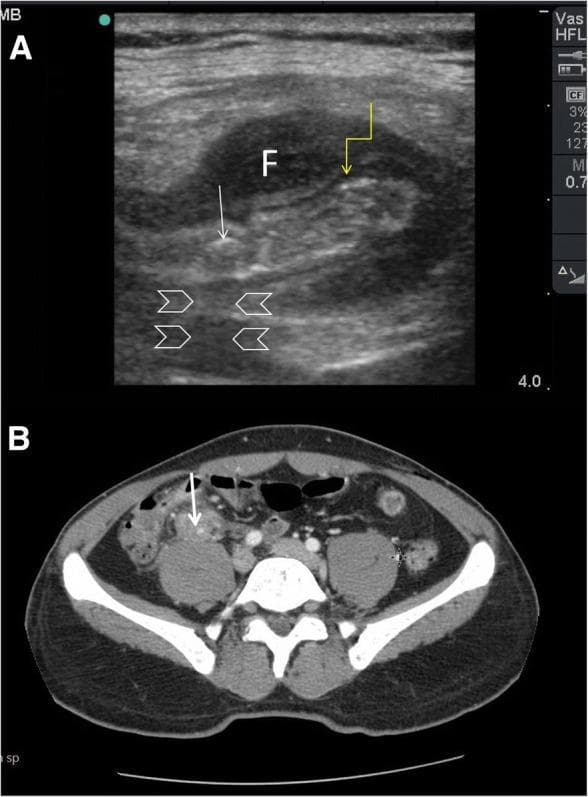
Hugging Face pmc clinical VQA raw
Page 0
GradeResponse
GradeResponse
GradeResponse
Appendicitis
Overview
Appendicitis is acute inflammation of the vermiform appendix and represents the most common cause of emergency abdominal surgery worldwide. It affects approximately 7–8% of the population at some point in life, with peak incidence in the second and third decades.
Pathophysiology
The central mechanism is luminal obstruction of the appendix, most commonly by:
- Faecolith (hardened stool) — most frequent cause
- Lymphoid hyperplasia (especially in children, following viral infections)
- Tumours, foreign bodies, or parasites (less common)
Obstruction leads to bacterial overgrowth, mucosal ischaemia, transmural inflammation, and, if untreated, perforation (typically within 24–72 hours of onset).
Clinical Presentation
| Feature | Detail |
|---|---|
| Pain | Classically periumbilical at onset, migrating to right iliac fossa (RIF) over 6–12 hours |
| Anorexia | Nearly universal — its absence should raise doubt |
| Nausea/vomiting | Common, usually follows onset of pain |
| Fever | Low-grade (37.5–38.5°C); high fever suggests perforation |
| Diarrhoea/urinary symptoms | Possible if appendix is pelvic or retrocaecal |
Key Examination Signs (Bailey & Love's, p. 1360)
- McBurney's point tenderness — maximum tenderness 1/3 of the way from ASIS to umbilicus
- Rovsing's sign — palpation in LIF causes pain in RIF
- Psoas sign — extension of right hip causes pain (retrocaecal appendix)
- Obturator sign — internal rotation of right hip causes pain (pelvic appendix)
- Rebound tenderness / guarding — suggest peritoneal irritation
- Pointing sign — patient points to where pain started and migrated
Diagnosis
Laboratory
- WBC: Elevated (>10,000/mm³) in ~80% — left shift (neutrophilia) is characteristic
- CRP: Elevated; rises later but useful in delayed presentations
- Urinalysis: May show mild pyuria/haematuria (do not exclude appendicitis)
- β-hCG: Must be checked in women of reproductive age (to exclude ectopic pregnancy)
Clinical Scoring Systems
| Score | Components | Interpretation |
|---|---|---|
| Alvarado (MANTRELS) | Migration of pain, Anorexia, Nausea/vomiting, Tenderness RIF, Rebound, Elevated temp, Leukocytosis, Shift to left | ≥7 = likely appendicitis |
| Appendicitis Inflammatory Response (AIR) | Similar with CRP added | More validated in adults |
| pAAS | Paediatric variant |
Imaging
| Modality | Findings | Use |
|---|---|---|
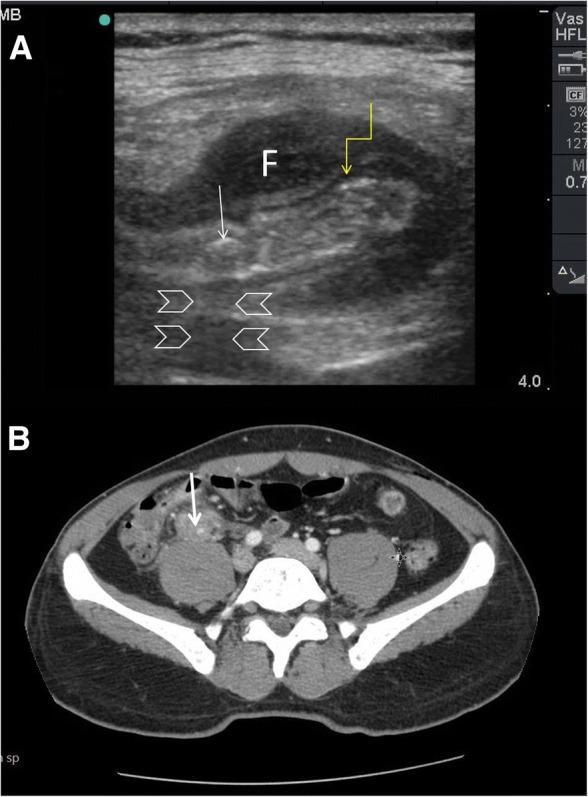
| Ultrasound | Non-compressible appendix >6 mm diameter, faecolith with posterior acoustic shadowing, periappendiceal fluid | First-line (no radiation); operator-dependent |
| CT abdomen/pelvis | Dilated appendix with wall enhancement, faecolith, periappendiceal fat stranding | Gold standard; sensitivity ~98% |
| MRI | Similar to CT without radiation | Preferred in pregnancy |
Differential Diagnosis
- Women: Ovarian cyst/torsion, ectopic pregnancy, PID, Mittelschmerz
- Men/Children: Mesenteric adenitis, Meckel's diverticulitis, intussusception
- All ages: Right ureteric colic, Crohn's disease, caecal carcinoma, psoas abscess, right-sided diverticulitis
Management
Preoperative Preparation (Bailey & Love's, p. 1365)
- IV fluids (target adequate urine output)
- IV antibiotics covering Gram-negative bacilli + anaerobes (e.g., ceftriaxone + metronidazole)
- VTE prophylaxis (mechanical ± pharmacological)
- Single perioperative dose of antibiotics reduces wound infection in uncomplicated cases
Surgical Treatment
- Appendicectomy is the definitive treatment — laparoscopic preferred (shorter hospital stay, less wound infection, faster recovery)
- Open appendicectomy remains valid when laparoscopy is unavailable or contraindicated
- In perforated appendicitis: therapeutic antibiotics, thorough washout; drain placement controversial
Non-operative Management
- Select uncomplicated cases (no perforation, no faecolith, low-risk patients) may be managed with IV antibiotics alone (e.g., ertapenem or ceftriaxone + metronidazole for 24–48h then oral step-down)
- Recurrence rate ~20–35% at 5 years; patients must be counselled appropriately
- Not appropriate for perforated appendicitis or appendiceal mass
Complicated Appendicitis (Abscess/Phlegmon)
- Appendiceal phlegmon: IV antibiotics first; interval appendicectomy at 6–8 weeks (debated)
- Appendiceal abscess: Percutaneous drainage + antibiotics; interval appendicectomy
Complications
| Complication | Notes |
|---|---|
| Perforation | ~20–30% at presentation; higher in extremes of age |
| Peritonitis | Local or generalised; requires urgent surgery |
| Appendiceal abscess/phlegmon | Walled-off infection |
| Portal pyaemia / liver abscess | Rare but serious |
| Post-op wound infection | Most common surgical complication |
| Stump appendicitis | Rare recurrence in residual stump after appendicectomy |
Special Populations
- Children: Perforation rates higher (thin appendiceal wall, delayed diagnosis); mesenteric adenitis is a common mimic
- Elderly: Atypical presentation common; higher perforation and mortality rates
- Pregnancy: MRI preferred for imaging; appendix displaced superiorly by gravid uterus; higher risk of preterm labour post-operatively
- Immunocompromised: May lack classic inflammatory signs; high index of suspicion required
Prognosis
- Uncomplicated appendicitis treated promptly: mortality <0.1%
- Perforated appendicitis: mortality rises to 1–5%, higher in elderly
- Laparoscopic appendicectomy is associated with faster return to normal activity and lower wound infection rates compared to open surgery
This is a shared conversation. Sign in to Orris to start your own chat.