
Vitiligo treatment
Reading File
Searching for vitiligo treatment across medical literature now.
search_medical_text
vitiligo treatment management therapies
search_medical_text
vitiligo phototherapy topical agents repigmentation
Harrison's Principles of Internal Medicine, Twenty First Edition
Page 1712
search_medical_image
vitiligo skin depigmentation clinical appearance
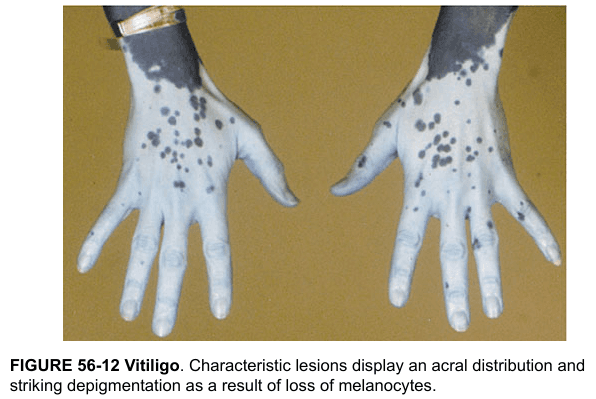
Harrison's Principles of Internal Medicine, Twenty First Edition
Page 1518
GradeResponse
GradeResponse
GradeResponse
Vitiligo Treatment
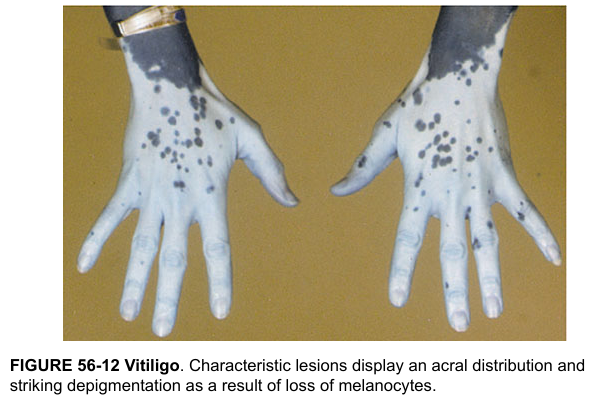
Vitiligo is an autoimmune disorder causing loss of melanocytes, resulting in well-demarcated depigmented patches. Treatment aims to halt progression and achieve repigmentation.
Goals of Treatment
- Stop active disease progression
- Repigment affected skin
- Maintain achieved repigmentation
First-Line Therapies
Topical Agents
| Agent | Details |
|---|---|
| Topical corticosteroids (TCS) | High-potency (e.g., clobetasol) for trunk/extremities; moderate-potency for face. First-line for localized disease. Monitor for skin atrophy with prolonged use. |
| Topical calcineurin inhibitors (TCIs) | Tacrolimus 0.1% or pimecrolimus 1%. Preferred for face and intertriginous areas (steroid-sparing). Safe for long-term use. |
| Ruxolitinib cream (JAK inhibitor) | FDA-approved (2022) for non-segmental vitiligo in adults/adolescents ≥12 years. JAK1/2 inhibitor targeting the IFN-γ/CXCL10 pathway. Most effective repigmentation agent to date for facial lesions. |
Phototherapy
Narrow-band UVB (NB-UVB) is the mainstay of phototherapy for vitiligo (Harrison's, p. 1712):
- Fluorescent bulbs emitting ~311 nm radiation
- Superior efficacy over broad-band UVB
- Suitable for widespread disease or lesions resistant to topicals
- 2–3 sessions/week for a minimum of 6–12 months
- Can be combined with topical agents for enhanced effect
PUVA (Psoralen + UVA):
- Oral or topical psoralen + UVA exposure
- Effective but higher risk (nausea, phototoxicity, cataract risk with oral psoralen)
- Less commonly used now that NB-UVB is available
Excimer laser (308 nm):
- Targeted phototherapy for localized lesions
- Allows high-dose UV delivery to affected patches while sparing normal skin
- Faster response than whole-body NB-UVB
Surgical Options
Reserved for stable segmental or focal vitiligo (no new lesions for ≥12 months):
| Procedure | Details |
|---|---|
| Suction blister epidermal grafting | Most widely used; good cosmetic outcomes |
| Split-thickness skin grafting | For larger areas |
| Punch grafting | Small, focal patches |
| Melanocyte-keratinocyte transplantation (MKTP) | Cultured cells; can cover large areas |
Systemic Therapies
- Oral mini-pulse corticosteroids (e.g., betamethasone 5 mg on 2 consecutive days/week): used to halt rapidly progressive disease
- Oral JAK inhibitors (ruxolitinib, baricitinib — investigational/emerging): promising phase II/III trial data for widespread disease
- Afamelanotide (MC1R agonist implant): used in combination with NB-UVB, accelerates repigmentation
Camouflage / Depigmentation
- Cosmetic camouflage (waterproof concealers, self-tanners) for psychosocial impact
- Depigmentation with monobenzone (monobenzyl ether of hydroquinone): considered only when >50% BSA is affected and repigmentation has failed — permanently depigments remaining normal skin
Special Considerations
| Factor | Guidance |
|---|---|
| Segmental vitiligo | Less responsive to medical treatment; surgical options preferred |
| Active/inflammatory vitiligo | Treat inflammation first (TCIs, TCS, systemic steroids) before surgery |
| Children | Prefer TCIs and NB-UVB; avoid prolonged high-potency TCS |
| Face/eyelids | TCIs + NB-UVB or excimer laser; avoid TCS long-term |
| Koebner phenomenon | Minimize trauma; treat wounds promptly |
Monitoring
- Assess repigmentation at 3–6 months
- Wood's lamp examination to detect early lesions and assess progress
- Screen for associated autoimmune conditions: thyroid disease (most common), type 1 diabetes, Addison's disease, alopecia areata
Key takeaway: Mild/localized disease → topical TCS or TCIs ± excimer. Moderate/widespread → NB-UVB ± topicals. Rapidly progressive → systemic mini-pulse steroids. Stable localized → surgical grafting. Ruxolitinib cream is a significant recent advance for facial non-segmental vitiligo.
This is a shared conversation. Sign in to Orris to start your own chat.