
Give notes on sterilization with its methods and types
Reading File
Now let me search the medical library for sterilization content in parallel:
Finding Sources
Finding Sources
The query is about sterilization in microbiology (methods/types for killing microorganisms). Let me read the most relevant microbiology sources and also check for disinfection content:
Reading File
Reading File
Finding Sources
Excellent content found. Let me now read more from Sherris microbiology for the full sterilization section and also check for radiation/filtration methods:
Reading File
Finding Sources
Reading File
I now have comprehensive content. Let me also fetch the autoclave diagram image:
Loading Image
Finding Sources
I have enough comprehensive content to compile detailed notes on sterilization. Let me now write a thorough response.
Sterilization - Complete Notes
Definition
Sterilization is the total destruction of ALL microorganisms, including the most resilient forms - bacterial spores, mycobacteria, nonenveloped (non-lipid) viruses, and fungi. It is an absolute term; an item is either sterile or it is not.
Key distinction: Sterilization kills everything, including spores. Disinfection destroys most but not all microbial forms (spores may survive).
Key Terminology (Definitions)
| Term | Meaning |
|---|---|
| Sterilization | Complete destruction of all microbial life, including spores |
| Disinfection | Destruction of most microbes using physical or chemical agents; spores may survive |
| Antisepsis | Use of chemical agents on living tissue/skin to inhibit or eliminate microbes; no sporicidal action implied |
| Bactericidal | Kills bacteria |
| Bacteriostatic | Inhibits bacterial growth without killing |
| Germicide | Kills microorganisms (broader term) |
| Sporicidal | Kills bacterial spores |
- Sherris & Ryan's Medical Microbiology, 8th ed.
Classification of Sterilization Methods
Sterilization can be accomplished using physical, gas/vapor, or chemical methods.
A. Physical Methods
1. Heat
Heat is the most widely used sterilization method. It acts by denaturing proteins and disrupting nucleic acids.
a) Moist Heat (Steam Sterilization)
Moist heat is far more rapid and effective than dry heat because reactive water molecules irreversibly denature proteins by disrupting hydrogen bonds between peptide groups at relatively low temperatures.
i. Autoclave (Steam under pressure)
- The gold standard of sterilization.
- Essentially a sophisticated pressure cooker.
- Air is removed either by:
- Evacuation of the chamber before filling with steam, OR
- Downward displacement - capitalizes on heaviness of air compared to saturated steam
- Standard cycle: 121°C for 15 minutes at 15 psi pressure
- Spores directly exposed are killed in < 5 minutes; 10-15 minutes accounts for variability in steam penetration
- A drop of just 1.7°C increases the required exposure time by 48%
- "Flash" autoclaves (used in operating rooms) use higher temperatures (~134°C) for shorter times
- Uses: Surgical instruments, dressings, culture media, aqueous solutions
- Cannot be used for: oils, waxes, powders (immiscible in water), heat-sensitive plastics
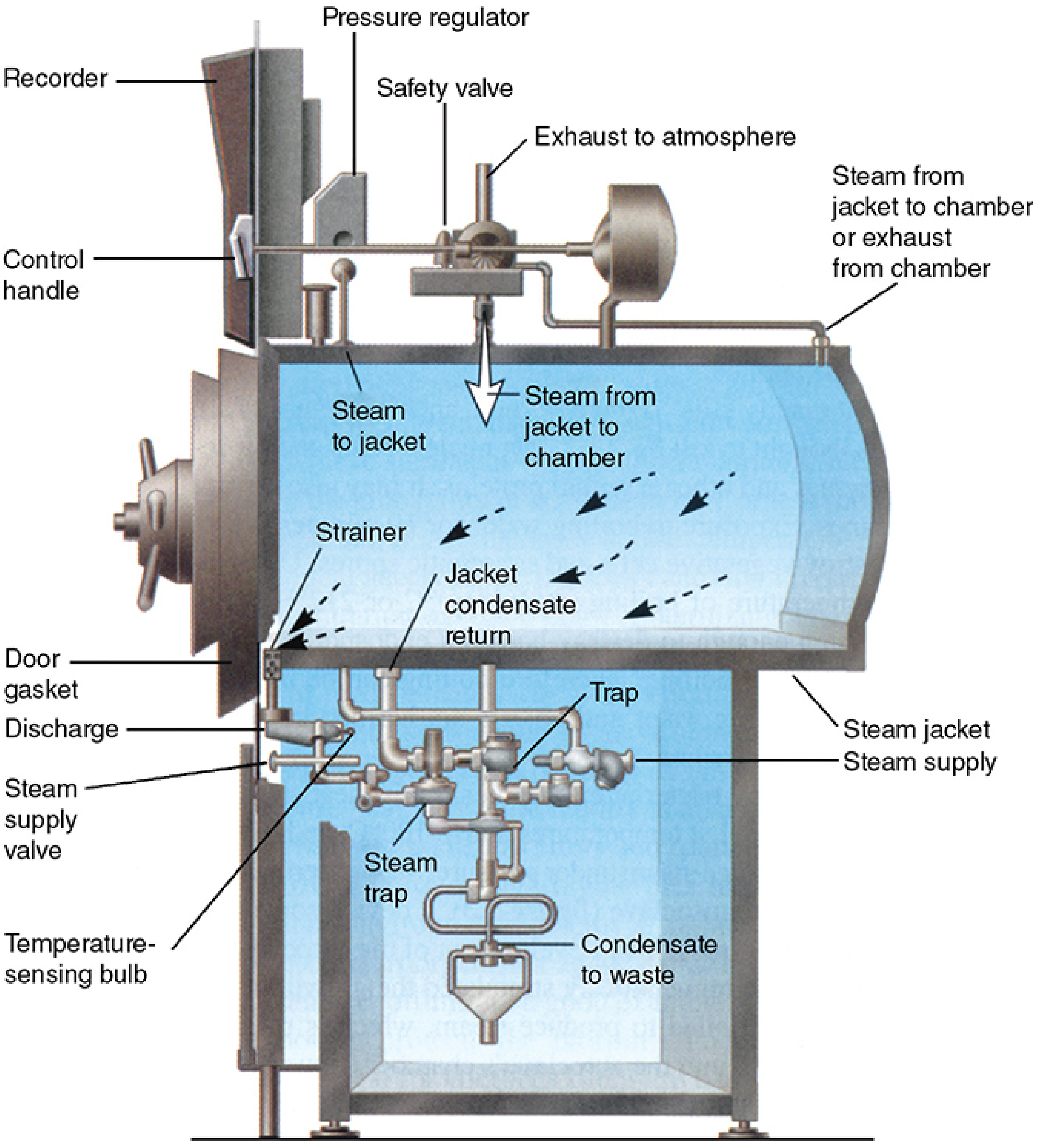
ii. Boiling (100°C at sea level)
- High-level disinfection, NOT true sterilization
- Kills most pathogens and some spores
- Vegetative bacteria killed within minutes at 70°C or less
- Some heat-resistant spores may survive prolonged boiling
iii. Pasteurization
- Exposure to 55-75°C to remove all vegetative bacteria
- Spores are unaffected
- Activity level: Intermediate
- Uses: milk, beverages, plastic hospital equipment, certain fruit drinks
- Originally proposed by Pasteur for wine-making to prevent microbial spoilage
b) Dry Heat
- Mechanism: Oxidation of cellular components (protein denaturation requires much higher temperatures without moisture)
- Temperature and time: 160°C for 2 hours in a sterilizing oven
- Less efficient than moist heat - carbonization of organic material occurs
- Uses: Metals, glassware, heat-resistant oils and waxes immiscible in water, laboratory glassware preparation
- Not recommended for most instruments due to prolonged exposure times and instrument damage
c) Incineration
- Simplest method - exposure to a naked flame
- Examples: wire loop in microbiology labs, knife blade, needle (emergency sterilization)
- Disposable materials are rapidly decontaminated by incineration
- Destroys all microorganisms including spores
2. Radiation
a) Ultraviolet (UV) Light
- Absorbed by nucleic acids, causing genetic damage (thymine dimer formation)
- Activity level: Sterilizing (but limited in practice)
- Major limitation: poor penetration ability - cannot penetrate glass, plastic, or most solid objects
- Uses: Irradiation of air in critical hospital sites, decontamination of air in facilities handling hazardous organisms, biosafety cabinets
- Not suitable for materials with irregular surfaces or anything UV cannot reach
b) Ionizing Radiation (Gamma rays, Cathode rays)
- Carries far greater energy than UV
- Mechanism: Direct DNA damage + production of toxic free radicals and hydrogen peroxide from water within microbial cells
- Activity level: Sterilizing - all microorganisms including spores
- Advantage: Can be applied to packaged items (packaging done before exposure to penetrating radiation)
- Uses: Industrial sterilization of disposable surgical supplies (gloves, plastic syringes, specimen containers), some foodstuffs
- Sherris & Ryan's Medical Microbiology, 8th ed.
3. Filtration
- Both live and dead microorganisms are physically removed from liquids by positive- or negative-pressure filtration
- Membrane filters are available with variable pore sizes: 0.005-1 μm
- For removal of bacteria: pore size of 0.2 μm is effective
- Best used for: sterilization of large volumes of fluid, especially fluids containing heat-labile components (e.g., serum, enzymes, certain drugs)
- Limitation: Not effective for removing viruses (too small to be trapped)
- Used in: pharmaceutical industry, microbiological media preparation, IV solutions
B. Gas / Vapor Methods
1. Ethylene Oxide (EO)
- An alkylating agent - inactivates microorganisms by replacing labile hydrogen atoms in DNA
- Activity: Sterilizing (all microorganisms)
- Treatment time: generally 4 hours, followed by 12-hour aeration to eliminate toxic gas before use
- Why aeration is required: The gas diffuses into absorbed substances and must be removed before clinical use
- Advantages: Effective for heat-labile devices (artificial heart valves, certain plastics, lensed instruments) damaged by autoclaving
- Disadvantages: Flammable, potentially explosive, carcinogenic to laboratory animals; strict regulations limit use
- Avoided if acceptable alternatives are available
2. Hydrogen Peroxide Vapor
- Mechanism: Oxidizing nature of the gas
- Activity: Sterilizing
- A more advanced variation: Plasma gas sterilization
- Hydrogen peroxide is vaporized, then reactive free radicals are produced with microwave-frequency or radio-frequency energy
- Efficient sterilizing method that does not produce toxic by-products
- Has replaced many applications of ethylene oxide
- Limitation: Cannot be used with materials that absorb hydrogen peroxide or react with it
- Uses: Sterilization of instruments
3. Formaldehyde Vapor
- An alkylating agent (similar mechanism to ethylene oxide)
- Can be used without pressure to decontaminate larger areas such as rooms
- Less commonly used due to toxicity and irritant properties
C. Chemical Sterilants (Liquid)
| Agent | Mechanism | Level | Uses / Notes |
|---|---|---|---|
| Glutaraldehyde | Alkylating agent | High (sterilizing with prolonged contact) | Endoscopes, surgical equipment; safety concerns with handling |
| Peracetic acid | Oxidizing agent | Sterilizing | Excellent activity; end products (acetic acid + O₂) are non-toxic |
| Hydrogen peroxide (liquid) | Oxidizing agent | High | Contact lenses; inactivated by organic matter |
| Chlorine compounds | Oxidizing agent | High | Water disinfection; inactivated by organic matter |
- Medical Microbiology 9e and Sherris & Ryan's Medical Microbiology, 8th ed.
Levels of Disinfection (vs. Sterilization)
| Level | What is killed | Examples |
|---|---|---|
| Sterilization | All organisms including spores | Autoclave, EO gas, ionizing radiation, plasma sterilization |
| High-level disinfection | All except high numbers of spores | Glutaraldehyde, hydrogen peroxide, peracetic acid, moist heat |
| Intermediate-level | Vegetative bacteria, fungi, most viruses; NOT spores | Alcohols, iodophors, phenolics |
| Low-level | Most bacteria and fungi, lipophilic viruses; NOT spores or M. tuberculosis | Quaternary ammonium compounds |
Summary Table of Sterilization Methods
| Method | Mechanism | Activity | Uses |
|---|---|---|---|
| Autoclave | Moist heat/protein denaturation | Sterilizing - all | General instruments, media |
| Dry heat oven | Oxidation | Sterilizing | Glassware, oils, metals |
| Incineration | Combustion | Sterilizing | Wire loops, waste |
| Boiling | Protein denaturation | High (not true sterilization) | General |
| Ethylene oxide | DNA alkylation | Sterilizing - all | Heat-labile devices |
| H₂O₂ vapor/plasma | Free radical oxidation | Sterilizing | Instruments (replaces EO) |
| Peracetic acid | Oxidation | Sterilizing | Non-toxic disposal |
| Glutaraldehyde | Alkylation | High/Sterilizing | Endoscopes |
| UV radiation | DNA damage (thymine dimers) | Sterilizing (limited penetration) | Air, biosafety cabinets |
| Ionizing radiation | DNA damage + free radicals | Sterilizing - all | Packaged surgical supplies |
| Filtration (0.2 μm) | Physical removal | Sterilizing for bacteria | Heat-labile fluids, media |
Clinical Points to Remember
- Autoclaving is the method of choice for heat-stable items in clinical settings.
- Ethylene oxide is reserved for heat-labile equipment (e.g., cardiac valves, plastic instruments) but is being replaced by plasma sterilization due to toxicity concerns.
- Filtration is used for heat-sensitive liquids but does NOT remove viruses.
- UV light is used for air and surface disinfection only - its poor penetration makes it unsuitable for solid materials.
- Ionizing radiation is the preferred method for industrial pre-packaged sterilization.
- The 3 critical parameters for autoclave sterilization: time, temperature, and moisture (steam must be saturated).
Sources: Sherris & Ryan's Medical Microbiology, 8th Ed. | Medical Microbiology 9e (Murray)
This is a shared conversation. Sign in to Orris to start your own chat.