

Findings?
Reading File
Analyzing this PA chest X-ray for findings.
search_medical_image
chest X-ray bilateral lung opacities interstitial markings infiltrates findings
Hugging Face pmc clinical VQA raw
Page 0
search_medical_text
chest X-ray bilateral interstitial infiltrates pulmonary opacities interpretation findings
Harrison's Principles of Internal Medicine, Twenty First Edition
Page 6322
GradeResponse
GradeResponse
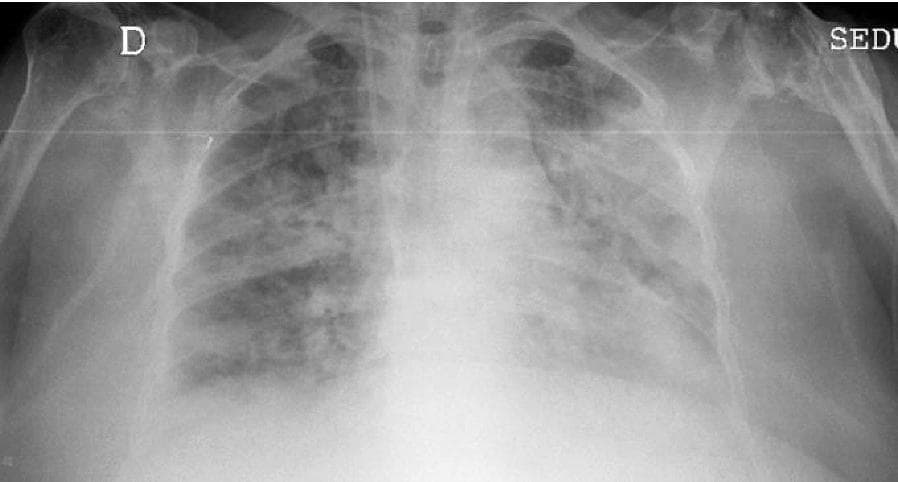
PA Chest X-ray Findings
Technical quality: PA projection, adequate inspiration, no rotation noted.
Key Findings
-
Bilateral interstitial infiltrates — diffuse reticular/reticulonodular markings throughout both lung fields, more prominent in the mid and lower zones. These obscure the normal vascular markings in areas.
-
Bilateral perihilar haziness — increased density in the perihilar regions bilaterally, consistent with interstitial thickening or early alveolar involvement.
-
Increased bronchovascular markings — prominent throughout, suggesting interstitial edema or an inflammatory/infectious process.
-
Cardiomegaly — the cardiac silhouette appears mildly enlarged (CTR likely >0.5), raising the possibility of cardiac contribution to the lung findings.
-
No obvious large effusion or pneumothorax — the costophrenic angles appear partially visible; cannot fully exclude a small effusion at the bases.
-
Mediastinum — appears central; trachea midline.
-
Bony structures — no obvious rib fractures or lytic lesions noted on this view.
Differential Diagnosis (for bilateral interstitial pattern)
| Priority | Diagnosis | Supporting Features |
|---|---|---|
| High | Cardiogenic pulmonary edema | Cardiomegaly + bilateral perihilar haziness |
| High | Bilateral pneumonia (viral/atypical/bacterial) | Diffuse infiltrates, bilateral |
| Moderate | Interstitial lung disease (ILD) | Reticular pattern, bilateral |
| Moderate | Pneumocystis jirovecii pneumonia (PCP) | Bilateral perihilar interstitial infiltrates (Harrison's, p. 6322) |
| Lower | Pulmonary TB | If upper lobe predominant; not dominant here |
| Lower | Lymphangitic carcinomatosis | Reticular pattern, clinical context |
Impression
Bilateral interstitial pulmonary infiltrates with possible cardiomegaly. The pattern is most consistent with cardiogenic pulmonary edema or bilateral interstitial pneumonia (viral/atypical). Clinical correlation with symptoms, vitals, BNP/NT-proBNP, SpO₂, and prior imaging is essential. HRCT chest and echocardiogram would help further characterize.
⚠️ This analysis is for educational/clinical support purposes. Formal radiology reporting by a qualified radiologist is recommended.
This is a shared conversation. Sign in to Orris to start your own chat.