
Why the ascending and descending tract get crossed and why not straight forward
Reading File
Searching for relevant content on this neuroanatomy topic.
search_medical_text
why do ascending and descending tracts cross decussate contralateral
Bailey and Love's Short Practice of Surgery 28th Edition
Page 411
search_medical_image
spinal cord ascending descending tracts decussation diagram
Hugging Face pmc clinical VQA raw
Page 0
GradeResponse
GradeResponse
Here is a thorough explanation of why neural tracts cross (decussate) rather than staying ipsilateral.
Why Do Ascending & Descending Tracts Cross?
The Short Answer
Most sensory and motor tracts cross the midline so that each side of the brain controls and perceives the opposite side of the body. This is called contralateral representation. The crossing itself is called decussation.
Evolutionary & Developmental Reasons
The honest answer is that we don't have a single definitive "why" — this is one of neuroscience's genuinely open questions. Several leading hypotheses exist:
1. The Ipsilateral Motor Advantage Hypothesis (Loeb, 1973 / Vulliemoz et al.)
Early bilateral organisms evolved eyes and limbs on opposite sides of the body. Neural connections had to cross the midline to coordinate these opposing structures. Once established, the pattern was conserved through evolution.
2. The Optic Chiasm "Inversion" Hypothesis (Ramón y Cajal)
Santiago Ramón y Cajal proposed that the optic chiasm was the ancestral driver. Light entering from the right visual field hits the left side of each retina → fibers cross to preserve a spatially coherent map of the visual world. Motor and somatosensory systems then "followed" the same lateralization logic to maintain consistent brain-body mapping.
3. The Developmental Axon Guidance Hypothesis
During embryogenesis, axonal growth cones follow molecular gradients (Netrin-1, Slit-Robo, EphrinB3). Midline crossing is an active, genetically programmed event — not an accident. Commissural interneurons are guided to cross the floor plate of the neural tube by these chemoattractants and chemorepellents. The motor and sensory tracts adopt a crossed architecture because the same molecular machinery governs their development.
4. The Reflex Arc Efficiency Hypothesis
A crossed arrangement allows bilateral reflex loops — e.g., when you step on a thorn (right foot), the right leg withdraws (via ipsilateral spinal reflex) while the left leg extends (crossed extensor reflex) to maintain balance. This requires crossed connections at the spinal level.
Where Do the Major Tracts Cross?
| Tract | Type | Where it Crosses |
|---|---|---|
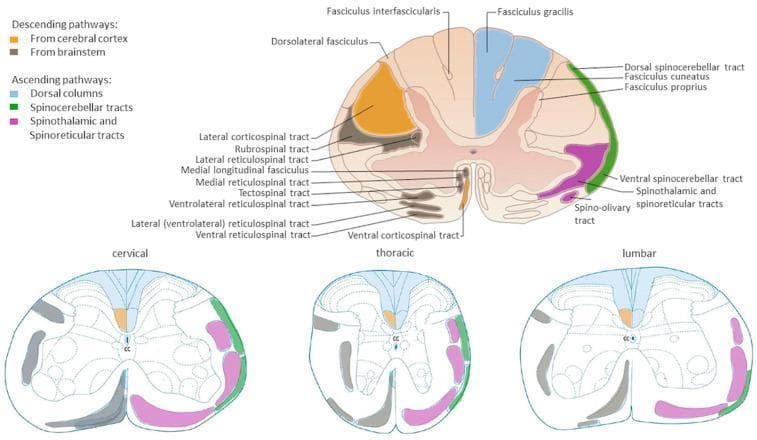
| Lateral corticospinal tract (motor) | Descending | Pyramidal decussation at the medulla-spinal cord junction |
| Dorsal columns / Medial lemniscus (fine touch, proprioception) | Ascending | Decussates in the medulla (internal arcuate fibers) |
| Spinothalamic tract (pain, temperature) | Ascending | Crosses within 1–3 spinal cord segments of entry (anterior white commissure) |
| Anterior corticospinal tract | Descending | Crosses segmentally in the spinal cord (bilateral control of axial muscles) |
(Bailey and Love's Surgery, 28th ed., p. 411)
Clinical Relevance — Why This Matters
The level at which each tract crosses determines the pattern of deficits after injury:
-
Spinal cord hemisection (Brown-Séquard Syndrome):
- Ipsilateral loss of motor function + proprioception (dorsal column hasn't crossed yet)
- Contralateral loss of pain and temperature (spinothalamic has already crossed)
-
Medullary lesion (e.g., lateral medullary/Wallenberg syndrome):
- Contralateral body pain/temperature loss + ipsilateral face involvement — because the tract crosses at different levels for body vs. face.
-
Cortical stroke → contralateral weakness/sensory loss, because both major tracts have already crossed above the lesion.
Spinal Cord Tract Organization
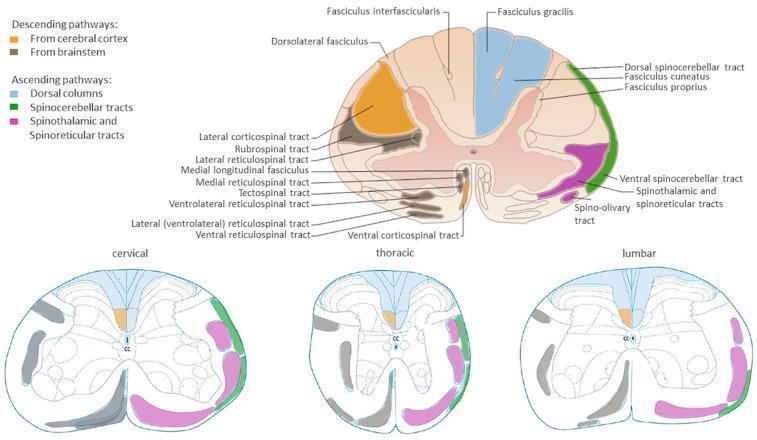
Motor (descending) tracts in orange/grey; sensory (ascending) in blue, green, and pink. Note the somatotopic arrangement and bilateral symmetry.
Key Takeaway
The crossed arrangement is:
- Evolutionarily ancient — conserved across all vertebrates
- Genetically hardwired — driven by floor-plate molecular signals in the embryo
- Functionally advantageous — enables coherent contralateral body maps and bilateral spinal reflexes
- Clinically predictable — the level of crossing determines the pattern of neurological deficits, which is the basis of neurological localization
This is a shared conversation. Sign in to Orris to start your own chat.