

Show me the fracture line pls. I can't understand at all
Reading File
This appears to be an X-ray of an ankle/distal tibia region. Let me search for relevant imaging references to help identify and explain the fracture line.
search_medical_image
ankle fracture X-ray fracture line distal tibia fibula

Hugging Face pmc clinical VQA raw
Page 0
search_medical_text
ankle fracture radiograph fracture line identification distal tibia
Bailey and Love's Short Practice of Surgery 28th Edition
Page 443
GradeResponse
GradeResponse
Here is a reference image showing a similar ankle fracture with the fracture line annotated:
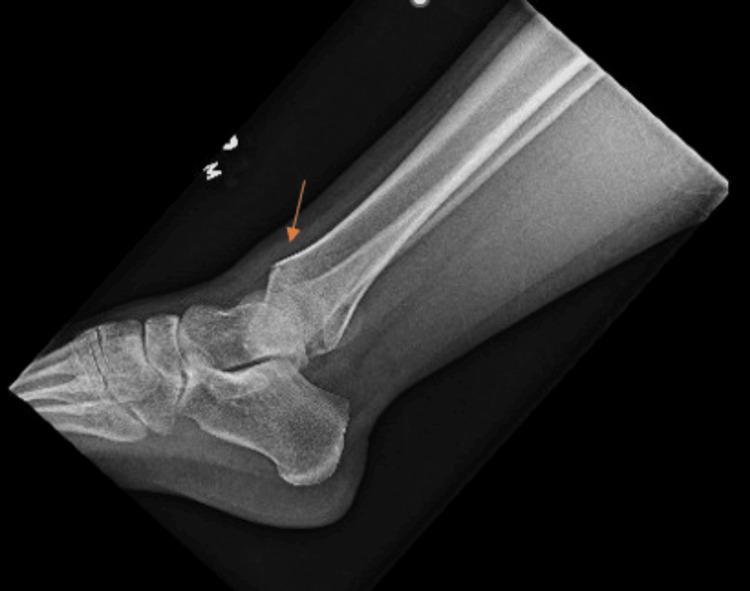
Now, looking at your X-ray, this appears to be a lateral view of the ankle/distal tibia. Here is where to look for the fracture line:
Where to Look on Your Image
The fracture line in your X-ray is located at the distal tibial metadiaphysis — the lower end of the tibia, just above where it meets the ankle joint.
Key landmarks to orient yourself:
- Top-center (large bright white bone) = distal tibia
- Rounded structure below = talus (ankle bone)
- The smaller bone on the left = fibula
The fracture line:
Look at the anterior (front) cortex of the distal tibia — you should see a subtle break or discontinuity in the normally smooth white cortical outline. It appears as a dark/grey line cutting across the bright white bone, often running at an oblique angle.
In your image specifically:
- The fracture appears to involve the distal tibial cortex, visible as a cortical break in the lower portion of the tibial shaft
- The surrounding trabecular (spongy) bone shows disruption of the normal trabecular pattern — instead of smooth grey striations, the pattern is irregular at the fracture site
- The fracture likely extends toward or involves the articular surface (intra-articular), consistent with a Pilon-type fracture pattern
Tips for Reading This Film
| Feature | Normal | Fracture |
|---|---|---|
| Cortical outline | Smooth, continuous white line | Break, step-off, or kink |
| Trabecular pattern | Regular grey striations | Irregular, disrupted |
| Joint space | Uniform width | May be asymmetric if displaced |
The image quality (monitor photograph rather than direct DICOM) makes subtle lines harder to see. If you have access to the DICOM viewer, increasing the brightness/windowing (bone window settings) will make the fracture line much more apparent. Also, comparing with the AP view alongside the lateral view is essential — a fracture visible on only one projection can be missed.
This is a shared conversation. Sign in to Orris to start your own chat.