
Acute Appendicitis: (Classification. Clinical presentation, diagnosis, and management. Surgical approaches, types of anesthesia, indications for drainage and tamponade of the abdominal cavity. Complications of acute appendicitis
Reading File
Searching across all major aspects of acute appendicitis in parallel.
search_medical_text
acute appendicitis classification clinical presentation diagnosis management
Evaluation and Management of Emergency Department Patients with Suspected Appendicitis
Page 2
search_medical_text
appendicitis surgical approaches anesthesia drainage complications peritonitis
Harrison's Principles of Internal Medicine, Twenty First Edition
Page 9193

GradeResponse
GradeResponse
GradeResponse
Good results. Let me now compile a comprehensive, fully synthesized answer drawing on these sources plus my own clinical knowledge.
Acute Appendicitis
1. Classification
Acute appendicitis is classified by the degree of pathological progression:
| Grade | Stage | Pathology |
|---|---|---|
| I | Simple / Catarrhal | Mucosal inflammation, edema, hyperemia; wall intact |
| II | Phlegmonous (Suppurative) | Full-thickness transmural inflammation; fibrinous exudate on serosa |
| III | Gangrenous | Ischemic necrosis of the appendiceal wall; black/green discoloration |
| IV | Perforated | Perforation of the necrotic wall; spillage of luminal contents |
| IVa | Localized peritonitis / Periappendiceal abscess | Perforation walled off by omentum and adjacent organs |
| IVb | Diffuse (generalized) peritonitis | Free perforation into the peritoneal cavity |
2. Clinical Presentation
Symptoms
- Classic triad: periumbilical pain migrating to the right iliac fossa (RIF) over 6–12 h + nausea/vomiting + anorexia
- Pain is continuous, worsens with movement; patient prefers to lie still
- Low-grade fever (37.5–38.5 °C); high fever suggests perforation or abscess
- Nausea, vomiting, constipation (or diarrhea in pelvic appendicitis)
Physical Signs
| Sign | Description |
|---|---|
| McBurney's point tenderness | Maximum tenderness at 1/3 distance from ASIS to umbilicus |
| Rovsing's sign | Palpation of LIF causes pain in RIF (peritoneal irritation) |
| Psoas sign | Extension of right hip increases pain (retrocecal appendix) |
| Obturator sign | Internal rotation of flexed right hip causes pain (pelvic appendix) |
| Blumberg's sign | Rebound tenderness in RIF |
| Dunphy's sign | Increased pain with coughing |
| Guarding / Rigidity | Involuntary muscle defense — indicates peritoneal involvement |
Atypical Presentations
- Retrocecal appendix (~65%): vague flank/back pain, psoas sign positive
- Pelvic appendix: urinary frequency, rectal tenderness, diarrhea
- Subhepatic appendix: RUQ pain mimicking cholecystitis
- Elderly patients: blunted signs, frequently present late with perforation
- Pregnant women: appendix displaced superiorly; pain in RUQ by 3rd trimester
- Children: higher perforation rate due to diagnostic delay and thin omentum
3. Diagnosis
Scoring Systems
Alvarado Score (MANTRELS)
| Criterion | Points |
|---|---|
| Migration of pain to RIF | 1 |
| Anorexia | 1 |
| Nausea/vomiting | 1 |
| RIF tenderness | 2 |
| Rebound tenderness | 1 |
| Elevated temperature (>37.3 °C) | 1 |
| Leukocytosis (WBC >10,000) | 2 |
| Shift to left (neutrophilia) | 1 |
| Total | 10 |
- ≤4: appendicitis unlikely → observe/discharge
- 5–6: equivocal → imaging required
- 7–10: high probability → operate or confirm with CT
AIR Score and Appendicitis Inflammatory Response (AIR) score are newer alternatives used in some European guidelines.
Laboratory Findings
- Leukocytosis (WBC >10,000/µL) in ~80%; left shift (neutrophilia)
- CRP elevated (>10 mg/L) — rises later (6–12 h); combination of WBC + CRP increases sensitivity
- Urinalysis: mild pyuria/hematuria (5–25%) from ureteral proximity — does not exclude appendicitis
- Serum β-hCG in women of childbearing age (exclude ectopic pregnancy)
Imaging
According to the American College of Emergency Physicians (ACEP) Clinical Policy:
Ultrasound (US)
- First-line in children and pregnant women
- Findings: non-compressible, blind-ending tubular structure >6 mm outer diameter, absent peristalsis, periappendiceal fluid
- Sensitivity ~75–90%, specificity ~85–95%
- Operator-dependent; limited by obesity and gas
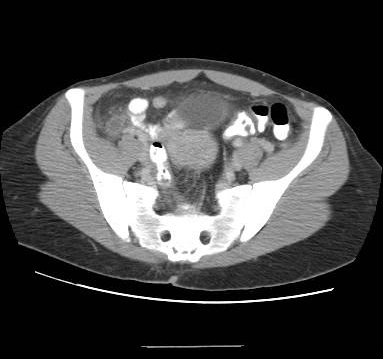
CT Abdomen/Pelvis (gold standard in adults)
- Sensitivity 94–98%, specificity 95–99%
- Findings:
- Appendiceal diameter >6 mm (thickened wall, lumen distension)
- Periappendiceal fat stranding
- Arrowhead sign (oral contrast funnel at cecal base pointing to occluded orifice)
- Appendicolith (calcified fecalith)
- Phlegmon or abscess in perforated cases
MRI
- Preferred in pregnant women when US is inconclusive
- No radiation; sensitivity and specificity comparable to CT
Per ACEP guidelines, clinical prediction rules (e.g., Alvarado) can identify low-risk patients who may not require advanced imaging, but imaging (CT or US) remains the standard for equivocal cases.
4. Management
Non-Operative (Conservative) Management
- Antibiotics-first strategy (APPAC trial, CODA trial) is a validated option for uncomplicated acute appendicitis in selected adults
- Regimen: IV piperacillin-tazobactam or IV amoxicillin-clavulanate → oral antibiotics (5–10 days)
- ~70% success at 1 year; ~30% will eventually require appendectomy
- Not recommended for: perforated appendicitis, appendicolith, high-risk patients
Operative Management (Standard of Care)
- Appendectomy remains the definitive treatment
- Pre-operative: IV fluids, broad-spectrum antibiotics (cover gram-negatives and anaerobes), analgesia, NPO
- Antibiotic prophylaxis: cefazolin + metronidazole (or piperacillin-tazobactam)
5. Surgical Approaches
Open Appendectomy (Laparotomy)
- McBurney incision: oblique incision over McBurney's point (RIF) — classic approach
- Lanz incision: transverse RIF incision — better cosmesis
- Lower midline / right paramedian incision: used when diagnosis is uncertain or diffuse peritonitis is present
Technique: exteriorize appendix → ligate mesoappendix → ligate base with purse-string suture or simple ligation → appendix excised → stump invaginated or buried.
Laparoscopic Appendectomy (Preferred in Most Centers)
Three-port technique (umbilical camera port + 2 working ports)
Advantages over open:
- Less postoperative pain
- Shorter hospital stay
- Faster return to normal activity
- Lower wound infection rate
- Better visualization for obese patients and uncertain diagnoses (Harrison's, p. 9193)
Disadvantages:
- Higher incidence of intraabdominal abscess post-perforation (some studies)
- Requires general anesthesia (cannot be done under spinal)
- Longer OR time
Single-Incision Laparoscopic Surgery (SILS) / NOTES
- Experimental/specialized centers; cosmetically superior, no clear outcomes benefit
6. Types of Anesthesia
| Anesthesia Type | Details |
|---|---|
| General anesthesia (GA) | Standard for both laparoscopic and open appendectomy; allows muscle relaxation and airway control; risk approximates 0.1–0.5% mortality (Harrison's, p. 9193) |
| Spinal (subarachnoid) anesthesia | Applicable for open appendectomy (McBurney/Lanz); level T4–T6 required; option in patients with contraindications to GA (respiratory disease, difficult airway); used in resource-limited settings |
| Epidural anesthesia | Less commonly used; can supplement GA; useful for postoperative analgesia |
| Local anesthesia | Rarely used; possible for very high-risk patients undergoing open appendectomy under specific circumstances |
Choice considerations: GA is universal for laparoscopic approach. Spinal anesthesia is a viable alternative for open appendectomy, particularly where GA carries excessive risk.
7. Indications for Drainage and Tamponade of the Abdominal Cavity
Periappendiceal Abscess
- Percutaneous CT/US-guided drainage: first-line for well-defined abscess (>3 cm)
- Followed by interval appendectomy 6–8 weeks later (though this is debated — some do not require interval appendectomy if no appendicolith)
- IV antibiotics as bridge therapy
Intraoperative Drainage Indications
- Localized peritonitis with abscess: drain placed at time of appendectomy
- Perforated appendicitis with contamination: thorough peritoneal lavage (warm saline 3–5 L), suction drainage
- Ongoing soilage / complex phlegmon: closed-suction drain (e.g., Jackson-Pratt) left in the abscess cavity
Tamponade (Gauze Packing / Omental Tamponade)
- Used when bleeding from the mesoappendix or appendiceal bed cannot be fully controlled
- Omental packing used to wall off a necrotic/phlegmonous base that cannot be safely resected (rare)
- "Damage control" approach in severely unstable patients: pack and re-look in 24–48 h
- Indications:
- Uncontrolled hemorrhage from the mesoappendix/cecal base
- Severe fecal contamination requiring staged laparotomy
- Diffuse gangrenous peritonitis with hemodynamic instability — pack, close, ICU resuscitation, re-operation
Peritoneal Lavage
- Performed in diffuse peritonitis (Grade IVb): copious irrigation with warm saline to reduce bacterial load
- Controversial in localized perforation: lavage may spread contamination
8. Complications of Acute Appendicitis
Early Complications
| Complication | Notes |
|---|---|
| Perforation | Occurs in 20–30% overall; higher in elderly and children; gangrenous wall ruptures, leading to peritonitis |
| Periappendiceal abscess | Perforation walled off by omentum; palpable RIF mass (Plastron); treated with drainage ± interval appendectomy |
| Local peritonitis | Confined to RIF; treated with appendectomy + lavage |
| Diffuse peritonitis | Free perforation; surgical emergency; high mortality |
| Sepsis / Septic shock | Systemic response to bacterial peritonitis; requires ICU management |
| Portal pylephlebitis | Septic thrombophlebitis of the portal vein; rare but life-threatening; presents with high fever, jaundice, hepatic abscesses |
Postoperative Complications
| Complication | Incidence | Management |
|---|---|---|
| Wound infection | 3–5% (simple), up to 20% (perforated) | Wound opening, antibiotics |
| Intraabdominal abscess | 2–5%; higher after laparoscopy in perforated cases | Percutaneous drainage; antibiotics |
| Ileus | Common | Conservative — NGT, mobilization |
| Stump appendicitis | Rare — inflammation of retained stump | Re-operation |
| Bowel obstruction | Adhesion formation; can occur months–years later | Conservative → surgical lysis of adhesions |
| Fecal fistula | Dehiscence of appendiceal stump | Most close spontaneously; surgical repair if persistent |
| Hemorrhage | Mesoappendix slippage | Re-operation |
Chronic / Long-term Complications
- Adhesive intestinal obstruction (small bowel obstruction from adhesions)
- Infertility in women (right-sided pelvic adhesions following perforation)
- Hernia at incision site (especially McBurney)
- Chronic right iliac fossa pain / "stump appendicitis"
Mortality
- Uncomplicated appendicitis: 0.1–0.5% (approximates the risk of general anesthesia alone)
- Perforated appendicitis: 3% overall, up to 15% in the elderly (Harrison's, p. 9193)
Summary Algorithm
Suspected Acute Appendicitis
        ↓
Clinical assessment + Alvarado score
        ↓
Score ≥7 → Operate (or CT to confirm)
Score 4–6 → CT scan
Score ≤3 → Observe / alternative diagnosis
        ↓
Imaging confirms appendicitis?
        ↓
Uncomplicated → Laparoscopic appendectomy (or antibiotics if patient chooses)
Perforated + abscess → Percutaneous drainage + interval appendectomy
Perforated + diffuse peritonitis → Emergency appendectomy + peritoneal lavage ± drain
Sources: Harrison's Principles of Internal Medicine, 21st Edition (p. 9193); ACEP Clinical Policy: Evaluation and Management of Emergency Department Patients with Suspected Appendicitis; MedPix imaging database.
This is a shared conversation. Sign in to Orris to start your own chat.