
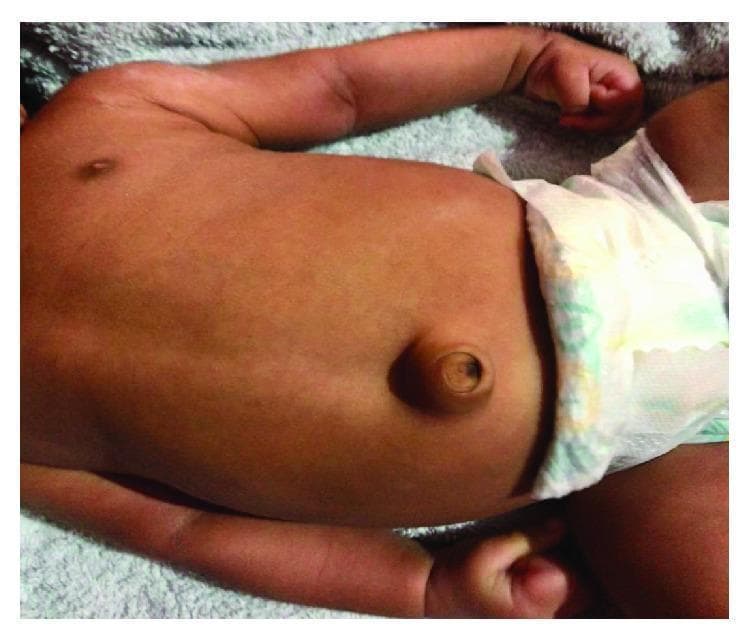
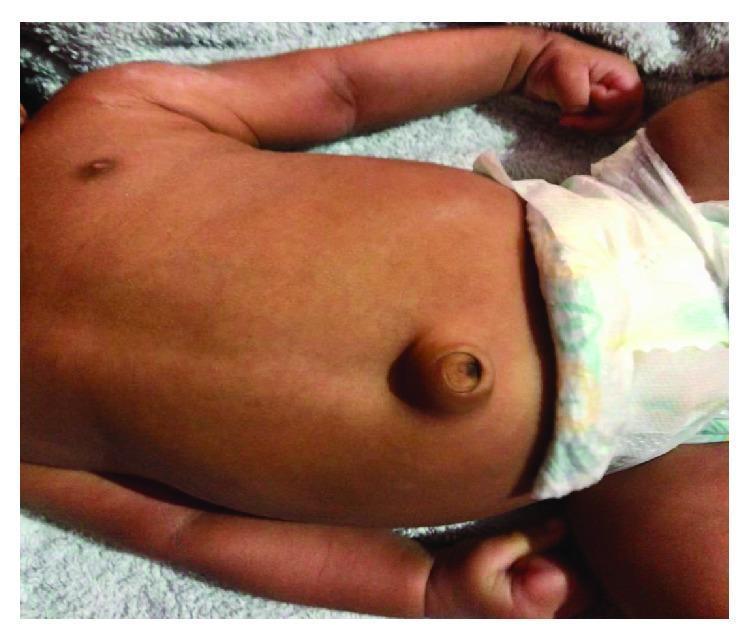
40-day-old baby boy having umbilical hernia and it started around after one month. On crying and on passing stool, it is increasing in size. Initially, it is small, day by day it increases in size. And online flat, it has reduced its size a little bit. So what is the remedy for it to become to a normal level?
Reading File
Searching for comprehensive information on umbilical hernia in neonates/infants — natural history, management, and indications for intervention.
search_medical_text
umbilical hernia infant neonate management natural history spontaneous resolution
GradeResponse
GradeResponse
Here is a comprehensive answer based on medical knowledge:
Umbilical Hernia in a 40-Day-Old Baby Boy
What Is Happening?
Your baby has a reducible umbilical hernia — a very common and almost always benign condition in newborns. The umbilical ring (the small opening in the abdominal wall through which the umbilical cord passed) has not yet closed completely after birth. When abdominal pressure increases — during crying, straining, or passing stool — the contents inside the abdomen (usually a small loop of bowel or fatty tissue) push outward through this gap, making the hernia appear larger. When lying flat and relaxed, pressure drops and the hernia reduces back in, which is exactly what you are observing.
Is This Dangerous?
In the vast majority of cases — No. The key reassuring signs in your baby are:
- The hernia reduces on its own when lying flat (it is reducible)
- The overlying skin appears normal (no redness, bluish discoloration, or hardness)
- The baby is not in constant pain
These signs mean the hernia is not strangulated (no trapped or cut-off blood supply), which would be the only urgent emergency.
Natural History — Will It Close on Its Own?
This is the most important point for parents to understand:
| Defect Size | Likelihood of Spontaneous Closure | When |
|---|---|---|
| < 1 cm | Very high (~95%) | By 1–2 years of age |
| 1–2 cm | High (~80%) | By 3–4 years of age |
| > 2 cm | Lower, but still possible | May persist beyond 4–5 years |
The majority of infantile umbilical hernias close completely on their own without any treatment, typically by the time the child is 2–4 years old. Appearing larger with crying is completely normal and does not indicate the hernia is worsening in a harmful way — it simply reflects increased intra-abdominal pressure.
What You Should Do — Management
✅ Conservative (Watchful Waiting) — The Standard Approach
- No treatment is required at this age. Simply observe the hernia over time.
- Keep the umbilical area clean and dry.
- Do not attempt home remedies such as taping a coin or binding the abdomen — these are ineffective and can cause skin damage or irritation.
- Allow the baby to cry, feed, and pass stool normally — these activities do not harm the hernia.
✅ Follow-Up With a Pediatric Surgeon or Pediatrician
- A doctor should examine the hernia to confirm it is reducible and measure the defect size.
- Routine follow-up every few months to monitor whether the ring is closing.
🔴 Seek Emergency Care Immediately If:
| Warning Sign | What It Means |
|---|---|
| Hernia becomes hard, firm, and cannot be pushed back in | Incarceration — bowel is trapped |
| Overlying skin turns red, purple, or dark | Strangulation — blood supply is compromised |
| Baby has persistent, inconsolable crying with a tense abdomen | Possible strangulation |
| Baby develops vomiting, abdominal distension, refusal to feed | Bowel obstruction |
These are rare in simple umbilical hernias (incarceration risk is < 0.5% in infants) but require immediate surgery if they occur.
When Is Surgery Considered?
Surgery (umbilicoplasty / umbilical hernia repair) is considered only if:
- The hernia has not closed by age 4–5 years
- The defect is > 2 cm and not reducing
- There is a single episode of incarceration
- The hernia is causing significant cosmetic or psychological concern after 4 years of age
At 40 days old, surgery is not indicated and would not be performed electively.
Summary for Parents
Your baby's umbilical hernia is common, benign, and almost certainly self-resolving. The bulging you see with crying and straining is normal. Keep the area clean, avoid home remedies like taping, visit your pediatrician for confirmation and follow-up, and expect the hernia to gradually close over the next 1–4 years. No special diet, medicine, or intervention is needed at this stage.
This information is for educational purposes. Always consult your child's pediatrician or a pediatric surgeon for a physical examination and personalized guidance.
This is a shared conversation. Sign in to Orris to start your own chat.