
Explain about knudson two hit hypothesis in simple terms with diagram
Knudson two hit hypothesis tumor suppressor gene retinoblastoma explanation
A clean educational diagram explaining Knudson's Two-Hit Hypothesis. Split into two columns labeled "HEREDITARY (Familial) Cancer" and "SPORADIC Cancer". Left column (Hereditary): Show a person icon at top labeled "Born with 1st hit (germline mutation inherited)". Below, show a cell with two chromosomes - one has a red X (mutated allele) and one is normal. Arrow pointing down labeled "2nd Hit - somatic mutation in one cell". Below that, show both chromosomes with red X marks. Final box labeled "CANCER develops" highlighted in red. Right column (Sporadic): Show a person icon at top labeled "Born with two normal alleles". Below, show a cell with two normal chromosomes (no mutations). Arrow labeled "1st Hit - somatic mutation". Show one chromosome with red X, one normal. Another arrow labeled "2nd Hit - somatic mutation in same cell". Below that, both chromosomes with red X marks. Final box labeled "CANCER develops" highlighted in red. At the bottom, add a summary note: "Both alleles of the tumor suppressor gene must be inactivated for cancer to develop. Hereditary cancer needs only 1 more somatic hit; sporadic cancer needs 2 somatic hits in the same cell." Use a white background, clear labels, simple icons, blue and orange color scheme for the chromosomes, red X marks for mutations.
404 Not Found. {'message': '{\n "error": {\n "code": 404,\n "message": "Publisher model `projects/engaged-beaker-474810-u2/locations/global/publishers/google/models/gemini-3-pro-image-preview` was not found or your project does not have access to it. Ensure you are using a valid model name and that the model is available in the specified region. For more information, see: https://docs.cloud.google.com/gemini-enterprise-agent-platform/resources/locations.",\n "status": "NOT_FOUND"\n }\n}\n', 'status': 'Not Found'}
We encountered an error while processing your request. Please try again or reach out to us for help.
Refer Robbins
Knudson's Two-Hit Hypothesis - As Explained in Robbins
What is It?
"Two loss-of-function mutations (hits) involving both alleles of RB are required to produce retinoblastoma."
- Robbins & Cotran Pathologic Basis of Disease, Chapter 7 (Fig. 7.25)
The Classic Example: Retinoblastoma and the RB Gene
The Two Scenarios
1. Familial (Hereditary) Form - "One Hit Already Done"
- ~40% of retinoblastomas
- The child inherits one mutated RB allele in every single cell of the body (this is Hit 1 - the germline mutation)
- The child appears completely normal, because one working copy of RB is still present
- Only ONE additional somatic mutation is needed in any retinal cell to knock out that second copy (Hit 2)
- Because second hits are virtually inevitable in a small fraction of retinoblasts, tumors almost always develop
- Result: bilateral tumors, earlier onset, multiple tumors, transmitted as autosomal dominant trait (because risk is dominant, even though the cellular mechanism is recessive)
2. Sporadic Form - "Both Hits Must Happen by Chance"
- ~60% of retinoblastomas
- The child is born with two perfectly normal RB alleles in all cells
- Hit 1: a somatic mutation in one allele of a single retinal cell
- Hit 2: a second independent somatic mutation knocking out the remaining allele in that same cell
- The probability of two independent hits in the same cell is low - which is why sporadic retinoblastoma is rare in the general population
- Result: unilateral tumor, later onset, single tumor, no family history
The Diagram (Fig. 6.18 / Fig. 7.25 - Robbins)
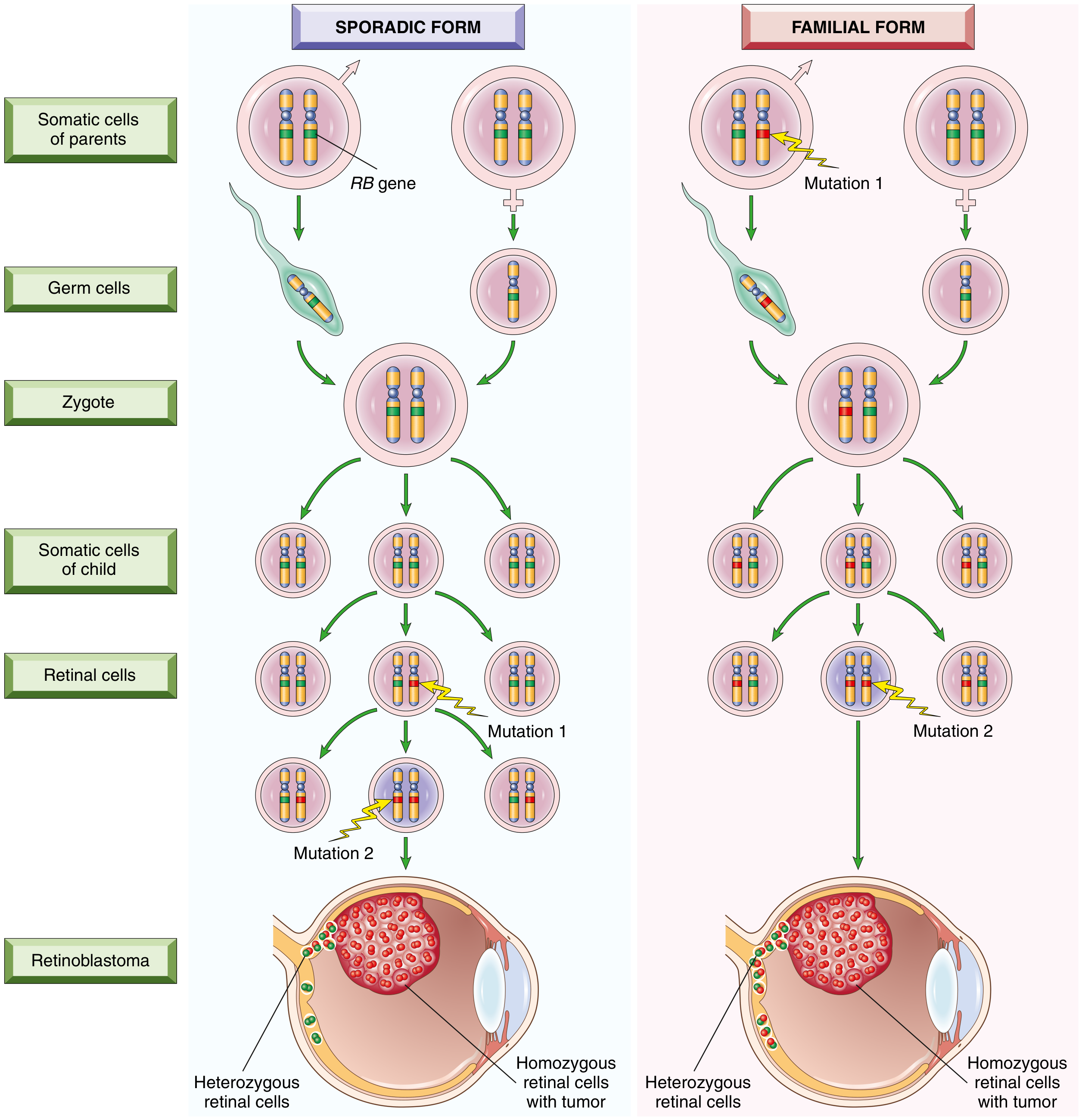
The Apparent Paradox: Recessive Mutation, Dominant Inheritance
"A child carrying an inherited mutant RB allele in all somatic cells is perfectly normal (except for the increased risk of developing cancer); it follows that one defective RB gene does not have adverse effects on cell behavior. Thus, although the genetic trait (increased cancer risk) associated with germline RB mutations is inherited in an autosomal dominant fashion, at the level of individual cells the phenotype associated with RB loss-of-function behaves like a recessive trait."
| Level | Behavior |
|---|---|
| At the tissue/inheritance level | Dominant (one bad allele = high cancer risk) |
| At the individual cell level | Recessive (both alleles must be lost for transformation) |
Beyond Retinoblastoma - Where Else Does This Apply?
"The major themes that emerged from the study of familial retinoblastoma hold for other familial cancers: the risk of cancer is inherited as an autosomal dominant trait due to a germline mutation in a tumor suppressor gene; tumors have second 'hits' in the sole normal tumor suppressor gene allele; and the same tumor suppressor gene is frequently mutated in sporadic tumors of the same type."
| Gene | Hereditary Syndrome | Sporadic Cancers |
|---|---|---|
| RB1 | Familial retinoblastoma | Osteosarcoma, breast, bladder, small cell lung |
| TP53 | Li-Fraumeni syndrome | Lung, breast, many others |
| APC | Familial adenomatous polyposis (FAP) | Colorectal cancer |
| BRCA1/2 | Hereditary breast & ovarian cancer | Breast, ovarian cancer |
| VHL | Von Hippel-Lindau syndrome | Clear cell renal carcinoma |
| MLH1/MSH2 | Lynch syndrome | Colorectal cancer |
Summary in Simple Terms
- Familial: You're born with one brake already broken. It only takes one more failure.
- Sporadic: Both brakes are fine at birth. Both need to break independently - rare, but it happens.