
What are the factors affecting the pulse rate
factors affecting pulse rate heart rate
physiological determinants of heart rate autonomic nervous system
Catheter Ablation of Ventricular Arrhythmias
Page 121
Factors Affecting Pulse Rate
1. Age
- Neonates: 120–160 bpm
- Children: 80–120 bpm
- Adults: 60–100 bpm (normal range)
- Elderly: Resting rate may decrease slightly; maximum achievable heart rate declines (~220 − age)
2. Autonomic Nervous System (ANS)
| Division | Effect on Heart Rate | Mediator |
|---|---|---|
| Sympathetic | Increases HR (positive chronotropy) | Norepinephrine → β1 receptors |
| Parasympathetic (Vagus) | Decreases HR (negative chronotropy) | Acetylcholine → M2 receptors |
3. Physical Activity & Exercise
- Exercise increases sympathetic drive and decreases vagal tone → HR rises
- Trained athletes have lower resting HR (sometimes 40–50 bpm) due to increased vagal tone and cardiac hypertrophy (athletic bradycardia)
4. Emotional State & Stress
- Anxiety, fear, excitement, and pain activate the sympathoadrenal axis → elevated HR
- Deep relaxation and meditation increase vagal tone → lower HR
5. Body Temperature
- Fever/hyperthermia: Each 1°C rise in core temperature increases HR by approximately 10–15 bpm (direct effect on SA node automaticity)
- Hypothermia: Decreases HR; extreme hypothermia can cause bradycardia and cardiac arrest
6. Medications & Drugs
| Drug/Substance | Effect |
|---|---|
| Beta-blockers (propranolol) | ↓ HR |
| Atropine (anticholinergic) | ↑ HR |
| Digoxin | ↓ HR (increases vagal tone) |
| Caffeine, nicotine | ↑ HR |
| Opioids | ↓ HR |
| Sympathomimetics (epinephrine) | ↑ HR |
| Calcium channel blockers (verapamil) | ↓ HR |
| Thyroid hormone (excess) | ↑ HR |
7. Blood Pressure & Hemodynamic Status
- Hypotension/hemorrhage/dehydration: Triggers baroreceptor reflex → sympathetic activation → tachycardia (compensatory)
- Hypertension: Can stimulate baroreceptors → reflex bradycardia
8. Respiratory Cycle (Sinus Arrhythmia)
- HR increases during inspiration (inhibition of vagal tone) and decreases during expiration
- This respiratory sinus arrhythmia is normal and more pronounced in children and athletes
9. Hormonal Factors
| Hormone | Effect |
|---|---|
| Epinephrine/Adrenaline | ↑ HR |
| Thyroid hormones (T3, T4) | ↑ HR (hyperthyroidism → tachycardia) |
| Cortisol | ↑ HR |
| Estrogen/Progesterone | Moderate effects; HR rises in pregnancy |
10. Posture & Position
- Moving from lying → sitting → standing activates orthostatic reflexes → slight HR increase (sympathetic activation to maintain BP)
- Orthostatic tachycardia is pronounced in POTS (Postural Orthostatic Tachycardia Syndrome)
11. Pathological Conditions
| Condition | Effect |
|---|---|
| Fever, infection, sepsis | ↑ HR (tachycardia) |
| Anemia | ↑ HR (compensatory) |
| Hyperthyroidism | ↑ HR |
| Heart failure | ↑ HR (compensatory) |
| Heart block (AV block) | ↓ HR (bradycardia) |
| Hypothyroidism | ↓ HR |
| Raised intracranial pressure | ↓ HR (Cushing's reflex) |
| Myocardial infarction | Variable |
12. Sex
- Women tend to have a slightly higher resting HR than men on average, partly due to smaller heart size and hormonal differences
13. Pain
- Acute pain typically causes tachycardia via sympathetic activation
- Severe visceral pain (e.g., inferior MI, vasovagal syncope) can cause bradycardia via vagal activation
14. Blood Gas & Metabolic Factors
- Hypoxia: ↑ HR (peripheral chemoreceptor stimulation)
- Hypercapnia: Initially ↑ HR; severe hypercapnia → bradycardia
- Acidosis: Can depress SA node function → bradycardia
- Electrolyte imbalances (e.g., hyperkalemia): Bradycardia; hypokalemia → tachyarrhythmias
Summary Table
| Category | Increases HR | Decreases HR |
|---|---|---|
| ANS | Sympathetic activation | Parasympathetic/vagal activation |
| Exercise | Yes | Trained state (resting) |
| Temperature | Fever, heat | Hypothermia |
| Drugs | Epinephrine, atropine, caffeine | Beta-blockers, digoxin, opioids |
| Hormones | Thyroid hormones, epinephrine | — |
| Pathology | Anemia, sepsis, hyperthyroidism | AV block, hypothyroidism, ↑ICP |
| Posture | Standing (orthostasis) | Supine position |
| Emotions | Stress, anxiety, pain | Relaxation, meditation |

Answers the following
tachycardia bradycardia definition causes
Harrison's Principles of Internal Medicine, Twenty First Edition
Page 6957
sinus arrhythmia pulse deficit arterial pulse recording
Harrison's Principles of Internal Medicine, Twenty First Edition
Page 6998
Q1. Factors Affecting the Pulse Rate
- Age
- Autonomic Nervous System
- Physical Activity & Exercise
- Emotional State
- Body Temperature
- Medications & Drugs
- Posture & Position
- Hormones, Sex, Blood pressure, Respiratory cycle
Q2. Define Tachycardia & Bradycardia — with Causes
(a) Tachycardia
- Fever and infections/sepsis
- Anemia
- Hyperthyroidism
- Exercise and physical exertion
- Anxiety, pain, stress
- Hemorrhage/hypovolemia (compensatory)
- Drugs: epinephrine, atropine, caffeine, salbutamol
- Heart failure
- Pulmonary embolism
- Hypoxia
(b) Bradycardia
- Well-trained athletes (physiological)
- Hypothyroidism
- Hypothermia
- Raised intracranial pressure (Cushing's reflex)
- AV block (heart block)
- Sick sinus syndrome
- Drugs: beta-blockers, digoxin, opioids, calcium channel blockers (verapamil)
- Vasovagal syncope
- Inferior myocardial infarction (vagal stimulation)
- Jaundice (bile salts depress SA node)
Q3. What is Sinus Arrhythmia?
- During inspiration: Heart rate increases (vagal tone is inhibited → sympathetic dominance)
- During expiration: Heart rate decreases (vagal tone is restored)
- Respiratory sinus arrhythmia – the common type described above; most pronounced in children and young adults
- Non-respiratory sinus arrhythmia – not linked to breathing; seen in elderly or those with heart disease
Q4. Pulse Deficit — Definition and Causes
Pulse Deficit = Apical Rate − Radial Rate
- Atrial fibrillation (most common cause) — irregular, chaotic contractions; many are too weak to transmit a peripheral pulse
- Atrial flutter
- Premature ventricular contractions (PVCs) — early beats have low stroke volume
- Ventricular tachycardia
- Multiple ectopic beats
- Any condition with weak, ineffective ventricular contractions
Q5. Arterial Pulse Recording — Diagram and Explanation
A neat labeled medical diagram of an arterial pulse waveform (sphygmogram). Show a single pulse cycle with clearly labeled components: percussion wave (primary upstroke), tidal wave (secondary rise), dicrotic notch (incisura), dicrotic wave, anacrotic limb (ascending limb), catacrotic limb (descending limb). Include labels for systole and diastole phases. Clean black and white educational style diagram with arrows and annotations.
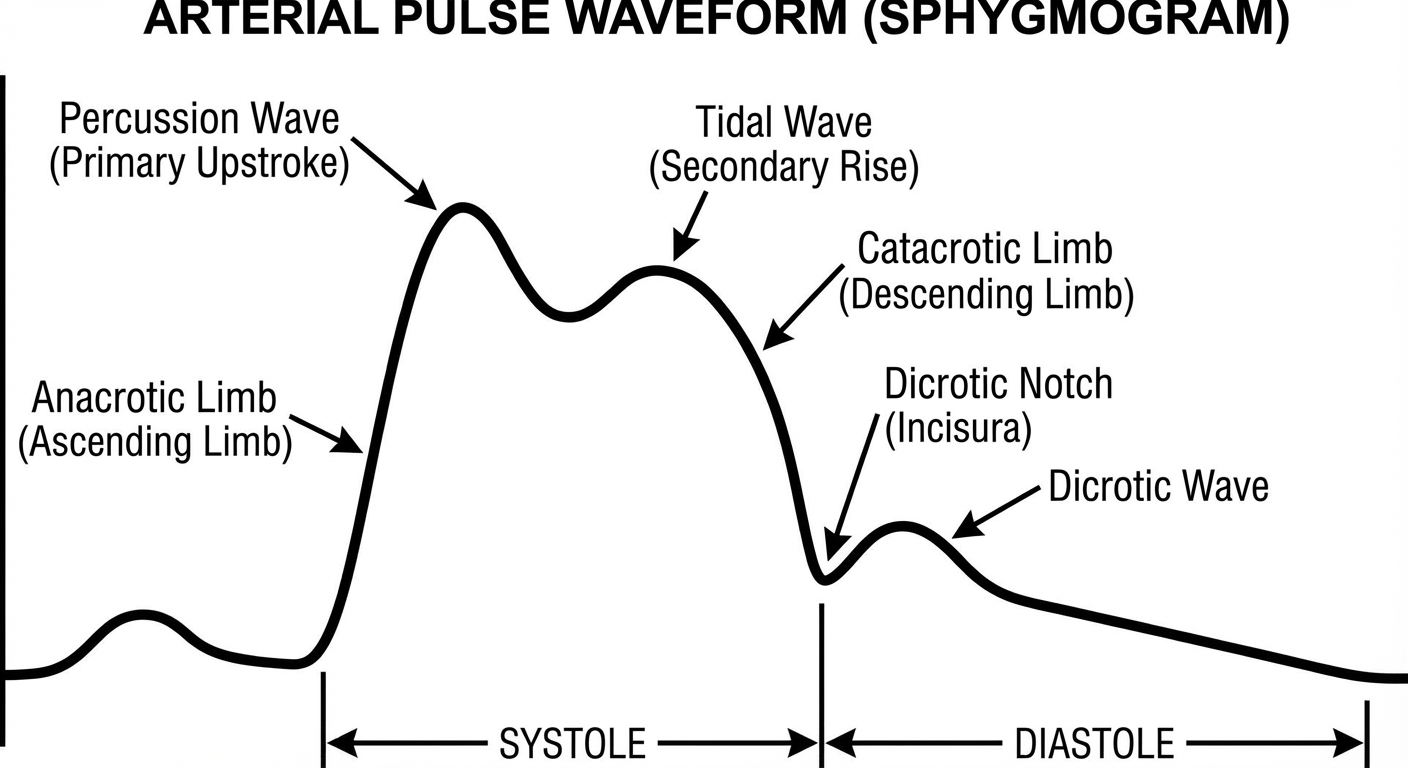
| Component | Description |
|---|---|
| Anacrotic limb | Rapid upstroke due to ejection of blood from the left ventricle into the aorta during systole |
| Percussion wave | The primary peak; represents the maximum pressure during ventricular systole |
| Tidal wave | A secondary smaller rise on the descending limb; due to reflection of pulse wave from the periphery |
| Dicrotic notch (Incisura) | A notch on the descending limb caused by the closure of the aortic valve at the end of systole |
| Dicrotic wave | A small wave just after the dicrotic notch; due to elastic recoil of the aortic wall during diastole |
| Catacrotic limb | The descending limb; represents the fall in pressure during diastole |
Q6. Effect of Exercise on Heart Rate
- Anticipatory rise — even before exercise begins, HR increases due to cortical stimulation of the sympathetic nervous system
- During exercise: Increased muscle activity → rise in CO₂ and lactic acid → stimulation of chemoreceptors → sympathetic activation → HR increases significantly
- Circulating epinephrine from adrenal medulla further increases HR
- Withdrawal of vagal (parasympathetic) tone contributes to rise
- Rise in body temperature during exercise directly stimulates the SA node
Q7. Effect of Standing from Supine Position on Heart Rate
- ~500–700 mL of blood pools in the lower limb veins due to gravity
- Venous return to the heart decreases → cardiac output falls → blood pressure drops transiently
- Baroreceptors in the aortic arch and carotid sinus detect the drop in BP
- Baroreceptor reflex is activated → sympathetic stimulation increases, vagal tone decreases
- Result: Heart rate increases by 10–20 bpm to compensate and maintain BP and cardiac output
In POTS (Postural Orthostatic Tachycardia Syndrome), HR rises by >30 bpm upon standing without an adequate BP response.